Entertainment
With 'Everything Must Go,' Hannah Einbinder returns to her first passion: stand-up

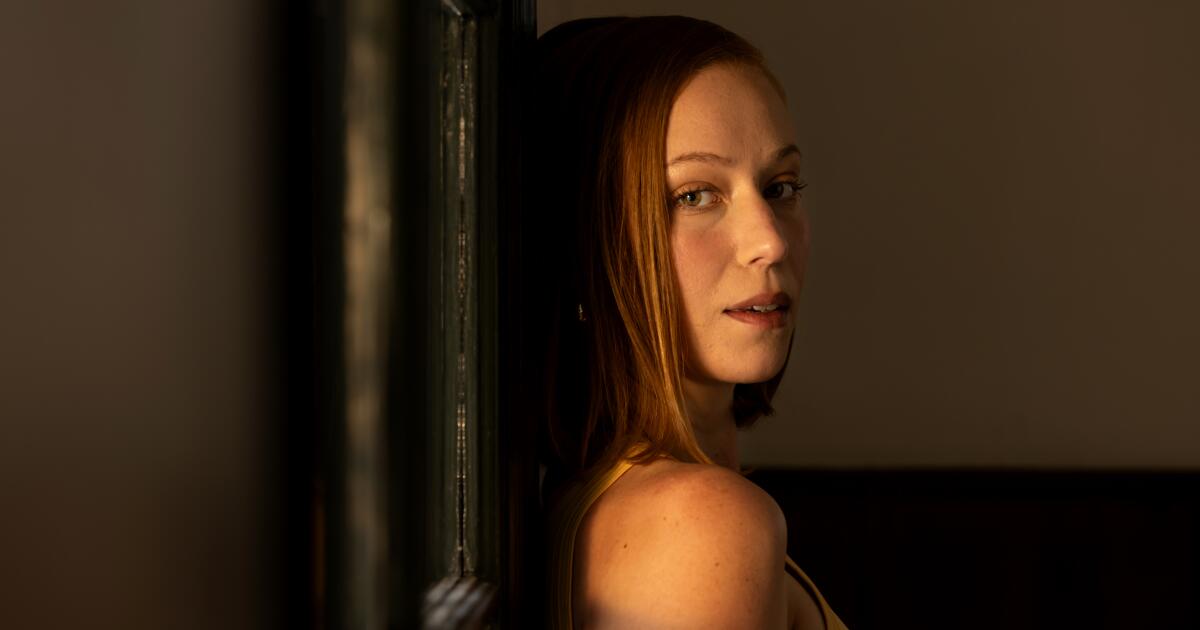
When I told Hannah Einbinder at the start of our interview that I had seen her new comedy special, “Everything Must Go,” a look somewhere between terror and elation crossed her face, which momentarily turned bright red.
“It feels like the most intimate extension of myself, being and soul that I am sharing,” she said when I asked what she was feeling. “So to hear you say that you’ve seen it is the first time I’ve heard someone say that they have seen it. It filled me with joy and excitement and anticipation and a little shock.”
At 29, she described the hour, premiering June 13 on Max, as her “very short” life’s work. “So,” she said, launching into a sarcastic tone, “no presh. It’s casual.”
Einbinder became known to audiences as the overworked comedy writer and underling Ava Daniels on “Hacks,” the Max series starring Jean Smart, which just wrapped up its third and most acclaimed season to date. However, stand-up has long been her main artistic passion and pursuit.
She remembers the exact date of her first open mic in Los Angeles — Jan. 3, 2018, at the Silverlake Lounge — and she considers this special the culmination of her entire time doing stand-up. It’s an hour that’s both deeply personal and couched in a performance style she has carefully crafted. She wears a sleek, all-black look and an expertly cut bob, but she uses her body to both bare her innermost feelings and to become various characters ranging from a witch-like hypnotist to planet Earth embodied as Marisa Tomei in “My Cousin Vinny,” who is angry at humanity for climate change. Einbinder’s “greatest love is the natural world,” she said over Zoom, wearing a sweatshirt with the rolling paper icon the Zig-Zag Man.
Hannah Einbinder in her Max comedy special, “Everything Must Go.”
(Eddy Chen)
If you want to get to know Einbinder, the special, which opens with her birth and ends with her grandmother’s funeral, is a good place to start. It starts with a bit she has done before on camera, notably on “The Late Show With Stephen Colbert” in 2020, when she became the youngest comedian to ever perform on the show. She explains that many comics, when they start their set, begin by telling the audience “a little bit about me.” Her version of that is sultry, with a jazz score, the result of watching a lot of Turner Classic Movies at the time she wrote the gag. Everything she says is true. Her mother, Laraine Newman, one of the original “Saturday Night Live” cast members, had Einbinder when she was 42. Her parents did sperm selection with the hope that they would have a boy. But the way Einbinder delivers the material makes you question just how real it is.
“When I originally wrote that bit, and it is an older bit of mine, I was still at a place where I was trying to create a little bit of distance between myself and the audience,” she said.
Since then, she’s become much more comfortable being honest with the crowd. Sandy Honig, a comedian who directed the special and has toured with Einbinder, has seen her friend and collaborator grow since they first met about six years ago. “Just watching her really come into her own and love herself and be confident, it’s all you really want for someone you love,” Honig said.
The material in “Everything Must Go” covers Einbinder’s bisexuality, her Judaism, her passion for the environment and her period, in addition to different eras of her life, from her stoner days to her time as a competitive cheerleader. She describes the intensity of cheering and how it ruined her body, holding up the microphone to her knee so you can hear it crack like a “gambling addict juggling dice.” The sound is awful.

“Just watching her really come into her own and love herself and be confident, it’s all you really want for someone you love,” said Sandy Honig, Hannah Einbinder’s friend and director of her stand-up special.
(Christina House / Los Angeles Times)
Yes — perhaps surprisingly given her lack of pep — Einbinder was extremely serious about cheerleading, a result of having seen “Bring It On” at an impressionable age.
“It was a huge chunk of my life and it was my first real passion for performance,” she said, speaking in her typically deliberate fashion and explaining that she was a “flyer,” one who is held aloft. “I was very dedicated to perfection. I think my work ethic can be very, obviously to me at least, be attributed to my time as a cheerleader.”
Growing up, Einbinder competed in the sport throughout Los Angeles, including at Beverly Hills High School, which she attended. She still considers the city her home base. “I love being in my car,” she said. “I wish they made a scented candle of the 405, I’d light that s— up every day in my home. I love Los Angeles. It is a huge part of my identity.”
In fact, the beginning of “Everything Must Go” is a tribute to Einbinder’s love of driving and her romantic vision of Los Angeles. She pulls up to the El Rey Theatre in a vintage red Mercedes as a French tune plays in the background.
For this story, the photo shoot was held at beloved West L.A. burger joint the Apple Pan, one of her childhood favorites. I was confused by the location because in the special she identifies as vegan, but she explained that during the taping, she forgot to say the line she added about how she no longer adheres to that diet, a joke about her own hypocrisy. “That is my bad,” she said. “That’s on me.” She does believe in reducing meat consumption, but being vegan is not her choice anymore.
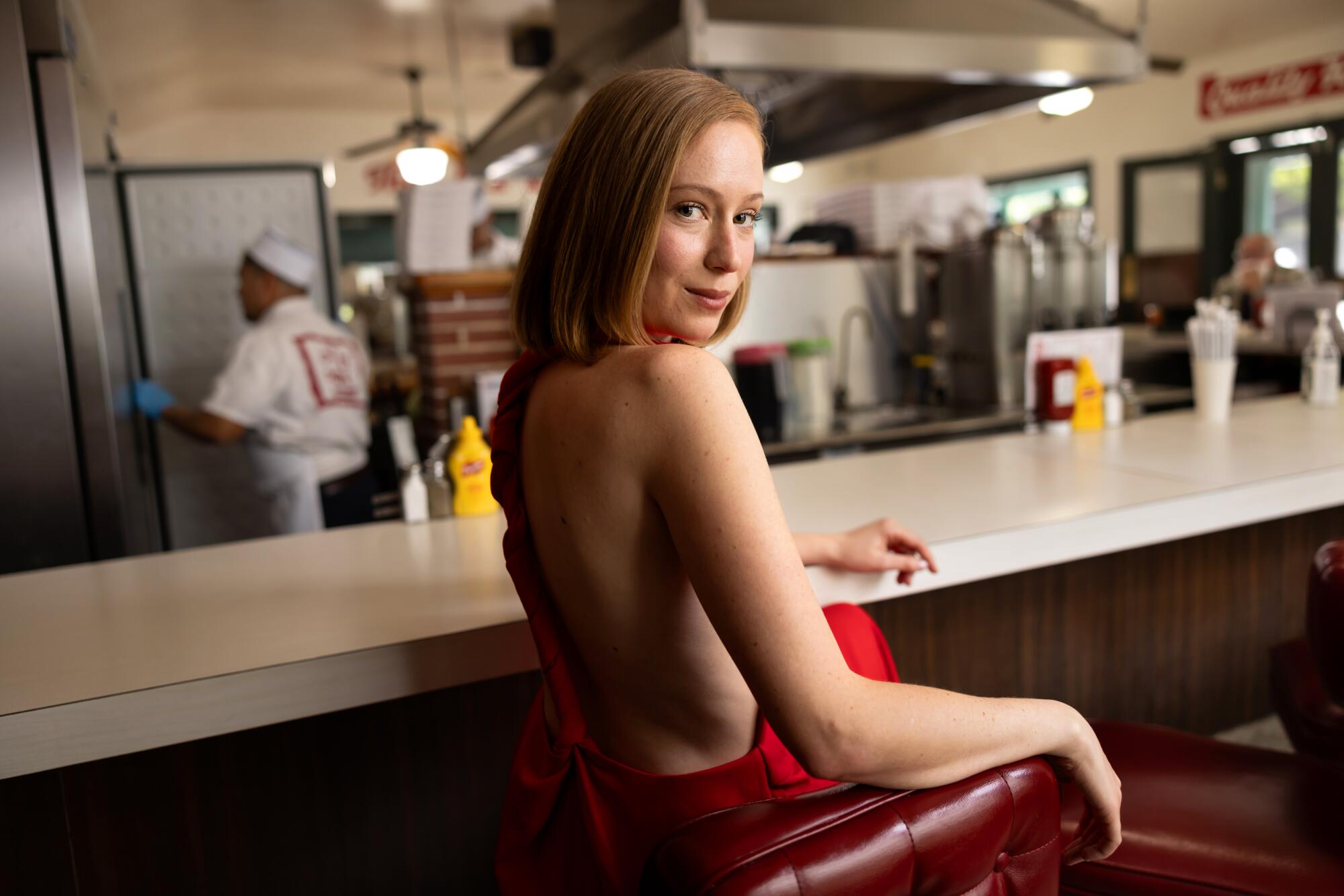
Hannah Einbinder said she considers L.A. her home base: “I love Los Angeles. It is a huge part of my identity.”
(Christina House / Los Angeles Times)
Einbinder grew up in Westwood where she was, in her words, an “ADHD child” who gravitated toward the comedy of Jim Carrey. “I had a lot of energy and I was very hyperactive,” she said. “There are many studies that examine the differences in ADHD between little boys and little girls, and I definitely fall on the little boy ADHD side of the spectrum. I was really rambunctious and really I think Jim Carrey’s physical style spoke to me and I kind of started to mimic him.”
These days, “Hacks” co-creators Jen Statsky, Lucia Aniello and Paul W. Downs compare her to Robin Williams, highlighting her ability to combine acting and character work with intimate revelations about herself in her stand-up.
She first tried stand-up in college at Chapman University, where she initially enrolled in the broadcast journalism program. She was doing improv but didn’t think comedy would be a path until comedian Nicole Byer came to Chapman and was looking for someone to open for her. Einbinder volunteered.
“That was when it became very clear to me,” she said. “I didn’t really view it as, ‘This is my career.’ I just maybe naively viewed it as like, ‘I’m obsessed with this and I’m going to pursue this and I can’t stop doing it.’”
After college she moved in with her mom, worked as a barista at the now-closed Alfred Tea Room on Melrose and started doing open mics. Newman was “brutally honest” in her opinions about her daughter’s chosen field, saying, in Einbinder’s telling, “Good luck, girl. It’s tough out there. Go off, girl, do your thing.”
Getting the role of Ava on “Hacks” not only raised Einbinder’s profile as an actor — it was her first time acting on television — but also boosted her stand-up career, allowing her to pursue it at a pace she wanted. Because of the fame the series brought, she could work out material while touring instead of trying to play the game of internet recognition that so many stand-ups do these days.
“It is never lost on me how fortunate I am and how much being on ‘Hacks’ has made it possible for me to take my time and not have to put my clips up on Instagram or TikTok and to be able to just go right to the road,” she said.

Hannah Einbinder, photographed at the Apple Pan, an L.A. burger joint that was a childhood favorite of hers, says she’s no longer a vegan.
(Christina House / Los Angeles Times)
Einbinder approaches acting with the same studied intensity she approaches stand-up. “She’s always been innately talented and had this thing inside her that is just so raw and you can’t teach it or learn it,” Statsky said. “But she also takes the job of being an actor on the show so seriously and she’s so prepared.”
Downs added that Einbinder has notebooks filled with preparation for her scenes. Still, her seriousness about the job hasn’t stopped her from befriending everyone on set. Downs said that he and his co-creators always joke that she is No. 2 on the call sheet but has the energy of a production assistant.
“She’s the kind of person who immediately makes friends with everybody on the crew and knows everything about everybody and hangs out with them and they’re buds,” her “Hacks” co-star Smart said.
That’s evident in how she brought the “Hacks” community along for her special, using cinematographer Adam Bricker as well as the crew of grips and electricians that worked the series. Smart remembered walking in to watch the taping and being greeted by the grips parked outside. Arranging the work for her “Hacks” co-workers was “textbook Hannah Einbinder,” Smart said.
“She fights for her people so hard in a way that I’ve never encountered with anybody else in this industry,” Honig said. In Honig’s case, it meant that Einbinder advocated for the director to receive a fair fee in order to make a healthcare minimum. Einbinder specifically wanted to “shout out to the artisans,” who quickly learned the lighting cues for her act so she and Honig could turn the set into a cinematic experience, where the stage transforms each time Einbinder takes on a different persona.
The ending of Season 3 of “Hacks” sets up new shades of Ava for Einbinder to play in the fourth season, which Max has already ordered. In the final moments of Season 3, Ava blackmails Smart’s Deborah Vance into letting her be the head writer on her new late-night talk show, after Deborah tells her it’s going to someone else.
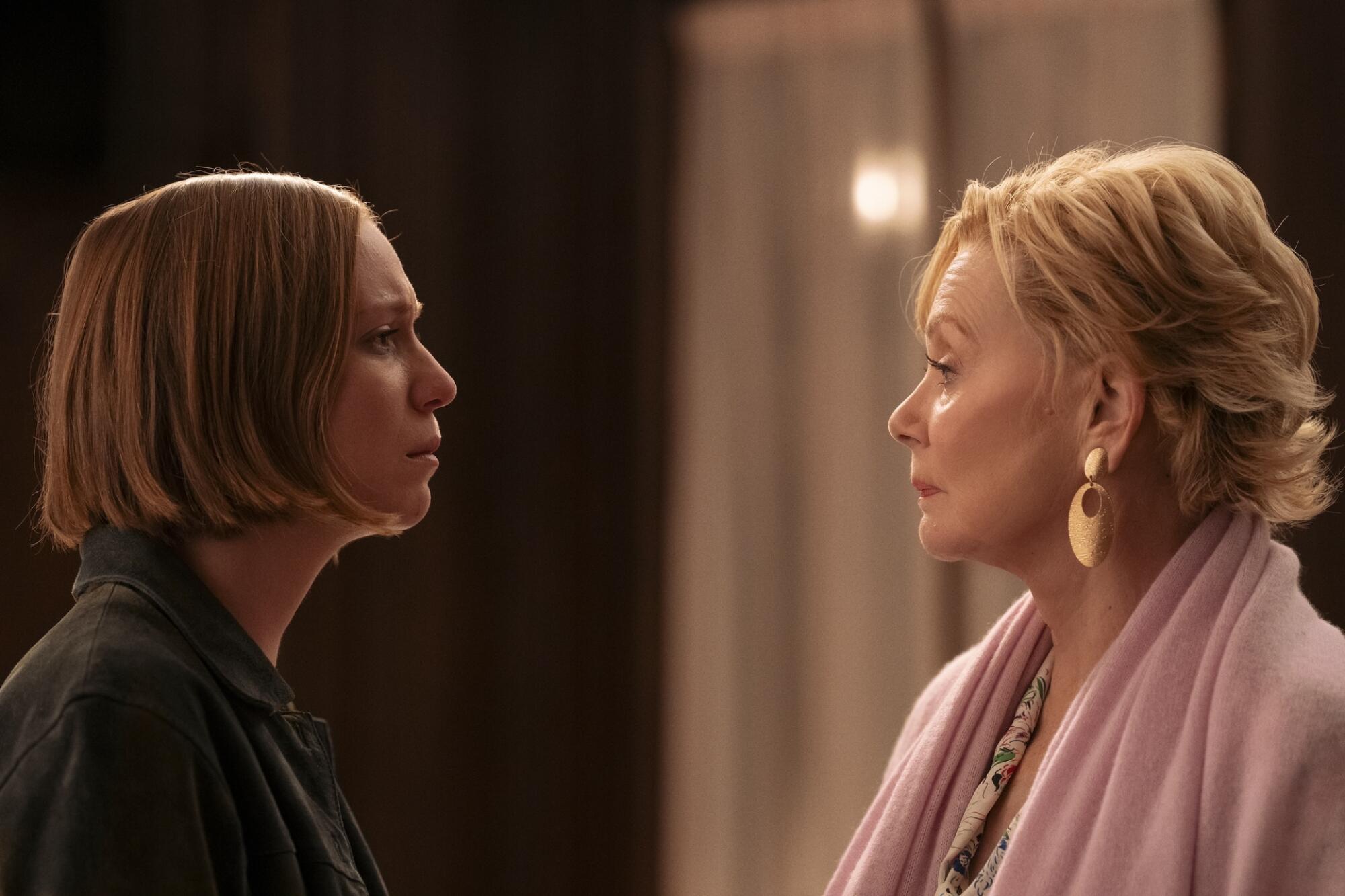
Ava (Hannah Einbinder) and Deborah (Jean Smart) in the Season 3 finale of “Hacks.”
(Jake Giles Netter / Max)
Smart said that Einbinder made her cry while filming one of the season’s most intense scenes — the confrontation between Ava and Deborah, in which Ava reveals her heartbreak over not getting the job.
“She is up for the challenge no matter what it is that we throw at her,” Downs said. “Because she has deepened her understanding of the character and because it’s been three seasons now, we knew that we wanted the character to level up.”
But as for what’s next for Einbinder, she plans to use her privileged position to take her time and choose what’s right. Smart even said that Einbinder turned down a meeting with an unnamed director on a “big, big movie” because of ethical issues with the project.
“I just went crazy when she told me,” Smart said. “But that’s the kind of person she is and I have to respect that. She’s an extraordinarily principled and kind person.”
For her part, Einbinder said she is trying to remove herself from a “capitalist timeline” where artists are required to churn out material when they have a level of heat in their careers. She wants to take her time to workshop new material with an eye toward quality above all else.
“I have been given the incredible gift of being able to make art and to be a part of art for a living and I hope to maintain that level of quality,” she said. “Cut to me in a Shell Oil commercial.” I said I don’t see that happening. She added: “No, just kidding, folks.”



A bartender who worked at Soho House’s exclusive Soho Warehouse in downtown Los Angeles is alleging a supervisor at the posh membership club and hotel drugged and raped her, according to a lawsuit filed in Los Angeles Superior Court on Wednesday.
The woman, who filed as Jane Doe, said in her complaint that she was “subjected to repeated sexual advances and unwelcomed physical touching” by one of her supervisors, Leonard Marcelo Vichique Maya, immediately after she began working as a bartender at Berenjak, the club’s restaurant, in September 2025.
Doe is suing Vichique Maya, Soho House, Soho House Los Angeles and Soho Warehouse for sexual harassment, retaliation and other claims..
“This is as egregious an instance of callous corporate indifference to workplace sexual violence that anyone can experience,” said her attorney Nick Yasman of Los Angeles-based West Coast Trial Lawyers in a statement.
Representatives for Soho House and Vichique Maya were not immediately available for comment.
Doe has further alleged that Vichique Maya made “numerous comments” about her appearance, propositioned her to be his “hook-up buddy” and told her that she “would be pregnant by now” had they met earlier, all within earshot of her supervisors and colleagues.
After two weeks on the job, Doe said that she reported Vichique Maya’s conduct to two male supervisors, including Soho House’s floor manager and food and beverage director, states the complaint, but “neither took any semblance of corrective or investigatory action.”
According to the suit, Doe claims that despite “his pattern of harassing behavior and complaints,” the company, did not address his alleged misconduct. ”
She claims his behavior escalated after a “team-bonding” work event on Sept. 13, where Doe said she became disoriented after drinking with supervisors and co-workers, eventually losing consciousness, and woke up naked in Vichique Maya’s apartment.
“Paralyzed and speechless despite her consciousness slowly returning, Plaintiff was condemned to simply watch in horror as [sic] MARCELO repeatedly raped her inanimate body,” states the suit.
The next day, Doe said that she reported to her floor manager that Vichique Maya had “sexually assaulted her.”
She said her general manager “confirmed” that he “appeared to be preying” on her during the work event, telling her that “These things happen between coworkers.”
When she proclaimed that she could no longer work with Vichique Maya,” she said the general manager dismissed her concerns telling her: “I have a restaurant to run; I can’t have it blow up on me.”
Despite informing three managers that she was “raped,” Doe said she was continuously scheduled to work shifts with Vichique Maya during which he repeatedly sexually harassed her.
In December, Doe filed a complaint with Soho House human resources, and she was assured that an investigation would be opened and “immediate corrective action” taken.
However, during the investigation, Doe said that she was placed on indefinite leave while Vichique Maya continued working. A month later, she was informed the company had completed its investigation and found her report of rape “was uncorroborated” and he “would not be disciplined.”
In February, the plaintiff said that she was forced to quit her job.
One of the first, exclusive members-only social clubs, Soho House debuted in London in 1995 and quickly became the bolt-hole of choice for celebrities and the deep-pocketed. It expanded globally with 48 houses in 19 countries.
It drew high-profile investors, including Ron Burkle through his investment fund Yucaipa.
In 2021, the company filed for an initial public offering on the New York Stock Exchange, but it has faced financial challenges. .
Last year, Soho House went private, selling itself to a group of investors including Apollo Global Management and actor Ashton Kutcher, who also joined its board of directors, at a $2.7-billion valuation.
Movie Reviews
MOVIE REVIEWS: “Mercy,” “Return to Silent Hill,” “Sentimental Value” & “In Cold Light” – Valdosta Daily Times

“Mercy”
(Thriller/Crime: 1 hour, 39 minutes)
Starring: Chris Pratt, Rebecca Ferguson, Kali Reis
Director: Timur Bekmambetov
Rated: PG-13 (Violence, bloody images, strong language, drug content and teen smoking)
Movie Review:
“Mercy” is a science fiction movie based on one of the more common themes of moviedom lately, artificial intelligence (AI). This crime thriller cleverly creates an intriguing story using technology and the justice system, yet it fails to be consistently interesting and intelligent throughout. The conclusion is less significant than the initial setup, as the concluding scenes become typical action sequences.
Detective Chris Raven (Pratt) of the LA Police Department is a huge supporter of the city’s new judicial courtroom. Crimes are now judged by an AI program (Ferguson) in the Mercy Court. The court is run by an artificial program that makes decisions based on all of the evidence before it without any prejudice. Detective Raven is all for this system until he is convicted of killing his wife. Now he must use all of the data, including the AI‘s ability to tap into everyone’s electronic devices, security cameras, and even into government files, within reason, to prove he did not murder his wife.
Mercy is an interesting movie. It entertains throughout, even when the story gets sloppy and characters’ actions are irrational. This mainly occurs during the final scenes. The movie tries too hard to insert unneeded narrative twists. This is disappointing because the story is interesting. What makes it fascinating is that it happens in real time. This is the most brilliant facet.
All the other theatrics are unnecessary. Director Timur Bekmambetov (“Profile,” 2018; “Wanted,” 2008) and “Mercy’s” producers should have just kept the ending simple, no plot twists or superfluous action sequences.
Grade: C (This flick needs some mercy. Let the trial begin.)
“Return to Silent Hill”
(Horror: 1 hour, 46 minutes)
Starring: Jeremy Irvine, Hannah Emily Anderson and Robert Strange
Director: Christophe Gans
Rated: R (Bloody violent content, strong language and brief drug use.)
Movie Review:
“Return to Silent Hill” is about one man’s quest to return to the love of his life. The problem is she has moved on to the afterlife. Meanwhile, audiences lose part of their life watching this movie, which is unlike any of the two prequels in this series. This one is a psychological horror that bores.
Artist James Sunderland (Irvine) decides to return to Silent Hill, a place where many people died during a devastating illness that nearly enveloped the entirety of the city’s population. What is left there is a horror show of freakish creatures, all with violent intent. Still, Sunderland searches for the love of his life, Mary Crane (Anderson).
Think of this movie as a slow suicide, where a guy goes back to retrieve his dead girlfriend. To do so, he must travel to the modern land of the dead that Silent Hill has become. This one is a type of swan song by the main character, and the movie becomes less scary while lackluster romantic notions wander aimlessly.
Grade: D (Do not return to see this.)
“Sentimental Value”
(Drama: 2 hours, 13 minutes)
Starring: Renate Reinsve, Stellan Skarsgård, Inga Ibsdotter Lilleaas and Elle Fanning
Director: Joachim Trier
Rated: R (Language, sexual reference, nudity and thematic elements)
Movie Review:
“Sentimental Value” is a Norwegian film that won the Grand Prix in France’s Cannes Film Festival and was nominated for nine Academy Awards, including Best Motion Picture. It is a solid drama filled with symbolism and family connections. It is brilliant performances by a talented cast under the direction of Joachim Trier (“The Worst Person in the World,” 2021).
This screenplay is about Gustav Borg (Skarsgård). He is a father, grandfather and a famed film director. He stayed away from his two daughters, actress Nora Borgwhile (Reinsve) and historian Agnes Borg Pettersen (Lilleaas), while he was creating works as a filmmaker. The director comes back into the lives of his daughters after the death of their mother. Their reunion leads to a rediscovery of their bond at their family home in Oslo.
Stellan Skarsgård is always a solid actor. He takes his roles and makes them tangible characters that seem like you know them, even when they’re speaking a foreign language. That is the quality of his act and why he gets nominated for multiple awards each season.
“Sentimental Value” is a valuable movie filled with enriching sentiment. It is an enjoyable film for those who value a good drama. The acting and original writing alone make the movie worth it. “Sentimental Value” starts in a very simple way, but everything in between, even when low-key, remains potent. Joachim Trier and writer Eskil Vogt have worked together on multiple projects such as “The Worst Person in the World” (2021). Their pairing is once again worthy.
Grade: A- (Any motive valuable movie.)
“In Cold Light ”
(Crime: 1 hour , 36 minutes)
Starring: Maika Monroe, Allan Hawco and Troy Kotsur
Director: Maxime Giroux
Rated: R (Violence, bloody images, strong language and drug material)
Movie Review:
“In Cold Light” sticks to a very straightforward story, primarily taking place over a short period. The problem is the story leaves one in the cold. Audiences have to guess what is being communicated because this movie uses American Sign Language (ASL) without subtitles. For those moviegoers who do not know ASL, they are left deciphering characters’ actions and facial expressions during some pivotal scenes.
Ava Bly (Monroe) attempts to start a legit life after prison. Her life changes when Ava’s twin, Tom Bly (Jesse Irving) is murdered while seated next to her. As her brother’s killers pursue her, Ava must evade law enforcement, which contains some crooked cops led by Bob Whyte (Hawco).
For a brief moment, this movie hits its exceptional moment when Oscar-recipient Helen Hunt enters the picture as a motherly Claire, a crime boss who seems more like a social worker/psychologist. Her long scene is wasted as it arrives too late.
French Canadian director Maxime Giroux’s style has potential in his first English-language film, but it does not fit a wayward narrative. A rarity, this crime drama has characters commit many dumb actions at once.
Moreover, Giroux (“Félix et Meira,” 2014) and writer Patrick Whistler forget to let their audiences in on their story. They allow much to get lost in translation, especially during heated conversations between Monroe’s Ava and her father, Will Bly, played by Academy Award-winning actor Troy Kotsur (“CODA,” 2021).
Grade: C- (Just cold and dark.)
More movie reviews online at www.valdostadailytimes.com.

As the media industry took stock of Paramount Skydance’s startling acquisition of Warner Bros. Discovery, one question lingered on the minds of many in the news business and beyond: What will this mean for CNN?
The iconic 24-hour cable news network is among the various Warner Bros. assets that would be scooped up by Paramount in a deal announced Thursday that could transform the media landscape.
Paramount has undergone a swift transformation under Chief Executive David Ellison following his family’s acquisition of the company last summer. These changes reached CBS News almost immediately with the appointment of Bari Weiss, the controversial Free Press co-founder, as its new editor in chief.
Bari Weiss moderated a town hall with Erika Kirk, widow of slain conservative activist Charlie Kirk.
(CBS via Getty Images)
Weiss’ tenure so far has been rocky.
Her decision to pull a “60 Minutes” story about conditions inside an El Salvador prison that housed undocumented Venezuelan migrants from the U.S. received widespread criticism and accusations of political motivation. The network said the story was held for more reporting, and the segment eventually aired.
There was more upheaval last week at the news magazine, when “60 Minutes” correspondent and CNN news anchor Anderson Cooper announced that he’d be leaving to spend more time with his family.
And earlier this year, a veteran producer at “CBS Evening News With Tony Dokoupil” was fired after he expressed disagreement about the editorial direction of the newscast.
Now, the concern is that similar changes could be in store for CNN, which has long been a target of President Trump’s ire. He has personally called for the ouster of hosts at the network who have questioned his policies.
CNN Worldwide Chief Executive Mark Thompson tried to quell some of those fears, particularly inside his own newsroom.
In an internal memo dated Thursday and obtained by The Times, Thompson urged employees not to “jump to conclusions about the future” and try to concentrate on their work.
“We’re still near the start of what is already an incredibly newsy year at home and abroad,” he wrote in the note. “Let’s continue to focus on delivering the best possible journalism to the millions of people who rely on us all around the world.”

Chairman and CEO of CNN Worldwide Mark Thompson and media editor for Semafor, Maxwell Tani, speak onstage.
(Shannon Finney / Getty Images for Semafor)
CNN declined to comment beyond Thompson’s memo.
Ellison has said his vision for a news business is one that is ideologically down the middle.
“We want to build a scaled news service that is basically, fundamentally in the trust business, that is in the truth business, and that speaks to the 70% of Americans that are in the middle,” he said during a Dec. 8 interview on CNBC, shortly after Warner said it had chosen Netflix as the winning bidder for its studios, HBO and HBO Max. “And we believe that by doing so that is for us, kind of doing well, while doing good.”
Ellison demurred when asked whether Trump would embrace him as CNN’s owner, given the president’s past criticisms of the network.
“We’ve had great conversations with the president about this, but … I don’t want to speak for him in any way, shape or form,” he said.
First Amendment scholars have raised concerns about press freedom and free speech rights under the Trump administration, particularly after last month’s arrest of former CNN journalist Don Lemon and the Federal Communications Commission’s pressure on late-night hosts like Jimmy Kimmel and Stephen Colbert.
Press freedom groups have long asked questions in other countries about how authoritarian regimes use their power and “oligarchical alliances to belittle, silence, and punish independent journalistic voices, or to steer media ownership toward … a preferred version of the truth,” said RonNell Andersen Jones, a 1st Amendment scholar and distinguished professor in the college of law at the University of Utah, in an email.
“We see them asking at least some of these questions about the U.S. today,” she wrote.
Apprehension about the merger also extends beyond its implications for CNN and the media business.
Lawmakers such as Rep. Laura Friedman (D-Glendale), Sen. Adam Schiff (D-Calif.) and Sen. Cory Booker (D-N.J.) have raised concerns about how the consolidation of two major Hollywood studios could affect industry jobs and film and television production — which has significantly slowed since the pandemic, the dual writers’ and actors’ strikes in 2023 and corporate cutbacks in spending.
Sen. Elizabeth Warren (D-Mass.) called the deal an “antitrust disaster” that she feared could raise prices and limit choices for consumers.
“With the cloud of corruption looming over Trump’s Department of Justice, it’ll be up to the American people to speak up and state attorneys general to enforce the law,” she said in a statement.
Already, California Atty. Gen. Rob Bonta has said the merger isn’t a “done deal,” adding that he is in communication with other states attorneys general about the issue.
“As the epicenter of the entertainment industry, California has a special interest in protecting competition,” he posted Friday on X.
The deal is subject to approval by the U.S. Justice Department. Bonta and other state attorneys general are expected to file a legal challenge to the mega-merger on antitrust grounds.
Ellison addressed some of these concerns in a statement Friday.
“By bringing together these world-class studios, our complementary streaming platforms, and the extraordinary talent behind them, we will create even greater value for audiences, partners and shareholders,” he said. “We couldn’t be more excited for what’s ahead.”
Times staff writer Meg James contributed to this report.

‘The Fall and Rise of Reggie Dinkins’ falls before it rises — but then it soars

Xiaomi 17 is a small(ish) phone with a big(ish) battery

World leaders split over military action as US-Israel strike Iran in coordinated operation

Iran fires missiles at US bases across Middle East after American strikes on nuclear, IRGC sites

Common nighttime noise exposure may trigger heart problems, study suggests

Florida High School Football Rankings: Top 25 teams – Oct. 21

Cleary's 21 help Le Moyne down Central Connecticut State 69-64 in OT

How old is Bo Nix? What to know about Oregon quarterback ahead of 2024 NFL Draft

99th annual Pony Swim held in Virginia

Indiana Members Credit Union announced as new anchor tenant at Bottleworks District
Iran fires missiles at US bases across Middle East after American strikes on nuclear, IRGC sites

Israel strikes two schools in Iran, killing more than 50 people

Anthropic CEO says he’s sticking to AI “red lines” despite clash with Pentagon

ICE blasts Washington mayor over directive restricting immigration enforcement

Did the EU bypass Hungary’s veto on Ukraine’s €90 billion loan?
-

 World3 days ago
Exclusive: DeepSeek withholds latest AI model from US chipmakers including Nvidia, sources say
-

 Massachusetts3 days ago
Mother and daughter injured in Taunton house explosion
-

 Montana1 week ago
2026 MHSA Montana Wrestling State Championship Brackets And Results – FloWrestling
-

 Louisiana5 days ago
Wildfire near Gum Swamp Road in Livingston Parish now under control; more than 200 acres burned
-

 Denver, CO3 days ago
10 acres charred, 5 injured in Thornton grass fire, evacuation orders lifted
-

 Technology1 week ago
YouTube TV billing scam emails are hitting inboxes
-

 Technology1 week ago
Stellantis is in a crisis of its own making
-

 Politics1 week ago
OpenAI didn’t contact police despite employees flagging mass shooter’s concerning chatbot interactions: REPORT