Entertainment
William Shatner reflects on his long career and how curiosity continues to drive him

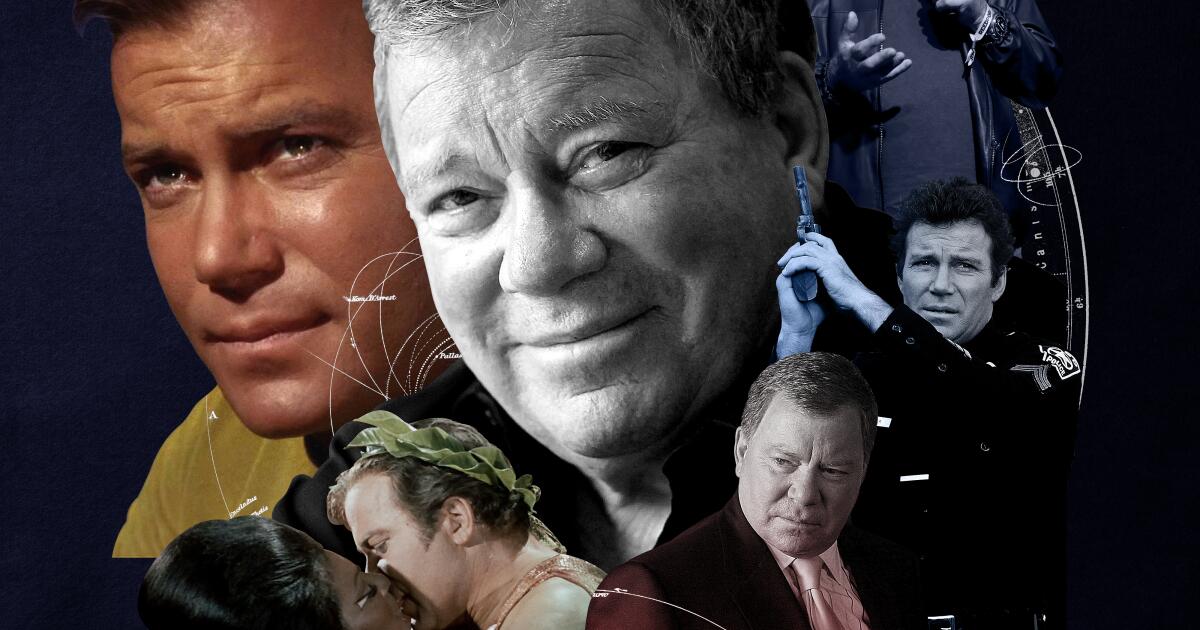
William Shatner is busy.
A documentary on his life, “You Can Call Me Bill,” directed by Alexandre O. Philippe (“Lynch/Oz”), is scheduled to roll out in theaters March 22 to coincide with his 93rd birthday. He continues to host and narrate the puzzling-phenomena History series “The UnXplained With William Shatner.” A 2022 performance at the Kennedy Center, backed by Ben Folds and the National Symphony Orchestra, is about to be released both as an album, “So Fragile, So Blue,” and a concert film. The title song, says Shatner, “encompasses a lot of my thinking about how we’re savaging the world, and [I’d hope] it’d be a song that people would listen to and perhaps be inspired to do something about global warming.” And on April 8, for 15 minutes before the shadow of an eclipse falls over Bloomington, Ind., Shatner will address “55, 60,000 people” in the Indiana University football stadium. “So what do you say, what do you write, what do you do? I’m going to have to solve those problems.”
Actor, author, recording artist, equestrian, pitchman, the range of his seven-decade career — from Broadway (he won a Theater World award for “The World of Suzie Wong” in 1958), to Hollywood, Shakespeare to He-Man — has made him more than an actor in the public mind and something of a brand, or perhaps a national monument. If his role as Capt. James T. Kirk on “Star Trek” is the fixed point from which that career extends backward and forward in time, there are things to admire in Early, Middle and Late Period Shatner alike, and the more I’ve explored the farther reaches of his work, the higher I’ve come to rate him.
There is something larger than life and at the same time very human about Shatner that makes him easy to love — and people do, sincerely, even though his singular presence can invite parody. (The word “Shatneresque” fetches back some 40,000 hits on Google.) Nothing one learns about him — that he’s gone into space, that he’s in a horse breeders hall of fame, that he once auctioned a kidney stone for charity — seems at all surprising.
I spoke with Shatner over Zoom recently, regarding his latest performance as the villainous Keldor in the animated Netflix series “Masters of the Universe: Revolution,” and some of those farther reaches.
William Shatner at the premiere of the documentary “You Can Call Me Bill” at the 2023 SXSW festival in Austin, Texas. The film will get a theatrical release March 22.
(Frazer Harrison / Getty Images for SXSW)
How do you keep your voice so young?
Wow. Where to start? I’ve had whatever the qualities of my voice are for a long time. I studied at the Stratford, Ontario, classical company when I graduated from university. And they had voice classes there, which I attended somewhat. But your voice reflects your health. It’s a light. Listening very closely to what your voice is saying, how it’s saying. What are the gifts? I don’t know. I presume I‘m using my vocal mechanism properly from all those years of training.
No regimen or voice exercises?
Used to.
You used to?
Well, I was taking singing lessons, so they’d want you to do what is called solfeggio, to read music, and I wasn’t very good at it.
Reading or singing? You’ve made a lot of recordings, but you never sing.
No. Because I’m of the belief I can’t sing. I don’t know. It must be mental. I love music, I love the lyrics, I love everything about music and song, all its nuances. I love it all. I just can’t do it to my satisfaction, singing. But since I’ve done a lot of classical plays, I’m accustomed to the rhythm of the language, the onomatopoeia of the language. So mechanically I know how the voice operates. Classical theater wants you to do 10 sentences of Shakespeare on one breath. I can’t do that now.
In “Masters of the Universe: Revolution” you play the villain with a sense of fun, as someone who’s enjoying himself.
I think that was there in the writing — I didn’t know what to do about it, an ancient animated character. How do you look for some way to do it in a new fashion, add some character to it? I didn’t know how to make choices so I just sort of intuitively went along.
Any instructions from Robert Lloyd Kevin Smith?
He yelled “Great!” a lot.
In “Masters of the Universe: Revolution,” William Shatner voices Keldor.
(Netflix)
Jumping back to the beginning of your TV career, at 24 you played the title role in a 1955 production of “Billy Budd.”
I did! Canadian live television, which is where I began essentially. After Stratford I moved to Toronto and became part of that contingent. Yeah, “Billy Budd,” a wonderful play!
Basil Rathbone, who played Capt. Vere, was an elegant, distinguished talent. He was an Englishman and he spoke [posh English accent] veddy veddy. That’s the way he did everything, very English. So one evening as we were approaching broadcast, Basil said to me, “Are you aware we’re going to be in front of 30 million people?” I said, “yeah. “[Accented burble], that’s frightening.” And he got on the air and put his foot in a bucket, and the bucket wouldn’t come off. It was like something out of Charlie Chaplin, and we spent the first act with him thumping around on a bucket and all of us trying not to laugh. You had one shot at this thing, one performance and that’s it, goodbye. You try not to laugh, but it was very funny.
Did you ever have any ever fear onstage?
No. The fear onstage is not remembering words. Laurence Olivier apparently retired for five years from the stage because he went through that moment when he couldn’t remember the words and frightened himself to death.
But you’re young, you’re on camera, basically the lead character — that didn’t feel intimidating at all?
No. In those days, I didn’t have a fear of not remembering. But you know you go through life — now, at my age, you forget why you entered the room, or your wife’s name. That’s what’s happened to me. I’m becoming a little forgetful. That can frighten you if you’re in front of a large audience.
You went to New York in the great era of live television.
I was perhaps the most popular actor in live television on a certain year or two; I was in demand the most because I had this classical background; I was young and had some looks and there was nobody in America who had my experience of doing a play a week for two years. That appealed to a lot of people in live television.
That was followed by a period of filmed anthology shows and episodic TV, including “The Twilight Zone,” where you starred in two of its best-remembered episodes, “Nick of Time” and “Nightmare at 20,000 Feet.”
In one year, it went from New York City live television to everybody heading to the West Coast to do film. I’m sure historians will have an answer to why all of a sudden there was this exodus, but it happened. So everybody went west, including me, and these little shows were around; and in order to make a living, you either did a big movie, if you could get into one, that took six months to make, or you did the best you could on shows like the ones I did, in order to wait for something to come along that had more breadth to it.
A scene from 1979’s “Star Trek: The Motion Picture,” in which William Shatner, center, reprised his role as Capt. James T. Kirk.
(Paramount Pictures)
Right before “Star Trek,” you played a New York City prosecutor in “For the People,” an on-location series I like a lot.
I had speeches to make and meaningful words. It wasn’t, “Where do we go to next, who do we arrest?” It was meaningful to the character, which was great fun for the actor. But we came up against “Bonanza,” and we did poorly and they canceled us.
The writers in those days were playwrights. They worked in Broadway. They were tremendously talented. And when they weren’t working in the theater, they were working in live television, which was as exacting as the theater. You had to hit your mark, you had to know your lines — you had to not only know your lines but you had to be able to play with them.
In 1970, you starred as another prosecutor in the Civil War courtroom drama “The Andersonville Trial” for PBS, sort of a jump back to live TV. George C. Scott directed you in the role he’d played on Broadway. What was that experience like?
I’ll sum it up in one moment, and I guess it’s been unforgettable for me. So I’m interrogating a prisoner, and I’m saying, “Why did you do these terrible things? [loud, accusatory] WHY DID YOU DO THESE TERRIBLE THINGS?” So after a couple of rehearsals, George comes to me, he says, “You know, I played this part on Broadway and I played it exactly the way you’re playing it for about six months, and then the second six months I learned to try and soften the role, like it was tearing at his heart.” Saying, [softly] “Why did you do these terrible things?” I thought, “Wow, what a crowning piece of direction that is.” I became his lap dog after that.
Your best-known series were with three very different producers — Gene Roddenberry on “Star Trek,” Aaron Spelling on “T.J. Hooker” and David E. Kelley on “Boston Legal” — each with a distinct approach.
David Kelley is a genius. He won an Emmy for comedy and an Emmy for drama one year [for “Ally McBeal” and “The Practice”], and he’d written all 48, 40 shows, whatever it was. So he would write a script and it was pretty much there when he presented it. He barely ever turned up on the set; I mean, half a dozen times over five years. But he wrote these marvelous, funny scripts. And he’s worthy of worship. He is an icon.
Aaron Spelling was so personable and so charming and had so many shows on the air that I don’t think he even knew which one was on that night or not. But he was very busy. I think his charm resulted in selling a lot of shows to the networks. Gene Roddenberry had the least experience of anybody, but he must have had a fascinating talent for writing, or creating, because how “Star Trek” came up as an idea, the fulfillment of “Star Trek” as a drama, the things that went on in production that you wouldn’t have believed was a lot to do with Gene Roddenberry. Gene was more of an everyday man. He was more the policeman, the airline pilot that he had been prior to being a writer. So there were a lot more shaded areas in Gene than anybody else.
William Shatner, left, with James Spader in “Boston Legal,” the David E. Kelley dramedy that starred the two actors and ran from 2004 to 2008 on ABC.
(Danny Feld / ABC)
When you got the part of Denny Crane in “Boston Legal,” did you expect to have another great role at that point in your career?
I just don’t recognize these miraculous things that happen. Denny Crane, it started off with Kelley writing this character, his having been a great lawyer and now he can’t remember very well — it’s not dissimilar to actors like we were talking about, not going onstage for five years. Fear. “Have I lost my talent?” I kept that in mind all the time. And the other thing that gave me great joy, his constant repetition of his name to me was like lizards flicking their tongue out — we know that their flicking their tongue out is their assessing their surroundings. So it’s a matter of “Who’s out there? What’s out there?” “Denny Crane, Denny Crane, Denny Crane”— flicking his tongue out to see what the reaction was. “Oh, Denny Crane, you were so wonderful!” I mean, I’m home. “Denny Crane, weren’t you the guy caught up in” — uh oh, I’d better leave now.
When did your relationship with horses begin? Was it on a television show?
I’d gone on and off a horse literally within a half hour when I was 12 years old, a rental horse; and my mother said, “Where did you learn to do that?” Because I was doing really well. I came to the mystical conclusion that in our DNA — ‘cause I’ve just been inducted into the [American Road Horse & Pony Assn.] Hall of Fame for breeding, breeders of American Saddlebreeds saddlebreds. You can breed for characteristics, and with some luck in three or four generations you might be able to get that characteristic you’re aiming at, or weed that one out. So I think, obviously, the same thing happens to human beings. We have in our DNA characteristics we’re not aware of. I think one of them for me was horses; somebody in my background dealt with horses a lot and then when I came upon a horse, “Wow, that’s my destiny.” I have lots of horses.
Are there things that you can get from a horse that you can’t get from a human?
You can get kicked. The thing about a horse — I’ve run a charity event for the last 35 years called the Hollywood Charity Horseshow and we draw in about $500,000 a year; over the years many millions of dollars have been put into children and into veterans, who have not dissimilar problems. I saw a thalidomide baby on a horse, no arms, one leg, grasping the reins with her toes, and I decided to do a horse show right then and there, helping kids like that and veterans coming back with [disabilities]. The horses allow the kids to talk when they wouldn’t talk, allowed veterans to move when they wouldn’t move. The horse in its size makes somebody feel better than before they got on the horse. You can move around, you can go where you want, high up. That’s what horses have.
William Shatner, center, with Audrey Powers, left, and Chris Boshuizen, when the actor took a space flight on a Blue Origin rocket in 2021. “I think that’s probably my best characteristic. I’m very curious about people and how events are made,” he says.
(LM Otero / Associated Press)
You hosted a couple of interesting interview shows, “William Shatner’s Raw Nerve” and “William Shatner’s Brown Bag Wine Tasting,” on which your guests included people from ordinary life — a butcher, a cheese monger, a magician, a cosplayer.
Discovery, discovering what they did, discovering their personal life, how they did it, why they did it. I said, I want anybody off the street walking by and let them spend 15, 20 minutes with me. They got me a kid from the streets who sold dope, and we talked about selling dope. I said, “I’ve got a horse show on this Sunday. You want to come?” He said, “Yeah, can I bring my kid”? So there was this young man who was trying to make it in this world bringing his 3-year old, 2-year-old baby to a horse show, and they’d never seen horses.
Is it fair to say you’re a person who’s driven by curiosity?
I think that’s probably my best characteristic. I’m very curious about people and how events are made. I’m designing a watch right now. What is time? We ask yourselves that question. [Quietly] What is time? [More quietly] What is time?
I’m designing a watch — I’ve got a watch out there now that I’ve already designed — and the concept is “Where does time go?” I’ve been looking, and searching my brain — where does time go? And I came across a coin that doesn’t look like a coin, it looks like a 3,500-year-old depiction of the skies. It’s made of blue, I don’t know what it is, azure of some kind, and gold, and that’s going to be the face of the watch. So we’ve got a watch trying to answer the question, “Where does time go?”



Movie Reviews
MOVIE REVIEWS: “Mercy,” “Return to Silent Hill,” “Sentimental Value” & “In Cold Light” – Valdosta Daily Times

“Mercy”
(Thriller/Crime: 1 hour, 39 minutes)
Starring: Chris Pratt, Rebecca Ferguson, Kali Reis
Director: Timur Bekmambetov
Rated: PG-13 (Violence, bloody images, strong language, drug content and teen smoking)
Movie Review:
“Mercy” is a science fiction movie based on one of the more common themes of moviedom lately, artificial intelligence (AI). This crime thriller cleverly creates an intriguing story using technology and the justice system, yet it fails to be consistently interesting and intelligent throughout. The conclusion is less significant than the initial setup, as the concluding scenes become typical action sequences.
Detective Chris Raven (Pratt) of the LA Police Department is a huge supporter of the city’s new judicial courtroom. Crimes are now judged by an AI program (Ferguson) in the Mercy Court. The court is run by an artificial program that makes decisions based on all of the evidence before it without any prejudice. Detective Raven is all for this system until he is convicted of killing his wife. Now he must use all of the data, including the AI‘s ability to tap into everyone’s electronic devices, security cameras, and even into government files, within reason, to prove he did not murder his wife.
Mercy is an interesting movie. It entertains throughout, even when the story gets sloppy and characters’ actions are irrational. This mainly occurs during the final scenes. The movie tries too hard to insert unneeded narrative twists. This is disappointing because the story is interesting. What makes it fascinating is that it happens in real time. This is the most brilliant facet.
All the other theatrics are unnecessary. Director Timur Bekmambetov (“Profile,” 2018; “Wanted,” 2008) and “Mercy’s” producers should have just kept the ending simple, no plot twists or superfluous action sequences.
Grade: C (This flick needs some mercy. Let the trial begin.)
“Return to Silent Hill”
(Horror: 1 hour, 46 minutes)
Starring: Jeremy Irvine, Hannah Emily Anderson and Robert Strange
Director: Christophe Gans
Rated: R (Bloody violent content, strong language and brief drug use.)
Movie Review:
“Return to Silent Hill” is about one man’s quest to return to the love of his life. The problem is she has moved on to the afterlife. Meanwhile, audiences lose part of their life watching this movie, which is unlike any of the two prequels in this series. This one is a psychological horror that bores.
Artist James Sunderland (Irvine) decides to return to Silent Hill, a place where many people died during a devastating illness that nearly enveloped the entirety of the city’s population. What is left there is a horror show of freakish creatures, all with violent intent. Still, Sunderland searches for the love of his life, Mary Crane (Anderson).
Think of this movie as a slow suicide, where a guy goes back to retrieve his dead girlfriend. To do so, he must travel to the modern land of the dead that Silent Hill has become. This one is a type of swan song by the main character, and the movie becomes less scary while lackluster romantic notions wander aimlessly.
Grade: D (Do not return to see this.)
“Sentimental Value”
(Drama: 2 hours, 13 minutes)
Starring: Renate Reinsve, Stellan Skarsgård, Inga Ibsdotter Lilleaas and Elle Fanning
Director: Joachim Trier
Rated: R (Language, sexual reference, nudity and thematic elements)
Movie Review:
“Sentimental Value” is a Norwegian film that won the Grand Prix in France’s Cannes Film Festival and was nominated for nine Academy Awards, including Best Motion Picture. It is a solid drama filled with symbolism and family connections. It is brilliant performances by a talented cast under the direction of Joachim Trier (“The Worst Person in the World,” 2021).
This screenplay is about Gustav Borg (Skarsgård). He is a father, grandfather and a famed film director. He stayed away from his two daughters, actress Nora Borgwhile (Reinsve) and historian Agnes Borg Pettersen (Lilleaas), while he was creating works as a filmmaker. The director comes back into the lives of his daughters after the death of their mother. Their reunion leads to a rediscovery of their bond at their family home in Oslo.
Stellan Skarsgård is always a solid actor. He takes his roles and makes them tangible characters that seem like you know them, even when they’re speaking a foreign language. That is the quality of his act and why he gets nominated for multiple awards each season.
“Sentimental Value” is a valuable movie filled with enriching sentiment. It is an enjoyable film for those who value a good drama. The acting and original writing alone make the movie worth it. “Sentimental Value” starts in a very simple way, but everything in between, even when low-key, remains potent. Joachim Trier and writer Eskil Vogt have worked together on multiple projects such as “The Worst Person in the World” (2021). Their pairing is once again worthy.
Grade: A- (Any motive valuable movie.)
“In Cold Light ”
(Crime: 1 hour , 36 minutes)
Starring: Maika Monroe, Allan Hawco and Troy Kotsur
Director: Maxime Giroux
Rated: R (Violence, bloody images, strong language and drug material)
Movie Review:
“In Cold Light” sticks to a very straightforward story, primarily taking place over a short period. The problem is the story leaves one in the cold. Audiences have to guess what is being communicated because this movie uses American Sign Language (ASL) without subtitles. For those moviegoers who do not know ASL, they are left deciphering characters’ actions and facial expressions during some pivotal scenes.
Ava Bly (Monroe) attempts to start a legit life after prison. Her life changes when Ava’s twin, Tom Bly (Jesse Irving) is murdered while seated next to her. As her brother’s killers pursue her, Ava must evade law enforcement, which contains some crooked cops led by Bob Whyte (Hawco).
For a brief moment, this movie hits its exceptional moment when Oscar-recipient Helen Hunt enters the picture as a motherly Claire, a crime boss who seems more like a social worker/psychologist. Her long scene is wasted as it arrives too late.
French Canadian director Maxime Giroux’s style has potential in his first English-language film, but it does not fit a wayward narrative. A rarity, this crime drama has characters commit many dumb actions at once.
Moreover, Giroux (“Félix et Meira,” 2014) and writer Patrick Whistler forget to let their audiences in on their story. They allow much to get lost in translation, especially during heated conversations between Monroe’s Ava and her father, Will Bly, played by Academy Award-winning actor Troy Kotsur (“CODA,” 2021).
Grade: C- (Just cold and dark.)
More movie reviews online at www.valdostadailytimes.com.

As the media industry took stock of Paramount Skydance’s startling acquisition of Warner Bros. Discovery, one question lingered on the minds of many in the news business and beyond: What will this mean for CNN?
The iconic 24-hour cable news network is among the various Warner Bros. assets that would be scooped up by Paramount in a deal announced Thursday that could transform the media landscape.
Paramount has undergone a swift transformation under Chief Executive David Ellison following his family’s acquisition of the company last summer. These changes reached CBS News almost immediately with the appointment of Bari Weiss, the controversial Free Press co-founder, as its new editor in chief.
Bari Weiss moderated a town hall with Erika Kirk, widow of slain conservative activist Charlie Kirk.
(CBS via Getty Images)
Weiss’ tenure so far has been rocky.
Her decision to pull a “60 Minutes” story about conditions inside an El Salvador prison that housed undocumented Venezuelan migrants from the U.S. received widespread criticism and accusations of political motivation. The network said the story was held for more reporting, and the segment eventually aired.
There was more upheaval last week at the news magazine, when “60 Minutes” correspondent and CNN news anchor Anderson Cooper announced that he’d be leaving to spend more time with his family.
And earlier this year, a veteran producer at “CBS Evening News With Tony Dokoupil” was fired after he expressed disagreement about the editorial direction of the newscast.
Now, the concern is that similar changes could be in store for CNN, which has long been a target of President Trump’s ire. He has personally called for the ouster of hosts at the network who have questioned his policies.
CNN Worldwide Chief Executive Mark Thompson tried to quell some of those fears, particularly inside his own newsroom.
In an internal memo dated Thursday and obtained by The Times, Thompson urged employees not to “jump to conclusions about the future” and try to concentrate on their work.
“We’re still near the start of what is already an incredibly newsy year at home and abroad,” he wrote in the note. “Let’s continue to focus on delivering the best possible journalism to the millions of people who rely on us all around the world.”

Chairman and CEO of CNN Worldwide Mark Thompson and media editor for Semafor, Maxwell Tani, speak onstage.
(Shannon Finney / Getty Images for Semafor)
CNN declined to comment beyond Thompson’s memo.
Ellison has said his vision for a news business is one that is ideologically down the middle.
“We want to build a scaled news service that is basically, fundamentally in the trust business, that is in the truth business, and that speaks to the 70% of Americans that are in the middle,” he said during a Dec. 8 interview on CNBC, shortly after Warner said it had chosen Netflix as the winning bidder for its studios, HBO and HBO Max. “And we believe that by doing so that is for us, kind of doing well, while doing good.”
Ellison demurred when asked whether Trump would embrace him as CNN’s owner, given the president’s past criticisms of the network.
“We’ve had great conversations with the president about this, but … I don’t want to speak for him in any way, shape or form,” he said.
First Amendment scholars have raised concerns about press freedom and free speech rights under the Trump administration, particularly after last month’s arrest of former CNN journalist Don Lemon and the Federal Communications Commission’s pressure on late-night hosts like Jimmy Kimmel and Stephen Colbert.
Press freedom groups have long asked questions in other countries about how authoritarian regimes use their power and “oligarchical alliances to belittle, silence, and punish independent journalistic voices, or to steer media ownership toward … a preferred version of the truth,” said RonNell Andersen Jones, a 1st Amendment scholar and distinguished professor in the college of law at the University of Utah, in an email.
“We see them asking at least some of these questions about the U.S. today,” she wrote.
Apprehension about the merger also extends beyond its implications for CNN and the media business.
Lawmakers such as Rep. Laura Friedman (D-Glendale), Sen. Adam Schiff (D-Calif.) and Sen. Cory Booker (D-N.J.) have raised concerns about how the consolidation of two major Hollywood studios could affect industry jobs and film and television production — which has significantly slowed since the pandemic, the dual writers’ and actors’ strikes in 2023 and corporate cutbacks in spending.
Sen. Elizabeth Warren (D-Mass.) called the deal an “antitrust disaster” that she feared could raise prices and limit choices for consumers.
“With the cloud of corruption looming over Trump’s Department of Justice, it’ll be up to the American people to speak up and state attorneys general to enforce the law,” she said in a statement.
Already, California Atty. Gen. Rob Bonta has said the merger isn’t a “done deal,” adding that he is in communication with other states attorneys general about the issue.
“As the epicenter of the entertainment industry, California has a special interest in protecting competition,” he posted Friday on X.
The deal is subject to approval by the U.S. Justice Department. Bonta and other state attorneys general are expected to file a legal challenge to the mega-merger on antitrust grounds.
Ellison addressed some of these concerns in a statement Friday.
“By bringing together these world-class studios, our complementary streaming platforms, and the extraordinary talent behind them, we will create even greater value for audiences, partners and shareholders,” he said. “We couldn’t be more excited for what’s ahead.”
Times staff writer Meg James contributed to this report.

NEW YORK (OSV News) – “Goat” (Sony) is an animated underdog sports comedy populated by anthropomorphized animals. While mostly inoffensive, and thus suitable for a wide audience — including teens and older kids — the film is also easily forgotten.
The amiable proceedings center on teen goat Will Harris (voice of Caleb McLaughlin). As opening scenes show, it has been Will’s dream since childhood to play for his hometown team, the Vineland Thorns.
The inhabitants of Vineland and the other areas of the movie’s world, however, are divided into so-called bigs and smalls, with professional competition dominated, unsurprisingly, by the former. Though Will stoutly maintains that he’s a medium, those around him regard him as too slight and diminutive to go up against the towering bigs.
Despite this prejudice, a video showing Will more or less holding his own against a famous and arrogant big, Andalusian horse Mane Attraction (voice of Aaron Pierre), goes viral and inspires the Thorns’ devious owner, warthog Flo Everson (voiced by Jenifer Lewis), to give the lad a shot. Though Will is understandably thrilled, his path forward proves challenging.
Will has idolized the Thorns’ sole outstanding player, black panther Jett Fillmore (voice of Gabrielle Union), since he was a youngster. But Jett, it turns out, is not only frustrated by her situation as a star among misfits but scornful of Will’s ambitions and resolute in helping to deprive her new teammate of playing time.
Given such divisions, the Thorns’ fortunes seem destined to continue their long decline.
“Roarball,” the invented game featured in director Tyree Dillihay’s film, is essentially co-ed basketball by another name. As produced by, among others, NBA champion Stephen Curry, the movie — adapted from an idea in Chris Tougas’ book “Funky Dunks” — is an unabashed celebration of hoop culture both on and off the court.
Viewers’ enthusiasm may vary, accordingly, depending on the degree to which they’re invested in the real-life sport.
Moviegoers of every stripe will appreciate the fact that the script, penned by Aaron Buchsbaum and Teddy Riley, shows the negative effects of self-centeredness as well as the value of teamwork and fan support. Plot developments also showcase forgiveness and reconciliation.
Will’s story is, nonetheless, thoroughly formulaic and most of the screenplay’s jokes feel strained and laborious. Still, while hardly qualifying as the Greatest of All Time, “Goat” does provide passable entertainment with little besides a few potty gags to concern parents.
The film contains brief scatological humor and at least one vaguely crass term. The OSV News classification is A-II — adults and adolescents. The Motion Picture Association rating is PG — parental guidance suggested. Some material may not be suitable for children.
Read More Movie & TV Reviews
Copyright © 2026 OSV News

Couple sentenced for selling faulty fire extinguishers to Mississippi daycares, businesses – SuperTalk Mississippi
Missouri Lottery Mega Millions, Pick 3 winning numbers for Feb. 27, 2026

Montana cowboys help build trauma ranch for Israeli soldiers

How to Watch No. 12 Nebraska Basketball at USC with Preview, Breakdown, TV Channel

Nye County Sheriff urges caution after deadly month on rural Nevada roads

Florida High School Football Rankings: Top 25 teams – Oct. 21

Cleary's 21 help Le Moyne down Central Connecticut State 69-64 in OT

How old is Bo Nix? What to know about Oregon quarterback ahead of 2024 NFL Draft

99th annual Pony Swim held in Virginia

Indiana Members Credit Union announced as new anchor tenant at Bottleworks District

ICE blasts Washington mayor over directive restricting immigration enforcement

Did the EU bypass Hungary’s veto on Ukraine’s €90 billion loan?

How the federal government is painting immigrants as criminals on social media

Where Iran’s ballistic missiles can reach — and how close they are to the US

Has India’s influence in Afghanistan grown under the Taliban?
-

 World2 days ago
Exclusive: DeepSeek withholds latest AI model from US chipmakers including Nvidia, sources say
-

 Massachusetts3 days ago
Mother and daughter injured in Taunton house explosion
-

 Montana1 week ago
2026 MHSA Montana Wrestling State Championship Brackets And Results – FloWrestling
-

 Louisiana5 days ago
Wildfire near Gum Swamp Road in Livingston Parish now under control; more than 200 acres burned
-

 Denver, CO2 days ago
10 acres charred, 5 injured in Thornton grass fire, evacuation orders lifted
-

 Technology7 days ago
YouTube TV billing scam emails are hitting inboxes
-

 Technology7 days ago
Stellantis is in a crisis of its own making
-

 Politics7 days ago
OpenAI didn’t contact police despite employees flagging mass shooter’s concerning chatbot interactions: REPORT