Entertainment
Through ‘K-Pops!,’ Anderson .Paak sought deeper familial connection


When the pandemic hit, and reality settled in that life would be isolated and mostly inside, Grammy winner Anderson .Paak found himself on the outside looking in, in a way he didn’t anticipate. “I was the odd man out. My son was 8, and BTS took over the whole house,” .Paak explained in an interview with The Times at his WeHo lounge, Andy’s. “It was a K-pop storm. Before that, me and my son were bonding off of my music.”
.Paak’s son, Soul Rasheed, and his now ex-wife originally from Korea, Jaylyn Chang, had become obsessed with K-pop alongside much of America, which reminded .Paak of the intensity of Beatlemania. Black American music influenced the birth of a new style, which formed and expanded across oceans, then returned to the U.S. and exploded. This effect in the .Paak household was palpable, causing Soul and Chang to deeply bond in a new way. .Paak himself, as a soul, R&B and hip-hop aficionado, was tapped into the source, but not the reinterpreted subject. So he had to find a way in.
Soul, at the time, like many 8-year-olds, had also become obsessed with becoming a YouTuber. Besides .Paak’s music, the father-and-son duo had also previously connected over humor, so .Paak started there. They began with funny skits and eventually fused them with BTS dances. Soon, there were even videos featuring them comedically educating each other about their individual music tastes. “I loved it,” .Paak recalled, getting lost in the memory. “I was getting to know him more, and he was getting to know me. My mom would always say, ‘It’s one thing for your kids to love you, but it’s another to share things you’re interested in.’ It wasn’t like I was being Anderson .Paak, I was just Dad.”
“I was getting to know him more, and he was getting to know me,” .Paak said of bonding with his son, Soul.
(Carlin Stiehl / For The Times)
Through this exploration and the realization of a potential continued familial bond, a story idea emerged, then a treatment for a K-pop-centered film that .Paak would direct and he and Soul would both star in. .Paak then began directing a slew of music videos as the pandemic began to fade, building a portfolio and gaining experience in the medium. But he could start to sense Soul’s interest fading as time passed. After a few failed pitch attempts, .Paak urgently enlisted the help of one of his oldest friends and fellow entertainer, Jonnie “Dumbfoundead” Park, who brought .Paak and the idea to Stampede Ventures.
“The pitch was from an idea that Anderson had, and [to introduce it], we showed them this TikTok that he had with his son,” Park recalled over Zoom. “Anderson was like, ‘Do you know anything about BET, son?’ And [Soul] was like, ‘No, but I know BTS.’ Then they were just going back and forth, arguing about BET and BTS. That was literally the deck, [us saying] we would take that energy and put it into a two-hour film. They loved it. As soon as we walked out of the office, Anderson looked over like, ‘Are we greenlit?!’ They just understood it, the whole intergenerational, intercultural element of Black and Korean.” Stampede combined forces on the project with Live Nation Studios and .Paak’s debut feature “K-Pops!” was off to the races.
It’s important to note that .Paak is himself Black and Korean. His mother was adopted from Korea by a SoCal Black American military family and .Paak’s father was also a Black military officer. Thus, while his mother was born in Korea, he was raised almost entirely within a Black cultural space. .Paak didn’t experience much direct exposure to Korean culture until his 20s, when he met Chang at the Musicians Institute in Hollywood. As an immigrant directly from Korea, Chang showed him the fortitude of structure amid her community. He was also taken by their inherent family value system. “In Korean households, you stay in the house until you get older so you can take care of your parents, and your parents can help take care of the kids,” .Paak explained. “There’s an infrastructure that’s worked out. Also, Korean food is important, as is learning the language. I was drawn to that. My son didn’t eat anything outside of Korean food for so long, and he’s just now getting into tacos.”
.Paak then further explored his Korean side through a burgeoning friendship with Park, which happened a bit later, after Chang had already given birth to Soul. Park introduced .Paak to K-town-based Korean culture through their shared music scene. “The people that came from K-town had a lot of Latino and Black influences as well,” .Paak remembered. “There was a little more of a melting pot, and it was more urban. But in a similarly communal way [to Koreans from Korea], they were all hanging out in K-town with other Korean friends. They’d drink soju, and go to after-hours where you had to have somebody Korean with you.”

While .Paak had some opportunities in adulthood to grasp a bit of his Korean heritage, in “K-Pops!,” through his main character BJ, he also got to actualize what his mother may have missed. In the film, BJ, a failed karaoke bar R&B musician, gets a lucky chance to go to Korea and be the drummer for a popular K-pop competition series. There, he bumps into his estranged ex-girlfriend’s son, Tae Young (played by Soul), who is competing on the show. He then finds out that the kid is his. While a messy transition ensues, BJ and Tae Young eventually get to galavant around Korea and work together to try to win the competition. Through this exploration, BJ finds out he can thrive in Korea while still holding onto his Blackness. .Paak’s mother’s dive back into her roots had a different result. “My mom went abroad and spent a year in Korea, but when she went there, she just didn’t like it,” .Paak explained. “In the movie, initially, BJ doesn’t really have any connection to his Korean side and doesn’t really care to know, but then he finds a bridge.” That bridge is music.
Actor Yvette Nicole Brown, who in “K-Pops!” plays BJ’s mother, proclaimed over Zoom that, “Everything about the film and the music in it is Blasian, every culture is celebrated and massaged and made into something beautiful.” .Paak made a concerted, intentional effort to explore both the Black and Korean sides of K-pop in two scenes.
The first is an early breakdown initiated by Soul’s character, Tae Young, who explains the structured roles of a K-pop group, which may be fun for superfans and educational for laypeople to the genre. The next is a winding presentation by BJ to Tae Young about the influence of Motown groups like the Jackson 5 and boy bands like New Edition on the momentum of K-pop’s rise. It’s particularly poignant because it is all shot at a record store on the streets of Korea, where .Paak explained he actually found the records he was referencing. “There’s nothing wrong with people doing their interpretation of Black music, as long as you pay homage and as long as you respect it and take care of it,” .Paak declared. “Because [if you do], then they’ll take care of you, but the moment you don’t, you’ll see what happens … I wanted to explain that history because that’s how I saw it.”

Real-life father and son, Anderson .Paak, left, and Soul Rasheed, co-star in “K-Pops!”
(Jake Giles Netter)
”K-Pops!” has as much of who .Paak and Soul are as father and son as he could fit in. There are appearances by legacy Black artists like Earth, Wind & Fire, as well as K-pop stars like Vernon from Seventeen. There are original songs co-written and co-produced by .Paak and musician Dem Jointz, that feature K-pop fused with soul and funk, one of which Tae Young performs as his finale competition number (soundtrack arriving soon). The film was shot in both L.A. and Korea and provided ample time for bonding (especially during scenes filled with off-the-cuff humor) that .Paak envisioned from the beginning. Yet still, at the time they were about to shoot, .Paak almost couldn’t get Soul on board because he had turned 11 and wasn’t as into K-pop or acting comedically anymore; he insisted he was instead “into Slipknot.”
The duo did find their footing, though, and executed a winding story that centers on their connection. As a burgeoning teenager in 2024, Soul went with his father to the world premiere at the Toronto International Film Festival, along with a plethora of Korean relatives from his mom’s side. .Paak anxiously awaited their full reaction to the culmination of his quest for a deeper bond.
“Everybody really enjoyed it,” .Paak remembered, relieved. “[Soul] was like, ‘I’m proud of you, Dad.’ I asked him, ‘You think you would ever do part two?’ He was like, ‘Nah, I don’t think acting is my passion, but I’ll never forget those moments … You know what? On second thought, it depends on the script.’ But I think he’s really proud of it. I think it’s something like, when he gets older, he’ll see how special it is as well. But yeah, he didn’t say it’s cringe.”
“K-Pops!” has its L.A. premiere on Tuesday and debuts in select theaters Friday.



Dreams, 2025.
Written and Directed by Michel Franco.
Starring Jessica Chastain, Isaac Hernández, Rupert Friend, Marshall Bell, Eligio Meléndez, Mercedes Hernández, Tatiana Ronderos, Bobby August Jr., Nessa Dougherty, and Jayden Leavitt.
SYNOPSIS:
A powerful socialite and a promising ballet dancer begin a dangerous affair. When he secretly crosses the US-Mexico border, she takes desperate measures to protect their future together.

Much will be written (and probably already has, given that the film has been released in several countries and played many film festivals) about the system-shocking, provocative final 20 minutes of writer/director Michel Franco’s Dreams. Aside from the fact that the filmmaker also knows how to stage erotic and passionate sex scenes moving the fornicators all over an area’s space (whether it be a countertop or a stairwell), and some sociopolitical/American dream commentary that is both nuanced yet clearly an unspoken focal point of an interracial relationship between a ballerina undocumented immigrant and a silver-spooned wealthy white woman torn between love and losing the privileges that come with living within such a rich but racist family, there also isn’t a whole lot to talk about regarding the first hour.
Everything about the shocking scene in question, which will certainly be offensive to some, is frustrating because of its racial optics. Some will unquestionably welcome anything that jolts the film out of its dull slumber. In the end, it’s Michel Franco resorting to in-your-face trauma and abuse to get a rise out of an audience, seemingly not knowing what else he wants to say, so he resorts to highlighting what has already been said through the above gratuity. Is it offensive? Sure, it will be to some. It’s more eye-rolling that the filmmaker apparently knows only one trick or mode to fall back on when everything else fails.

And yes, the optics are indeed quite bad with the kind of implied message that is downright stunning being sent from the filmmaker of Mexican heritage. There is a high chance viewers will rebuke everything about Dreams after a certain scene (it’s the kind of moment that can lower 4 stars to 2 in some eyes), but what is more illuminating about the film and filmmaker is that there will be a variety of reasons.
Michel Franco seems to mean well, as the majority of his torrid secret love affair drama follows newcomer Isaac Hernández’s Fernando Rodriguez, an aspiring dancer who has become so romantically entangled with Jessica Chastain’s Jennifer, a socialite and integral member of a foundation funding such Mexican arts, that he crosses the border to be with her in San Francisco. Expectedly, the physicality of the relationship is hot and heavy, yet it comes to a screeching halt, even after time, as Jennifer remains unwilling to let her family (including a brother played by Rupert Friend and a father played by Marshall Bell) in on the truth about their dynamic. This initially causes Fernando to pull back and distance himself entirely from Jennifer, who essentially becomes a stalker, offering more and more until she gets the relationship back.

Again, the filmmaker demonstrates social and power imbalances not merely through situational elements and dialogue, but also through cinematography, using large spaces and wide shots whenever Fernando is in the dance rehearsal studio or mingling with Jennifer. The world is simply much bigger to him with more opportunity when he is underneath her thumb. This is also a double-edged sword, given her obsessive craziness, which makes it just as dangerous.
Once all of this is established, Dreams, unfortunately, doesn’t really have anywhere to go for nearly an hour. As previously mentioned, even then, Michel Franco takes it in a direction that gives new meaning to sledgehammering home a “yikes”-worthy metaphor (here, it’s more like a missile to the brain, with it written all over its side in all capital letters). The sex scenes and occasional dancing are the only reprieve from dullness.

That is, before a tone-flipping third act brings both uncomfortable crimes of whirlwind passion, which would be fine if the filmmaker had the wherewithal to exert some restraint. Artists deserve free rein to do whatever they want, so I generally dislike calling any film irresponsible, but releasing Dreams during this US administration, with everything happening in the world right now, is dancing on that knife-edge. With one major change and a similarly provocative, challenging ending, the film would be fine. Instead, a better conclusion must be dreamed up. And yet it is still such an unexpected assault on the senses that it’s misguidedly trying to say something about these imbalances throughout the film; the film shouldn’t be written off entirely.
Flickering Myth Rating – Film: ★ ★ / Movie: ★ ★ ★
Robert Kojder
https://www.youtube.com/watch?v=embed/playlist

As Paramount moved Monday to sweeten its bid for Warner Bros. Discovery, a high-stakes political battle is playing out behind the scenes.
Paramount’s latest offer enhanced its earlier $30-a-share bid, valued at $108 billion, said a person familiar with the process who was not authorized to comment publicly. Details of the revised proposal, first reported by Bloomberg, were not immediately available.
The firm is leveraging both the dynastic wealth of Larry Ellison’s empire and his ties to the Trump administration to dismantle Netflix’s rival $82.7-billion deal for Warner, which owns CNN, HBO and the premier Hollywood film and television studios, according to people close to the auction.
Over the weekend, President Trump turned up the heat, demanding that Netflix “IMMEDIATELY” fire Susan Rice — a former Obama and Biden administration official — who serves on Netflix’s 13-member board or “pay the consequences.”
Trump, in a Saturday night social media post, called the former ambassador “deranged … She’s got no talent or skills — Purely a political hack!”
Trump previously said he would not get involved in the pivotal Warner Bros. auction, instead leaving the matter to the Department of Justice, which is investigating whether a Netflix takeover, or Paramount’s alternative bid, would harm competition. Trump has been an outspoken critic of CNN and many of its on-air hosts.
Netflix won the bidding for the storied studio and HBO in December, prompting the spurned Paramount executives to launch a multipronged strategy to scuttle the Netflix deal.
Netflix co-Chief Executive Ted Sarandos sought to downplay the latest controversy, saying during a BBC interview Monday: “This is a business deal, it’s not a political deal.”
But Paramount, which declined to comment for this article, has not been shy about playing its political cards.
Warner Bros. Studio in Burbank.
(Myung J. Chun/Los Angeles Times)
The company, overseen by Larry Ellison’s son, David, is trying to convince Justice Department regulators and Warner Bros. shareholders that the Netflix deal is too dicey and that they should instead side with Paramount, said sources who were not authorized to comment publicly.
Paramount has attempted numerous maneuvers to gain the upper hand.
“This deal was never going to be decided on the merits of the offer or rigid antitrust considerations,” said Gabriel Kahn, a professor at the USC Annenberg School for Communication and Journalism. “This was a classic Trump administration deal where proximity to the president counts a lot more than financial terms.”
Trump’s Saturday night outburst came after Rice, during a podcast interview last week, said that “it is not going to end well” for corporations, media outlets and law firms that “bent the knee” to Trump should Democrats regain control in Washington.
The comments of Rice, a Netflix director for eight years, came as Paramount-owned CBS was involved in a headline-grabbing dust-up with late-night talk-show host, Stephen Colbert, over Trump’s Federal Communications Commission chair‘s threat to modify a rule requiring that broadcasters to give political candidates equal time. Colbert has accused his company of kowtowing to Trump, which CBS has denied.
Netflix’s Sarandos and Paramount’s David Ellison have made separate treks to the White House.
In October, Paramount hired a former Trump administration official, Makan Delrahim, who oversaw the Justice Department’s antitrust division during Trump’s first term, to quarterback Paramount’s campaign to win over regulators and politicians.
A formidable ally — Sen. Ted Cruz (R-Texas) — recently visited Delrahim on Paramount’s Melrose Avenue lot in Los Angeles. While there, Cruz said he was a fan of the CBS show “NCIS,” which prompted Paramount executives to put together an impromptu tour of the “NCIS Origins” soundstages, according to a person familiar with the visit.
In December, Delrahim made a tactical move to apply for Justice Department approval of Paramount’s deal — despite the absence of a signed agreement with the Warner Bros. board and the consent of its shareholders. The gambit was meant to speed the agency’s approval should the Netflix deal crumble. Warner stockholders are expected to vote March 20.
Last week, Paramount announced that a major deadline had passed without pushback from the Justice Department. “There is no statutory impediment in the U.S. to closing Paramount’s proposed acquisition of WBD,” Paramount said in a regulatory filing.
Paramount faces a separate deadline late Monday to improve the finances of its proposed takeover to shake the support of Warner Bros. Discovery’s board members for the Netflix deal.
Paramount wants to buy all of Warner Bros. Discovery, including CNN.
Netflix, in contrast, does not want the bulk of cable TV channels beyond HBO, and has offered $27.75 a share. It has the right to match any improved Paramount proposal.
Warner is planning to spin off the bulk of its channel portfolio, including HGTV, TBS and Cartoon Network, in a separate company. Its shareholders will receive stock in that entity, slated to be called Discovery Global.
Concerns over Netflix’s deal have been mounting.
Department of Justice regulators have sent inquiries to the three companies, according to one senior executive who was not authorized to speak publicly. The department is said to be looking at Netflix’s historic business strategy of steering most of its film releases to its streaming platform, often bypassing movie theaters. Sarandos has promised to maintain a 45-day theatrical window for Warner Bros. films.
Bloomberg has reported that regulators also are trying to determine whether Netflix has exerted leverage over creators in negotiations when acquiring programming to build its catalog.
This month, Republican lawmakers blasted Sarandos during a Senate Judiciary Subcommittee on Antitrust, Competition Policy, and Consumer Rights hearing to explore antitrust implications of the Warner Bros. sale. Sen. Mike Lee (R-Utah) sent Netflix a series of pointed follow-up questions, including: “If allowed to proceed, what effect will the merger have on future competition?”

Ted Sarandos, left, and David Zaslav at the 2026 Golden Globes.
(Allen J. Schaben / Los Angeles Times)
The hearing also veered into culture wars, with Sen. Josh Hawley (R-Mo.) suggesting Netflix was promoting a “transgender ideology” to children, which Sarandos denied.
Another Missouri Republican, Sen. Eric Schmitt, accused Netflix of making some of “the wokest content in the history of the world.”
“Netflix has no political agenda of any kind,” Sarandos told the lawmakers.
David Ellison also was invited to appear at the Feb. 3 hearing, but he declined — which raised the eyebrows of some members of the panel.
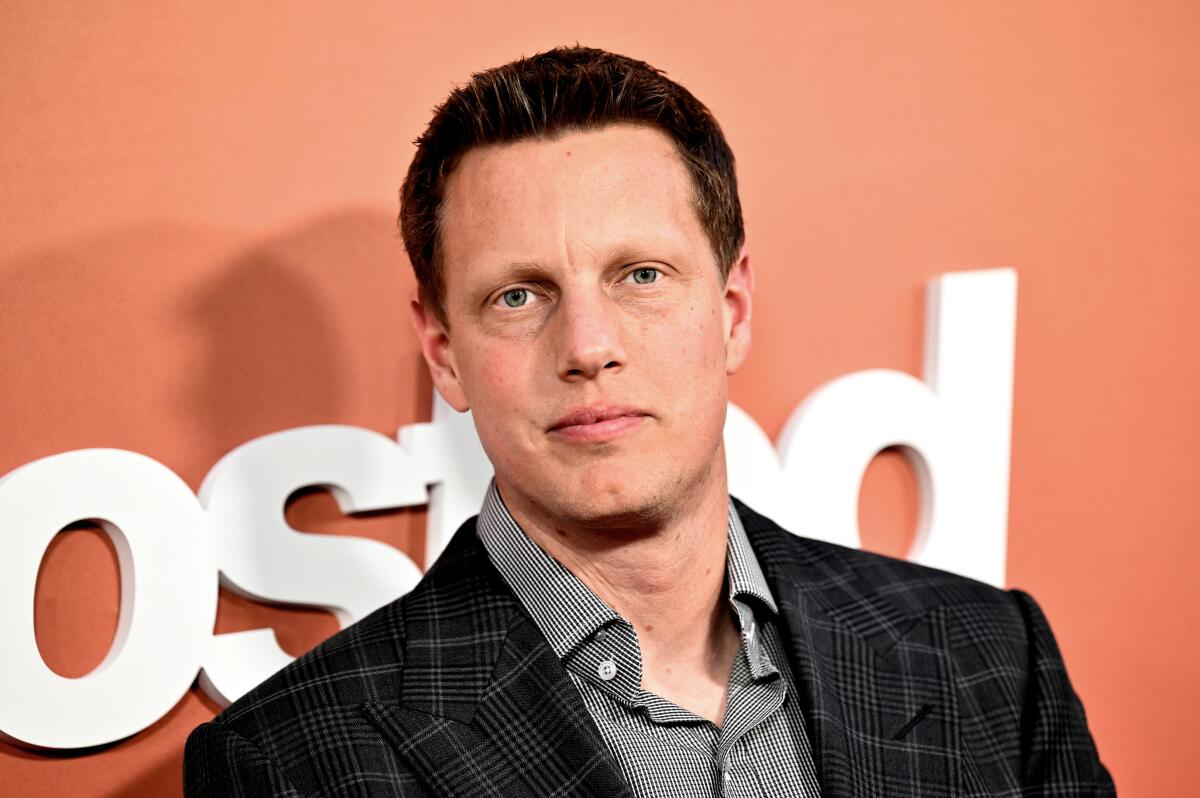
Skydance Media founder and Chief Executive David Ellison, who leads Paramount, is shown in 2023 in New York.
(Evan Agostini / Invision / Associated Press)
Sen. Cory Booker (D-N.J.) challenged Ellison for failing to answer lawmakers’ questions under oath, including about his dealings with the president.
Ellison instead responded with a statement but Booker and other lawmakers wrote back, saying Ellison’s statement “failed to address” the issues raised by Booker.
“The pattern of evasion, combined with Paramount’s apparent confidence that a politically sensitive transaction will clear without difficulty warrants serious scrutiny,” Booker, Senate Minority Leader Chuck Schumer and others wrote in the Feb. 19 letter.
The Democrats instructed Ellison “to preserve records related to the proposed Paramount-Warner Bros. Discovery transaction.”
The move came days after Gail Slater, the Justice Department’s antitrust chief, was bounced from her job, reportedly after becoming a thorn in the side of some business interests. Slater’s former top deputy, who also left the Justice Department, publicly warned that antitrust decisions are being influenced by corporate lobbyists — not in the interest of ordinary Americans.
“We see this happen again and again,” USC’s Kahn said.
“Let’s not forget that Larry Ellison’s Oracle was part of the consortium that purchased the U.S. operations of TikTok. Repeated complaints from the FCC about content at CBS have been heeded by the Ellison regime,” Kahn said, adding: “This is the reality of trying to do any business in the Trump administration: It’s about payoffs and proximity.”
Movie Reviews
Letterboxd’s most eager reviewers are changing cinema etiquette: ‘I was excited to pull out my phone’

I completely turn my phone off when I go to the movies. Not just on silent – all the way off. I say this not because I think that I’m better than you, or that by doing so the ghost of Billy Wilder will come back to shake my hand. I consider it one of life’s little luxuries: for at least an hour and 45 minutes, I am entirely unreachable. I keep my phone off for the duration of the credits, too. It feels decadent to stay put as my fellow moviegoers slowly filter out, illuminated only by rolling text.
And, lately, the glow of the Letterboxd app.
Over 26 million people use Letterboxd, a movie-cataloguing app. Like the Criterion Collection or A24, it has become industry shorthand for a certain type of tastemaker who hypes new releases and delights in rediscovering old classics. Users rate and review movies, and the funniest or most illuminating critiques rise to the top of the page, incentivizing cinephiles to put in some effort.
On a recent trip to the movies, the credits had barely started before the man in front of me began typing his review. A few seats over, a couple sat, heads down, jotting down their respective thoughts.
The late film-maker David Lynch had a piece of advice: write down every great idea the exact moment that it comes. If you don’t, it could slip your mind, and, as he put it: “If you forget a good idea, you want to commit suicide.” Lynch was speaking to aspiring film-makers, but the same ethos applies to Letterboxd.
Josh Stern, a 20-year-old student in New York, always writes his reviews from his movie seat.
“If I don’t get my thoughts out quickly once the movie ends, my reviews are much less coherent and articulate,” he said. “It takes some time. I’m pretty slow, and my girlfriend doesn’t like it.”
Stern goes to the movies a lot – 182 times last year – and is on a first-name basis with the theater employees, who sometimes have to kick him out so they can start cleaning the aisles. He thinks it’s fair game to milk the credits: “When you pay for a movie ticket, credits are a part of the movie.”
Letterboxd’s most enthusiastic supporters credit the app with reviving excitement around a battered film industry, where productions are down and unemployment is up. (Letterboxd also boasts the kind of demographics brands covet – its highest cohort of users is between the ages of 18 and 24, followed by 25 to 35.)
Hype begets hype; eagerly awaited movies see a flurry of activity on Letterboxd immediately after the first screenings. The most-liked review of Emerald Fennell’s divisive Wuthering Heights – “emily brontë died of tuberculosis 177 years ago yet this adaptation is still the worst thing that has ever happened to her” – has more thank 50,000 double taps. The Moment, Charli xcx’s fictionalized retelling of Brat summer, produced this comparison to tabloid enemy Taylor Swift’s concert film: “eras tour documentary found dead.”
“It’s a little bit of an addiction,” said Ben Glidden, a 33-year-old New Yorker who works in marketing for women’s sports. He also likes to write reviews during the credits. “Reflecting on what you just saw, immediately after you saw it, helps with the artistic experience. It helps you grasp the key messages of a film. If it makes you feel like a warm hug, that’s not necessarily something you remember five hours down the line.”
Glidden feels most compelled to review a film if it was very good – or very bad. Case in point: he recently sat through the Chris Pratt sci-fi vehicle Mercy. “I was actually so offended by how egregiously bad it was, that I was excited to pull out my phone and give it a half-star review,” he said. (Glidden’s a tougher critic than the Guardian’s film critic Pete Bradshaw, who gave the film three stars, calling it, “ingenious and watchable stuff”.)
Dakota Chester, a 28-year-old New Yorker who works in social media, saw Arco, the Oscar-nominated animated fantasy film, at an Upper West Side theater and stuck around to write the review (“it got five stars”). He’s clocked worse behavior: people taking out their phones to Letterboxd the movie they are currently watching. “That gets on my nerves,” he said.
One of film’s most enduring urban legends recounts a screening of the Lumiere brothers’ 1896 silent short that showed a train pulling into a station. Cinema was in its infancy and – according to this debunked rumor – the shot of a locomotive heading straight toward the camera shocked the crowd so much that people ran away screaming.
A hundred-and-thirty years later, cinema etiquette remains just as bad. No one knows how to act in public any more, especially when the lights go down: viewers take pictures of the screen, bring in smelly food, and, as was the case during Barbenheimer summer, sometimes engage in all-out brawls.
Some have taken to social media to debate the appropriateness of Letterboxding during credits. When one TikTok user posted about her “quiet little moment” writing a review in an AMC theater after the credits ended, movie theater employees chimed in. “Pls do this in your car, as soon as the credits stop rolling we have to clean in there or we get way behind in our scheduled cleans,” one wrote. “Take this to the lobby,” another added.
Courtney Mayhew, a representative for Letterboxd, wrote in a statement: “Anecdotally, we’ve heard from members who’ve struck up conversations after noticing someone nearby on the app, sometimes leading to ongoing friendships or just a great chat about what they’ve just watched. That impulse to get your thoughts down while they’re fresh is something we understand – it’s part of the ritual for many people … And obviously, phones out during the actual film is still a cardinal sin – we’re not monsters.”
Other Letterboxd users like to let a film marinate before posting. Irene Vasquez is a 22-year-old film student who joined Letterboxd in 2018 and credits the app for helping her take movies more seriously.
“As I’ve seen it get more popular, it’s gamified movies for people, and it feels like everyone’s in competition to watch as many movies as possible,” she said. “I get frustrated with all the people who pull out their phones immediately to rate films, because I really value sitting with a movie and letting it sink in. I treasure that experience.”
Professional critics used to be arbiters of taste, but in a fractured, post-Gene Siskel or Pauline Kael media ecosystem, Letterboxd reviews probably do more to get young people talking to each other about films than any New York Times writeup could. Raphael Martinez, 43, who manages and programs for a movie theater in Chicago that caters to a “pretty hardcore” art-house crowd, is heartened by the app’s most immediate reviewers. “Within 20 minutes of the movie ending, we have a handful of advertisements on Letterboxd for the movie,” he said. “It helps get people to the theater and gauges community reaction to what we show.”
In the 2010s, Marvel movies conditioned millennials to stay for post-credit scenes offering breadcrumbs or plot reveals for future films in the universe. Martinez found that much more annoying than the cinephiles who stay to get their thoughts down. “People weren’t doing anything, they would just wait around,” he said. “Now, people are hanging out, engaging, and it’s more of a vibe, as opposed to simply consuming.”

The F1 sideshow that went sideways: Peeing, roof-climbing, and a mayor along for the ride

A targeted approach to dredging White Rock Lake

MLS Power Rankings: LAFC No. 1 after win over Miami, Messi

After nearly 3 feet in areas, the possibility of more snow this week

Denver is poised to pass mask ban for ICE agents, joining other cities in pushing back on enforcement

Florida High School Football Rankings: Top 25 teams – Oct. 21

Cleary's 21 help Le Moyne down Central Connecticut State 69-64 in OT

How old is Bo Nix? What to know about Oregon quarterback ahead of 2024 NFL Draft

99th annual Pony Swim held in Virginia

Indiana Members Credit Union announced as new anchor tenant at Bottleworks District

House Dem compares Trump’s illegal immigration crackdown to ‘terrorism,’ vows to abolish ICE
Exclusive: European Parliament rejects minute of silence for French nationalist student

In pictures: Winter storm slams the east coast

Video: Why the Supreme Court Struck Down Trump’s Tariffs

Trump envoy rebukes Greenland leader for rejecting hospital ship proposal
-

 Montana4 days ago
2026 MHSA Montana Wrestling State Championship Brackets And Results – FloWrestling
-

 Science1 week ago
What a Speech Reveals About Trump’s Plans for Nuclear Weapons
-

 Oklahoma6 days ago
Wildfires rage in Oklahoma as thousands urged to evacuate a small city
-

 Technology1 week ago
The DJI Romo robovac had security so poor, this man remotely accessed thousands of them
-

 Technology3 days ago
YouTube TV billing scam emails are hitting inboxes
-
 Science1 week ago
Notoriously hazardous South L.A. oil wells finally plugged after decades of community pressure
-

 Education1 week ago
Video: Secret New York City Passage Linked to Underground Railroad
-

 World1 week ago
AU calls for end to ‘extermination’ of Palestinians, decries African wars