Entertainment
The week’s bestselling books, July 1


Hardcover fiction
1. James by Percival Everett (Doubleday: $28) An action-packed reimagining of “The Adventures of Huckleberry Finn.”
2. The Women by Kristin Hannah (St. Martin’s Press: $30) An intimate portrait of coming of age in a dangerous time and an epic tale of a nation divided.
3. The Midnight Feast by Lucy Foley (William Morrow: $30) Twists abound in this locked-room murder mystery.
4. The Ministry of Time by Kaliane Bradley (Avid Reader Press/Simon & Schuster: $29) A fusion of genres and ideas that’s part time-travel romance and part spy thriller.
5. Funny Story by Emily Henry (Berkley: $29) Two opposites with the wrong thing in common connect.
6. Sandwich by Catherine Newman (Harper: $27) The story of a family summer vacation full of secrets, lunch and learning to let go.
7. Table for Two by Amor Towles (Viking: $32) A collection of stories from the author of “The Lincoln Highway.”
8. All Fours by Miranda July (Riverhead Books: $29) A woman upends her domestic life in this irreverent and tender novel.
9. Same As It Ever Was by Claire Lombardo (Doubleday: $30) A long marriage faces imminent derailment from events both past and present.
10. All the Colors of the Dark by Chris Whitaker (Crown: $30) A novel combining a missing person mystery, a serial killer thriller and a love story.
…
Hardcover nonfiction
1. On Call by Anthony Fauci, M.D. (Viking: $36) A memoir by the doctor whose six-decade career in public service has spanned seven presidents.
2. The Creative Act by Rick Rubin (Penguin: $32) The music producer’s guidance on how to be a creative person.
3. The Demon of Unrest by Erik Larson (Crown: $35) An exploration of the pivotal five months between Abraham Lincoln’s election and the start of the Civil War.
4. The Friday Afternoon Club by Griffin Dunne (Penguin Press: $30) The actor-director’s memoir of growing up in Hollywood and Manhattan.
5. The Anxious Generation by Jonathan Haidt (Penguin Press: $30) An investigation into the collapse of youth mental health.
6. What This Comedian Said Will Shock You by Bill Maher (Simon & Schuster: $30) The host of HBO’s “Real Time” has written a vivisection of American life, politics and culture.
7. Somehow by Anne Lamott (Riverhead Books: $22) A joyful celebration of love from the bestselling author.
8. Democracy or Else by Jon Favreau, Jon Lovett, Tommy Vietor (Zando-Crooked Media Reads: $28) The “Pod Save America” hosts offer a step-by-step guide to navigating the chaotic waters of American politics.
9. The Wager by David Grann (Doubleday: $30) The story of the shipwreck of an 18th century British warship and a mutiny among the survivors.
10. Inventing Paradise by Paul Haddad (Santa Monica Press: $30) An exploration of the rise of Los Angeles through six influential figures: Phineas Banning, Harrison Gray Otis, Henry Huntington, Harry Chandler, William Mulholland and Moses Sherman.
…
Paperback fiction
1. Tomorrow, and Tomorrow, and Tomorrow by Gabrielle Zevin (Vintage: $19)
2. Not in Love by Ali Hazelwood (Berkley: $19)
3. A Court of Thorns and Roses by Sarah J. Maas (Bloomsbury: $19)
4. Lady Tan’s Circle of Women by Lisa See (Scribner: $19)
5. Play It As It Lays by Joan Didion (Farrar, Straus & Giroux: $18)
6. The Seven Husbands of Evelyn Hugo by Taylor Jenkins Reid (Atria, $17
7. Happy Place by Emily Henry (Berkley: $19)
8. Circe by Madeline Miller (Back Bay: $19)
9. The Alchemist by Paulo Coelho (HarperOne: $18)
10. This Summer Will Be Different by Carley Fortune (Berkley: $19)
…
Paperback nonfiction
1. The Art Thief by Michael Finkel (Vintage: $18)
2. Everything I Know About Love by Dolly Alderton (Harper Perennial: $19)
3. Crying in H Mart by Michelle Zauner (Vintage: $17)
4. Meditations by Marcus Aurelius (Modern Library: $11)
5. All About Love by bell hooks (Morrow: $17)
6. What an Owl Knows by Jennifer Ackerman (Penguin: $19)
7. Liliana’s Invincible Summer by Cristina Rivera Garza (Hogarth: $18)
8. The Artist’s Way by Julia Cameron (TarcherPerigee: $19)
9. The Four Agreements by Don Miguel Ruiz (Amber-Allen: $13)
10. The Courage to Be Disliked by Ichiro Kishimi, Fumitake Koga (Atria Books: $19)



Movie Reviews
Lake Of Nightmares: Jennifer Van Gesell’s ‘WATER HORSE’ (2024) – Movie Review – PopHorror

I have mentioned before that I am a big fan of found footage films. Jennifer Van Gesell’s Water Horse took me to another realm. A realm where found footage meets a dark back story. The style has been tried many times, but these movies are hit or miss. The style never really worked until recently.
Anyway, let’s get to the review.
Synopsis
A paranormal investigator links a bizarre string of seemingly unrelated events to the disappearance of her mother.
Lake of No Return
I have seen several movies with this premise, I mean, The Blair Witch Project astounded viewers before others tried to outdo it. However, none of them were good. Water Horse isn’t just a film; it’s an entire experience. Water Horse takes you on a ride of basic confusion. If you don’t understand the genre, there is not much I can say about this story combo. The film left me completely speechless over how well they nailed this story.
Nailing the trick
Water Horse uses a combo of an interrogation and folks being followed by a video camera, trying to get the next best story. We have seen this done in films like 21 Days that pulled this idea into my favour, complete me, it worked perfectly for a very long time. In the 90’s and early 2000’s saw a brief glance at something I will always consider a terrible film. Films such as Quarantine may have been one of the early found footage genre, and I am glad there isn’t really too much. It took a while with strong dedication to really pull this film off, and it’s clear that Water Horse broke down all those walls and not only flashed to detectives. However, Water Horse was able to switch easily from documentary film to found footage.

The ending really caught me off guard. It was a scene I wasn’t expecting at all. Everything has a completely different ending scene. Water Horse had me between finding knowledge and studying the story, and sitting at the edge of reality. Could this story have actually happened? Probably not, but the film crew made you believe it could. We have all heard local folklore growing up, or moving to a new state, and listening to local legends, especially from senior citizens. We have also seen that done a million times over, and it is very hit or miss. The climax at the end is what I love the most. It is where the monster comes alive, and you don’t know whether to turn the movie off or let it play and infest your brain so you sleep with the light on. Water Horse also captured one of the best climax scenes in my life as a horror movie fan.

In The End
In the end, Water Horse thrilled me, and chilled me. The movie left those uncomfortable negative thoughts, maybe you will even lose sleep. These are the movies most old-school fans hunt down in the current time. I will also admit here and now that all of these blockbuster movies suck, while films like Water Horse go completely under the RADAR. I didn’t want to see anyone have sex with a scarecrow. It is all getting a little weird. The only things left for me are splatter movies, which I also love. Water Horse sits high in my fandom, and it will stay there for a long time.
Water Horse is coming to most cable and streaming services on March 17th, 2026
Entertainment
Billionaires Spielberg, Zuckerberg eyeing East Coast, stirring concerns about California’s wealth-tax proposal
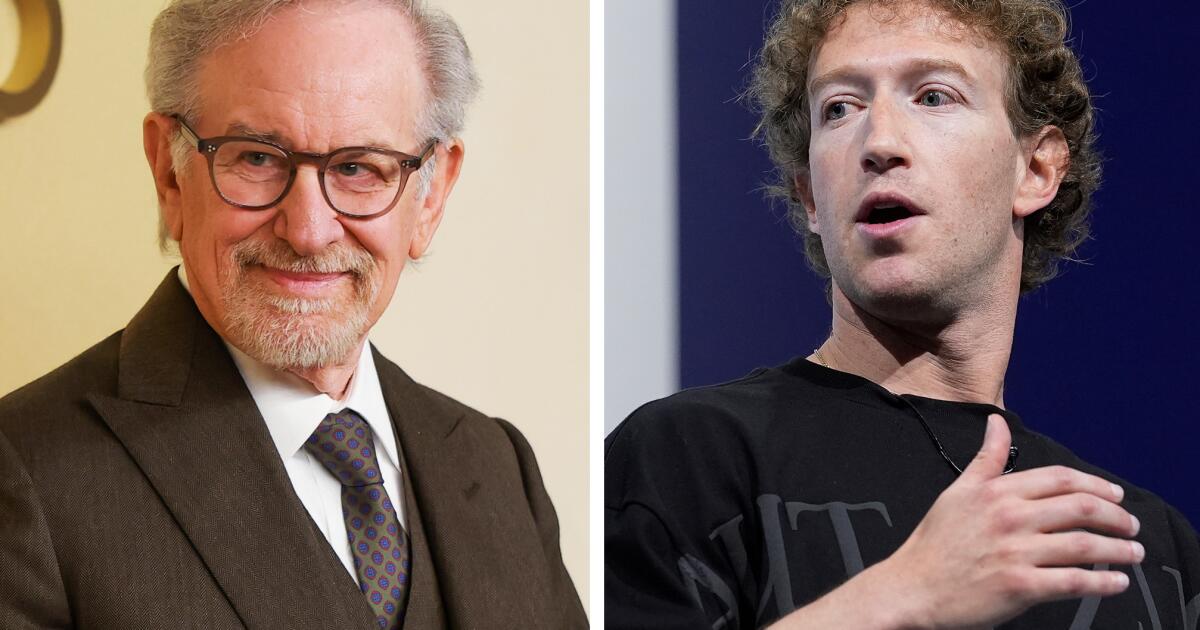
California may be losing two of the state’s most famed residents and generous political donors.
Filmmaker Steven Spielberg recently moved to New York and Facebook co-founder Mark Zuckerberg is eyeing purchasing a new property in Florida, stirring speculation about whether their decisions are tied to a proposed new tax on California billionaires to fund healthcare for the state’s most vulnerable residents.
Although a handful of prominent conservatives who bolted out of California noisily blamed their departure on the controversial wealth tax measure, as well as the state’s liberal ways and what they describe as cumbersome business regulations, neither Zuckerberg nor Spielberg has given any indication that the tax proposal is the reason for their moves.
A spokesperson for Spielberg, who has owned homes on both the East and West coasts since at least the mid-1990s, said the sole motivation for Spielberg and his wife, actor Kate Capshaw, decamping to Manhattan was to be near family.
“Steven’s move to the East Coast is both long-planned and driven purely by his and Kate Capshaw’s desire to be closer to their New York based children and grandchildren,” said Terry Press, a spokesperson for the prodigious filmmaker. She declined to answer questions about his position on the proposed ballot measure.
Director Steven Spielberg presents president Bill Clinton with the Ambassadors Humanity award at the 5th Annual Ambassadors for Humanity Dinner Honoring former President Bill Clinton to support the Survivors of the Shoah Visual History Foundation held at the Amblin theatre Universal Studios on February 17, 2005 in Los Angeles, California.
(Frazer Harrison / Getty Images)
On Jan. 1, Spielberg and Capshaw officially became residents of New York City, settling in the historic San Remo co-op in Central Park West. The storied building is among the most exclusive in Manhattan, having been home to Bono, Mick Jagger, Warren Beatty, Tiger Woods and many other celebrities. On the same day, Spielberg’s Amblin Entertainment opened an office in New York City.
Zuckerberg and his wife, pediatrician Priscilla Chan, are considering buying a $200-million waterfront mansion in South Florida, the Wall Street Journal first reported this month. The property is located in Miami’s Indian Creek, a gated barrier island that is an alcove of the wealthy and the influential, including Amazon founder Jeff Bezos and Trump’s daughter Ivanka and her husband, Jared Kushner.
Representatives for Zuckerberg declined to comment.
The billionaires’ moves raised eyebrows because they take place as supporters of the proposed 5% one-time tax on the assets of California billionaires and trusts are gathering signatures to qualify the initiative for the November ballot. Led by the Service Employees International Union-United Healthcare Workers West, they must gather the signatures of nearly 875,000 registered voters and submit them to county elections officials by June 24.
If approved, the tax would raise roughly $100 billion that would largely pay for healthcare services, as well as some education programs. Critics say it would drive the wealthy and their companies out of the state. On Dec. 31, venture capitalist David Sacks announced that he was opening an office in Austin, Texas, the same day PayPal co-founder Peter Thiel publicized that his firm had opened a new office in Miami.
The proposed ballot measure, if it qualifies for the ballot and is approved by voters, would apply to Californians who are residents of the state as of 2026. But residency requirements are murky. Among the factors considered by the state’s Franchise Tax Board are where someone is registered to vote, the location of their principle residence, how much time they spend in California, where their driver’s license was issued and their cars registered, where their spouse and children live, the location of their doctors, dentists, accountants and attorneys, and their “social ties,” such as the site of their house of worship or county club.
It’s unclear whether the proposal will qualify for the November ballot, and if it does, whether voters will approve it. However, a mass exodus of a number of the state’s billionaires — more than 200 people — would have a notable effect on state revenue, regardless. The state’s budget volatility is caused by its heavy reliance on taxes paid by the state’s wealthiest residents, including from levies on capital gains and stock-based compensation.
“The highest-income Californians pay the largest share of the state’s personal income tax,” according to Gov. Gavin Newsom’s 2026-27 budget summary that was published in January. “The significant share of personal income taxes — by far the state’s largest General Fund revenue source — paid by a small percentage of taxpayers increases the difficulty of forecasting personal income tax revenue.”
This reliance on wealthy Californians is among the reasons the proposed billionaires tax has created a schism among Democrats and is a source of discord in the 2026 governor’s race to replace Newsom, who cannot seek another term and is weighing a presidential bid. He opposes the proposal; Sen. Bernie Sanders (I-VT.) campaigned for it Wednesday evening at the Wiltern in Los Angeles.
“I am not only supportive of what they’re trying to do in California, but we’re going to introduce a wealth tax for the whole country. We have got to deal with the greed, the extraordinary greed, of the billionaire class,” Sanders told reporters Feb. 11.
Zuckerberg and Spielberg are both prolific political donors, though it is difficult to fully account for their contributions to candidates, campaigns and other entities because of how they or their affiliates donate to them as well as the intricacies of campaign finance reporting.
Spielberg, 79, a Hollywood legend, is worth more than $7 billion, according to Forbes. He and his wife have donated almost universally to Democratic candidates and causes, according to Open Secrets, a nonprofit, nonpartisan tracker of federal campaign contributions, and the California secretary of state’s office.
The prolific filmmaker, who won acclaim for movies such as “Schindler’s List,” “Jaws,” “Jurassic Park” and the “Indiana Jones” trilogy, was born in Ohio and lived with his family in several states before moving to California. He attended Cal State Long Beach but dropped out after Universal Studios gave him a contract to direct television shows.
Zuckerberg, 41, launched Facebook while in college and is worth more than $219 billion, making him among the world’s richest people, according to Forbes.
His largest personal federal political donation appears to be $1 million to FWD.us, a group focused on criminal justice and immigration reform nationwide, according to Open Secrets.
Zuckerberg, who is currently a registered Democrat in Santa Clara County, has donated to politicians across the partisan spectrum, including Democrats such as former House Speaker Nancy Pelosi and current Senate Minority Leader Chuck Schumer to Republicans such as President Trump’s Secretary of State Marco Rubio when he ran for the White House and Chris Christie during his New Jersey gubernatorial campaign.
Both men’s personal donations don’t include their other effects on campaign finances — Spielberg has helped countless Democratic politicians raise money in Hollywood; Zuckerberg’s company has made other contributions. Meta — the parent company of Facebook, Instagram and WhatsApp — donated $1 million to Trump’s inauguration committee in December 2024. Zuckerberg later attended the president’s swearing in at the U.S. Capitol Rotunda.
Zuckerberg, born in White Plains, N.Y., created an early prototype of Facebook while at Harvard University and dropped out to move to Silicon Valley to complete the social media platform, as depicted in the award-winning film “The Social Network.”
He still owns multiple properties in California and elsewhere, including a controversial, massive compound on Kauai that includes two mansions, dozens of bedrooms, multiple other buildings and recreational spaces — and an underground bunker that features a metal door filled with concrete, according to a 2023 investigation by Wired. The cost of land acquisition and construction reportedly has topped $300 million.
Meta is based in Menlo Park, Calif., though it has been incorporated in Delaware since Facebook’s founding in 2004.
Times staff writer Queenie Wong contributed to this report.
Movie Reviews
Movie Review: In ‘Midwinter Break,’ a quiet marriage story with Lesley Manville and Ciarán Hinds

Stella and Gerry might not have a bad marriage, but they don’t have especially healthy one either. In the new film “Midwinter Break,” out Friday, these two Irish empty nesters beautifully portrayed by Lesley Manville and Ciarán Hinds have become the embodiment of the words “alone together” in their late 60s and early 70s. She goes to church. He reads, and drinks, and passes out on the recliner. Repeat. But one Christmas Eve, Stella decides to break the monotony: She books a trip for two to Amsterdam, departing as soon as possible. Gerry beams that it’s a fantastic idea and off they go to try to get out of their routine and maybe remember why they made this lifelong commitment in the first place.
An adaptation of a Bernard MacLaverty novel of the same name, “Midwinter Break” is a delicate film that stays in a minor key, but whose impact is profound if you can get on its level. Directed by theater veteran Polly Findlay making her feature debut, the film parachutes the audience into the current state of this relationship, in all its quietly contradictory beauty.
These are two people who have walked through most of their adult lives together, raising a child, living a self-imposed exile in Glasgow and now sort of watching the clock tick down on their lives. The film teases that something violent and traumatic happened many years ago in Belfast, but that they don’t talk about that, or the Troubles, at all.
We gather that nothing quite so dramatic has happened since, but you can see the distress in Stella’s face as she sits down for the nth time to remove the plastic wrap to eat some sandwiches she prepared while Gerry sleeps. It seems both then and now, they’ve opted for a change of location instead of a serious chat about things. But there’s nothing like a new location to bring all that buried discontent to the surface.
One of the loveliest things about “Midwinter Break” is how it lets Stella and Gerry be all things at once. In some moments, they’re loving and intimate, sharing a sweet before their flight takes off, laughing in the red-light district and resting their tired feet in their nice hotel room. Other times, they seem like strangers. Stella has only grown more devout as they’ve gotten older, while Gerry can’t be bothered to even accompany her to church. Later in the film, they’ll both explain why, though not to each other.
Amsterdam in winter is expectedly picturesque, and the film makes sure to have Stella and Gerry out in the fresh air as much as possible visiting real sites around town (though the interiors of the Anne Frank House were a recreation). It’s tempting to draw comparisons to the “Before” series, but Jesse and Celine are a little chattier than these two.
This is a relationship that’s all about the small moments and what’s left unsaid, which is tricky to compellingly execute on film. There aren’t big fights or particularly mean words said: And yet when Stella, nearly shaking with nerves, quietly proposes a possible change to their lives, it feels earth shattering. You’re relieved later when she wants to go out and have some fun; Gerry is too.
This image released by Focus Features shows Ciarán Hinds, right, and Lesley Manville in a scene from “Midwinter Break.” Credit: AP/Mark de Blok
These may just be the ordinary, dull rhythms of a relatively stable relationship, and yet these actors make the mundane so much more. It was a brilliant stroke to let “Midwinter Break,” which could have been deadly in the transition from the page to the screen, rest on these two actors in particular, sharing the big screen for the first time. Our investment in Stella and Gerry raises real questions about long-term commitment, assumptions of stability and the possibility of change. It might also have you planning your own Amsterdam getaway in your head, hopefully with fewer weighted silences on the schedule.
“Midwinter Break,” a Focus Features release in theaters Friday, is rated PG-13 by the Motion Picture Association for “some strong language, bloody images, alcoholism, suggestive material and thematic material.” Running time: 90 minutes. Three stars out of four.

Issue resolved roads back open after police activity forced closure of several roads around downtown

Some of the coldest air in the country is right here in Montana

Kearney Area Animal Shelter announces 2026 Gala featuring ‘The Voice’ finalist Bryan Olesen

State offices on two hour delay due to weather conditions

Lucas: Healey goes for ‘meddle’ of honor over NH ICE move

Florida High School Football Rankings: Top 25 teams – Oct. 21

Cleary's 21 help Le Moyne down Central Connecticut State 69-64 in OT

How old is Bo Nix? What to know about Oregon quarterback ahead of 2024 NFL Draft

99th annual Pony Swim held in Virginia

Indiana Members Credit Union announced as new anchor tenant at Bottleworks District

DC Mayor Bowser declares emergency over Potomac sewage spill, asks for federal help

Israel installed security at Epstein’s Manhattan apartment for ex-PM Barak

Iran and the US lean into gunboat diplomacy as nuclear talks hang in balance

Democrats risk FEMA disaster funding collapse as DHS shutdown hits Day 5

Fact check: Will Spain’s regularised migrants be allowed to vote?
-

 Culture1 week ago
Try This Quiz on Passionate Lines From Popular Literature
-

 Oklahoma2 days ago
Wildfires rage in Oklahoma as thousands urged to evacuate a small city
-

 Health1 week ago
James Van Der Beek shared colorectal cancer warning sign months before his death
-
![“Redux Redux”: A Mind-Blowing Multiverse Movie That Will Make You Believe in Cinema Again [Review]](https://i1.wp.com/www.thathashtagshow.com/wp-content/uploads/2026/02/Redux-Redux-Review.png?w=400&resize=400,240&ssl=1 "“Redux Redux”: A Mind-Blowing Multiverse Movie That Will Make You Believe in Cinema Again [Review]")
![“Redux Redux”: A Mind-Blowing Multiverse Movie That Will Make You Believe in Cinema Again [Review]](https://i1.wp.com/www.thathashtagshow.com/wp-content/uploads/2026/02/Redux-Redux-Review.png?w=80&resize=80,80&ssl=1 "“Redux Redux”: A Mind-Blowing Multiverse Movie That Will Make You Believe in Cinema Again [Review]") Movie Reviews1 week ago
Movie Reviews1 week ago“Redux Redux”: A Mind-Blowing Multiverse Movie That Will Make You Believe in Cinema Again [Review]
-

 Technology1 week ago
HP ZBook Ultra G1a review: a business-class workstation that’s got game
-
 Science1 week ago
A SoCal beetle that poses as an ant may have answered a key question about evolution
-
 Politics7 days ago
Culver City, a crime haven? Bondi’s jab falls flat with locals
-

 Politics7 days ago
Tim Walz demands federal government ‘pay for what they broke’ after Homan announces Minnesota drawdown