Entertainment
'The Phantom Menace' dominated 1999's box office. History has been kinder to it

May 19, 1999, in a galaxy not so far away …
Excitement for “Star Wars” is at an all-time high. The first new film in the beloved series that originally concluded with 1983’s “Return of the Jedi” is about to be released in 2,970 theaters, with a majority starting their first screenings just after midnight. (Ticket sales opened just the week before.)
Audiences have had 16 long years to dream about what George Lucas has conjured up for this new cinematic adventure. But instead of whatever they’d imagined, “Star Wars: Episode I — The Phantom Menace” involves a nefarious trade dispute, myth-altering midi-chlorians and Jar Jar Binks.
And although it becomes, for a while, the second-highest grossing film of all time, the divisive new chapter gains a reputation as one of the worst “Star Wars” movies ever.

The 1999 Project
All year we’ll be marking the 25th anniversary of pop culture milestones that remade the world as we knew it then and created the world we live in now. Welcome to The 1999 Project, from the Los Angeles Times.
Today, “The Phantom Menace” returns to theaters in celebration of its 25th anniversary. In the 19 years since 2005‘s “Star Wars: Episode III — Revenge of the Sith,” the much maligned prequel trilogy has, in many ways, been redeemed.
Just look at how its stars — including Ewan McGregor, Hayden Christensen and Ahmed Best — have been re-embraced by fans in their returns to the franchise in television projects such as “Obi-Wan Kenobi” and “Ahsoka.” Even the actors themselves have voiced appreciation that their original films seem to be regarded more positively. Becoming “more aware of the fondness that the generation that we made the prequels for has for those films … [has] meant a lot to me,” McGregor told NBC News in 2022.
And as the “Star Wars” franchise continues to grow, with upcoming projects including two new series, “The Acolyte” and “Skeleton Crew,” the second seasons of “Andor” and “Ahsoka” and at least two additional films, it has become increasingly apparent just how much of it is built upon a foundation laid down by the prequels. “Star Wars’” most recent successes would not exist if not for “The Phantom Menace.”

“The Phantom Menace” arrived saddled with many expectations. Audiences who grew up on “Star Wars” in theaters or on VHS tapes knew how Darth Vader’s story ended.
“The Phantom Menace” was going to show how it began, something only teased in the original films. Many fans camped outside movie theaters for weeks, just to be among the first to see it. Reports at the time mention that the line outside Westwood’s Village Theatre included about two dozen regulars ages 14 to 40 equipped with couches, recliners, beach chairs, video games and even satellite TV.
“It is only a movie,” The Times reported Lucas insisting during a press event during the lead-up to release. “We have tried hard not to let the film get over-hyped. . . . [It’s] a film for 12-year-olds . . . a Saturday-afternoon serial for children.”

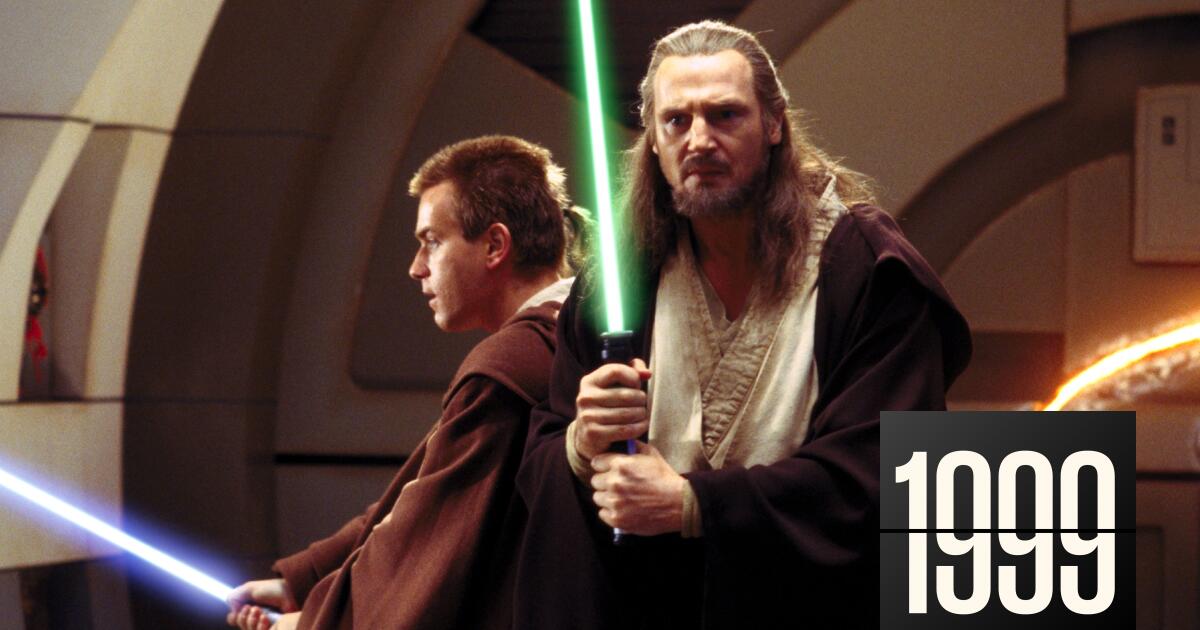
From left, Natalie Portman, Liam Neeson, Jake Lloyd and Ewan McGregor in the movie “Star Wars: Episode I — The Phantom Menace.”
(Keith Hamshere / Lucasfilm Ltd.)
Set roughly 30 years before the events of the original “Star Wars” (which was re-christened “A New Hope” in 1981 after a re-release), “The Phantom Menace” introduced audiences to a 9-year-old Anakin Skywalker (played by Jake Lloyd), a child who would eventually grow up to become Darth Vader.
Anakin’s story begins when a diplomatic mission gone awry brings Jedi Knight Qui-Gon Jinn (Liam Neeson), his apprentice Obi-Wan Kenobi (McGregor), the clumsy and, to some, cringeworthy Jar Jar Binks (Best) and young Queen Amidala (Natalie Portman) to his home planet, Tatooine.
Many critics were underwhelmed. In his review, Times film critic Kenneth Turan described the film as a “considerable letdown” but “certainly adequate.”
It’s “not going to change anyone’s life or method of worship,” wrote Turan. “It’s only a movie, and … a much less impressive one than all the accompanying genuflection would have you believe.” (Lucas, for his part, noted in advance of “Phantom’s” release that the original trilogy got “generally bad reviews” and that he expected the same this time around as well.)
What “The Phantom Menace” did have were state-of-the-art visual effects: Lucas was uninterested in revisiting “Star Wars” until the technology caught up to his vision. The film boasts the first fully computer-generated supporting character in Jar Jar Binks, and regardless of one’s opinion of the character, that is a landmark, paving the way for “The Lord of the Rings’” Gollum and the “Avatar” films.
“The Phantom Menace” also included such memorable sequences as Anakin’s podrace and a lightsaber showdown (referred to by the John Williams theme that accompanies it, the “Duel of the Fates”) between our Jedi heroes and the film’s fantastically designed villain, Darth Maul.
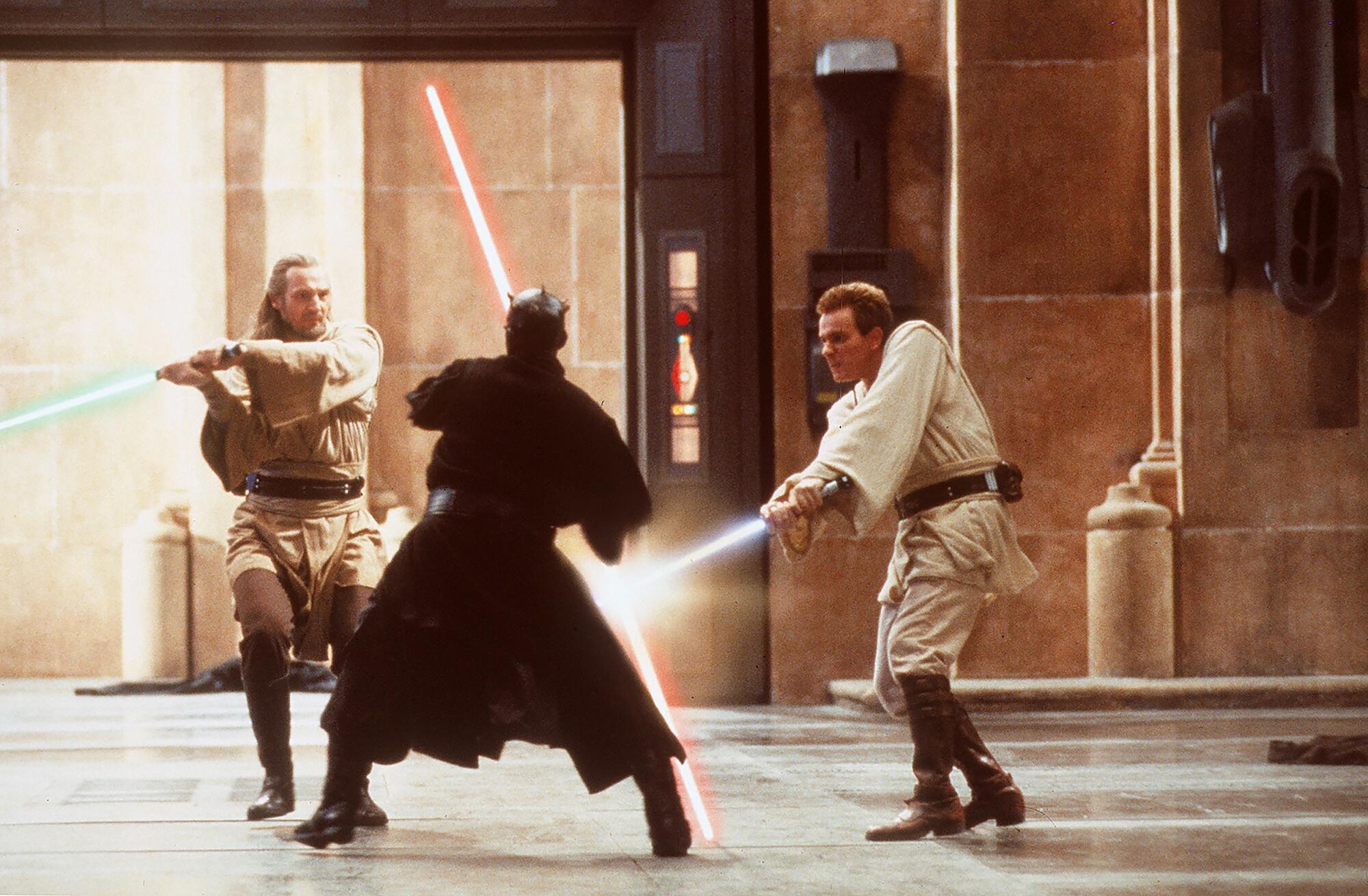
From left, Liam Neeson, Ray Park and Ewan McGregor in the climactic lightsaber duel of “Star Wars: Episode I — The Phantom Menace.”
(Keith Hamshere / Lucasfilm Ltd.)
Still, audiences were much more vocal about the ways “The Phantom Menace” was a disappointment. Criticism of the film included concerns that certain new aliens like the Neimoidians and Gungans appeared to reflect racist tropes. (Lucasfilm rejected those claims as “absurd.”) Any thoughtful responses were drowned out by more vitriolic pushback on everything from the characters and acting to the story and execution.
It was an early glimpse into the darker side of the “Star Wars” fandom — and maybe self-entitled fandom in general. Jar Jar Binks actor Best has been candid about how the negative responses to his character led to his receiving online abuse and death threats. Such bad behavior intensified 16 years later, beginning with the release of the sequel trilogy, which saw stars John Boyega and Kelly Marie Tran becoming targets of racist backlash.
And the newer shows are arriving at a time when “anti-woke” superfans who can’t imagine a “Star Wars” galaxy (one already populated with nonhumanoid aliens) as diverse and inclusive have been increasingly emboldened to make racist and sexist remarks.
Luckily, the “Star Wars” fandom is not defined by that vocal minority.
In recent years, appreciation for “The Phantom Menace” has grown. The 2022 arrival of “Obi-Wan Kenobi,” in particular, had even skeptics reassessing the significance of the prequel trilogy.
“The nostalgia for the prequels can’t redeem those movies in full … But they’re quotable, they’re memeable, and they’re fun to rant against and argue about and rally around,” wrote the Ringer’s Justin Charity.
Part of the reason “The Phantom Menace” has been increasingly embraced is because for a generation of fans, “Episode I” was their first “Star Wars” experience. They‘re now old enough to defend what was to them just as foundational as seeing “Star Wars” in a theater was for kids in 1977.
The prequel films have also been further recontextualized by additional storytelling. Series like the animated “Star Wars: The Clone Wars,” set in the years between the events of “Attack of the Clones” (2002) and “Revenge of the Sith,” have fleshed out the universe. Live-action shows like “The Mandalorian” and “The Book of Boba Fett” have drawn on lore established in the prequel-era stories — with success.
The “Obi-Wan Kenobi” series revisits McGregor’s version of the title character for a glimpse at how the man at the end of “Revenge of the Sith” became the one in “A New Hope” (portrayed by Alec Guinness). Concepts like cloning and even midi-chlorians, the micro-organisms with ties to the Force first mentioned in “The Phantom Menace,” have also endured: The only reason the Mandalorian and Grogu even cross paths is because the remnants of the Empire are so interested in the latter’s midi-chlorian count.
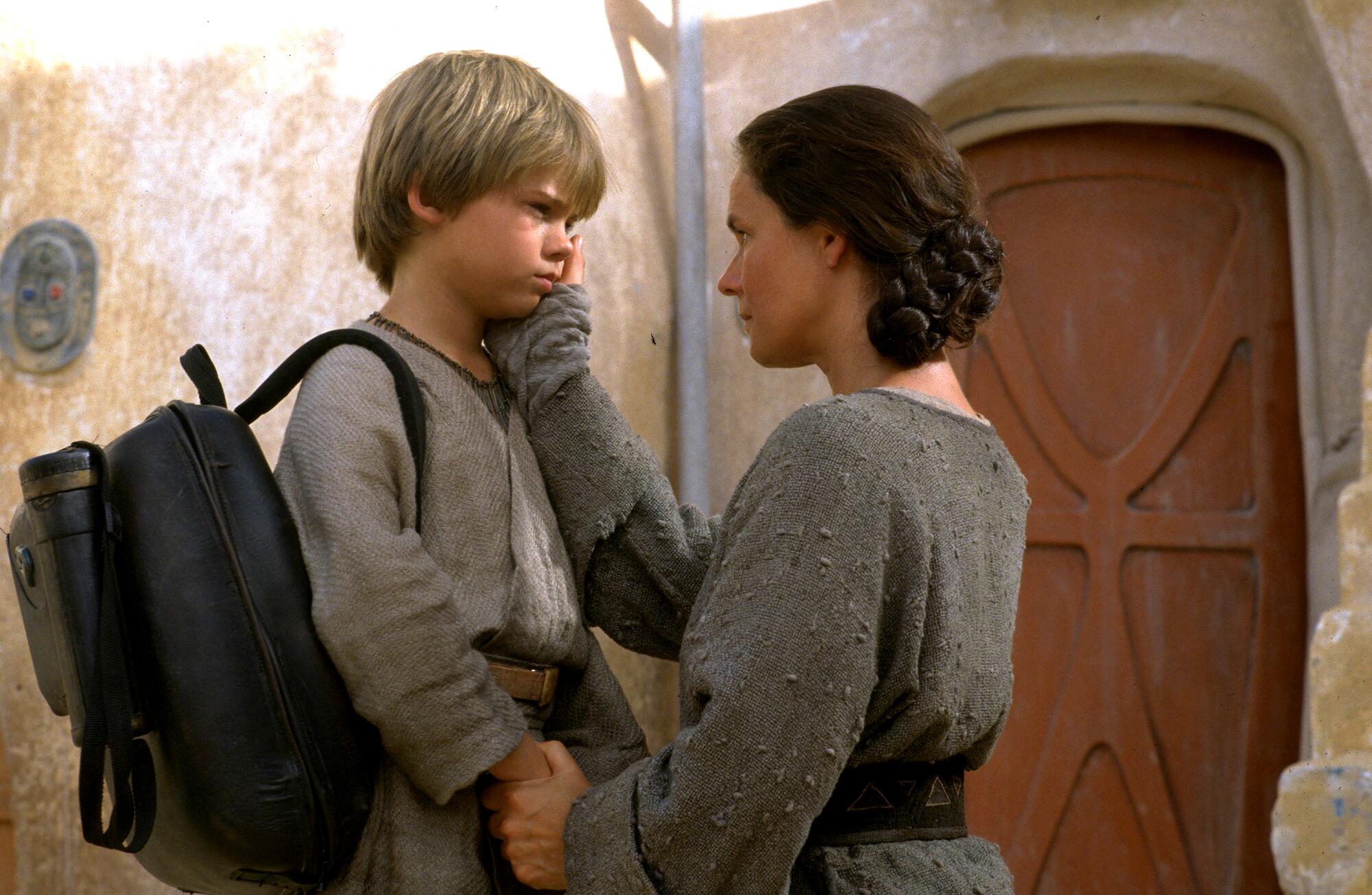
Jake Lloyd and Pernilla August in “Star Wars: Episode I — The Phantom Menace.”
(Lucasfilm Ltd.)
In a larger sense, even shows like “Andor” can trace their DNA to the prequels, by being unafraid to enter into what is considered canon and challenge the assumptions of what is expected of a “Star Wars” story. The franchise has increasingly become one large tapestry where new titles build upon and reframe what came before — not a collection of three classics “owned” by gatekeeping fans. And while subsequent projects do not actually change the quality of past installments, they do sometimes lead to reassessment.
“The Phantom Menace” is also a precursor — for good and ill — of today’s modern media landscape of sprawling IP and interconnected universes like the Marvel Cinematic Universe, DC Universe and even Godzilla’s Monsterverse. Lucas’ enormous box office success not only made an eventual sequel series an inevitability but it also signaled to others that there were possibilities in revisiting dormant worlds to attract new audiences.
The bar for “The Phantom Menace” was set impossibly high — not necessarily by the films of the original trilogy but the audience’s relationship with them. But “Star Wars” movies are special because of their potential to make people fall in love with storytelling just as much as the world itself.
And for a generation that grew up on the prequels, “The Phantom Menace” did just that.



The Times of India
TNN, Jan 15, 2026, 11:11 AM IST
3.0
Thalaivar Thambi Thalaimaiyil Movie Synopsis: A village panchayat member tries to broker peace when a wedding and a funeral collide on the same morning.Thalaivar Thambi Thalaimaiyil Movie Review: Nothing strips civilization off grown men faster than a scheduling conflict. Thalaivar Thambi Thalaimiyil understands this. It parks us in a remote village for one long night where two neighbors go to war over whose event gets the morning slot, and watches as every attempt at reason bounces off their egos like rubber balls off concrete.Jeevarathinam (Jiiva) is the local panchayat head, summoned to oversee a wedding. The bride’s father (Ilavarasu) treats the whole affair like a personal coronation. Next door, an old man dies, and his son Mani (Thambi Ramaiah) decides mourning means asserting dominance. Both want 10:30 AM. Neither will move. Jeevarathinam tries to mediate, fails, tries again, fails again. The man cannot land a single compromise.Nithish Sahadev, making his Tamil debut after the well-received Malayalam film Falimy, makes an interesting call with Jiiva’s character. Jeevarathinam isn’t portrayed as bumbling or clueless. He’s smart, reasonable, level-headed in conversation. The problem is that when situations escalate beyond discussion, when Mani starts swinging a giant sickle in the air and someone needs to physically put him down, Jeevarathinam just... doesn’t. He’ll talk, he’ll reason, he’ll negotiate. But that extra step required to actually resolve things is not in his toolkit. It’s a curious limitation to build a protagonist around, and while it generates some dry humor, you do wonder if the film needed him to be quite this passive for quite this long.The laughs come through texture rather than big setups: a reaction held just long enough, the specific cadence of village dialect landing a punchline, two patriarchs puffing their chests like they’re settling ancient blood feuds when they’re really arguing about procession routes. The director understands that comedy lives in small beats, even when the material itself rarely surprises.Jiiva commits to the energy without overplaying it: a man who keeps hitting walls he won’t climb over. Ilavarasu and Thambi Ramaiah deliver their usual reliable work. TTT draws considerable mileage from its rotating cast of village characters. The groom and his brother have an amusing accent they really play up. Mani’s bedridden father gets a couple of funny moments before shuffling off. Jenson Dhivakar is a total weasel, meaning he did his job. A lot of small characters perform one or two well-timed bits before fading into the background. Not all of it lands, but enough does.TTT asks for too much credit eventually. Once a woman chases a persistent suitor into the forest with a blade, once shotguns emerge, once ruffians lob homemade grenades at wedding decorations, the make-believe world you’d accepted tips into something sillier than it can support.You likely won’t recall much of the film in a few days, but it is a good festival watch. There’s craft in knowing your lane and staying in it.Written By: Abhinav Subramanian

Timothy Busfield made a first appearance in New Mexico court Wednesday as prosecutors detailed a new sexual abuse accusation against the Emmy-winning actor.
Busfield, 68, has been charged with two felony counts of criminal sexual contact of a minor and a single count of child abuse for allegedly inappropriately touching two child actors while he worked as a director and executive producer on the Fox drama “The Cleaning Lady,” filmed in Albuquerque. He was held without bond pending a hearing on a motion for pretrial detention.
In that motion, prosecutors argued Busfield should be jailed pending trial due to what they called “a sustained pattern of predatory conduct” that they said dated to at least 1994. That year, a 17-year-old extra on the film “Little Big League” accused Busfield of sexually assaulting her in a lawsuit filed in Los Angeles Superior Court that was later settled privately, the motion states.
Most recently, a man named Colin Swift reported to law enforcement on Tuesday that, years ago, Busfield sexually abused Swift’s then-16-year-old daughter during an audition at B Street Theatre in Sacramento, the motion states. Swift alleged that Busfield begged the family to not report the abuse to law enforcement if he received therapy, and they initially agreed, the filing states.
No charges have been filed against Busfield in connection with that incident.
Busfield founded B Street Theatre as a touring company called Theatre for Children Inc. in 1986, according to its website. Although he is listed as an emeritus board member, he has not participated in the organization since 2001, and the incident recently reported to police is alleged to have taken place there about 25 years ago, according to a statement from B Street Theatre. The theater has retained legal counsel to conduct an internal investigation, the statement said.
Prosecutors allege Busfield’s conduct “reflects a calculated pattern of grooming, lack of boundaries, and exploitation of professional authority to gain access to minors,” according to the motion for pretrial detention. Witnesses have said they fear retaliation and career harm for speaking out against him, demonstrating “how individuals in positions of power are able to silence victims and witnesses, allowing abuse to persist unchecked,” they wrote.
A representative for Busfield could not be reached Wednesday. His attorney Stanton “Larry” Stein previously said in a statement that the actor is innocent and “determined to clear his name.” He also referenced an affidavit in which Busfield suggested to investigators that the child actors’ mother might have sought “revenge” on the director for “not bringing her kids back for the final season.”
The actor, known for his work on television series “The West Wing” and “Thirtysomething,” turned himself in Tuesday, which prosecutors allege was five days after he knew a judge had issued a warrant for his arrest. During that time, Busfield traveled from New York to New Mexico to avoid the extradition process and surrender at a convenient time, the motion alleges.
He was booked into the Metropolitan Detention Center in Albuquerque, where he remained Wednesday.
Busfield is accused of inappropriately touching the two child actors, who are brothers, on the set of “The Cleaning Lady,” according to an affidavit. Their mother reported the abuse took place from November 2022 to spring 2024, according to the complaint. Police launched an investigation in November 2024 after being notified of the alleged abuse by a doctor at the University of New Mexico Hospital.
According to prosecutors, “Cleaning Lady” producer Warner Bros. conducted an investigation into Busfield’s behavior in February 2025 after the Screen Actors Guild-American Federation of Television and Radio Artists hotline fielded an anonymous complaint that the director entered a trailer on the set and kissed a 6-year-old boy on the face while he was getting a haircut. Another caller to the hotline claimed that, in September 2024, Busfield asked a parent to wait outside and took a minor — one of the alleged victims in the New Mexico case — behind closed doors for an audition at the Cinelease Studios office in Albuquerque, according to the motion.
A third-party investigator retained by Warner Bros., however, found no evidence that Busfield had been alone with the brothers on set or engaged in other inappropriate conduct, according to a statement from the investigator released by Stein, Busfield’s attorney. But the investigator failed to speak with one of the victims and his parents, as well as key witnesses, prosecutors allege in the motion.
Warner Bros. Television said in a statement that it takes all misconduct allegations seriously and has cooperated with law enforcement by expediting the sharing of the report by its third-party investigator, which it could have withheld as privileged. The studio has a clear non-retaliation policy to ensure employees feel comfortable reporting concerns, the statement said. “Our top priority is the health and safety of our cast and crew across all productions,” it said.
Busfield, who is married to actor Melissa Gilbert, was also accused of battery in March 2012 by a 28-year-old woman who said he sexually assaulted her in a Los Angeles movie theater, but prosecutors declined to file charges due to “slim evidence,” according to the motion for pretrial detention.
The hearing on the motion, during which a judge will decide whether Busfield remains in jail, will be scheduled in 2nd Judicial District Court in Albuquerque within the next five business days, said Camille Cordova, a public information officer for the Bernalillo County Metropolitan Court.
Before he surrendered, Busfield recorded a video at his attorney’s office in which he denied the allegations. “I’m gonna confront these lies,” he said in the video published by TMZ, “they’re horrible.”
Prosecutors called the move “troubling” and said it demonstrated “a willingness to prioritize personal narrative control and public relations” over complying with court processes.
Times staff writer Alexandra Del Rosario contributed to this report.

Jodie Foster plays a self-assured psychoanalyst whose composure unravels after a patient unexpectedly dies in the genre-bending French film “A Private Life.”
Rebecca Zlotowski’s latest, in theaters Friday, is part noir, part comedy of remarriage, and part Freudian fever dream about past lives.
This is a film that does not abide by rules or play into any easy expectations about what it should be, resulting in big swings, tonal shifts and even a lurking Holocaust through-line. Also, oddly enough considering such grave themes and subjects, it’s all done with a relatively light touch set, in part, by the cheeky needle drop at its opening: the Talking Heads song “Psycho Killer.” Some parts work better than others, but you can’t help but admire the go-for-broke originality and unabashed femininity of it all. And anchoring it all is Foster, using the full force of her star power and impeccable French to make “A Private Life,” unwieldy and complex as it is, go down as easy as a glass of gamay.
Foster’s character, Dr. Lilian Steiner, is an American expat living and working in France. She’s an accomplished, sophisticated woman who believes she has a grasp on people and the world around her, recording and cataloging all her private sessions with clients on meticulously organized CDs. This act in and of itself is a little odd — her son wonders why she doesn’t just use a more modern method, for instance. But it also kind of gets to the heart of why, perhaps, despite her evident intelligence, there’s a cold disconnect between analyst and subject. Is she even listening to them?
Lilian starts to wonder this herself after she receives a call that her client Paula ( Virginie Efira ) has died by suicide. Paula was not someone she believed was capable of this. Instead of looking inward, she goes back to the tapes to begin an amateur investigation to find some other explanation: It must be murder, she concludes. Suspects include Paula’s daughter Valérie (Luàna Bajrami) and husband Simon (Mathieu Amalric).
She also enlists a sidekick in her sleuthing, her ex-husband Gabriel (a delightful Daniel Auteuil ) who is more than happy to go along for the ride, to listen to her conspiracy theories over several bottles of wine, to be a decoy distraction so that she can snoop through Simon’s house, and, ultimately, to just be there for her, no matter how unhinged she’s becoming. You can just see the love and admiration in his attentiveness. He’s not off put by the crazy; it’s just part of what makes her, well, her. Their rekindled relationship, so effortlessly lived in, so mature, so fun, is by far the highlight of “A Private Life.”
It’s a shame that their romance is basically a side show to the more convoluted rest, which involves a hypnotist and a revelation of a past life in which Lilian and Paula were members of the same WWII-era orchestra and lovers torn apart by jealous exes and Nazis. One of those Nazis is Lilian’s son (Vincent Lacoste), which she awkwardly, drunkenly tells him at his birthday dinner to try to explain why they’ve never been that close. She’s also completely disinterested in her grandchild, which might be one “let’s unpack that” too many in this film. In other words, there’s a lot going on in “A Private Life,” which Zlotowski co-wrote with Anne Berest.
This image released by Sony Pictures Classics shows Jodie Foster, left, and Virginie Efira in a scene from “A Private Life.” Credit: AP/Jérôme Prébois
One thing there’s not enough of is Efira. She gets some moments in flashback, but most of them teeter on the “dead wife montage” cliche. It’s not that Zlotowski wasn’t aware of what she had in Efira (case in point, their poignant, tender work together in “Other People’s Children”), but perhaps she was counting on our familiarity to fill in the gaps.
“A Private Life” is ultimately Foster’s show anyway and she seems to relish the tricky assignment. The tone around her might be on the lighter side, but for Lilian, the stakes are grave with the very essence of her self-worth and life’s work on the line. It’s a fascinating portrait of a woman essentially forced to rethink and revise all of the rules she’d lived by, the facts that she made sense of the world with and submit herself to the idea that some things might just be unknowable — even for a know-it-all psychoanalyst.
“A Private Life,” a Sony Pictures Classics release in theaters Friday, is rated R by the Motion Picture Association for “language, graphic nudity, brief violence, some sexual content.” Running time: 105 minutes. Three stars out of four.

Penn Township fires finance director after about 5 months on the job
Focused on Fitness | Ithaca College

Thalaivar Thambi Thalaimaiyil Movie Review: Familiar romp with enough comic spark

Iran warns of retaliation if Trump strikes, US withdraws some personnel from bases
Julio Iglesias accused of sexual assault as Spanish prosecutors study the allegations

Florida High School Football Rankings: Top 25 teams – Oct. 21

Cleary's 21 help Le Moyne down Central Connecticut State 69-64 in OT

How old is Bo Nix? What to know about Oregon quarterback ahead of 2024 NFL Draft

99th annual Pony Swim held in Virginia

Video: ‘It Didn’t Have to Happen This Way:’ U.Va. Faculty Call for Review of Police Response to Protests

Hochul endorses legislation to allow New Yorkers to sue ICE agents: ‘Power does not justify abuse’

Iran reopens airspace after closure to most flights amid US attack threats

Trump says he’s been assured Tehran has stopped killing protesters as Iran reopens its airspace – live

Republicans light cigars, cigarettes on burning photos of Khamenei to show support for Iranian protesters

EU Parliament questions defence loan’s ‘€17 billion gift’ to Hungary
-

 Montana4 days ago
Service door of Crans-Montana bar where 40 died in fire was locked from inside, owner says
-

 Technology1 week ago
Power bank feature creep is out of control
-

 Delaware6 days ago
MERR responds to dead humpback whale washed up near Bethany Beach
-

 Dallas, TX6 days ago
Anti-ICE protest outside Dallas City Hall follows deadly shooting in Minneapolis
-

 Dallas, TX1 week ago
Defensive coordinator candidates who could improve Cowboys’ brutal secondary in 2026
-

 Education1 week ago
Video: This Organizer Reclaims Counter Space
-

 Virginia5 days ago
Virginia Tech gains commitment from ACC transfer QB
-

 Iowa1 week ago
Pat McAfee praises Audi Crooks, plays hype song for Iowa State star