

Entertainment
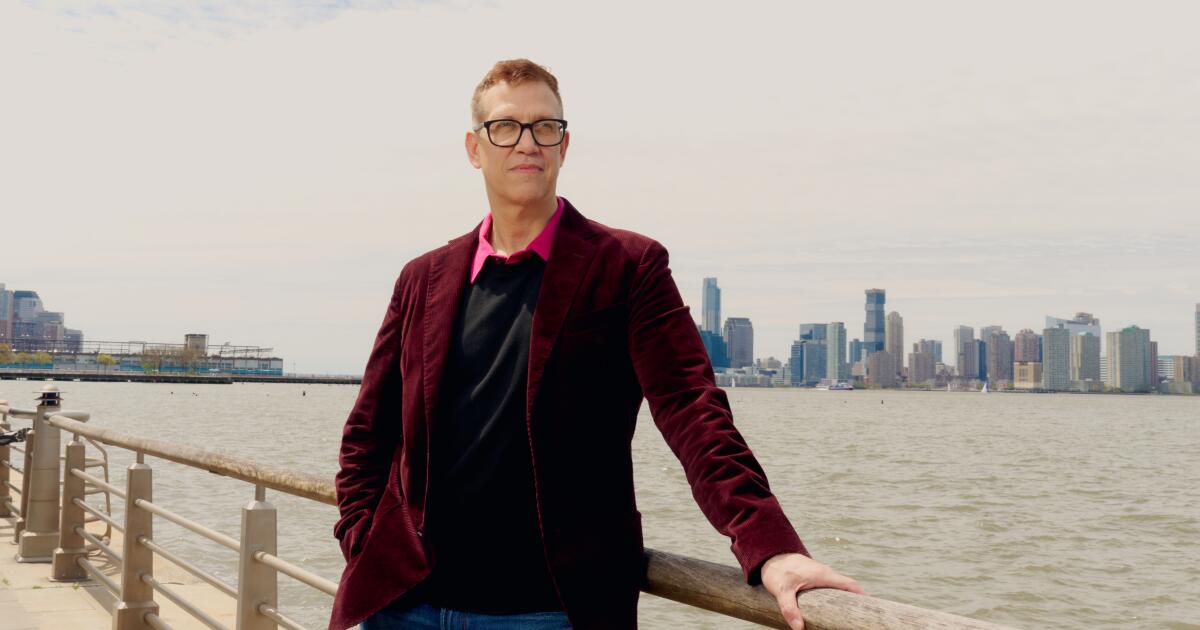
That time Meryl Streep reached out and said she wanted to work with me
“Hey, we just got this email — Meryl Streep wants to Zoom with us about working together. Should we tell her, ‘Well, you know, we do have this TV show’?”
“Um, yes, sure, absolutely, yes, of course??!”
This was an exchange between Steve Martin, Martin Short and me. A few days later came the text: “Hey, we just Zoomed with Meryl. She’s in. Do you have something good for her?”
I really hope Meryl knows what can happen to people when she says she wants to do your project. For me, it was a thunderbolt of thrill followed by pure abject terror that we might disappoint or “not have something good for her.”
The thing I clung to was that a few days before that first reach-out from Meryl, I’d spent a day with [executive producers] Dan Fogelman and Jess Rosenthal brainstorming big-picture ideas for Season 3. We talked about opening it all on a new character, a potential love interest for Oliver Putnam, and how we could show the life of a New York City actress who is so talented but spent decades hoping for something that never came — a career-changing break. I remember saying to Dan and Jess, “Well, you know who the perfect person to cast here is, right? The most celebrated actress of our time playing this part. I mean … right?” The guys looked at me, “Yeah, John, that’s right. Let me know how that works out.”
Meryl Streep plays Loretta Durkin, an actress who finds a career boost and a love interest in Martin Short’s Oliver Putnam in Season 3 of “Only Murders in the Building.”
(Patrick Harbron / Hulu)
Like most of us who’ve worked in this business (and like Loretta Durkin, this new character we were now going to tailor for Meryl), I’ve had a career of many whopper disappointments. Getting close after years — writing, researching, pouring my heart into a screenplay or pilot — only to have it end with a “Nope, not gonna happen.” I’m not in any way “pie in the sky” about these realities, but I also recognize and actually trust in a belief that sometimes good things happen in ways that feel predetermined and fateful. With this third season of our half-hour comedy, that seemed to keep happening over and over and over again. No matter how many times we pushed — OK, maybe I pushed — toward the potential, it could also all go careening off the cliff.
We were given the gift of a dream cast for a half-hour television comedy with mysterious twists and turns, and we decided that if Oliver Putnam’s character was steering the ship — as he had to be in this season, to save his beloved return to Broadway — we had to swing like Oliver would, by turning his shot into a musical. We decided to triple down on the shot we were given.
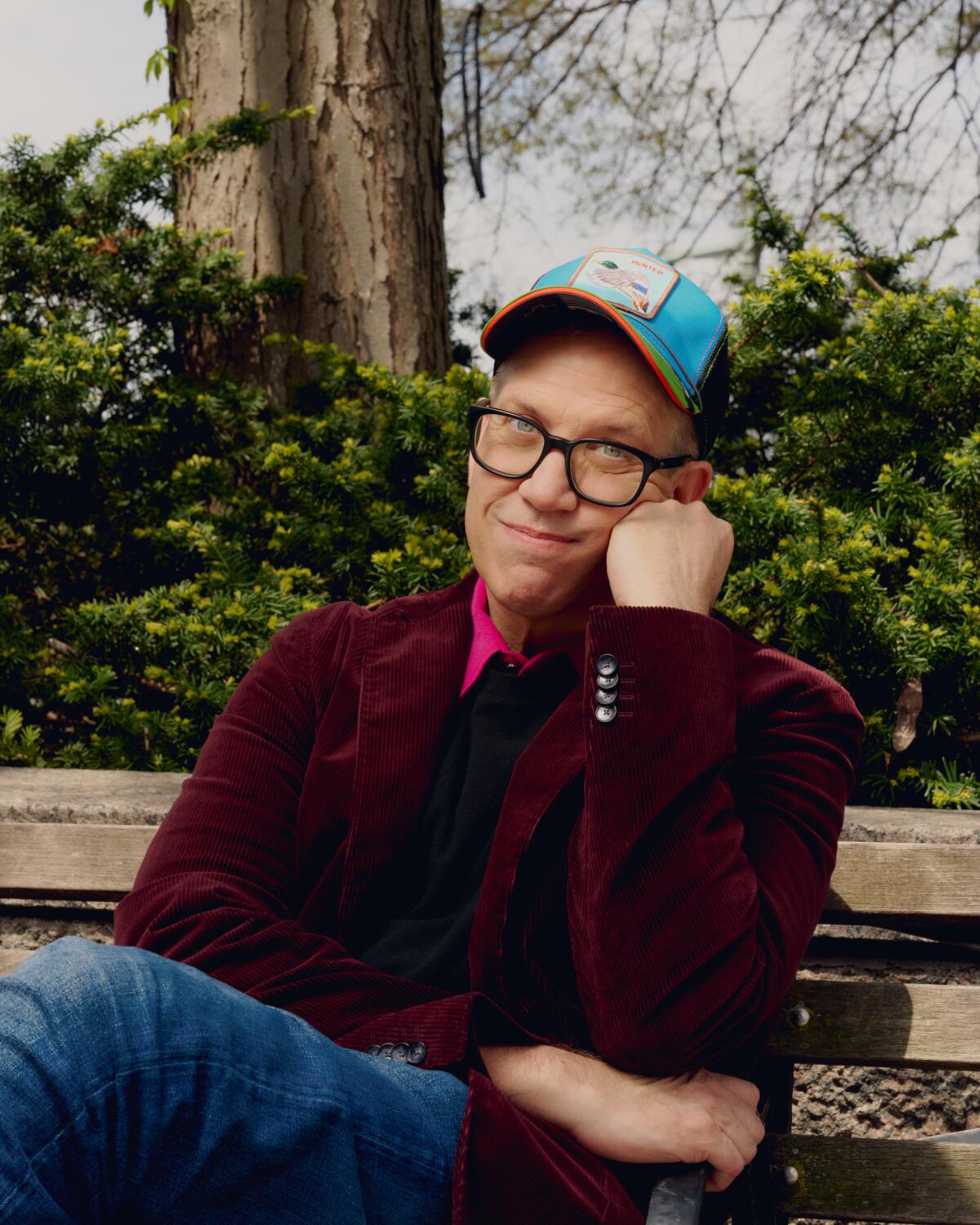
With “Only Murders in the Building’s” all-star cast, how can you not take a big swing? says showrunner John Hoffman.
(Evelyn Freja / For The Times)
“Yes, you’re going to sing too, Meryl. And Steve. And Marty. And Selena [Gomez], you’re not getting out of this; we have a fantasy number for Mabel. And Paul Rudd.” I remember Paul’s face when I told him he’s going to have a big, climactic duet with Meryl even though his character is dead. “Does that sound too crazy?” I held my breath, hoping he wouldn’t run out of the room. Instead, he got that glint we all love in his eye: “I’m going to sing with Meryl Streep? That may be the best sentence I’ve ever said out loud.”
By another twist of fate, Sas Goldberg, with whom I would co-write our first episode of the season, was close friends with my big-wish pick for composers of the musical within our show, Benj Pasek and Justin Paul. They hopped aboard via one text from Sas. Then they brought along their own murderers’ row of Broadway friends to help, in Marc Shaiman and Scott Wittman, Michael R. Jackson and Sara Bareilles. Are you kidding me?
At some point while filming in the stunning United Palace theater New York’s Washington Heights, I was sitting in the middle of the orchestra when Meryl came by in a preposterously delightful small chapeau (her nanny costume for the musical), and she sat down beside me and said, “Boy, you really like a big swing, don’t you?” I think I laughed, and then I said what feels maybe like the point of this essay: “Well, what’s the point of having you and this bonkers group of super-talents all in one season if you’re only gonna go for a base hit?”
Buoyed by a strong touch of the fates and a colossal collection of madly talented support, we all took a swing together — and that “something good for her” became “something we’ll all never forget and loved making so damn much as we made it sing.”
Movie Reviews
Review | Paper Tiger: Adam Driver and Scarlett Johansson lead dark gangster movie
3.5/5 stars
The American filmmaker started his career with 1994’s Little Odessa, starring Tim Roth as a Russian-Jewish hitman operating in the Brighton Beach area of New York. His next two films, The Yards (2000) and We Own the Night (2007), kept him ensconced in the world of low-life criminals.
Paper Tiger also casts the Russian mob as the antagonists. Set in 1986 in Queens, New York, it stars Miles Teller and Adam Driver as the Pearl brothers, Irwin and Gary.
Irwin (Teller), an engineer, is married to Hester (Scarlett Johansson) and has two teenage sons: Scott (Gavin Goudey), who is about to turn 18, and the younger Ben (Roman Engel), who is diligently studying for his exams.
Gary (Driver), a former policeman who still has connections on the force, encourages Irwin to team up and create an environmental clean-up business involving the filthy Gowanus Canal.
Entertainment
Pedro Pascal goes undercover for ‘Star Wars’ surprise at Disneyland
Pedro Pascal took his “Star Wars” character to the streets on Saturday, going undercover as the Mandalorian to surprise Disneyland guests aboard the Millennium Falcon: Smuggler’s Run attraction.
A video posted on Disney’s social media showed the actor in full costume, then lifting his helmet to reveal himself.
“Now you all have to die because you’ve seen my face,” he joked to the stunned parkgoers.
After the surprise, Pascal posed for pictures with the dozen or so fans.
Pascal was later joined by co-star Sigourney Weaver, director Jon Favreau and LucasFilm President Dave Filoni at Galaxy’s Edge, the 14-acre “Star Wars”-themed section of the park modeled after an outpost on the fictional planet of Batuu.
The appearance was part of the press tour for “The Mandalorian and Grogu,” a spinoff of the Disney+ series “The Mandalorian.” The film, which releases on May 22, is the first “Star Wars” movie to hit theaters since 2019.
Movie Reviews
‘Avedon’ Review: Ron Howard’s Admiring Profile of Groundbreaking Photographer Richard Avedon Embraces His Genius, Flair and Mystery
For Richard Avedon, as with most significant artists, work and life were inseparable. When the photographer died in 2004, at 81, he was on the road, mid-project — “with his boots on,” in the words of Lauren Hutton, one of the many beautiful people he helped to immortalize over a 60-year career. Hutton and the two dozen or so other interviewees in Ron Howard’s admiring documentary make it clear how much affection the New York native inspired while reinventing fashion photography and putting his iconoclastic stamp on fine-art portraiture.
The profile Avedon paints is that of a relentless seeker and high-flying achiever, and a deliciously unapologetic contrarian. How can you not adore an image-maker who says, “Beautiful lighting I always find offensive,” and, regarding little kids as potential photographic subjects: “I find them intensely boring.” Avedon’s interest in the grown-up human face, in what it conceals and reveals, was his lifelong project, one that he pursued within circles of rarefied fame, on the backroads of the American West, and in a poignant late-in-life connection with his father.
Avedon
The Bottom Line A solid mix of glitz and angst.
Venue: Cannes Film Festival (Special Screenings)
Director: Ron Howard
1 hour 44 minutes
As confrontational as his images could be, the camera was Avedon’s way of experiencing the world, a way of seeking truth through invention. Howard, whose previous doc subjects include Jim Henson and Luciano Pavarotti, and whose fiction movies are designed more to engage rather than to confront, seems particularly inspired here by Avedon’s auteur approach to still photography — it was a narrative impulse, not a documentary one, that shaped his vision, a drive to create moments and mise-en-scènes for the camera.
Avedon built his career at magazines in an era when magazines mattered. He was only 21 when he joined Harper’s Bazaar, where he stayed for 20 years, leaving to follow fashion editor Diana Vreeland to Vogue, where he stayed even longer. And when Tina Brown took the helm at The New Yorker and overturned its age-old no-photos policy, she hired Avedon as its first staff photographer.
When Harper’s sent him to Paris in 1947 with an edict to summon some of the battered capital’s prewar glamour, he turned to movies for inspiration and conjured visions of romantic fantasy amid the ruins. It was his first significant assignment, and a turning point for fashion photography. The doc emphasizes how, at a Dior show, the images he captured of the designer’s voluminous skirts mid-twirl expressed an ecstatic moment after years of wartime rationing. “People were weeping,” recalls Avedon, a vivid presence in the doc thanks to a strong selection of archival material.
The kinetic energy of those shots would become a defining element of his approach. Injecting movement and a theatrical edge into fashion photography, he lifted it out of the era of posed mannequins. To get models into the spirit of his concepts, he often leapt and danced alongside them. It’s no wonder that in Funny Face, the romantic musical loosely inspired by his career and first marriage, Fred Astaire played the photographer. Eventually Avedon shifted to a large-format camera, an 8×10, that allowed him to interact with his subjects directly, rather than through a viewfinder. There would be more scripted and carefully choreographed moments in his TV spots for Calvin Klein jeans and Obsession, collaborations with the writer Doon Arbus (daughter of Diane and Allan Arbus) that took chances (and which, for some viewers, are inseparable from memorable spoofs on SNL).
Fashion and advertising were mainstays, but he also became a notable portraitist. Positioning his subjects against a plain white background, he removed flattery from the equation. It was an artist-subject relationship in which he held all the power, and he didn’t pretend otherwise; on that point, Brown offers a trenchant anecdote. Remarkably, even though his refusal to sugarcoat was well established — not least by his notorious photo of the Daughters of the American Revolution — an Avedon portrait carried such cachet that establishment figures including the Reagans, Henry Kissinger and George H.W. Bush all submitted themselves to his crosshairs.
The film suggests that a moral imperative was as essential to Avedon’s work as his unconventional aesthetic vocabulary. He threatened to sever his contract with Harper’s when the magazine didn’t want to publish his photos of China Machado, and he prevailed: In 1959, she became the first model of color to appear in the editorial pages of a major American fashion magazine. Howard looks beyond the catwalks and salons to Avedon’s portraits of wartime Saigon, Civil Rights leaders and patients at Bellevue, many of those images collected in Nothing Personal, the book he did with James Baldwin, a friend from high school. A superb clip from a D.A. Pennebaker short of the book launch encapsulates the painfully awkward disconnect between the artist and the corporate media contingent. Most surprising, though, is how hard Avedon took it when the book was lambasted by critics. A later book, In the American West, would also meet harsh criticism; Avedon was, in the eyes of some, a condescending elitist.
Howard’s film is a celebration of a complicated man. It acknowledges Avedon’s naysayers, as well as his struggles and doubts, but this is very much an official story, made in association with the Richard Avedon Foundation, and steering clear of the disputed 2017 biography by Avedon’s business partner. The commentary, whether from models (Hutton, Isabella Rossellini, Twiggy Lawson, Penelope Tree, Beverly Johnson) or writers (Adam Gopnik, John Lahr, Hilton Als) or Avedon’s son, John, can be gushing, but it’s always perceptive.
The connection he sought with his subjects wasn’t about star worship but the instant when the ego lets down its guard, yet at the same time he was more interested in what he called “the marriage of the imagination and the reality” than straight documentation. Without putting too fine a point on it, Avedon links those twinned yet seemingly contradictory impulses to certain formative experiences. There was the devastation of extreme mental illness for Avedon’s sister and his second wife. There was the pretense of happiness in his childhood home in Depression-era New York (the city is captured in terrifically evocative clips). He recalls, discerning and exasperated, the staged domestic harmony — “the borrowed dogs!” — in family photos.
Avedon doesn’t aim to unsettle, like Avedon himself did, but neither does it tie things up neatly. There’s nothing simple or reductive about the emotional throughlines the documentary traces. It embraces the complexities of a man who turned artifice into a kind of superpower, whether he was dreaming up scenarios for fashion spreads or confronting an America as far removed from haute couture Manhattan as you could get.
-
News7 minutes agoThe Supreme Court avoids taking up a fight over Voting Rights Act enforcement for now
-
New York2 hours agoHow a Web Developer Lives on $45,000 in Far Rockaway
-
Los Angeles, Ca2 hours agoSanta Monica kidnapping suspect in custody after early-morning pursuit, officer-involved shooting
-
Detroit, MI2 hours ago5 players who could help Detroit Lions in NFL free agency
-
San Francisco, CA2 hours agoSan Francisco forward David Fuchs commits to Clemson out of NCAA transfer portal
-
Dallas, TX2 hours agoWhataburger revives iconic A-frame design at new Texas restaurants
-
Miami, FL3 hours agoAi’King Hall’s Recruiting Flip to Miami Signals Concerning Oregon Trend
-
Boston, MA3 hours agoSexual assault trial of Alvin Campbell, Massachusetts attorney general’s brother, begins today
