Entertainment
Teri Hatcher splits with dating apps after Hinge found her account 'too good to be true'

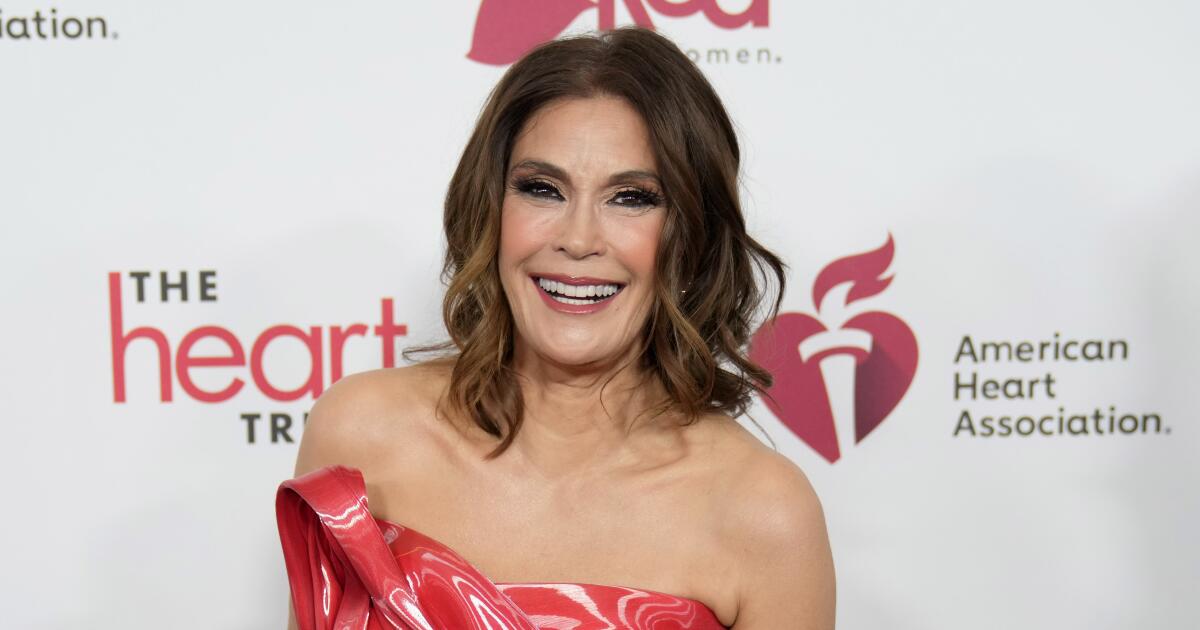
“Desperate Housewives” star Teri Hatcher is breaking up with dating apps after one platform suspected the actor of impersonating herself.
The Emmy-nominated actor revealed in a recent episode of HSN’s “Getting Grilled With Curtis Stone” that she turned to dating app Hinge to meet new people. However, after signing up, she claims she was swiftly booted off the platform as a potential “catfish” — someone who uses an identity other than their own to entice another person into a relationship.
“Well, they thought I was pretending to be Teri Hatcher,” she said.
Hatcher, also known for the TV series “Lois & Clark: The New Adventures of Superman,” said she filed a complaint to Hinge about the lockout and requested a refund. The Hinge team apologized, but she has since gotten over finding love on the apps.
“We’re so sorry, Teri! Some people thought you were too good to be true,” Hinge said in a December 2021 X response to the actor, before referencing her brief stint on “Seinfeld.” “Shoot us an email … with the subject line ‘Jerry Missed Out’ and we’ll make this right!”
As part of its efforts to keep its users safe and minimize catfishing, Hinge implemented “Selfie Verification” in 2022. “Selfie Verification” prompts users to prove they’re the real deal with a video selfie that matches their face to the one in their profile photos.
During the “Getting Grilled” conversation, Stone seemingly alluded to the exclusive celebrity dating app Raya, but Hatcher said that didn’t work for her either.
Instead of swiping through potential matches, Hatcher wants to take a more organic approach to starting a relationship.
“I feel like if there’s any way I’ll go somewhere and meet someone, that’s what it’s gonna have to be,” she said.
Hatcher, 59, has been married twice. From 1988 to 1989, she was married to “Deadly Prey” actor Marcus Leithold. In 1994, she married “The Closer” actor Jon Tenney. They divorced in 2003. Hatcher shares 26-year-old daughter Emerson with Tenney.
Teri Hatcher, right, and daughter Emerson Tenney attend a 2013 premiere in L.A.
(Richard Shotwell / Invision / Associated Press)
Even without a significant other or dating apps, Hatcher said, she’s “happy.”
She continued: “I have a really full life, a really busy life. I have beautiful friends. It’s fine: I don’t need a man. I have a cat.”



Movie Reviews
MOVIE REVIEWS: “Mercy,” “Return to Silent Hill,” “Sentimental Value” & “In Cold Light” – Valdosta Daily Times

“Mercy”
(Thriller/Crime: 1 hour, 39 minutes)
Starring: Chris Pratt, Rebecca Ferguson, Kali Reis
Director: Timur Bekmambetov
Rated: PG-13 (Violence, bloody images, strong language, drug content and teen smoking)
Movie Review:
“Mercy” is a science fiction movie based on one of the more common themes of moviedom lately, artificial intelligence (AI). This crime thriller cleverly creates an intriguing story using technology and the justice system, yet it fails to be consistently interesting and intelligent throughout. The conclusion is less significant than the initial setup, as the concluding scenes become typical action sequences.
Detective Chris Raven (Pratt) of the LA Police Department is a huge supporter of the city’s new judicial courtroom. Crimes are now judged by an AI program (Ferguson) in the Mercy Court. The court is run by an artificial program that makes decisions based on all of the evidence before it without any prejudice. Detective Raven is all for this system until he is convicted of killing his wife. Now he must use all of the data, including the AI‘s ability to tap into everyone’s electronic devices, security cameras, and even into government files, within reason, to prove he did not murder his wife.
Mercy is an interesting movie. It entertains throughout, even when the story gets sloppy and characters’ actions are irrational. This mainly occurs during the final scenes. The movie tries too hard to insert unneeded narrative twists. This is disappointing because the story is interesting. What makes it fascinating is that it happens in real time. This is the most brilliant facet.
All the other theatrics are unnecessary. Director Timur Bekmambetov (“Profile,” 2018; “Wanted,” 2008) and “Mercy’s” producers should have just kept the ending simple, no plot twists or superfluous action sequences.
Grade: C (This flick needs some mercy. Let the trial begin.)
“Return to Silent Hill”
(Horror: 1 hour, 46 minutes)
Starring: Jeremy Irvine, Hannah Emily Anderson and Robert Strange
Director: Christophe Gans
Rated: R (Bloody violent content, strong language and brief drug use.)
Movie Review:
“Return to Silent Hill” is about one man’s quest to return to the love of his life. The problem is she has moved on to the afterlife. Meanwhile, audiences lose part of their life watching this movie, which is unlike any of the two prequels in this series. This one is a psychological horror that bores.
Artist James Sunderland (Irvine) decides to return to Silent Hill, a place where many people died during a devastating illness that nearly enveloped the entirety of the city’s population. What is left there is a horror show of freakish creatures, all with violent intent. Still, Sunderland searches for the love of his life, Mary Crane (Anderson).
Think of this movie as a slow suicide, where a guy goes back to retrieve his dead girlfriend. To do so, he must travel to the modern land of the dead that Silent Hill has become. This one is a type of swan song by the main character, and the movie becomes less scary while lackluster romantic notions wander aimlessly.
Grade: D (Do not return to see this.)
“Sentimental Value”
(Drama: 2 hours, 13 minutes)
Starring: Renate Reinsve, Stellan Skarsgård, Inga Ibsdotter Lilleaas and Elle Fanning
Director: Joachim Trier
Rated: R (Language, sexual reference, nudity and thematic elements)
Movie Review:
“Sentimental Value” is a Norwegian film that won the Grand Prix in France’s Cannes Film Festival and was nominated for nine Academy Awards, including Best Motion Picture. It is a solid drama filled with symbolism and family connections. It is brilliant performances by a talented cast under the direction of Joachim Trier (“The Worst Person in the World,” 2021).
This screenplay is about Gustav Borg (Skarsgård). He is a father, grandfather and a famed film director. He stayed away from his two daughters, actress Nora Borgwhile (Reinsve) and historian Agnes Borg Pettersen (Lilleaas), while he was creating works as a filmmaker. The director comes back into the lives of his daughters after the death of their mother. Their reunion leads to a rediscovery of their bond at their family home in Oslo.
Stellan Skarsgård is always a solid actor. He takes his roles and makes them tangible characters that seem like you know them, even when they’re speaking a foreign language. That is the quality of his act and why he gets nominated for multiple awards each season.
“Sentimental Value” is a valuable movie filled with enriching sentiment. It is an enjoyable film for those who value a good drama. The acting and original writing alone make the movie worth it. “Sentimental Value” starts in a very simple way, but everything in between, even when low-key, remains potent. Joachim Trier and writer Eskil Vogt have worked together on multiple projects such as “The Worst Person in the World” (2021). Their pairing is once again worthy.
Grade: A- (Any motive valuable movie.)
“In Cold Light ”
(Crime: 1 hour , 36 minutes)
Starring: Maika Monroe, Allan Hawco and Troy Kotsur
Director: Maxime Giroux
Rated: R (Violence, bloody images, strong language and drug material)
Movie Review:
“In Cold Light” sticks to a very straightforward story, primarily taking place over a short period. The problem is the story leaves one in the cold. Audiences have to guess what is being communicated because this movie uses American Sign Language (ASL) without subtitles. For those moviegoers who do not know ASL, they are left deciphering characters’ actions and facial expressions during some pivotal scenes.
Ava Bly (Monroe) attempts to start a legit life after prison. Her life changes when Ava’s twin, Tom Bly (Jesse Irving) is murdered while seated next to her. As her brother’s killers pursue her, Ava must evade law enforcement, which contains some crooked cops led by Bob Whyte (Hawco).
For a brief moment, this movie hits its exceptional moment when Oscar-recipient Helen Hunt enters the picture as a motherly Claire, a crime boss who seems more like a social worker/psychologist. Her long scene is wasted as it arrives too late.
French Canadian director Maxime Giroux’s style has potential in his first English-language film, but it does not fit a wayward narrative. A rarity, this crime drama has characters commit many dumb actions at once.
Moreover, Giroux (“Félix et Meira,” 2014) and writer Patrick Whistler forget to let their audiences in on their story. They allow much to get lost in translation, especially during heated conversations between Monroe’s Ava and her father, Will Bly, played by Academy Award-winning actor Troy Kotsur (“CODA,” 2021).
Grade: C- (Just cold and dark.)
More movie reviews online at www.valdostadailytimes.com.

As the media industry took stock of Paramount Skydance’s startling acquisition of Warner Bros. Discovery, one question lingered on the minds of many in the news business and beyond: What will this mean for CNN?
The iconic 24-hour cable news network is among the various Warner Bros. assets that would be scooped up by Paramount in a deal announced Thursday that could transform the media landscape.
Paramount has undergone a swift transformation under Chief Executive David Ellison following his family’s acquisition of the company last summer. These changes reached CBS News almost immediately with the appointment of Bari Weiss, the controversial Free Press co-founder, as its new editor in chief.
Bari Weiss moderated a town hall with Erika Kirk, widow of slain conservative activist Charlie Kirk.
(CBS via Getty Images)
Weiss’ tenure so far has been rocky.
Her decision to pull a “60 Minutes” story about conditions inside an El Salvador prison that housed undocumented Venezuelan migrants from the U.S. received widespread criticism and accusations of political motivation. The network said the story was held for more reporting, and the segment eventually aired.
There was more upheaval last week at the news magazine, when “60 Minutes” correspondent and CNN news anchor Anderson Cooper announced that he’d be leaving to spend more time with his family.
And earlier this year, a veteran producer at “CBS Evening News With Tony Dokoupil” was fired after he expressed disagreement about the editorial direction of the newscast.
Now, the concern is that similar changes could be in store for CNN, which has long been a target of President Trump’s ire. He has personally called for the ouster of hosts at the network who have questioned his policies.
CNN Worldwide Chief Executive Mark Thompson tried to quell some of those fears, particularly inside his own newsroom.
In an internal memo dated Thursday and obtained by The Times, Thompson urged employees not to “jump to conclusions about the future” and try to concentrate on their work.
“We’re still near the start of what is already an incredibly newsy year at home and abroad,” he wrote in the note. “Let’s continue to focus on delivering the best possible journalism to the millions of people who rely on us all around the world.”

Chairman and CEO of CNN Worldwide Mark Thompson and media editor for Semafor, Maxwell Tani, speak onstage.
(Shannon Finney / Getty Images for Semafor)
CNN declined to comment beyond Thompson’s memo.
Ellison has said his vision for a news business is one that is ideologically down the middle.
“We want to build a scaled news service that is basically, fundamentally in the trust business, that is in the truth business, and that speaks to the 70% of Americans that are in the middle,” he said during a Dec. 8 interview on CNBC, shortly after Warner said it had chosen Netflix as the winning bidder for its studios, HBO and HBO Max. “And we believe that by doing so that is for us, kind of doing well, while doing good.”
Ellison demurred when asked whether Trump would embrace him as CNN’s owner, given the president’s past criticisms of the network.
“We’ve had great conversations with the president about this, but … I don’t want to speak for him in any way, shape or form,” he said.
First Amendment scholars have raised concerns about press freedom and free speech rights under the Trump administration, particularly after last month’s arrest of former CNN journalist Don Lemon and the Federal Communications Commission’s pressure on late-night hosts like Jimmy Kimmel and Stephen Colbert.
Press freedom groups have long asked questions in other countries about how authoritarian regimes use their power and “oligarchical alliances to belittle, silence, and punish independent journalistic voices, or to steer media ownership toward … a preferred version of the truth,” said RonNell Andersen Jones, a 1st Amendment scholar and distinguished professor in the college of law at the University of Utah, in an email.
“We see them asking at least some of these questions about the U.S. today,” she wrote.
Apprehension about the merger also extends beyond its implications for CNN and the media business.
Lawmakers such as Rep. Laura Friedman (D-Glendale), Sen. Adam Schiff (D-Calif.) and Sen. Cory Booker (D-N.J.) have raised concerns about how the consolidation of two major Hollywood studios could affect industry jobs and film and television production — which has significantly slowed since the pandemic, the dual writers’ and actors’ strikes in 2023 and corporate cutbacks in spending.
Sen. Elizabeth Warren (D-Mass.) called the deal an “antitrust disaster” that she feared could raise prices and limit choices for consumers.
“With the cloud of corruption looming over Trump’s Department of Justice, it’ll be up to the American people to speak up and state attorneys general to enforce the law,” she said in a statement.
Already, California Atty. Gen. Rob Bonta has said the merger isn’t a “done deal,” adding that he is in communication with other states attorneys general about the issue.
“As the epicenter of the entertainment industry, California has a special interest in protecting competition,” he posted Friday on X.
The deal is subject to approval by the U.S. Justice Department. Bonta and other state attorneys general are expected to file a legal challenge to the mega-merger on antitrust grounds.
Ellison addressed some of these concerns in a statement Friday.
“By bringing together these world-class studios, our complementary streaming platforms, and the extraordinary talent behind them, we will create even greater value for audiences, partners and shareholders,” he said. “We couldn’t be more excited for what’s ahead.”
Times staff writer Meg James contributed to this report.

NEW YORK (OSV News) – “Goat” (Sony) is an animated underdog sports comedy populated by anthropomorphized animals. While mostly inoffensive, and thus suitable for a wide audience — including teens and older kids — the film is also easily forgotten.
The amiable proceedings center on teen goat Will Harris (voice of Caleb McLaughlin). As opening scenes show, it has been Will’s dream since childhood to play for his hometown team, the Vineland Thorns.
The inhabitants of Vineland and the other areas of the movie’s world, however, are divided into so-called bigs and smalls, with professional competition dominated, unsurprisingly, by the former. Though Will stoutly maintains that he’s a medium, those around him regard him as too slight and diminutive to go up against the towering bigs.
Despite this prejudice, a video showing Will more or less holding his own against a famous and arrogant big, Andalusian horse Mane Attraction (voice of Aaron Pierre), goes viral and inspires the Thorns’ devious owner, warthog Flo Everson (voiced by Jenifer Lewis), to give the lad a shot. Though Will is understandably thrilled, his path forward proves challenging.
Will has idolized the Thorns’ sole outstanding player, black panther Jett Fillmore (voice of Gabrielle Union), since he was a youngster. But Jett, it turns out, is not only frustrated by her situation as a star among misfits but scornful of Will’s ambitions and resolute in helping to deprive her new teammate of playing time.
Given such divisions, the Thorns’ fortunes seem destined to continue their long decline.
“Roarball,” the invented game featured in director Tyree Dillihay’s film, is essentially co-ed basketball by another name. As produced by, among others, NBA champion Stephen Curry, the movie — adapted from an idea in Chris Tougas’ book “Funky Dunks” — is an unabashed celebration of hoop culture both on and off the court.
Viewers’ enthusiasm may vary, accordingly, depending on the degree to which they’re invested in the real-life sport.
Moviegoers of every stripe will appreciate the fact that the script, penned by Aaron Buchsbaum and Teddy Riley, shows the negative effects of self-centeredness as well as the value of teamwork and fan support. Plot developments also showcase forgiveness and reconciliation.
Will’s story is, nonetheless, thoroughly formulaic and most of the screenplay’s jokes feel strained and laborious. Still, while hardly qualifying as the Greatest of All Time, “Goat” does provide passable entertainment with little besides a few potty gags to concern parents.
The film contains brief scatological humor and at least one vaguely crass term. The OSV News classification is A-II — adults and adolescents. The Motion Picture Association rating is PG — parental guidance suggested. Some material may not be suitable for children.
Read More Movie & TV Reviews
Copyright © 2026 OSV News
Missouri Lottery Mega Millions, Pick 3 winning numbers for Feb. 27, 2026

Montana cowboys help build trauma ranch for Israeli soldiers

How to Watch No. 12 Nebraska Basketball at USC with Preview, Breakdown, TV Channel

Nye County Sheriff urges caution after deadly month on rural Nevada roads

Sen. Denise Ricciardi & Jeff Rogers: Stopping super speeders can save lives in New Hampshire

Florida High School Football Rankings: Top 25 teams – Oct. 21

Cleary's 21 help Le Moyne down Central Connecticut State 69-64 in OT

How old is Bo Nix? What to know about Oregon quarterback ahead of 2024 NFL Draft

99th annual Pony Swim held in Virginia

Indiana Members Credit Union announced as new anchor tenant at Bottleworks District

ICE blasts Washington mayor over directive restricting immigration enforcement

Did the EU bypass Hungary’s veto on Ukraine’s €90 billion loan?

How the federal government is painting immigrants as criminals on social media

Where Iran’s ballistic missiles can reach — and how close they are to the US

Has India’s influence in Afghanistan grown under the Taliban?
-

 World2 days ago
Exclusive: DeepSeek withholds latest AI model from US chipmakers including Nvidia, sources say
-

 Massachusetts3 days ago
Mother and daughter injured in Taunton house explosion
-

 Montana1 week ago
2026 MHSA Montana Wrestling State Championship Brackets And Results – FloWrestling
-

 Louisiana5 days ago
Wildfire near Gum Swamp Road in Livingston Parish now under control; more than 200 acres burned
-

 Denver, CO2 days ago
10 acres charred, 5 injured in Thornton grass fire, evacuation orders lifted
-

 Technology7 days ago
YouTube TV billing scam emails are hitting inboxes
-

 Technology7 days ago
Stellantis is in a crisis of its own making
-

 Politics7 days ago
OpenAI didn’t contact police despite employees flagging mass shooter’s concerning chatbot interactions: REPORT