
Entertainment
Spirit Awards ceremony disrupted by protesters as 'Past Lives' takes top prize
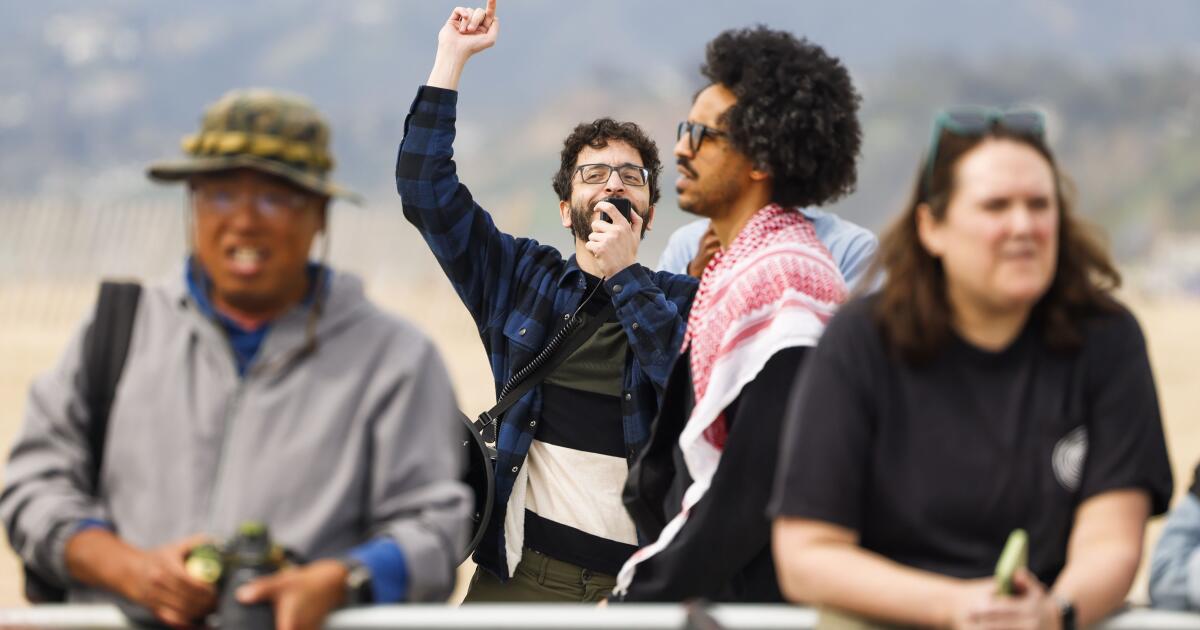
In what could be a sign for awards shows to come, the Spirit Awards were severely disrupted on Sunday afternoon by pro-Palestinian protesters.
About 40 minutes into the daytime ceremony, which was held in a tent near the beach in Santa Monica, loud sounds could be heard by attending guests. A small group of protesters had assembled on a public sidewalk across from the tent, holding up a loudspeaker that played a pre-recorded looped chant of “Free, free Palestine,” “Long live Palestine” and “Cease-fire now” that could be heard throughout the rest of the show.
Da’Vine Joy Randolph, left, and Anne Hathaway at the Independent Spirit Awards on Sunday.
(Jason Armond / Los Angeles Times)
Nevertheless, the ceremony continued and awards were handed out, with writer-director Celine Song’s “Past Lives” winning for feature and director.
“Past Lives” is also nominated for best picture and screenplay at the Academy Awards. In an interview with The Times before the Spirit Awards ceremony got underway, Song said, “At the heart of it, ‘Past Lives’ is an independent film. It was made independently, and then we also premiered at Sundance, which is really the heart of independent cinema. So to me, this is like being home. Walking in here, I already felt like this is where the movie belongs.”
As often happens, Spirit Awards voters went for films also nominated for Academy Awards; Along with “Past Lives,” Oscar-nominated films such as “American Fiction,” “The Holdovers,” “May December,” “Four Daughters” and “Anatomy of a Fall” all took home Spirit Awards.
Benny Safdie, left, and “American Fiction” screenwriter-director Cord Jefferson at the Independent Spirit Awards on Sunday.
(Jason Armond / Los Angeles Times)
“American Fiction” won for screenplay for Cord Jefferson, who also directed the film, as well as lead performance for Jeffrey Wright. This was the second year the Spirit Awards gave out non-gendered acting awards with 10 nominees, including men and women, for each prize in lead and supporting categories.
Da’Vine Joy Randolph, of Alexander Payne’s “The Holdovers,” won for supporting performance, as did her co-star, Dominic Sessa, for breakthrough performance. Eigil Bryld’s cinematography won as well.
But as the awards show continued, the protesters’ chanting could be heard through acceptance speeches. The protesters were outside on a sidewalk adjoining the beach, on the far side of the tent from where the stage was set up. Event organizers moved a shuttle bus backward and forward in front of the protesters to attempt to block the sound of their loudspeaker. Depending on where one was located inside the tent, they were either loud or unclear. The ceremony was being livestreamed on YouTube, where it was reported that muffled, indistinct noise could be heard on the broadcast.
The protest was noted a few times from the stage, often with a note of confusion as to what was going on. Host Aidy Bryant was beginning a comedy segment not long after the protest erupted and noted, “We are at the beach and people are practicing their freedom of speech.”
Lily Gladstone, center, at the Independent Spirit Awards on Sunday.
(Jason Armond / Los Angeles Times)
Comedian Jimmy O. Yang, while presenting another award, referred to the “heckler” outside and joked that people in the independent film community are “used to getting yelled at.”
Winning the John Cassavetes award for a film made for under $1 million, “Fremont” filmmaker Babak Jalali said, “There are people speaking outside and whatever they’re saying, I think it’s far more important than what I’m about to say.” His words were met with applause.
Prior to the ceremony, Josh Welsh, president of Film Independent, which puts on the Spirit Awards, said that the switch last year from a broadcast partner to livestreaming on YouTube had actually doubled the audience for the show and made it available internationally.
“This is where the community comes together,” Welsh said. “And people I think need that now and really value it.”
Will Ferrell at the Independent Spirit Awards on Sunday.
(Jason Armond / Los Angeles Times)
Accepting the Robert Altman Award for the ensemble of “Showing Up,” filmmaker Kelly Reichardt summed up the afternoon by recalling seeing filmmaker Robert Altman receive a lifetime achievement award in 2003 as war was erupting in Iraq. “And he was pissed.” Reichardt added, gesturing to the disruption outside. “I think he’d have a lot to say, just this weirdness of us being here and celebrating each other and our work, and also, you know: Life goes on outside the tent. Peace.”
Here is a complete list of today’s Spirit Award winners.
FILM CATEGORIES
Best feature
“Past Lives”
Producers: David Hinojosa, Pamela Koffler, Christine Vachon
Director
Celine Song, “Past Lives”
Screenplay
Cord Jefferson, “American Fiction”
First feature
“A Thousand and One”
Director: A.V. Rockwell
Producers: Julia Lebedev, Rishi Rajani, Eddie Vaisman, Lena Waithe, Brad Weston
From left, Greta Lee, Emma Corrin, Andrew Scott, Jeffrey Wright and Elijah Wright at the Independent Spirit Awards on Sunday.
(Jason Armond / Los Angeles Times)
First screenplay
Samy Burch, “May December”
John Cassavetes Award
(for a feature made under $1,000,000)
“Fremont”
Writer-director: Babak Jalal
Producers: Rachael Fung, Chris Martin, Marjaneh Moghimi, George Rush, Sudnya Shroff, Laura Wagner
Breakthrough performance
Dominic Sessa, “The Holdovers”
Supporting performance
Da’Vine Joy Randolph, “The Holdovers”
Jeffrey Wright, left, and Colman Domingo at the Independent Spirit Awards on Sunday.
(Jason Armond / Los Angeles Times)
Lead performance
Jeffrey Wright, “American Fiction
Robert Altman Award
(for an ensemble cast, director and casting director)
“Showing Up”
Director: Kelly Reichardt
Casting Director: Gayle Keller
Ensemble Cast: André Benjamin, Hong Chau, Judd Hirsch, Heather Lawless, James Le Gros, John Magaro, Matt Malloy, Amanda Plummer, Maryann Plunkett, Denzel Rodriguez, Michelle Williams
Cinematography
Eigil Bryld, “The Holdovers”
Editing
Daniel Garber, “How to Blow Up a Pipeline”
International film
“Anatomy of a Fall” (NEON)
Director: Justine Triet
Documentary
“Four Daughters”
Director: Kaouther Ben Hania
Producer: Nadim Cheikhrouha
Someone to Watch
Monica Sorelle, “Mountains”
Truer Than Fiction
Set Hernandez, “unseen”
Producers Award
Monique Walton
Andrew Scott and Anne Hathaway at the Independent Spirit Awards on Sunday.
(Jason Armond / Los Angeles Times)
TELEVISION CATEGORIES
New scripted series
“Beef”
Creator/Executive Producer: Lee Sung Jin
Executive Producers: Steven Yeun, Ali Wong, Jake Schreier, Ravi Nandan, Alli Reich
Co-Executive Producers: Alice Ju, Carrie Kemper
New non-scripted or documentary series
“Dear Mama”
Executive Producers: Lasse Järvi, Quincy “QD3” Jones III, Staci Robinson, Nelson George, Charles D. King, Peter Nelson, Adel “Future” Nur, Jamal Joseph, Ted Skillman, Allen Hughes, Steve Berman, Marc Cimino, Jody Gerson, John Janick, Nicholas Ferrall, Nigel Sinclair
Supporting performance in a new scripted series
Nick Offerman, “The Last of Us”
Lead performance in a new scripted series
Ali Wong, “Beef”
Breakthrough performance in a new scripted series
Keivonn Montreal Woodard, “The Last of Us”
Ensemble cast in a new scripted series
“Jury Duty”
Ensemble Cast: Alan Barinholtz, Susan Berger, Cassandra Blair, David Brown, Kirk Fox, Ross Kimball, Pramode Kumar, Trisha LaFache, Mekki Leeper, James Marsden, Edy Modica, Kerry O’Neill, Rashida Olayiwola, Whitney Rice, Maria Russell, Ishmel Sahid, Ben Seaward, Ron Song, Evan Williams
Movie Reviews
Film Review: “Late Fame” – The Art of the Second Act – The Arts Fuse
By David Stewart
Director Kent Jones explores aging, ego, and New York’s literary ghosts in a wry, performance-driven drama led by Willem Dafoe.
Late Fame, directed by Kent Jones
Willem Dafoe in a scene from Late Fame. Photo: IFFBoston
Does creativity remain fertile as one reaches the end of their life? From In a Lonely Place (1950) to The Wonder Boys (2000), a number of films have probed the internal insecurities of the world-weary, burnt-out writer. Directed by respected film critic, former NYFF programmer, and documentarian Kent Jones, Late Fame is a cerebrally warm but satirically stark exploration of the theme, focusing on how the influence of celebrity can upend creativity. Inspired by Arthur Schnitzler’s posthumously titular novella, screenwriter Samy Burch (May December) deliberately discards the dour setting of Schnitzler’s 1920s Vienna for the livelier atmosphere of New York City’s modern-day Lower East Side.
Willem Dafoe plays Ed Saxberger, a postal worker and once-published poet who hasn’t written anything in nearly four decades. His daily grind is comfortably monotonous until Meyers (Edmund Donovan), a young overenthusiastic fan of his, shows up outside his apartment. After persistent wheedling, Meyers introduces Ed to a café salon of various writers who dream of their big break. In reality, the group is made up of pretentious rich boys who haven’t the slightest idea what artists of Ed’s generation went through to be published. Meyers and his wealthy cohorts sit on the far end of the café, away from the social media influencers, as they profess hypocritical Luddite-based principles while taking calls on their cell phones. But these coffee sessions fuel Ed’s once-depleted ego and rekindle his affection for Gloria (Greta Lee), an actress and chanteuse struggling to make her mark. Ed finds himself cajoled by Meyers into writing new material and a memoir as part of a campaign to revive his career by making him the keynote speaker at a public reading. Panic sets in: Ed’s days are spent looking at a blank page as he listens to audiotapes of the poets of his generation, such as Anne Waldman and William Carlos Williams, attempting to foil his writer’s block.
Late Fame is Jones’ reverential (and earnest) love letter to creativity and New York City. The director grew up in the Berkshires before moving to NYC in the ’80s to work on Martin Scorsese’s documentaries. His lens affectionately embraces the eccentric characters in Burch’s script, the remnants of the city’s bygone literary era. His quasi-verité approach to filming the salons hums with a verve reminiscent of Jim Jarmusch’s Stranger Than Paradise (1984) as well as John Cassavetes’ Shadows (1959) and Opening Night (1977). As in Jones’ first narrative feature, Diane (2018), the director finds a transcendent resonance in Ed’s life of self-induced loneliness. He hides his cell phone — only to end up hearing voicemails from his estranged family as he toils in the service of adoring strangers. Meanwhile, Ed has to deal with his social life, his blue-collar postal worker buddies putting down his literary dreams in a dive bar worthy of a visit from Charles Bukowski.
Dafoe is a consistently engaging actor. His composed presence here is not unlike Jack Nicholson’s David Staebler in Bob Rafelson’s The King of Marvin Gardens (1972). He is reluctant to go along with the insane plans of those around him; we know this because we hear him reflect on his plight during nightly walks around the city. Dafoe started his career in the late ’70s as a member of the experimental theatre company the Wooster Group, and his reenactment of Ed’s spirited youthful performances evokes an edgy energy. Greta Lee taps into Sally Bowles–styled stamina; she lights up Ed’s life, serenading him as she sings Kurt Weill numbers in a downtown cabaret. (The film that inspired Jones to become a critic and director was Bob Fosse’s Cabaret (1972).) Edmund Donovan’s hyperactive performance as Meyers lampoons those who are oblivious to the barriers posed by class and unable to separate the rewards of creativity from those of instant gratification. Late Fame has its creative limitations: Ed’s past as an alcoholic and Gloria’s psychological conflicts are underexplored. Still, the depth of Dafoe and Lee’s performances makes up for these weaknesses; the pair help amplify the suspense that holds the film’s third act together.
The film’s visuals are a tactile plus. The handheld camerawork of Wyatt Garfield, who shot Jones’ previous film along with Beasts of the Southern Wild (2012), underscores the morbidity of Ed’s isolation and the reverie of his newfound friends. Editor Mike Selemon has cut the snappy wit and pathos in Burch’s script with a sharp eye. Don Fleming’s bluesy guitar score evokes the sounds of John Lurie and other No Wave musicians who were a big part of the downtown New York scene of the late ’70s, when Ed established his career.
In his preface to The Picture of Dorian Gray, Oscar Wilde wrote that “to reveal art and conceal the artist is art’s aim. The critic is he who can translate into another manner or a new material his impression of beautiful things.” Jones, no doubt drawing on his critical sensibility, successfully conveys the complexities of making art, regardless of age, and shares them beautifully in Late Fame.
David Stewart currently teaches at Emerson College, Plymouth State University, and Southern New Hampshire University. His first book, 2025’s There’s No Going Back: The Life and Work of Jonathan Demme, was published by the University of Kentucky Press.
Entertainment
After years in comedy, Deon Cole still likes who he sees in the mirror
Deon Cole will tell anyone plainly: Not every comic wants to talk about their audience members.
The longtime stand-up comedian will do some crowd work if he must. But he would much rather tell you the jokes he wrote. It’s the nature of a changing audience that is now more likely to stumble upon comedians they haven’t seen before through short social media clips, rather than an impromptu night at a comedy club.
“[The audience] feel like, ‘Hey, we came to improv, we came to have fun’ and it’s like, no, you know how long it took me to write these jokes?” Cole said with a laugh. “I don’t need you coming here screaming at me, and then I spend five minutes talking about you and your mom and your kids, and then I forgot what I was doing, and now the tone of the show is messed up.”
The Chicago-born comedian, actor and writer has long juggled multiple projects. This includes writing for “The Tonight Show With Conan O’Brien” and acting in films such as “The Color Purple” and “The Harder They Fall” as well as television shows like “black-ish.” Cole has also taped multiple comedy specials with Netflix over the years including “Cole Hearted” in 2019, “Charleen’s Boy” in 2022, and “Ok, Mister” in 2024. He has also been excited about the launch of his YouTube show “Funny Knowing You” where he gets to interview fellow comics and celebrities as they talk about their life stories.
But as he considers his legacy and comedic craft, Cole said he is proud he is still himself after all of this time in the industry.
“There’s a lot of people who look in the mirror every morning and go out in the world and become something else, when the thing that’s going to make them rich and successful is in the mirror,” Cole said. “ I think that whoever that person is in the mirror you need to take that person with you and apply that person to everything that you do, and that’s gonna make the difference in your life.”
Now, as part of the Netflix Is a Joke comedy festival, Cole is looking forward to doing a set for Altadena residents to raise money for ongoing relief in the aftermath of the 2025 wildfires that decimated much of the area. The Times spoke with Cole about how he’s thinking about his craft, crowd work and the importance of comedians revealing themselves.
What’s felt different this time in preparation for this particular show compared with your other ones?
This isn’t just a regular comedy show, like at some city, you know, these people really went through something, and they are still devastated by it. And so it’s not just a regular “we’re going to do a show.” We’re trying to raise as much money as possible for this community to help people in need so that’s a big difference. I don’t do that every weekend. It’s a big difference. And then having the people we want to show up and come get down and perform, seeing all of them on the same show, it’s going to be surreal as well.
Cole prioritizes written material and personal storytelling over crowd work, believing audiences should get to know comedians as individuals rather than hearing disconnected jokes.
(Cécile Boko)
How has your preparation changed over the years of you doing stand up compared with when you started?
I’m more confident. You know, back in the day, it might be a 30-60 chance that the joke will work: 30 meaning it will work, 60 that it won’t. And now I’m at a point where I can think of something, and there’s an 85% chance that it will work, there’s a 15% chance that it won’t. So my preparation, as far as thinking of something and then going to execute it, being able to execute it, is another difference. Back in the day I would have to ask for stage time. Now I can think of something and just go to a club and go right up.
What does improving your craft look like at this point in your career?
Just being more confident in my choice of what is funny and what’s not. I can hear something now and go, that’s funny, and then go, do it, and it becomes funny. So it’s just having confidence to do that and not question myself as much. That’s basically the difference, to be honest with you. Other than that, my drive, my thought pattern, everything is still the same. It’s heightened to the point where I’m paying attention more because I have a lot more free time to to pay attention. It gets to a point where you can pay a lot of people to do a lot of stuff for you, and the more time you got free, the more time you got to think about other things. So I try to pay everybody to do everything so I can go create. And so it’s been good to be in that space, to not worry about a lot of stuff and stay creative. When a lot of people that’s been doing it this long can’t and to still be relevant after all this time, and still be funny and still pack out shows… that means a lot to me.
How do you incorporate crowd work into your shows then?
If something happens while I’m doing my stuff, then fine but I’m not going to create a crowd work environment. If it happens, it happens, but I’m not going to purposely create it. And I mean to each his own that do it. And there’s some people who are very funny at it, and there’s some people that’s like, what are you doing? And for a lot of audience members, I feel like they’re being tricked a lot of times, because a lot of comedians, and I ain’t going to say a lot of comedians, but a few. Not every comic that does crowd work does this. There’s some great crowd work comedians that I really love and admire and respect. But there are some comedians that get up there and they’re doing a meet and greet. It’s downstage, “Hey, what’s your name?,” “What do you do for a living?,” “Hey, so how many kids do you got?,” “So, hey, where do you where you work at?,” “Oh, who are you?” Do that at the meet and greet. What are you standing up here for 45 minutes, getting to know everybody for? Where’s your jokes at? If people like it, you know, what can you do about it? But I’m old school with the craft. I like written comedy. I like storytelling. I like hearing something I never heard before. I like that. That’s just my preference. I don’t like sitting in the audience laughing at somebody’s name or what they do for a living, or who they with. My brain ain’t learning that way.
Do you think that sense of audience participation is coming from people watching social media clips?
I mean people love it, and it’s a younger audience that I think they really love it. Even though older people love it, don’t get me wrong. But the majority, I think, it’s a younger audience. And granted, there’s an audience for that. It really is and have at it. I think everybody should go out there, get their money, do what they do. My personal preference, which I am entitled to have, I think that it’s all about balance, like it is with everything in life. I don’t think you should eat candy all day. I think you should eat some vegetables. I don’t think you should eat vegetables all day. I think you should eat some protein. It’s all about balance. You can give me crowd work, but let’s hear about you. Who are you? What happened to you today? That’s what’s funny. How do you feel about this and that? Can I get that? And then you can go back to your crowd work. But if people keep going up to these shows and they like all the crowd work, and that’s it, me personally, I think you’re not getting your money’s worth when you leave there and you don’t even know if the comic was married, [have] kids, if they’re happy, sad. You just leave there going, “did you hear what he said about the girl in the fourth row?” “Oh, that was hilarious.” “Did you see the guy in the back with the toupe on?” “That was funny.” And it’s like, OK, well, who said that? Who’s the guy that said it? What about him? Do we know anything about him? Is he a racist? Is he a revolutionary? Who said this? Let me know who said this. I’m not just going to laugh at that.
Why do you think it’s important for a comic to reveal parts of themselves on stage?
That’s what the greats have done. Greats are that way. They have been that way. You get caught up into who these people are. It’s good to hear that. A lot of great comics got sitcoms. Why? Because you can listen to their jokes and see the show, and then they go create the show off of what they were talking about. You can see this. So when you have a comic, it’s a lot of comics that go on stage and they tell jokes, and then they leave, and then you go, who was that person? You can’t even remember the comic’s name. You know what I mean? I just think that you should let people know who you are, because that’s what makes you unique. Can’t just go up and tell joke after joke after joke. Anybody could tell jokes, [but it’s] who’s telling the joke that makes it great.
Movie Reviews
Movie Review: In ‘Michael,’ the King of Pop is resurrected, sans complications – The Philadelphia Sunday Sun
Jaafar Jackson as Michael Jackson and KeiLyn Durrel Jones as Bill Bray in Michael. Photo Credit: Glen Wilson/Lionsgate
By Jake Coyle
associated press
“Michael” slides a sequin glove over the pop staar’s tarnished legacy, shrouding Michael Jackson’s complications with a conventional biopic that, if you cover your ears, sounds great.
Antoine Fuqua’s movie is sanctioned by Jackson’s estate and its producers include the estate’s executors. So it is, by its nature, a narrow, authorized perspective on Jackson. The film ends before the flood of allegations of sexual abuse of children, or Jackson’s own acknowledgment of sleeping alongside kids. Jackson and his estate have long maintained his innocence. In his only criminal trial, in 2005, Jackson was acquitted.
“Michael” doesn’t even subtly nod to these facts. It moonwalks right past them. The result is a kind of fantasy film, one that relives the extraordinary highs of Michael Jackson while turning a blind eye to the lows.
There’s something understandably hard to resist about that. Who wouldn’t love to forget all the bad that comes with Michael Jackson? “Billie Jean,” alone, is good enough to give you amnesia. We’re talking about one of the greatest song-and-dance entertainers of the 20th century. The connection he forged with millions shouldn’t be taken for granted. And it can feel downright giddy to once again bask in Jackson’s former glory — or, at least, an uncanny approximation of it by Jaafar Jackson, his nephew. But that also makes “Michael” as much a fairy tale as Peter Pan’s Neverland.
“Michael” originally included scenes dealing with the sexual abuse allegations, but those were cut due to stipulations in an earlier settlement. The finished film, scripted by John Logan (“Gladiator,” “Aviator”), is largely structured as a father-son drama. In the film’s early Gary, Indiana-set scenes, Joe Jackson (a typically compelling Colman Domingo) forcefully drills his children into becoming the Jackson 5 and whips young Michael (an excellent Juliano Krue Valdi) with his belt.
While “Michael” spans the Jackson 5 and “Off the Wall” and “Thriller,” its through line is Michael’s struggle for emancipation from his overbearing father and manager. In that way, it’s quite similar to 2022’s “Elvis,” which likewise turned on the dynamic between Presley and the controlling Colonel Tom Parker.
Similarly, the broad-strokes, play-the-hits biopic approach is very much at work in “Michael,” produced by Graham King (“Bohemian Rhapsody”). Fuqua, best known for muscular thrillers like “Training Day” and “The Equalizer,” is maybe an unlikely pick for the task. But he cleverly stages some scenes, like when young Michael first lays down a track in a recording studio. While his father looms outside and producers tell Michael not to shuffle his feet so much, Fuqua moves inside the booth. We hear nothing but Michael’s voice. The noise stops and there’s just his pure, not-yet-corrupted vocal power, singing “Who’s Lovin’ You.”
What happened to Jackson as he became an adult, many would consider both an astonishing success story and an American tragedy. “Michael” doesn’t try for that balance. It mainly follows the emergence of an icon, albeit a peculiar one who takes shelter in a room full of children’s toys and whose need to be “perfect” drives him to cosmetic surgery in his early 20s. These and other developments (like the arrival of Bubbles the chimp) are mostly met with eye rolls by family members: the idiosyncrasies of a man-child genius.

At nearly every turn, you can feel the narrative being twisted, sometimes by those still alive. (Joe Jackson died in 2018, nine years after his son’s death at 50.) Katherine Jackson (Nia Long), Michael’s mother, is downright saintly. John Branca (Miles Teller), co-executor of Jackson’s estate and a producer of the film, is seen as a heroic ally to Michael.
Branca, perhaps, deserves the victory lap. Such a big-screen revival for Jackson was once unthinkable. But “Michael” is the latest in a string of successes for the former King of Pop, including Cirque du Soleil shows and “MJ the Musical” on Broadway — all despite the evidence presented by the 2019 documentary “Leaving Neverland.” “Michael” isn’t really a rebuttal to that film. It’s pure pop shock-and-awe. And turning up the volume on “Beat It” will win you some arguments.
What’s on screen is constantly running, in our minds, alongside what isn’t. Even the glossiest of biopics allow some negative characteristics to show, but Fuqua’s film sticks almost entirely to Michael, the myth. He visits kids in hospitals, makes Black history on MTV, writes the “Thriller” album in near solitude. (Kendrick Sampson plays a seldom-seen Quincy Jones.)
As played by Jaafar Jackson, Michael is a wide-eyed innocent who bore the scars of abuse and yet nevertheless maintained a childlike belief in music: king and casualty of pop, at once. If there’s one thing that needs no embellishment here, it’s the fervor of audiences for Jackson at his astonishing peak. Fuqua lingers on the fans losing their minds for Michael, but that ardor was real. Jaafar Jackson’s performance is a remarkable, charming facsimile not just for the dance moves and singing voice but, more crucially, for channeling Jackson’s sweetness.
“Michael” concludes on an oddly and — considering where things would ultimately go for Jackson — completely false note of triumph. But when the movie sticks to the music, as it often does in copious concert performances, it’s hard not to be moved. There is an undeniable thrill in being transported back to a more innocent America awakening to the power of pop spectacle, when arenas sang in unison to “Man in the Mirror” and “Human Nature.” The nostalgia of “Michael” is for more than Michael Jackson. But blindly believing only in that celebrity, in that fantasy, is repeating a sad history all over again.
“Michael,” a Lionsgate release in theaters Thursday, is rated PG-13 by the Motion Picture Association for some thematic material, language, and smoking. Running time: 127 minutes. One and a half stars out of four.
-
Movie Reviews11 minutes agoFilm Review: “Late Fame” – The Art of the Second Act – The Arts Fuse
-
World23 minutes agoOlivia Rodrigo Announces Massive ‘Unraveled’ Tour Dates
-
News29 minutes agoHow Trump’s Iran Blockade Is Complicating a High-Stakes Trip to China
-
Politics35 minutes agoTrump Administration Casts Host of Policies Under Biden as Anti-Christian
-
Business41 minutes agoCrop Undercount Raises Questions About Reliability of U.S.D.A. Data
-
Science47 minutes agoSmog in Phoenix and Salt Lake City? The E.P.A. Is Blaming Asia.
-
Health53 minutes agoHow To Lose Belly Fat After 50 Fast Without Crash Diets or Crunches
-
Culture1 hour agoBook Review: ‘Cave Mountain,’ by Benjamin Hale
