Entertainment
Specters, lies and videotape: Steven Soderbergh’s ‘Presence’ jolts Sundance to life

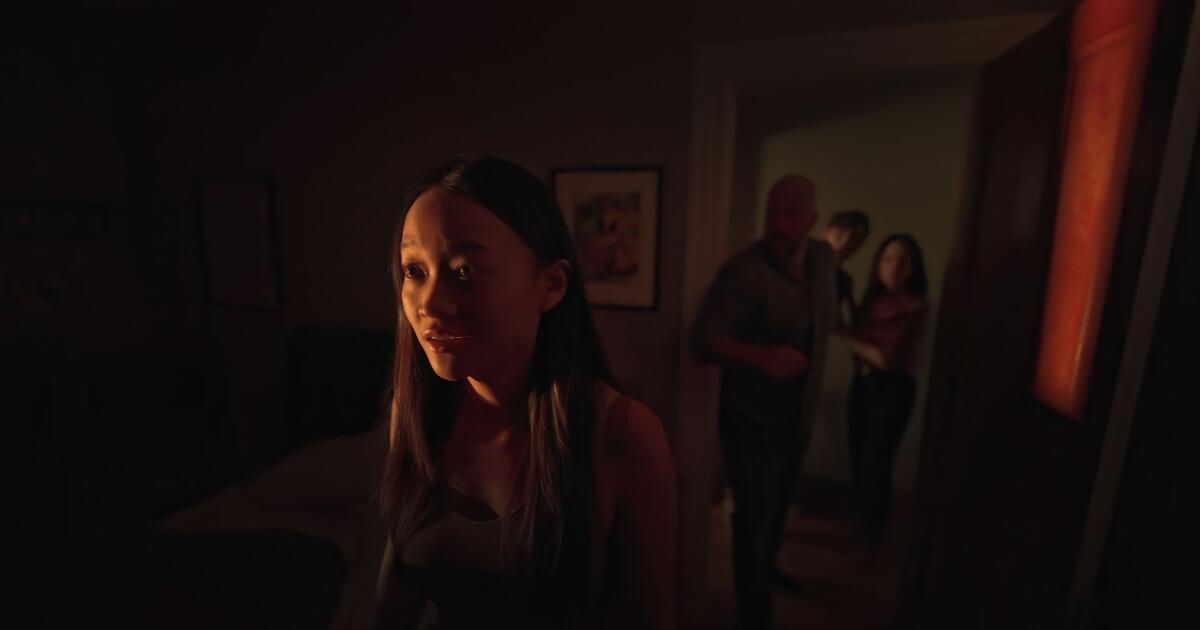
Steven Soderbergh’s “Presence,” a sleek and sublimely nimble ghost story with a world-premiere Friday night at the 40th annual Sundance Film Festival, hinges on a formal conceit so spookily effective that it’s hard to believe it’s never been attempted before. Maybe it has been (the history of independent cinema contains unseen, uncovered multitudes), though surely not to such thrillingly sustained ends, or with such ingenious modesty of means.
For the entirety of this 85-minute movie, we are in a handsome Craftsman-style home where a married couple, Rebecca (Lucy Liu) and Chris (Chris Sullivan), have recently moved in with their teenage children, Tyler (Eddy Maday) and Chloe (Callina Liang). From the start, as nerves fray and tempers flare, it’s clear this family has its demons, which will soon be supernaturally compounded by eerie rumblings, self-operating doors and collapsing shelves. But if the genre trappings seem familiar, it’s the prowling, ghostlike vantage of the camera that makes all the difference: Soderbergh has elected to tell this haunted-house story entirely from the perspective of the haunter. Shooting in wide-angled long takes that range in tenor from voyeuristic languor to nerve-shredding anxiety, he transforms a domestic horror exercise into another Soderberghian tour de force.
For all its conceptual spareness, “Presence” has any number of built-in reference points, including Soderbergh’s own recent exercises in physical and narrative confinement, like “Unsane” and “Kimi” (which, like this movie, was written by David Koepp). Those two movies, incidentally, were both centered on a smart, rattled woman who maintains a tight grip on her wits and sanity even as they’re repeatedly called into question; the same is true of “Presence,” in which Chloe, still grieving the recent death of a close friend, senses the ghost far more acutely than her parents and brother do.
Pedro Pascal in the movie “Freaky Tales.”
(Sundance Institute)
The sight of a fractious family under continual surveillance might also remind you of the “Paranormal Activity” movies, although what’s striking about the camerawork in “Presence” is how the camera seems to hover — and shiver — with more compassion than menace. You wonder almost immediately if this spectral visitor, for all the trouble it causes, might also be a benevolent one. That idea becomes even more pronounced if you know it’s the director himself behind the camera, operating under his usual pseudonym of Peter Andrews. There’s a sly in-joke buried in there somewhere: The key to Steven Soderbergh’s “Presence” is, well, Steven Soderbergh’s presence.
There is also, perhaps, a sly metaphor for the direct and indelible ways in which the best filmmakers can haunt us — and Soderbergh, now 61, has been one of those filmmakers for some time now. Arriving in Park City exactly 35 years after “sex, lies, and videotape” took Sundance by storm, “Presence” offers further evidence (as if it were needed) that Soderbergh has never shaken off his restlessly experimental edge. Deploying lightweight digital cameras and a seamless mix of visual effects and old-fashioned stunt work, he remains American independent cinema’s great problem solver, someone who approaches each movie as a logistical puzzle and sees aesthetic and financial limitations as creative enablers rather than deterrents.
But can Soderbergh solve the great problem of American cinema itself — namely, the sense that the audience for independent movies, limited and self-selecting to begin with, has dwindled to nothingness in the wake of flashier, more technologically au courant entertainment alternatives? If not, it wouldn’t be for lack of trying. Long before the pandemic swept in and shut down theaters (in some cases permanently), Soderbergh has been one of the industry’s most insightful thinkers and speakers on the challenge of making thoughtful, adventurous movies in a climate that has always been hostile to art. At the same time, Soderbergh has continued to make his own canny counterarguments, usually in the form of movies. And for all his well-earned cynicism about the industry, these movies — invariably smart, deft and disarmingly modest — have continued to express an unwavering optimism about the possibilities of the medium.
Some of those features have been unveiled on streaming platforms like Netflix (“High Flying Bird,” “The Laundromat”) and HBO Max (“Let Them All Talk,” “Kimi”), and it’s easy enough to see “Presence” following suit: This is a movie that will glide effortlessly into your living room and linger in the air afterward. But I hope a theatrical distributor buys the movie, an audience picture through and through that deserves, among other things, the horror-loving date-night crowds that reliably flock to the umpteenth “Saw” sequel. Will Soderbergh’s elegant camerawork and gore-free effects prove too subtle for those viewers? In some cases, sure. But an industry that doesn’t let them discover it for themselves in the first place truly has given up the ghost.
An image from the documentary “Girls State.”
(Apple/Sundance Institute)
Soderbergh’s presence here made for a nice 40th birthday present from the festival to itself, though he certainly wasn’t the only Park City veteran in attendance. The festival got off to an attention-grabbing start Thursday night with “Freaky Tales,” a funny, bloody valentine to the city of Oakland from the returning writing-directing duo of Ryan Fleck and Anna Boden, whose 2006 debut feature, “Half Nelson,” was a highlight of my very first Sundance Film Festival. Subsequent efforts, among them the superb “Sugar” (2008) and “Mississippi Grind” (2015), confirmed Fleck and Boden’s standing as two of the most promising independent voices in American movies. But that was before they abandoned those models of low-key realism for “Captain Marvel,” a franchise blockbuster that proved a dispiriting waste of their distinctive talents.
The unevenly entertaining “Freaky Tales” suggests a promising attempted return to indie basics, one with a healthy smattering of gonzo fantasy, a typically strong supporting turn from Pedro Pascal and some intricate storytelling gamesmanship replete with Tarantino-esque structural fillips. Set in 1987 Oakland, an as-yet-ungentrified hotbed of predatory cops and neo-Nazi scum, the movie rattles off a quartet of stories, each of which becomes a kind of revenge fantasy in which Black, Asian, Latino and queer protagonists rise up and sometimes join forces against bullies of every racist and homophobic stripe. Before long the movie is awash in a river of gore, green neon and Golden State Warriors references. It diverts for a while, only to dissipate almost immediately upon conclusion.
Another returning duo: Amanda McBaine and Jesse Moss, previously at Sundance with their excellent documentaries “The Overnighters” and “Boys State.” They’re back this year with a bristlingly insightful sequel to the latter: “Girls State,” which offers a microcosmic look at a one-week high-school program built to give young American women a firsthand taste of democratic self-governance. In tracking a handful of protagonists whose talents, aspirations and dreams will shape the outcome of this exercise, McBaine and Moss shrewdly apply the roving observational techniques of “Boys State” to remarkably different ends. Unsurprisingly, the abortion debate looms with great urgency over “Girls State,” which was shot not long before the Supreme Court overturned Roe vs. Wade. There’s also a fascinating dive into the inequalities that bedevil Boys State and Girls State themselves, reminding us how organizations often embody, at a structural level, some of the very problems they’re ostensibly trying to rectify.
Juan Jesús Varela in the movie “Sujo.”
(Ximena Amann/Sundance Institute)
“Boys State” began streaming on Apple TV+ in 2020; “Girls State” will arrive on the same platform, with similar election-season timing, on April 5. It will probably take longer for American audiences to discover the rewards of another duo-directed movie, “Sujo,” an early standout in Sundance’s international narrative competition. With any luck, though, this tender, harrowing and beautifully modulated coming-of-age drama will find its place in the art-house ecosystem and boost the profile of the Mexican filmmakers Fernanda Valadez and Astrid Rondero, reteaming after their much-acclaimed debut, “Identifying Features” (which Valadez directed and co-wrote with Rondero).
“Sujo” is named after a young boy who is raised in the shadow of cartel violence — an early scene finds his father, a sicario, locking the child in a car before heading off to dispose of some dirty business — but who is then set on a jagged path toward a better, safer life. (He’s played at different ages by Juan Jesús Varela and Kevin Aguilar.) Along the way, Sujo is nurtured by a number of wise women, including a pair of tough-loving aunties and a patient schoolteacher, who recognize his strength and potential but also know he must ultimately forge his own path. It’s that principled refusal of easy outcomes that makes “Sujo,” for all its tense, violent realism, so delicate and moving. Here, too, a compassionate spiritual presence seems to assert itself, in front of the camera as well as behind it.



Movie Reviews
MOVIE REVIEWS: “Mercy,” “Return to Silent Hill,” “Sentimental Value” & “In Cold Light” – Valdosta Daily Times

“Mercy”
(Thriller/Crime: 1 hour, 39 minutes)
Starring: Chris Pratt, Rebecca Ferguson, Kali Reis
Director: Timur Bekmambetov
Rated: PG-13 (Violence, bloody images, strong language, drug content and teen smoking)
Movie Review:
“Mercy” is a science fiction movie based on one of the more common themes of moviedom lately, artificial intelligence (AI). This crime thriller cleverly creates an intriguing story using technology and the justice system, yet it fails to be consistently interesting and intelligent throughout. The conclusion is less significant than the initial setup, as the concluding scenes become typical action sequences.
Detective Chris Raven (Pratt) of the LA Police Department is a huge supporter of the city’s new judicial courtroom. Crimes are now judged by an AI program (Ferguson) in the Mercy Court. The court is run by an artificial program that makes decisions based on all of the evidence before it without any prejudice. Detective Raven is all for this system until he is convicted of killing his wife. Now he must use all of the data, including the AI‘s ability to tap into everyone’s electronic devices, security cameras, and even into government files, within reason, to prove he did not murder his wife.
Mercy is an interesting movie. It entertains throughout, even when the story gets sloppy and characters’ actions are irrational. This mainly occurs during the final scenes. The movie tries too hard to insert unneeded narrative twists. This is disappointing because the story is interesting. What makes it fascinating is that it happens in real time. This is the most brilliant facet.
All the other theatrics are unnecessary. Director Timur Bekmambetov (“Profile,” 2018; “Wanted,” 2008) and “Mercy’s” producers should have just kept the ending simple, no plot twists or superfluous action sequences.
Grade: C (This flick needs some mercy. Let the trial begin.)
“Return to Silent Hill”
(Horror: 1 hour, 46 minutes)
Starring: Jeremy Irvine, Hannah Emily Anderson and Robert Strange
Director: Christophe Gans
Rated: R (Bloody violent content, strong language and brief drug use.)
Movie Review:
“Return to Silent Hill” is about one man’s quest to return to the love of his life. The problem is she has moved on to the afterlife. Meanwhile, audiences lose part of their life watching this movie, which is unlike any of the two prequels in this series. This one is a psychological horror that bores.
Artist James Sunderland (Irvine) decides to return to Silent Hill, a place where many people died during a devastating illness that nearly enveloped the entirety of the city’s population. What is left there is a horror show of freakish creatures, all with violent intent. Still, Sunderland searches for the love of his life, Mary Crane (Anderson).
Think of this movie as a slow suicide, where a guy goes back to retrieve his dead girlfriend. To do so, he must travel to the modern land of the dead that Silent Hill has become. This one is a type of swan song by the main character, and the movie becomes less scary while lackluster romantic notions wander aimlessly.
Grade: D (Do not return to see this.)
“Sentimental Value”
(Drama: 2 hours, 13 minutes)
Starring: Renate Reinsve, Stellan Skarsgård, Inga Ibsdotter Lilleaas and Elle Fanning
Director: Joachim Trier
Rated: R (Language, sexual reference, nudity and thematic elements)
Movie Review:
“Sentimental Value” is a Norwegian film that won the Grand Prix in France’s Cannes Film Festival and was nominated for nine Academy Awards, including Best Motion Picture. It is a solid drama filled with symbolism and family connections. It is brilliant performances by a talented cast under the direction of Joachim Trier (“The Worst Person in the World,” 2021).
This screenplay is about Gustav Borg (Skarsgård). He is a father, grandfather and a famed film director. He stayed away from his two daughters, actress Nora Borgwhile (Reinsve) and historian Agnes Borg Pettersen (Lilleaas), while he was creating works as a filmmaker. The director comes back into the lives of his daughters after the death of their mother. Their reunion leads to a rediscovery of their bond at their family home in Oslo.
Stellan Skarsgård is always a solid actor. He takes his roles and makes them tangible characters that seem like you know them, even when they’re speaking a foreign language. That is the quality of his act and why he gets nominated for multiple awards each season.
“Sentimental Value” is a valuable movie filled with enriching sentiment. It is an enjoyable film for those who value a good drama. The acting and original writing alone make the movie worth it. “Sentimental Value” starts in a very simple way, but everything in between, even when low-key, remains potent. Joachim Trier and writer Eskil Vogt have worked together on multiple projects such as “The Worst Person in the World” (2021). Their pairing is once again worthy.
Grade: A- (Any motive valuable movie.)
“In Cold Light ”
(Crime: 1 hour , 36 minutes)
Starring: Maika Monroe, Allan Hawco and Troy Kotsur
Director: Maxime Giroux
Rated: R (Violence, bloody images, strong language and drug material)
Movie Review:
“In Cold Light” sticks to a very straightforward story, primarily taking place over a short period. The problem is the story leaves one in the cold. Audiences have to guess what is being communicated because this movie uses American Sign Language (ASL) without subtitles. For those moviegoers who do not know ASL, they are left deciphering characters’ actions and facial expressions during some pivotal scenes.
Ava Bly (Monroe) attempts to start a legit life after prison. Her life changes when Ava’s twin, Tom Bly (Jesse Irving) is murdered while seated next to her. As her brother’s killers pursue her, Ava must evade law enforcement, which contains some crooked cops led by Bob Whyte (Hawco).
For a brief moment, this movie hits its exceptional moment when Oscar-recipient Helen Hunt enters the picture as a motherly Claire, a crime boss who seems more like a social worker/psychologist. Her long scene is wasted as it arrives too late.
French Canadian director Maxime Giroux’s style has potential in his first English-language film, but it does not fit a wayward narrative. A rarity, this crime drama has characters commit many dumb actions at once.
Moreover, Giroux (“Félix et Meira,” 2014) and writer Patrick Whistler forget to let their audiences in on their story. They allow much to get lost in translation, especially during heated conversations between Monroe’s Ava and her father, Will Bly, played by Academy Award-winning actor Troy Kotsur (“CODA,” 2021).
Grade: C- (Just cold and dark.)
More movie reviews online at www.valdostadailytimes.com.

As the media industry took stock of Paramount Skydance’s startling acquisition of Warner Bros. Discovery, one question lingered on the minds of many in the news business and beyond: What will this mean for CNN?
The iconic 24-hour cable news network is among the various Warner Bros. assets that would be scooped up by Paramount in a deal announced Thursday that could transform the media landscape.
Paramount has undergone a swift transformation under Chief Executive David Ellison following his family’s acquisition of the company last summer. These changes reached CBS News almost immediately with the appointment of Bari Weiss, the controversial Free Press co-founder, as its new editor in chief.
Bari Weiss moderated a town hall with Erika Kirk, widow of slain conservative activist Charlie Kirk.
(CBS via Getty Images)
Weiss’ tenure so far has been rocky.
Her decision to pull a “60 Minutes” story about conditions inside an El Salvador prison that housed undocumented Venezuelan migrants from the U.S. received widespread criticism and accusations of political motivation. The network said the story was held for more reporting, and the segment eventually aired.
There was more upheaval last week at the news magazine, when “60 Minutes” correspondent and CNN news anchor Anderson Cooper announced that he’d be leaving to spend more time with his family.
And earlier this year, a veteran producer at “CBS Evening News With Tony Dokoupil” was fired after he expressed disagreement about the editorial direction of the newscast.
Now, the concern is that similar changes could be in store for CNN, which has long been a target of President Trump’s ire. He has personally called for the ouster of hosts at the network who have questioned his policies.
CNN Worldwide Chief Executive Mark Thompson tried to quell some of those fears, particularly inside his own newsroom.
In an internal memo dated Thursday and obtained by The Times, Thompson urged employees not to “jump to conclusions about the future” and try to concentrate on their work.
“We’re still near the start of what is already an incredibly newsy year at home and abroad,” he wrote in the note. “Let’s continue to focus on delivering the best possible journalism to the millions of people who rely on us all around the world.”

Chairman and CEO of CNN Worldwide Mark Thompson and media editor for Semafor, Maxwell Tani, speak onstage.
(Shannon Finney / Getty Images for Semafor)
CNN declined to comment beyond Thompson’s memo.
Ellison has said his vision for a news business is one that is ideologically down the middle.
“We want to build a scaled news service that is basically, fundamentally in the trust business, that is in the truth business, and that speaks to the 70% of Americans that are in the middle,” he said during a Dec. 8 interview on CNBC, shortly after Warner said it had chosen Netflix as the winning bidder for its studios, HBO and HBO Max. “And we believe that by doing so that is for us, kind of doing well, while doing good.”
Ellison demurred when asked whether Trump would embrace him as CNN’s owner, given the president’s past criticisms of the network.
“We’ve had great conversations with the president about this, but … I don’t want to speak for him in any way, shape or form,” he said.
First Amendment scholars have raised concerns about press freedom and free speech rights under the Trump administration, particularly after last month’s arrest of former CNN journalist Don Lemon and the Federal Communications Commission’s pressure on late-night hosts like Jimmy Kimmel and Stephen Colbert.
Press freedom groups have long asked questions in other countries about how authoritarian regimes use their power and “oligarchical alliances to belittle, silence, and punish independent journalistic voices, or to steer media ownership toward … a preferred version of the truth,” said RonNell Andersen Jones, a 1st Amendment scholar and distinguished professor in the college of law at the University of Utah, in an email.
“We see them asking at least some of these questions about the U.S. today,” she wrote.
Apprehension about the merger also extends beyond its implications for CNN and the media business.
Lawmakers such as Rep. Laura Friedman (D-Glendale), Sen. Adam Schiff (D-Calif.) and Sen. Cory Booker (D-N.J.) have raised concerns about how the consolidation of two major Hollywood studios could affect industry jobs and film and television production — which has significantly slowed since the pandemic, the dual writers’ and actors’ strikes in 2023 and corporate cutbacks in spending.
Sen. Elizabeth Warren (D-Mass.) called the deal an “antitrust disaster” that she feared could raise prices and limit choices for consumers.
“With the cloud of corruption looming over Trump’s Department of Justice, it’ll be up to the American people to speak up and state attorneys general to enforce the law,” she said in a statement.
Already, California Atty. Gen. Rob Bonta has said the merger isn’t a “done deal,” adding that he is in communication with other states attorneys general about the issue.
“As the epicenter of the entertainment industry, California has a special interest in protecting competition,” he posted Friday on X.
The deal is subject to approval by the U.S. Justice Department. Bonta and other state attorneys general are expected to file a legal challenge to the mega-merger on antitrust grounds.
Ellison addressed some of these concerns in a statement Friday.
“By bringing together these world-class studios, our complementary streaming platforms, and the extraordinary talent behind them, we will create even greater value for audiences, partners and shareholders,” he said. “We couldn’t be more excited for what’s ahead.”
Times staff writer Meg James contributed to this report.

NEW YORK (OSV News) – “Goat” (Sony) is an animated underdog sports comedy populated by anthropomorphized animals. While mostly inoffensive, and thus suitable for a wide audience — including teens and older kids — the film is also easily forgotten.
The amiable proceedings center on teen goat Will Harris (voice of Caleb McLaughlin). As opening scenes show, it has been Will’s dream since childhood to play for his hometown team, the Vineland Thorns.
The inhabitants of Vineland and the other areas of the movie’s world, however, are divided into so-called bigs and smalls, with professional competition dominated, unsurprisingly, by the former. Though Will stoutly maintains that he’s a medium, those around him regard him as too slight and diminutive to go up against the towering bigs.
Despite this prejudice, a video showing Will more or less holding his own against a famous and arrogant big, Andalusian horse Mane Attraction (voice of Aaron Pierre), goes viral and inspires the Thorns’ devious owner, warthog Flo Everson (voiced by Jenifer Lewis), to give the lad a shot. Though Will is understandably thrilled, his path forward proves challenging.
Will has idolized the Thorns’ sole outstanding player, black panther Jett Fillmore (voice of Gabrielle Union), since he was a youngster. But Jett, it turns out, is not only frustrated by her situation as a star among misfits but scornful of Will’s ambitions and resolute in helping to deprive her new teammate of playing time.
Given such divisions, the Thorns’ fortunes seem destined to continue their long decline.
“Roarball,” the invented game featured in director Tyree Dillihay’s film, is essentially co-ed basketball by another name. As produced by, among others, NBA champion Stephen Curry, the movie — adapted from an idea in Chris Tougas’ book “Funky Dunks” — is an unabashed celebration of hoop culture both on and off the court.
Viewers’ enthusiasm may vary, accordingly, depending on the degree to which they’re invested in the real-life sport.
Moviegoers of every stripe will appreciate the fact that the script, penned by Aaron Buchsbaum and Teddy Riley, shows the negative effects of self-centeredness as well as the value of teamwork and fan support. Plot developments also showcase forgiveness and reconciliation.
Will’s story is, nonetheless, thoroughly formulaic and most of the screenplay’s jokes feel strained and laborious. Still, while hardly qualifying as the Greatest of All Time, “Goat” does provide passable entertainment with little besides a few potty gags to concern parents.
The film contains brief scatological humor and at least one vaguely crass term. The OSV News classification is A-II — adults and adolescents. The Motion Picture Association rating is PG — parental guidance suggested. Some material may not be suitable for children.
Read More Movie & TV Reviews
Copyright © 2026 OSV News

Eight takeaways from Friday’s high school playoffs action, including four 1,000-point scorers – The Boston Globe

Utah Mammoth take down Minnesota 5-2 to end the Wild’s winning streak at 6

Couple sentenced for selling faulty fire extinguishers to Mississippi daycares, businesses – SuperTalk Mississippi
Missouri Lottery Mega Millions, Pick 3 winning numbers for Feb. 27, 2026

Montana cowboys help build trauma ranch for Israeli soldiers

Florida High School Football Rankings: Top 25 teams – Oct. 21

Cleary's 21 help Le Moyne down Central Connecticut State 69-64 in OT

How old is Bo Nix? What to know about Oregon quarterback ahead of 2024 NFL Draft

99th annual Pony Swim held in Virginia

Indiana Members Credit Union announced as new anchor tenant at Bottleworks District

ICE blasts Washington mayor over directive restricting immigration enforcement

Did the EU bypass Hungary’s veto on Ukraine’s €90 billion loan?

How the federal government is painting immigrants as criminals on social media

Where Iran’s ballistic missiles can reach — and how close they are to the US

Has India’s influence in Afghanistan grown under the Taliban?
-

 World2 days ago
Exclusive: DeepSeek withholds latest AI model from US chipmakers including Nvidia, sources say
-

 Massachusetts3 days ago
Mother and daughter injured in Taunton house explosion
-

 Montana1 week ago
2026 MHSA Montana Wrestling State Championship Brackets And Results – FloWrestling
-

 Louisiana5 days ago
Wildfire near Gum Swamp Road in Livingston Parish now under control; more than 200 acres burned
-

 Denver, CO2 days ago
10 acres charred, 5 injured in Thornton grass fire, evacuation orders lifted
-

 Technology7 days ago
YouTube TV billing scam emails are hitting inboxes
-

 Technology7 days ago
Stellantis is in a crisis of its own making
-

 Politics7 days ago
OpenAI didn’t contact police despite employees flagging mass shooter’s concerning chatbot interactions: REPORT