Entertainment
‘Sentimental Value’ isn’t a critique of Netflix. ‘It’s an encouragement’


Joachim Trier’s “Sentimental Value” is nominated for an impressive nine Academy Awards, among them the first best picture nod for a Norwegian film and the auteur himself for both directing and co-writing (with longtime collaborator Eskil Vogt) the family drama’s original screenplay.
But perhaps the film’s most remarkable achievement, Oscar-wise, is four first-time acting nominations.
Renate Reinsve, the director’s muse from his acclaimed feature “The Worst Person in the World,” is a lead actress nominee for playing popular but troubled Oslo stage and TV actor Nora Borg.
Sweden’s Stellan Skarsgård — whose career has run the gamut from Lars von Trier’s arty provocations to Marvel, “Dune,” “Star Wars” and “Mamma Mia!” franchise entries — is, at 74, arguably leading the supporting actor race. He plays Nora’s long-absent father Gustav, a once-respected writer-director trying to revive his career with a semiautobiographical project he needs his daughter to star in — and she wants nothing to do with.
Norwegian Inga Ibsdotter Lilleaas and American Elle Fanning both have supporting actress nods for, respectively, Nora’s younger, more conciliatory sister Agnes and the Hollywood star Rachel Kemp, who yearns for artistic cred and could definitely be the replacement casting that gets Gustav’s movie financed — if she can handle its very Scandinavian main role.
But while suicide, wartime atrocities and intimate betrayals haunt the picturesque Borg family home, Trier does not take “Sentimental Value” into obvious Bergman territory. The four principals’ unmet personal and professional needs play out in unpredictable, funny and warm — as well as shattering — ways.
Though both dressed in black when they spoke with The Envelope at the Four Seasons Los Angeles recently, Trier and Skarsgård exhibited high spirits and fond camaraderie while examining the mysteries of relationships and art.
This interview was edited for length and clarity.

Stellan Skarsgård, center, with Renate Reinsve and Inga Ibsdotter Lilleaas in “Sentimental Value.”
(Kasper Tuxen Andersen / Neon)
You guys really seem to enjoy all the awards–season hoopla.
Trier: We’ve become such good friends, it’s like we really love each other. We made this film about a terribly dysfunctional family, but we are actually quite functional!
The whole gang looked so excited watching the nomination announcements on that viral video.
Skarsgård: I was most happy that Elle and Inga got nominations. I’ve lived my whole life without a nomination — not a problem! — and you know that Renate will get a couple of Oscars, probably, in the near future. So it was beautiful.
For me, it’s the highest award in the world for a film actor. I do appreciate it, but it doesn’t mean much professionally.
Especially for you, who’s done just about everything a film actor can. Gustav seems like a special role, though.
Skarsgård: It is one of the best roles I’ve gotten in my life, but not on paper. It’s with Joachim directing it. He is interested in whatever nonverbal reaction you have between the lines. That is the acting I like, that kind of attention to the details of the psychological narrative that is not the normal film narrative.
Did you gain new insights into the plight of aging film workers?
Skarsgård: [grinning] Well, I’m in the beginning of my career still.
Tell Stellan why you wrote Gustav for him, Joachim.
Trier: You’ve worked with Spielberg and Fincher and all of these great directors. I wanted to offer you a proper drama role where you can also be very vulnerable and honest about who you are. It’s not your biographical story at all — you have very good relationships to your kids and this man doesn’t — but you really brought your heart to it and made him somehow a human being in the three-dimensional sense. And I think your colleagues recognized that.

“When you see him directing, you see that he has the sensibility and psychological intelligence of a good director,” Skarsgård, left, says of his character, Gustav Borg. “It’s very common that those directors are not very good with their family life.”
(Christina House / Los Angeles Times)
Since a stroke damaged his short-term memory, Stellan receives prompts through an earpiece on set. How was it to work with that?
Trier: I witnessed a process that moved me deeply, and I think it’s made this film better. First, we decided to make Stellan’s prompter [Vibeke Brathagen, a prompter at Oslo’s National Theatre, where a number of “Value’s” scenes were filmed] part of the ensemble. To see an artist of this caliber in such a vulnerable position of trying something new coincided with portraying a character at a turning point in his life. Both the character and Stellan are working this deep feeling of, can I go on? Will there be another chance for me?
Skarsgård: It’s permanent, I can’t remember lines. What worried me was not only the language, but I had problems with the thought that goes over several beats. So I have to talk shorter and more in pulses. And it’s hard work because it’s not just somebody prompting and you repeat it, but rhythm between the actors is very important. To keep that rhythm, the prompter has to talk over the other actor’s lines. So you’re hearing two lines at the same time but you only react to one.
How was working with Renate?
Trier: She’s like a force of nature. We don’t know how she does what she does. We did one day of rehearsals and Stellan came up and gave me a hug [and] said, “Who is this person? She’s incredible!”
Skarsgård: I remember that! Her face is transparent; you can see every feeling. She’s natural and curious and has a musicality that’s wonderful. I’m talking about rhythm again, of our scenes together. It was really good fun.
Inga?
Trier: One of the biggest challenges of this film was finding someone to play Renate’s younger sister who could match her level of performance, looked like her and spoke Norwegian fluently. There’s not an endless pool of those, but we did see around 200 people. When Inga arrived, it was very clear. There is an authenticity, a groundedness and something unneurotic and unproblematic about her approach. The earnestness transferred into the character and lifted it. She’s escaped the mad circus of the Borg family in a way — said, “I want my own family.”
And Elle?
Trier: I really wanted to work with Elle for her skills and craft, but she’s also grown up in the Hollywood system. She could portray this person yearning to connect with something deeper as an actor.
She offered a lot of nuanced, different takes. There’s a scene where Rachel’s reading a text and crying in front of Gustav. It’s good acting, but there’s some sense that she’s acting stylistically, different than how he wants. Elle did several versions of that so we could find the right tone. She’s like a super-sophisticated jazz musician.
Saying the house is like a character too sounds a bit lame. But you really did some amazing things with the place, up to and including copying its interiors on a soundstage — which, despite his desire to shoot in his ancestral home, is ultimately where Gustav makes his film within the film.
Trier: I’ve been very aware that this film is about generational trauma and the house witnessing the 20th century. It’s subtly there. I’m not making a huge point of it. But for me that mattered when making the film. The thing is, how do these things percolate three, four generations later? I’ve felt that, and I know a lot of people have, and those conversations matter.
I wouldn’t use the word “device,” but the house gives us a more poetic approach to how quick time moves. The house has witnessed what the family can’t speak about. What Gustav’s mother went through. What he has felt but doesn’t know how to articulate. How it’s affected him toward his daughters. How they are choosing or not choosing to have a family. It’s connected through the gaze of the house.
So how to make that interesting and cinematic? I had a wonderful production design department, and our cinematographer, Kasper Tuxen, built a replica of the house on a soundstage. We went between that and the real house, and we did every 10 years of the 20th century with different lenses, different film stocks, different production design. It’s a love letter to cinema, also. It gave us an opportunity to nerd out and say, “We’re in the ’20s and ’30s, now we’re in the ’60s” and really play with the form.

(Christina House / Los Angeles Times)
Though he’s a master manipulator, Gustav always has to compromise to get a semblance of what he wants. Guess that’s directing in a nutshell, huh?
Trier: That’s the drama. How far do you have to be pragmatic without losing your art and still sustaining your career? All people in this business have to make tough choices at times. I could project my nightmares through him. What if I had been that person who didn’t spend time with my family? What if I had to compromise?
Skarsgård: There’s a lot of things out of Gustav’s control. He can’t manipulate his family enough; he’s trying, he brings out all the tools — be funny, be nice, everything — but he doesn’t reach them, and it’s tragic. When you see him directing, you see that he has the sensibility and psychological intelligence of a good director. It’s very common that those directors are not very good with their family life.
Speaking of compromises, the specter of Netflix hangs over Gustav’s whole project.
Trier: Someone asked me if this is a critique. No, it’s an encouragement [chuckles]. I mean, wouldn’t it be wonderful if a lot of the great films Netflix does were shown in theaters first?
You concluded your Golden Globes acceptance speech, Stellan, saying “Cinema should be seen in cinemas.”
Skarsgård: One of the great things with cinema is it can touch on all the things that are inexplicable, that you cannot say in words. The narrative form of television is based on you not watching. It explains everything through dialogue so you can make pancakes at the same time. But cinema is the only place where you can do those silent things.
“Sentimental Value” says so much with wordless glances and still faces.
Trier: Now we’re speaking about Stellan’s character. That silent space, where words don’t work for that character and the trauma which can never be quite articulated, is also connected to the silent space where we hope that art can be created. It’s a bit of a yin and yang, but there’s something about the traumatic and the sublime that’s connected in the world. I see it all the time. I’ve spent my whole life hanging out with creative, wonderful people, and in ways that they can’t explain, you feel that you’re working through something. It might never be resolved, but you’re using what you can, you’re telling what you can.
To end on the wonderful Joan Didion quote — a writer we all adore, of course — “We tell ourselves stories in order to live.” It’s a mystery to me, but the film is certainly trying to deal with that somehow.

(Christina House / For The Times)



Comedy saved Teruko Nakajima’s life.
In 2016, Nakajima received psychiatric care at Cedars-Sinai Medical Center, diagnosed with depression, PTSD and suicidal ideation. Her doctors searched for ways to manage her stress by exposing her to various activities, including video games, serene Icelandic landscapes and an aerial silks performance. The last brought her anxiety down, revealing that the arts were the answer. Her doctor prescribed the arts, comedy specifically, so she went to the Upright Citizens Brigade for class.
She found a calling and a safe space in comedy.
“I didn’t know I was born a comedian,” Nakajima said. “Finally, I really felt I was accepted as a comedian, validated for who I am.”
Nakajima shares her healing journey to the stage in “Made in America,” which just had an encore performance at UCB on Tuesday after its award-winning run in 2022 (it is also available for streaming on UCB’s website through Tuesday). The one-woman show arrives in time for the United States’ 250th anniversary on Saturday, documenting Nakajima’s search for the American dream as a first-generation Japanese American woman. “Made in America” premiered in 2022 at the Hollywood Fringe Festival during Joe Biden’s presidency and following the Jan. 6 United States Capitol attack. In 2026, its musings on identity and belonging pierce through today’s political landscape shaped by Donald Trump’s second presidency.
“I wanted to let people know this is an American story,” she said.
“Made in America” is about Nakajima’s life. It begins in her mother’s womb. She felt so safe there, she yearned to return. Growing up, she experienced an emotionally and physically abusive life at home, recalling her father breaking furniture and her mother’s alcohol-induced belittling comments. But her name, Teruko, translates to a “shining child.” Thus, she proclaims in the show, “I’m a superstar!”
The beauty in “Made in America” is Nakajima’s ability to find the humor in her trauma. When the show transitions to her life in America, she talks about her life as a dominatrix in New York City and her struggles with romance in Los Angeles. Her comedic jabs at the American economy and humorous reflections juxtapose somber moments of stillness in the midst of her struggles. This balance puts her life into perspective, revealing a positive personality beneath a dark saga.
Nakajima performs “Made in America” at Upright Citizens Brigade Theater.
(Nick Rasmussen)
“I look very happy-go-lucky and cheerful, but actually, I am a very dark person because I have a dark history,” she said. “I always wanted to leave my story behind. I wanted to leave my mark in this world before I died, so I needed to make something.”
The first class Nakajima took at UCB was John Flynn’s storytelling course. There, she started building pieces of the show without realizing it. As they added up, the idea for a show surfaced. After class one day, she asked Flynn to direct it. Flynn, who has been teaching at UCB in New York and L.A. for about 20 years, agreed.
“She disarms people,” Flynn said. “There’s something about her that is just so unique and so delightful that you won’t forget her.”
Flynn first met her at his storytelling open mic. She walked in with her emotional support dog Titi (also known as Tiny Teruko), wearing her signature red heart-framed glasses, without lenses. Soon, these glasses would make him double over in laughter when she performed and cried, dabbing her eyes with tissue through the frame.
“When you start to learn her story and the experiences she’s had, it is amazing that she is so positive,” he said. “She’s such a sort of undeniable positive energy that she just radiates all the time, which is so compelling and why people are so drawn to her.”

Revived at UCB amid Trump’s second term and the nation’s 250th birthday, Nakajima’s show doubles as a defiant immigrant love letter to America — and a refuge for audiences feeling alone.
(Nick Rasmussen)
Nakajima puts all of herself into the show. Aside from comedy, she has been a cheerleader in Japan, a salsa dancer in New York and a sculptor on the side — she loves sculpting MLB players’ butts; Derek Jeter is her favorite. In the show, she folds these aspects of her life into a single story, dancing from section to section. Comedy is more than just laughs; it’s storytelling.
“I am so good at cheering people up, since I was very little,” she said. “I had no competition with others because I’m the one and only. Nobody looks like me.”
Together, Flynn and Teruko parsed through her life stories to give the show an arc. For Flynn, it’s like carving away at what is already there to create something fun and cohesive, like a sculpture. “What’s fun about directing one-person shows like this is that it’s usually just two people in a room putting something together,” Flynn said.
Bringing the show back this year, the work gets sharper and tighter, but the biggest shift is in its conclusion. Once optimistic about the future of life in America, the show now has a stronger desire to make change. There was a sense of hope in 2022 for women like Nakajima, an immigrant who sought safety in a new country and struggled with abuse from her family and strange men. Today, as Trump’s immigration policies lean on deportation and discrimination, she simply wants to be seen.
“America, thank you for not giving up on me,” Nakajima said toward the end of the show. She is proud to be American, not just because she gets to have the same nationality as her dog Titi, but primarily because of the new life it offered her. America promised happiness. Whether it actually comes is another story, but in this one, the promise itself gave her a sense of purpose.
“After the show, people come to me in person and through messages,” she said. “A lot of people said, ‘I felt like I am not alone.’ That gives me so much hope and unity. I feel safe and like I have something to look forward to because I’m not the only one.”
Flynn realized how much he took for granted while working on the show with Nakajima. “I think, even though these are scary times and things seem to be going in directions that aren’t the best, there are still great people, and there’s something that is still there and is not dying and is still fighting,” Flynn said.
When she began her acting journey, Nakajima thought she’d turn to drama, but there’s something more unguarded in comedy.

Nakajima holding up her dog Titi during a performance of “Made in America.”
(Nick Rasmussen)
“I’m very authentic and invincible through comedy,” she said.
By the end of “Made in America,” Nakajima is no longer trying to find her way back to her mother’s womb. She is confident in her place in the world. She remembers that she is a star. She brings out her dog Titi, who was hidden on stage throughout the entire performance, and shares that UCB gave her a new outlook on life. Comedy breaks away her stresses and allows viewers to be vulnerable with her.
“I always wanted to feel safe,” she said. “I never had that. Finally, I found a safe space, and then I realized that I’m actually important. I’m actually worthy. I’m so happy right now to be able to express myself through comedy because it’s the truth.”
Movie Reviews
1986 Movie Reviews – About Last Night, Big Trouble in Little China, The Great Mouse Detective, Howling II, Psycho III, Under the Cherry Moon | The Nerdy

Welcome to an exciting year-long project here at The Nerdy. 1986 was an exciting year for films giving us a lot of films that would go on to be beloved favorites and cult classics. It was also the start to a major shift in cultural and societal norms, and some of those still reverberate to this day.
We’re going to pick and choose which movies we hit, but right now the list stands at nearly four dozen.
Yes, we’re insane, but 1986 was that great of a year for film.
The articles will come out – in most cases – on the same day the films hit theaters in 1986 so that it is their true 40th anniversary. All films are also watched again for the purposes of these reviews and are not being done from memory. In some cases, it truly will be the first time we’ve seen them.
This time around, it’s July 4, 1986, and we’re off to seeAbout Last Night, Big Trouble in Little China, The Great Mouse Detective, Howling II, Psycho III, and Under the Cherry Moon.
About Last Night
St. Elmo’s Fire was awful. This feels like a make-good for two of the actors.
Danny Martin (Rob Lowe) meets Debbie Sullivan (Demi Moore) and their chemistry is electric and immediate. They waste no time becoming serious, and moving in together, despite neither of them having ever had a serious relationship. They quickly discover it’s not quite as easy as just sharing an apartment like you do with a roommate.
I didn’t love the movie (mainly due to Jim Belushi’s Bernie character), but I did enjoy it far more than I anticipated.Moore and Lowe’s on-screen chemistry really clicked far more than most on-screen couples.
It’s a good character study, and keeps you engaged. Is it essential viewing? That’s up to you.
Where to watch: Available to stream.
Big Trouble in Little China
If there was ever a poster child for a movie that found a second life in rentals and on cable, this is it.
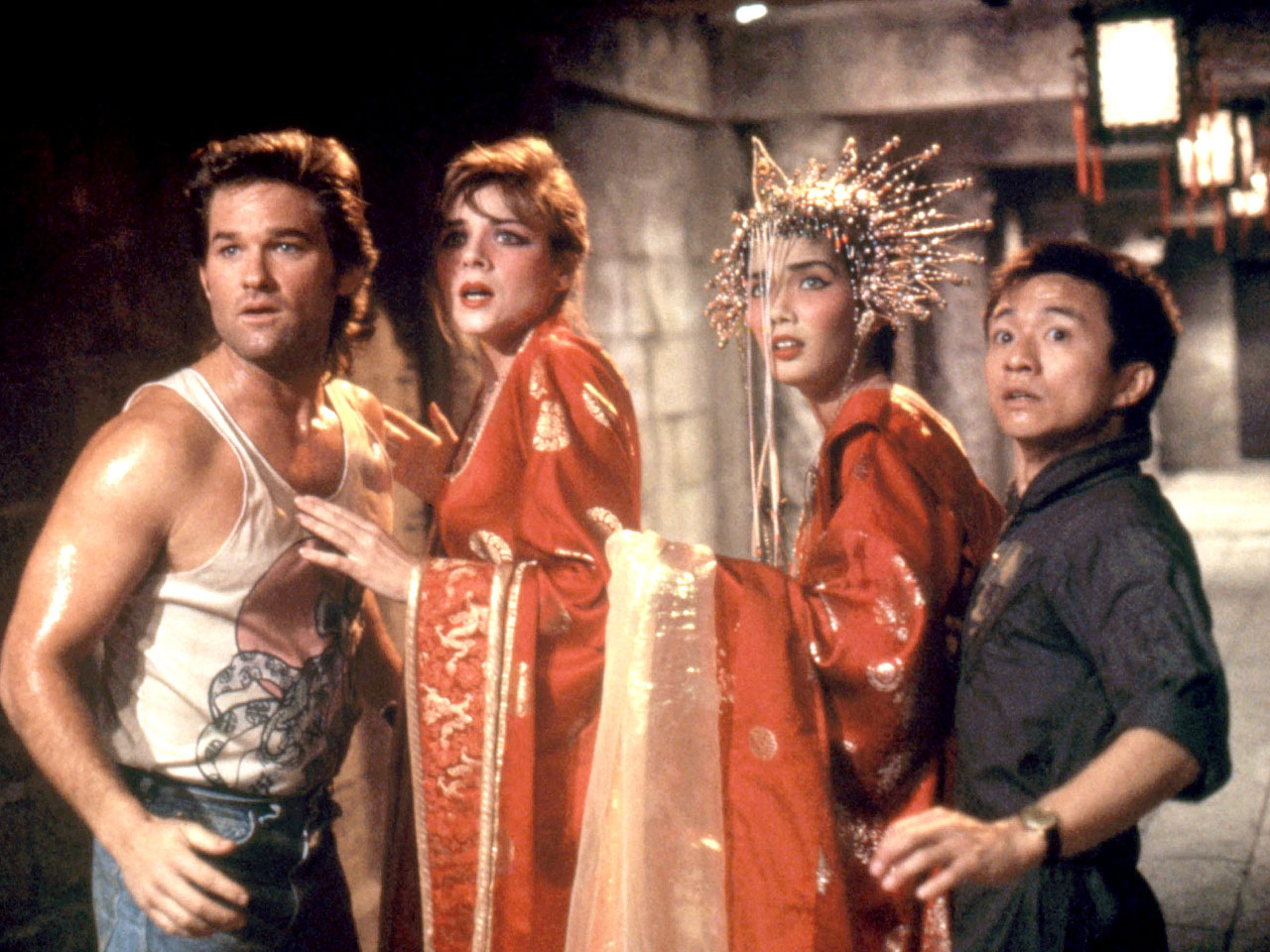
Jack Burton (Kurt Russell) is a over-the-road trucker with a lot of thoughts on life and how important reflexes are. While making a delivery in Chinatown, he gets sucked into a situation with an ancient Chinese evil trying to regain its humanity, and all Jack really wants is to get his truck back.
John Carpenter wasn’t quite a household name, but with films such as Halloween, The Thing and Escape From New York to his name, people were taking notice. Teaming with Russell for another outing seemed like it would be another win, but this one proved just a little too odd for mainstream audiences. Once it got into our homes, however, everyone fell in love with it.
As Jack Burton always says, it’s a must-see for any 80s journey.
Where to watch: Available to stream.

The Great Mouse Detective
I had never seen it, and as Disney films go, I would have been fine keeping it that way.
Set in Longon in 1897, a young mouse named Olivia Flaversham witnesses her toymaker father get kidnapped. She seeks out Basil of Baket Street, also known as the Great Mouse Detective. Along with David Q. Dawson, recently returned from serving in the military in Afghanistan, the three of them try to stop Professor Ratigan from replacing the Queen.
It’s just a Sherlock Holmes story, but with mice. I didn’t find anything that compelling about it. It was pretty enough to look at, but the story just left me fairly empty.
Where to watch: Available to stream.

Howling II
I… have a lot of thoughts.
Following up on the end of the The Howling, Ben White (Reb Brown) buries his sister Karen White, and quickly learns she was a werewolf. He teams up with werewolf hunter Stedan Crosscoe (Christopher Lee) to take down Stirba (Sybil Danning), the queen of the werewolves who is about to celebrate her 1,000th birthday, and stop the spread of the werewolf curse.
On paper it sounds fine, in execution it is just… horrible. Poorly lit, horrible acting, low-grade effects, and costuming that leaves you more confused than anything else.
Avoid at all costs.
Where to watch: Available to stream.

Psycho III
I have to admit, so far these sequels haven’t been horrible.
Following up shortly after the vents of Psycho II, Norman (Anthony Perkins) is still hiding the body of Emma Spool, and having issues again with seeing “Mother.” He hires drifter Duane Duke (Jeff Fahey) to run the motel. He also meets Maureen (Diana Scarwid), a nun on the run after she accidentally kills one of her sisters. With a new woman in his life, Mother has some thoughts on what Norman should be doing.
In general I actually enjoyed this new outing in the franchise, although it feels it missed some opportunities at the end of the story of Norman and Maureen working together. What if Maureen had actually been the one manipulating Norman this time? There was another movie lurking in the background that sadly never gets broached.
What we did end up with, however, was entertaining.
Where to watch: Available to stream.

Under the Cherry Moon
This film was unfairly maligned.
Christopher Tracy (Prince) and Tricky (Jerome Benton) as wooing women in France in hopes of getting enough money to head back to Miami one day. When Christopher hears about Mary Sharon (Kristin Scott Thomas) inherting a trust fund of $50 million for her 21st birthday, she becomes his next mark, but little does he know how it will end for him.
Following Purple Rain, Prince could do no wrong in Hollywood and was given a blank check for his next film. Audiences and critics did not warm to this film as it wasn’t Purple Rain 2 and it lived with a bad reputation for years.
I hadn’t seen it in 35 years or more when I watched it for this report, and… I really enjoyed it. It’s over-the-top, but in the right way. Prince was clearly paying homage to the silent movie romance films, and it works for what it is. Is he a great actor? No. Does it work for this film? Yes.
Honestly, this may be one of the most enjoyable films I’ve had in this project in several weeks. It’s worth a reassessment.
Where to watch: Available to stream.
1986 Movie Reviews will continue on July 11, 2026, with Club Paradise.
Entertainment
Taylor Swift and Travis Kelce: Revisit the roots of their love story ahead of MSG wedding bash

Taylor Swift and Travis Kelce’s love story will reach new heights this week with a totally low-key two-day wedding bash at New York’s Madison Square Garden.
The billionaire pop titan and the NFL star, both 36, kicked off their wedding festivities Thursday afternoon with a rehearsal dinner at the famed sports arena. They have all but confirmed that they will then exchange their vows Friday in a grand MSG celebration with around 1,000 guests (including Swift’s celebrity friends and Kelce’s fellow sports stars) in attendance, at least according to numerous reports. The celebrity wedding will also reportedly feature heightened security around Madison Square Garden, performances by Stevie Nicks and Tim McGraw, and a red carpet outside the arena.
Representatives for Madison Square Garden, Swift and Kelce have not responded to The Times’ requests for comment.
Swift and Kelce’s relationship began nearly three years ago during the singer’s blockbuster Eras tour with a simple request and a friendship bracelet. Read on to revisit the roots of Swift and Kelce’s whirlwind romance turned generational love story, from the Kelce brothers’ “New Heights” podcast to a romantic garden engagement.
July 2023: Travis Kelce shoots his shot
Swift and Kelce’s romance can be traced back to summer 2023, when the Kansas City Chiefs tight end attended an Eras tour concert at Arrowhead Stadium, the Chiefs’ house. Kelce — a self-proclaimed Swiftie — told brother Jason Kelce in an episode of their “New Heights” podcast that he had a friendship bracelet with his phone number on it but didn’t get it to the singer. “I was a little … hurt I didn’t get to hand her one of the bracelets I made for her,” he said at the time. Eventually, the two got in touch.
September 2023: Taylor Swift shows up for her guy
Taylor Swift watches the Chiefs take on the Chicago Bears at Arrowhead Stadium in Kansas City, Mo., on Sept. 24, 2023.
(David Eulitt / Getty Images)
The then-rumored romance quickly became commentary fodder for NFL broadcasts (sometimes to sports fans’ chagrin) but took a turn when Swift seemingly accepted Kelce’s personal invitation to a home game. She was seen cheering for him in a private box alongside his mother, Donna Kelce. Soon enough, Swift became a staple in the Chiefs audience. In the following months, Swift and Kelce further solidified their relationship, making it paparazzi-official during an after-party for “Saturday Night Live” and on her Eras tour in November when the singer changed her “Karma” lyrics to reference her budding romance.
February 2024: Super Bowl LVIII (Taylor’s Version)

Chiefs tight end Travis Kelce and Taylor Swift smooch after Kansas City Chiefs defeated the San Francisco 49ers at the Super Bowl in Las Vegas in February 2024.
(John Locher / Associated Press)
Swift and Kelce’s love notably played out at Super Bowl LVIII, where the Chiefs faced the San Francisco 49ers. When the Chiefs won, the Grammy winner joined Kelce on the field, kissing and hugging him. A week before the big game, Swift announced her album, “Tortured Poets Department,” at the Grammy Awards. The album seemingly refers to Kelce in songs “The Alchemy” and “So High School.”
The pair continued going strong throughout 2024. As Swift‘s tour continued, Kelce joined his superstar girlfriend on stage in London. She also returned regularly to Arrowhead Stadium for Chiefs home games during the 2024-25 NFL season. Swift ended her Eras tour in December 2024 and hosted a private wrap party to celebrate her musical marathon. Of course, beau Kelce was in attendance.
August 2025: Baby, just say ‘yes!’
The following year was a relatively quieter one for the couple. Kelce and his Chiefs failed to beat the Philadelphia Eagles at Super Bowl LIX and Swift was in the midst of recovering from her tour and preparing for her newest album. But just when there seemed to be a lull in all things Taylor-Travis, the couple hit some major milestones.
First, Swift finally appeared on the Kelce brothers’ “New Heights” podcast. Remember, that’s where all of this started. The couple, of course, spoke about their whirlwind romance, but the main headline was that Swift would release her album “The Life of a Showgirl” later that fall. With songs “Redwood” and “Wish List,” it was pretty clear Kelce inspired Swift during the songwriting process.
Second, and more importantly, “Love Story” singer Swift announced on Instagram that she and Kelce were engaged. She shared photos from their dreamy garden proposal with the caption: “Your English teacher and your gym teacher are getting married.” Kelce popped the question with an elongated old mine cut cushion set within an engraved gold band. Speculation on the details of their nuptials, including date and location, were almost immediately underway.
Since their engagement, Kelce and Swift have appeared together at a handful of high-profile events including the iHeartRadio Music Awards in March, courtside at Rocket Arena in Cleveland during the 2026 NBA playoffs and the Songwriters Hall of Fame induction ceremony in June, which honored Swift.
For now, welcome to New York, soon-to-be Mr. and Mrs.
-
World7 minutes ago
150 people from 50 countries become US citizens at Mount Vernon on America’s 250th birthday
-
 Lifestyle49 minutes ago
But first, coffee: The drink that energized the American Revolution
-

 Technology57 minutes ago
NASA launched an emergency mission to stop the Swift Observatory from crashing to Earth
-

 World1 hour ago
Tens of thousands of far-left protesters clash with police in anti-conservative party riots
-

 Politics1 hour ago
Trump set to deliver ‘historic’ speech celebrating America’s 250th anniversary
-

 Health1 hour ago
The ‘1776 Diet’: What Americans really ate during the nation’s founding
-

 Sports1 hour ago
Kylian Mbappé’s seventh goal of the World Cup lifts France past Paraguay in physical Round of 16 match
-
 Business1 hour ago
California is bringing back EV rebates. This is how to get one

