Entertainment
Review: ‘The Testaments’ feels timely because it’s the Epstein files writ large

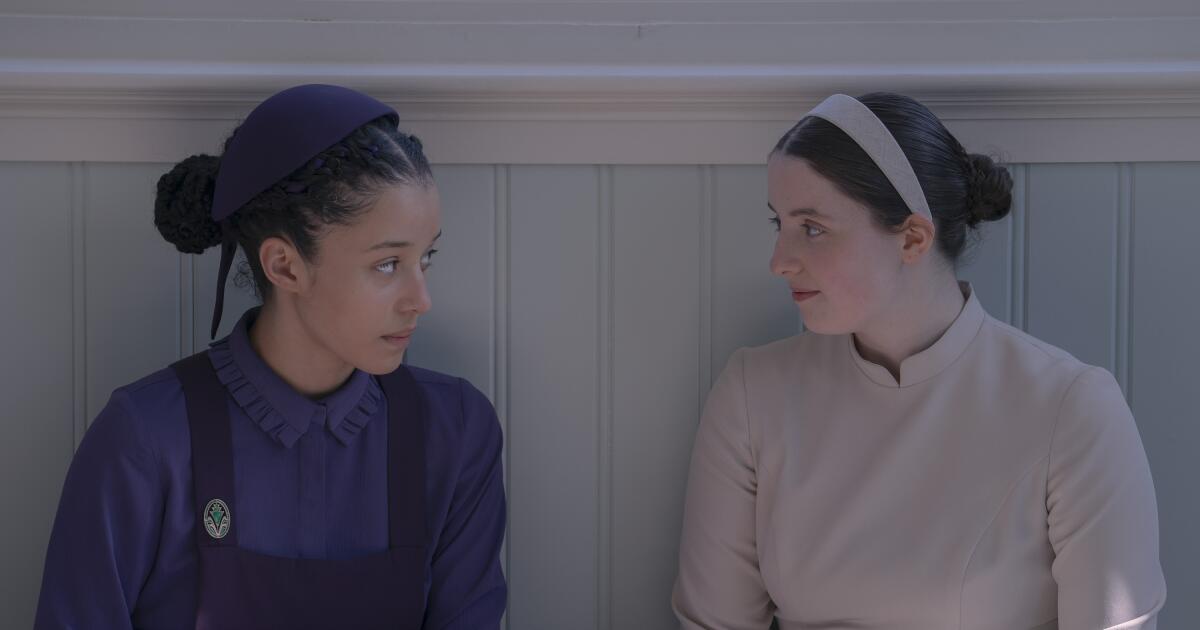
When the Hulu adaptation of Margaret Atwood’s “The Handmaid’s Tale” premiered during the early months of the first Trump presidency, it was seen by many as a timely prophecy — the crimson cloaks and white bonnets of the story’s eponymous sex slaves became a symbol of protest against a president who, though not a religious man himself, embraced many policies supported by the far-right Christian minority, especially those regarding the reproductive and civil rights of women.
This was not the plan, of course, or at least not as regards the Trump factor. The book was written in 1985, the show greenlit long before Trump became president, which only proves the grim resilience of Atwood’s themes. So it shouldn’t be surprising that the sequel series, “The Testaments,” also has name-specific cultural resonance. Plum-cloaked in a YA-leaning, high school drama that owes as much to “Pretty Little Liars” or “Gossip Girl” as it does to “The Handmaid’s Tale,” “The Testaments” gives us an apocryphal version of the Epstein files.
Based on Atwood’s 2019 Booker Prize-winning novel, “The Testaments” takes place some years after the final events of “The Handmaid’s Tale” series and revolves around Ardua Hall where Aunt Lydia (Ann Dowd), having regained her Gileadean status, oversees the instruction of young women as they prepare to take up their lives as obedient wives and, Under His Eye, fruitful mothers.
Agnes (Chase Infiniti) is our initial central character and narrator. Though we know from her backward-looking tone that change is coming, her initial main worries are her mean stepmother and when (or if) she will finally begin to menstruate. She and her friends — Becka (Mattea Conforti), Shunammite (Rowan Blanchard) and Hulda (Isolde Ardies) — have all graduated from the “Pinks” (little girls) to the “Plums” (young women) but only Becka has achieved the “blessing” of menarche, which means she can now be chosen by an unmarried (or widowed) Commander or other man of lesser rank.
This particular form of reaping occurs midway through the season at a dance where all the eligible girls meet with all manner of young bachelors, only to discover that the oldest and most powerful members of the elite get first choice. Watching as the men joke among themselves before staking their claims, it is difficult not to think of Jeffrey Epstein parceling out young women to his powerful male friends (albeit not for marriage).
Though touched on throughout “The Handmaid’s Tale,” the horrifying connection between status and the systematic procurement of women is the sinister force that drives “The Testaments.” A global infertility crisis may have been the catalyzing force for Gilead’s rise but this “privilege” of power is not about repopulation; Agnes and the Plums are simply victims of sexual grooming taken to its pathological conclusion.
Becka is the only one who is less than thrilled by her “prospects” — everyone else, including Agnes, can hardly wait to be married off and, with any luck, quickly become pregnant (not that they know anything about sex, forced by the state or otherwise).
Having been raised in a beautiful home with no material wants, Agnes knows little about the outside world. Like most women in Gilead, she is not allowed to read or write, and she and her friends coolly accept public executions, torture and other means of corporal punishment as the inevitable consequence of breaking any of the many rules drilled into them. They accept that their bodies are instruments of the devil designed to compel men to commit lustful acts and that they are responsible for ensuring that this does not happen.
Ann Dowd reprises her role as Aunt Lydia in “The Testaments.”
(Russ Martin / Disney)
But girls will be girls and even under the stern eye of Aunt Vidala (Mabel Li) and the more kindly countenance of Aunt Estee (Eva Foote), they tease each other and romp together, compare hairstyles and trade snarky comments about the Aunts as they dream of a happy ending.
In its own way, that’s even more chilling and resonant than the horrors of “The Handmaid’s Tale.” Enslavement will always require some level of violence, but violence tends to spark rebellion — indoctrination is always more effective. Training people to believe they are fated, or even happy, to live without freedom, rights or real choice is the only way a totalitarian society can survive.
Showing this is far less exciting than the images of grown women being killed or stripped of their rights as presented in “The Handmaid’s Tale” (though “The Testaments” does offer a few very chilling flashbacks). But as social commentary, it’s difficult to beat the sight of young women, recognizable in so many ways as modern teens, complying with their own enslavement, out of ignorance and, as events proceed, the gut-wrenching fear of what the truth might mean.
Gilead’s future hangs on whether the Plums remain ignorant and compliant, as does the story of “The Testaments.” Agnes may not share Becka’s unhappiness with forced marriage, but she is soon given other things to worry about, including a growing attraction to one of the Eyes who guards her and a request to mentor one of the school’s new “Pearl Girls.” These young female missionaries, dressed in white, have been sent into Canada to draw girls to Gilead’s cause. Among the recruits is Daisy (Lucy Halliday), who Aunt Lydia puts under Agnes’ care.
Shunammite, the sharpest-tongued of Agnes’ friends, is convinced Daisy is a spy. Daisy, whose backstory includes, in the first episode, a brief glimpse of Elisabeth Moss’ June, certainly upsets things, most often by reacting to Gilead’s penchant for public atrocities the way a non-sociopath outsider would.
Over the course of the season (upon which many, many plot-point embargoes have been placed), Agnes and Daisy form a bond that threatens Agnes’ worldview, as well as her friend group. The novel “The Testaments” is a much larger and more complex book than “The Handmaid’s Tale.” Each are presented as historical records of a government long gone, but where Bruce Miller, who adapted both, had to first spin a series out of “The Handmaid’s Tale’s” relatively short and fairly elliptical story, he has much more to work with here.
He does so carefully, and perhaps a tad too slowly. Much of the first season is spent getting to know the girls, especially Agnes (whose pre-Gilead identity is obvious to anyone who read or watched “The Handmaid’s Tale.”) Coming off her Oscar-nominated performance in “One Battle After Another,” Infiniti masterfully conjures the rigorous placidity of a young woman so accustomed to holding herself in check she has a hard time recognizing the difference between her mask and her real self.
Her friends share the same disability, though to greater and lesser degrees. As their characters, Conforti, Blanchard and Ardies, deftly carve out discrete personalities beneath their plum-colored homogeneity, each playing a role that is, in turn, playing a role while also remaining desperately human.
Halliday as Daisy is the rawest nerve among them, but all the main characters, including the Aunts, are people trapped inside uniforms and all allow their intelligence to shine through state-imposed ignorance, embodying both the tense acceptance of indoctrination and the disorientation that strikes when it begins to crack.
Dowd, of course, is next level. Compressing and occasionally revealing all that she has been through in “The Handmaid’s Tale” and before, what she manages to make Aunt Lydia is both Dorian Gray and his portrait. What exactly Aunt Lydia is doing by handing Daisy into Agnes’ care is not made clear but she is obviously doing something.
Both “The Handmaid’s Tale” and “The Testaments” were written as historic documents gathered from a fallen regime; it doesn’t break any embargo to say that at some point Gilead will fall. Whether that fall begins, or occurs within, the action of “The Testaments” remains to be seen.
But we all know what happened to Epstein in the end.



Movie Reviews
Movie Review: Ian McKellen and Michaela Coel are razor-sharp in art comedy ‘The Christophers’

“The Christophers” looks like an art heist movie at first. A couple of wannabe heirs (James Corden and Jessica Gunning) hire a restoration specialist (Michaela Coel) to finish a series of paintings by their famous father (Ian McKellen), who wants nothing to do with them or the uncompleted works that would surely command an astronomical price tag.
The offspring, whom McKellen’s Julian Sklar vividly describes as wrecks — one a train wreck, one a shipwreck — feel they deserve an inheritance they’re smart enough to know they won’t receive through any will — or talent of their own. The specialist and sometimes forger Lori (Coel) has other motives. There’s the promise of paying rent, yes, but there’s also an element of revenge. Lori and Julian have a kind of history that the movie will reveal in time. She’s also been publicly critical of his later works.
But “The Christophers” is not an “Ocean’s” movie or a “Logan Lucky,” which is to say it’s not really a heist. There’s the tease of one, right up until the end, and the promise of the con. This latest film by the great and astonishingly prolific Steven Soderbergh is not out to give the audience what they think they want from him. Instead, it’s a meditation on art, legacy, creativity and the oh-so-touchy subject of who has the right to critique. It might sound a bit dreary, but Ed Solomon’s razor-sharp script and the brilliant pairing of McKellen and Coel make this lean two-hander breeze by.
You can read however much you want into how much Soderbergh (or Solomon) may or may not relate to Julian, who is determined to burn, bury and shred the unfinished “Christophers,” a series of paintings of a former boyfriend that became his most famous. It’s a fun and prickly exercise for any creative person to reconcile with the peaks and lulls of a long career in the arts — and Julian is luckier than most. He actually got famous and relatively wealthy from his paintings.
Julian huffs that “to judge art one must possess the skills to make said art.” It’s the kind of statement that, if given in an interview, might launch a thousand think pieces. Julian is both old and a devout rebel, with a lifetime’s worth of wisdom, wit and burned bridges in his arsenal. It’s a potent combination ripe for internet virality, but at the moment his online presence is mostly relegated to something akin to Cameo messages for 149 pounds a pop (249 if he mimes a signature).
When Lori arrives, he suddenly has an audience for his theatrical, nonstop musings: fun for McKellen, his character and the audience, but not so much for Lori, who absorbs the monologuing with steely indifference until she decides to take more control of the situation. There’s a bit of the generational disconnect that happens, but it’s somehow never cliche or predictable. The story zigs and zags with its characters as they work through the situation at hand and the larger issues both seem to be plagued by. The script throws a lot of ideas out there and, refreshingly, none of them is to be taken as dogma, especially not Julian’s comment about who has the right to judge art. Like many things he says, it’s probably just the most withering thing he could think of at the moment.
It is a funny thing, though, to critique a movie that does have so much to say about criticism, about what the person behind the keyboard might actually have the guts to say out loud to the person courageous enough to make something and put it out in the world. Perhaps it’s not actually that hard when the movie is as solid as “The Christophers,” or when the filmmaker in question is on a roll like Soderbergh with both “Presence” and “Black Bag.” His movies may have gotten smaller, but the verve remains.
This image released by Neon shows Ian McKellen in a scene from “The Christophers.” Credit: AP/Claudette Barius
“The Christophers,” a Neon release in New York and LA on Friday and nationwide on April 17, is rated R by the Motion Picture Association for “language.” Running time: 100 minutes. Three stars out of four.
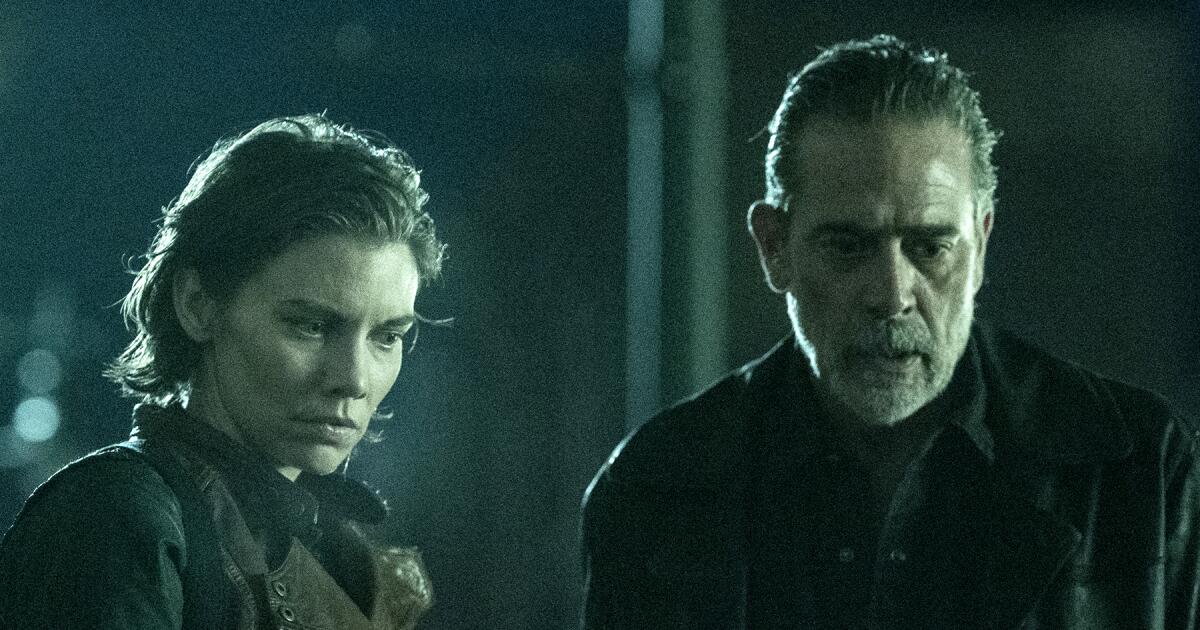
AMC Networks, the cable home of “The Walking Dead” and adaptations of Anne Rice’s vampire novels, is getting a new name to reflect its shift to streaming and program production.
In a legal filing, the New York based company announced Wednesday it will be called AMC Global Media, effective immediately.
The company, which owns a suite of cable networks including AMC, We TV, SundanceTV, BBC America and IFC, said most of its domestic revenue now comes from streaming.
AMC has more than 10 million paid subscribers to its services including Shudder, a platform for horror fans, and ALLBLK, which caters to Black audiences, an anime service called HIDIVE and All Reality which is devoted unscripted programming.
AMC’s production studio distributes programming to TV networks and streaming outlets internationally. The company has also sold shows domestically to outside streaming services such as Netflix and HBO Max.
“Our new name reflects the ongoing transformation of our business into a global media and studio-driven company, with streaming out front as our leading source of domestic revenue,” the company’s chief executive Kristin Dolan said in a statement.
AMC Networks has seen revenues decline as consumers forgo satellite and cable subscriptions and move to streaming for video entertainment. The decline in ratings has put pressure on adverting dollars as well.
The company’s stock closed Wednesday at $7.55. It was trading at over $60 per share in 2021.

Watch Psycho Killer on VOD now
Psycho Killer was directed by Gavin Polone, who has produced a lot of amazing genre movies. These include Stephen King‘s Secret Window (2004), Cold Storage, and Zombieland: Double Tap, while also having produced projects in various other genres. As a director, this is his feature film debut, and I’m sorry to say I think this is the main issue of the finished product.
I say this because the screenplay was written by Andrew Kevin Walker, who also wrote Se7en. Much of what I liked initially about Psycho Killer feels like classic Andrew Kevin Walker, so I’m hesitant to truly believe the story is bad. After all, the iconic Seven could also have been a very strange experience if not directed by David Fincher.
For the record, Seven is far from the only successful script by Andrew Kevin Walker. He also wrote Brainscan (1994), Hideaway (1995), 8MM (1999), Sleepy Hollow (1999), The Wolfman (2010), Windfall (2022), and The Killer (2023). In other words, he is very far from being a one-hit wonder.
I don’t want to recommend that you skip this movie, because the first half of Psycho Killer shows what a brilliant serial killer horror slasher this could have been. So watch it, and try to prepare yourself for an ending that does not live up to that strong opening.
Psycho Killer is out on digital from April 7, 2026.

Michigan Lottery Daily 3, Daily 4 results for April 8, 2026

New boating safety law in effect in Massachusetts

What will bring visitors back to the Science Museum of Minnesota?

Mississippi Farmers Market to host Native Plant Fest

Missouri advocates push for red flag laws

Florida High School Football Rankings: Top 25 teams – Oct. 21

How old is Bo Nix? What to know about Oregon quarterback ahead of 2024 NFL Draft

Cleary's 21 help Le Moyne down Central Connecticut State 69-64 in OT

99th annual Pony Swim held in Virginia

Indiana Members Credit Union announced as new anchor tenant at Bottleworks District

Video: Military Families Bear the Burden of War, Again

Fox News Poll: Record number say taxes are too high; government spending seen as wasteful

‘Even the street cats ran’: Inside Israel’s deadliest attack on Beirut

California Supreme Court halts GOP sheriff’s voter fraud investigation

AOC doubles down on call for Trump’s ouster even after ceasefire announcement
-

 Atlanta, GA4 days ago
1 teenage girl killed, another injured in shooting at Piedmont Park, police say
-

 Movie Reviews7 days ago
Vaazha 2 first half review: Hashir anchors a lively, chaos-filled teen tale
-

 Culture1 week ago
Do You Know Where These Famous Authors Are Buried?
-

 Georgia1 day ago
Georgia House Special Runoff Election 2026 Live Results
-

 Pennsylvania2 days ago
Parents charged after toddler injured by wolf at Pennsylvania zoo
-

 Education1 week ago
Video: We Put Dyson’s $600 Vacuum to the Test
-
 Milwaukee, WI2 days ago
Potawatomi Casino Hotel evacuated after fire breaks out in rooftop HVAC system
-
 Entertainment7 days ago
Inside Ye’s first comeback show at SoFi Stadium