Entertainment
Review: 'The Pradeeps of Pittsburgh' is a splendid new comedy centered on an immigrant family

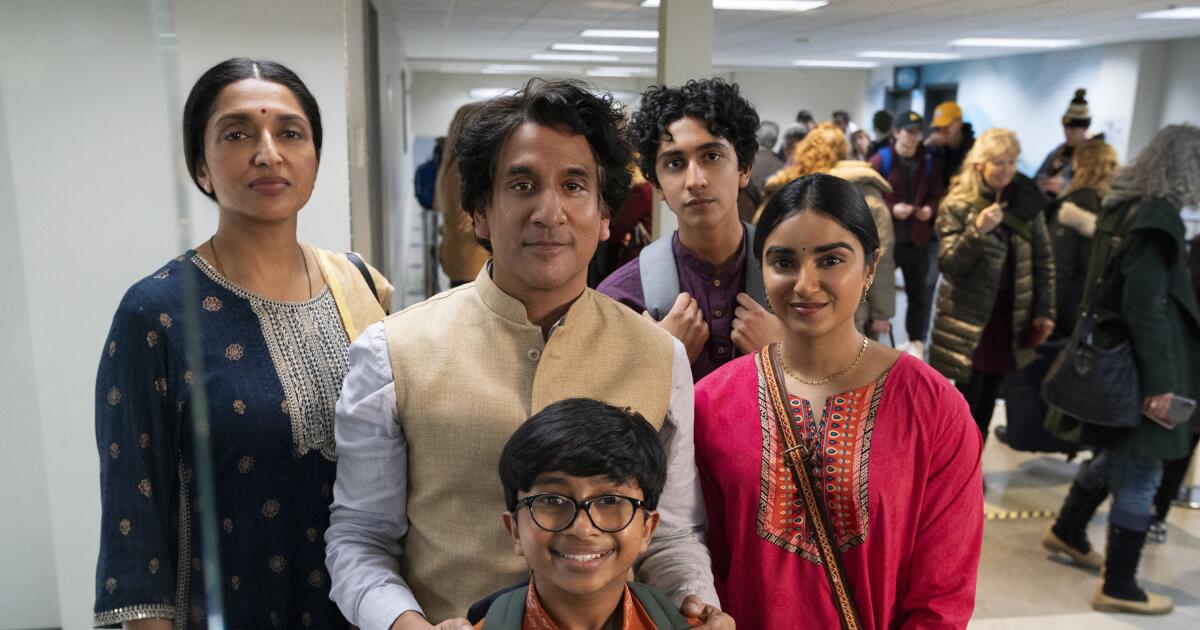
“The Pradeeps of Pittsburgh,” premiering Thursday on Prime Video, is a funny, splendid, oddball new series from Vijal Patel, whose own family experience it reflects and whose writing and producing credits include “The Kids Are Alright,” “black-ish” and “The Middle,” among the century’s best family comedies — which is to say it comes from a place of professional knowledge and lived experience.
That it’s generic on a couple of counts — culture clash comedy, battling neighbors comedy, crazy family comedy — says nothing against it, since you have not seen these characters before, and the writing and acting are consistently top flight. If I say it reminds me of Jason Jones’ great “The Detour,” whose framing (it’s a story being told to investigators), family dynamics and hectic attitude it calls to mind, I don’t expect it to mean anything to many readers; but those who know, know.
We begin in the offices of the U.S. Immigration and Naturalization Service, where the five Pradeeps, who arrived from India two years earlier, are being interviewed by two agents identified in credits only as Dark Suit (Pete Holmes), the friendly junior, and Light Suit (Romy Rosemont), his super-serious superior. They’re trying to get to the bottom of a couple of mysteries — who burned down a house, and something illegal that happened in Ohio — which might or might not end in the family’s deportation.
Father Mahesh Pradeep (Naveen Andrews) is behind the move to Pittsburgh (played by Toronto, and snowing when they arrive). He has a contract with SpaceX to make some sort of rocket part and a space to make it in (formerly a sex toy factory, with some inventory still on site). Wife Sudha (Sindhu Vee), the power in the family, is a surgeon who expects that Americans’ poor eating habits will keep her busy in the new country. Eldest child and only daughter Bhanu (Sahana Srinivasan) sees America as a chance to break free and live; middle child Kamal (Arjun Sriram) is freakishly attached to his mother and afraid of everything; and youngest Vinod (Ashwin Sakthivel) is, in his mother’s words “an optimistic dufus” who worships the garbage man.
Vinod (Ashwin Sakthivel) is the youngest Pradeep, whom his mother describes as an “optimistic dufus.”
(Steve Wilkie / Prime Video)
“It’s OK, we have two others,” Mahesh says to Sudha, when Vinod declares his intention to follow that profession.
“Do we?” she ruefully wonders.
Two houses over live the Mills, Janice (Megan Hilty), Jimbo (Ethan Suplee) and son Stu (Nicholas Hamilton); Sudha describes them as trash, but they do have a thing for TV show “The Good Fight.” Janice, who makes velour Bible covers she hopes to sell on QVC and has a sideline selling nutritional supplements, is also Kamal’s English teacher, on whom he has an all-consuming crush. Jimbo, who coaches basketball at Vinod’s school, is friendly and nonjudgmental, and he and Mahesh, who is also friendly and nonjudgmental, easily bond. (Which is not to say there won’t be hiccups.) Stu, a sweet lug Bhanu first sees doing pull-ups in his garage, will become the focus of her romantic aspirations, and she his. Vinod will later be smitten with Stu himself, when he discovers his online stunt videos.
Naturally, things will not go smoothly. The story is developed through interviews with all the main and some minor characters who pass narration on to one another like a basketball, each bringing a different point of view, reflected in what plays out onscreen. (Sudha and Janice’s visions of each other’s children as corrupting influences on their own is especially funny.)

Ethan Suplee and Megan Hilty star as the Pradeep’s neighbors, Jimbo and Janice.
(Ian Watson / Prime Video)
There are more jokes about (white) Americans from the South Asian point of view than about South Asians from the (white) American point of view. On first stepping on to the school bus, Bhanu gasps as she’s “blinded by the Caucasians.” Sudha explains that the denial of a medical license is a matter of “accreditation and compatibility, a.k.a. America hates brown foreigners.” Still, though race is a subject for humor — “I don’t even see color,” says Janice, “to me everyone’s white” — it’s not the subject of the series.
There are weak spots. The question of Mahesh’s business is so far in the background, except as a shadowy motivating force, or a threat to stability, that it barely exists at all. (A late scene reveals some random equipment in his factory, but there is no one to work it.) Indeed, one wonders how the Pradeeps have survived for two years. A drug dealing storyline, portrayed as innocuously as drug dealing can be, fades away to nothing, and makes no great sense for the characters involved — though it does produce some funny scenes in Janice’s imagined retelling.
The central mysteries are strung out across the season’s eight episodes, as the agents pursue — but practically speaking, put off — answers. (Their evolving relationship is its own amusing arc.) Episodic events involve bullies, basketball, bankruptcy, a bad grade, a Halloween party, a hunting trip. Vinod makes two friends, Willa (Beatrice Schneider), who stutters, and Mo (Zachary Rayment), who walks with two canes; a sort of pee-wee “Jules & Jim” scenario develops.
Indeed, you may have stopped caring who burned down the Mills’ house long before you realize it’s nothing you’re going to learn this season. All that matters is how our heroes — and they’re all heroes, each in their own way — get along. Deep down, every dysfunctional family comedy is about togetherness.



Movie Reviews
‘Only Beautiful Things to Look At’ Review: A Handsome but Muffled Portrait of State-Sanctioned Cruelty

The fashions and furnishings of Czechoslovakia in the 1980s — the height of the state’s racist program of suppressing the Roma population through coerced sterilization — are painstakingly evoked in Slovakian filmmaker Ivan Ostrochovský’s “Only Beautiful Things to Look At.” But the film’s attractive yet oddly bloodless presentation gives the impression of a period drama set much farther back, as though we’re peering at the prettily mounted arrowheads and artifacts of a long-gone atrocity through museum glass. Alongside the decision to centralize the perspective of a white female doctor, this old-school, soft-focus approach robs an undeniably well-intentioned movie of a vital edge of urgency and discomfort, allowing viewers to consign the cruelties it outlines to some imaginary distant past, when in truth, the sterilization policy continued well into the 21st century in both the Czech and Slovak Republics.
The film begins with a montage of young Roma women, each shot as though for a studio portrait, impassively absorbing an offscreen voice lecturing them about family planning. “Sterilization,” the voice concludes disingenuously, “allows Gypsy women to improve their family’s quality of life.” The intention behind the portraiture is noble: to put faces to a crime more often recounted in impersonal statistics, when it is acknowledged at all. But although framed and lit with dignity by cinematographer Juraj Chlpík, none of these Roma women speak. The first words of argument or protest we hear are from Ingrid (Anna Geislerová), the film’s white protagonist, and she is not talking about reproductive rights at all. Instead, she is facing an all-male panel of her peers as she interviews for the role of head doctor at the hospital where she works. Ingrid knows the position will very likely go to one of her male colleagues, but that doesn’t stop her being angry and disappointed when it actually does.
Outside her work at the hospital, which in large part comprises assessing and performing the sterilizations in a procedure that leaves patients with a small scar beneath the navel nicknamed “the bow,” Ingrid has what can only be described as a beautiful life. With her music teacher husband Maros (Vlad Ivanov), she lives in a gorgeous house in the countryside, where her bedroom, glass-paned on two sides overlooking a lush forest, looks almost like a fairytale princess’ lair. In the warm-lit evenings she and Maros read and drink wine and listen to classical music; on her days off she goes for walks in the forest or, when it’s hot, visits the nearby river and looks on benignly as Roma children bob along playfully on tire tubes.
It is only through her burgeoning friendship with Agata (a radiant Simona Boledovičová), a sweet-natured orderly who is reticent about her Romani idenitity, that Ingrid eventually starts to become uncomfortable with the work she does helping the hospital meet its government-recommended quotas for sterilizations. Ostrochovský’s film, co-written with Marek Leščák, is not anything quite as crude as a white savior narrative, but it is certainly one that assumes the best conduit for a wide audience to understand the cruelty visited on Czechoslovakian Roma families, is the moral awakening of a white woman.
This faulty focus is particularly frustrating because Agata’s own story, and the manner in which she comes to reconcile herself with her Roma background, is by far the more intriguing narrative strand. As an orphan, Agata was separated from her sister Jula (an excellent Eva Mores), with each then going on to lead very different lives. Jula married within the Roma community, has had two children and is pregnant with an unwanted third. Agata, who at first barely acknowledges their connection, has been more independent, living with a roommate and working at the hospital, and recently getting serious with a boyfriend. “He’s white?” queries Jula in surprise when she hears that he’s a soldier. “Good for you.”
The tides of unspoken resentment and disapproval that flow between the sisters are fascinating, with Agata able to move between Jula’s world, in a cramped flat in a crumbling building where kids play in dirty stairwells, and Ingrid’s enviably refined domestic environment. Eventually, just like Chlpík’s limpid camera, Agata comes to see the beauty in both, when in the film’s most moving moment, the sisters tacitly reconcile while Jula’s kids splash about in the tub at bathtime. There would have been the opportunity here to probe the long-term consequences for the Roma women bearing “the bow,” many of whom had been conned into a procedure that was misrepresented to them, in a language they did not speak, or in documentation they could not read.
Instead, the film insistently returns us to Ingrid. As she’s kept awake by the first stirrings of her conscience, as she lazes in rumpled white bedsheets watching a beetle trundle across her pillow, as she’s depicted in macro close-ups that emphasize the blondeness of her hair, the fairness of her skin, the blueness of her eyes. Indeed, right up to a finale which resolves the remaining conflict with a rather glib miracle, the film’s loveliness practically becomes a liability, placing the real plight of the Roma several removes of perspective and aesthetic manipulation away, until you begin to wonder why we’re being given only beautiful things to look at, when there are so many ugly things that better warrant the attention.

Here’s a terrible-seeming idea: The Rolling Stones should get started on their next album.
Like, now.
After taking nearly two decades to release 2023’s “Hackney Diamonds” — the band’s first set of original material since “A Bigger Bang” in 2005 — the Stones are back this week with a follow-up, “Foreign Tongues,” that took them less than 36 months to get out.
And it’s the better record in every way.
In the old days, of course, two and a half years was all they needed to make “Beggars Banquet,” “Let It Bleed” and “Sticky Fingers.” So let’s not get too carried away by the fact Mick Jagger, Keith Richards and Ronnie Wood are working as fast as they are in their late 70s and early 80s.
Yet to listen to the brisk and sportive “Foreign Tongues” is to hear a band clearly going on instinct rather than overthinking the music à la any number of veteran acts in legacy-maintenance mode. I don’t know if the result is the Stones’ best since 1978’s “Some Girls,” but it’s definitely the funniest, which is actually the more impressive achievement.
“Wake up in the morning and you wanna make me puke,” Jagger sneers in the punky “Hit Me in the Head” — exactly the kind of lyric you’d hope to hear from a band whose only possible reason for still being in the game is to have a gas-gas-gas.
Like “Hackney Diamonds” — and, for that matter, like Paul McCartney’s “The Boys of Dungeon Lane” (to name one recent overthinking-veteran LP) — “Foreign Tongues” was produced by 35-year-old Andrew Watt, who’s made a career of helping boomer icons put a little shine on their late-in-life efforts. And he’s helped the Stones convene an appealingly motley crew of collaborators here, including McCartney (who plays bass on “Covered in You”), the Cure’s Robert Smith (who contributes guitar to “Divine Intervention”), Steve Winwood (who plays piano and organ throughout the album) and Bruno Mars (who’s credited with, uh, cowbell in “Never Wanna Lose You”).
You also get a welcome appearance from the late Charlie Watts in a hard-thwacking performance recorded before his death in 2021. (Steve Jordan otherwise keeps time.)
But none of the stunt casting feels like the point of the album, which instead simply doles out a dozen tunes in the Stones’ various idioms — the bluesy stomp, the country-ish lope, the sleazy disco jam — plus a couple of covers in just over an hour. It’s frisky and lighthearted, even when Jagger is lamenting what he sees as the sorry state of his beloved America in “Ringing Hollow” and when Richards is croaking about love having put him on his knees in “Some of Us.”
And when they go goblin mode, they really lean in: “Mr. Charm” is a demented soul-rock rave-up about how boring money is — OK, Mick — in which Jagger drops a diss of the “mad mogul Mr. Musk” into a verse laying out the delights of staying home and doing anagrams.
In “Divine Intervention,” Jagger offers a colorful travelogue of trips through New York and Los Angeles — “I kept moving on to Silver Lake / To play guitar with a brand new friend of mine” — while Richards and Wood get their guitars slip-sliding all over the place. “Jealous Lover” is gorgeously trashy: a horny little strut that sounds like “Dirty Mind”-era Prince doing “Waiting on a Friend.” (Legitimately loony Mick vocal here.)
For God knows what reason, the Stones offer up a faithful rendition of Amy Winehouse’s “You Know I’m No Good” with Jagger on harmonica. And the album ends with a very ragged take on Chuck Berry’s “Beautiful Delilah,” obviously meant to remind you of how the two lifers at the core of the Stones came together more than half a century ago.
The memory is ancient; the thrill, somehow, is alive.

Comedy is a matter of taste and preference — it’s a deeply personal thing. Which makes it hard for a critic to give a blanket assessment of a specific kind of comedy, especially if it didn’t work for them, but clearly worked for others (the laughter or lack thereof is the indication). “It’s not funny,” the critic says, “well I had fun,” someone else can reply, and then we’re at an impasse.
Which is the dilemma one finds oneself in with “Gail Daughtry and the Celebrity Sex Pass,” a very strange and shaggy Hollywood satire of sorts from David Wain and The State crew, still riding the goodwill of “Wet Hot American Summer” after all these years. If only this were as funny.
“Gail Daughtry” lives in the same world as that iconic summer camp spoof, as well as Wain’s 2014 rom-com parody, “They Came Together,” in that he’s playing with genre convention and expectation, taking well-known norms to the goofiest extremes. But those films hewed more closely to their respective genres, while “Gail Daughtry” is totally scattered, combining crime and spy movie tropes with a fish-out-of-water comedy and a Hollywood send-up. It has far too many ideas for its own good, and yet no ideas that are good enough to sustain this bizarre curio of a comedy.
What’s ironic is that one of the problems driving this wacky plot forward is the characters have to come up with a movie idea to pitch to star Jon Hamm (playing himself of course), leading them to do some pretty inane and shockingly violent things. It’s almost as if Wain and co-writer and co-star Ken Marino had no idea for a movie, then baked their search for an idea into their script, and then turned it into a madcap adventure about a woman on a quest to have sex with Jon Hamm. What an ouroboros!
OK, about the sex quest. Gail Daughtry (Zoey Deutch) is a chipper hairdresser from Kansas born without the part of the brain that recognizes sarcasm or irony. She’s a cheerful, Pollyanna-ish naïf whose literal-mindedness is almost as extreme as Amelia Bedelia. Her childhood sweetheart and fiancé Tom (Michael Cassidy) is the same. She tells him about the concept of the “celebrity sex pass” as a joke, and he promptly boinks Jennifer Aniston at local book reading.
(Nitpicky aside: why didn’t they use the common nomenclature “hall pass”? Is it copyrighted? “Celebrity sex pass” is clunky and sounds like an off-brand version of the well-known slang.)
That infidelity crisis is how Gail ends up in Los Angeles determined to bang Hamm, collecting a motley crew of similarly clueless helpers along the way. There’s her best friend Otto (Miles Guttierez-Riley), her salon bestie; Caleb (Ben Wang), an overly ambitious intern at Creative Artists Agency; Vince (Marino), a screenwriter turned paparazzo with a heart of gold; and John Slattery, as John Slattery, down on his luck. An accidental briefcase swap has a pair of thugs on their tail, in a forgettable and underdeveloped B-plot.
With a parade of celebrity cameos and collaborators in bit parts, “Gail Daughtry” at times feels like an excuse for Wain and co. to make something at home with all of their friends. Fair enough, it’s great to see all these people employed, but what about what we’re watching? Behold, the Los Angeles of the middle-aged working comedian: the CAA lobby, the Chateau Marmont, Griffith Park, etc. And the plot is as half-baked as the pitch they present to Hamm.
What’s actually interesting about this comedy is the distinct streak of despair and even resentment that reveals itself at the climax, a feeling of helplessness and uselessness. Everyone’s been striving to make it in this crazy town: the intern, the actor, the paparazzo. But not even Jon Hamm can help them get a movie made; even he feels inherently powerless. There’s an unexplored anxiety vibrating there that feels the most thematically fruitful, about what it means, some 25 years after bursting onto the scene with a generation-defining comedy, about maintaining the work, the drive, a sense of purpose, after years of strikes, and in the face of a constricting industry. Do they still have it? Is the dream still alive?
Maybe that’s why Wain and Marino need to invent a dreamer stand-in with Gail, a guileless eternal optimist who knows nothing of the craven Los Angeles and accepts everything at face value (though she is filled with a scary bit of rage too). She might behave like she has a head injury, but she’s going to achieve her goal, dammit. “Gail Daughtry and the Celebrity Sex Pass” might not be as funny as “Wet Hot American Summer” (for this critic), but reframed, it serves as a fascinating status update on life in La La Land for this troupe.
‘Gail Daughtry and the Celebrity Sex Pass’
2 stars (out of 4)
MPA rating: R (for sexual content, violence/bloody images and language)
Running time: 1:33
How to watch: In theaters July 10
-

 Alaska2 minutes ago
Delegation Welcomes Corps Permit for King Cove Road
-

 Arizona7 minutes ago
2026 MLB Draft: Arizona likely to be minimally impacted after down season
-

 Arkansas14 minutes ago
ARKANSAS A-Z: Band formed by faculty members of what is now UCA | Arkansas Democrat Gazette
-
 California17 minutes ago
Disneyland turns to cheaper evening passes and the internet speculation explodes
-

 Colorado22 minutes ago
Colorado mountains could see near-record temperatures as heat dome develops over the West
-
Connecticut29 minutes ago
I moved from Connecticut to the South chasing a cheaper, simpler life. It wasn’t at all what I expected, so I moved back.
-

 Delaware30 minutes ago
New information on “sophisticated cybercriminal attack” against Delaware County
-

 Florida37 minutes ago
NW Florida authorities make two more arrests in murder case

