Entertainment
Review: 'Home Alone' with fangs, 'Abigail' is a comedy that goes violently wrong for kidnappers


The filmmaking team known as Radio Silence, made up of directors Matt Bettinelli-Olpin and Tyler Gillett, plus producer Chad Villella, struck black (comedy) gold with their 2019 horror-thriller “Ready or Not,” about a young bride, played by Samara Weaving, who has to battle her way out of a murderous game hosted by her wealthy soon-to-be in-laws. The film demonstrated their mastery of coupling an irreverent tone with splashy violence, and netted the team the responsibility of making the next two “Scream” movies, the first without Wes Craven behind the camera.
With their latest feature, “Abigail,” Universal gets into the Radio Silence business, hoping that their brand of female-driven horror can pay big dividends at the box office (and birth a franchise?). With a script by Stephen Shields and Guy Busick, who co-wrote “Ready or Not,” Radio Silence have delivered what is essentially a spiritual sequel to their breakout hit, this time with vampires rather than superstitious old-money sadists, and starring “Scream” queen Melissa Barrera.
Once again, the setting is an old creepy mansion filled with taxidermy and firelight. Once again, our heroine is a steely, scrappy young woman who has a single vice — Weaving’s Grace had a penchant for cigarettes; Barrera’s Joey gobbles hard candy. And once again, a group has been assembled in this isolated location and given a task to be completed within a set amount of time.
In “Abigail,” the group is a band of sarcastic kidnappers who have been hired to snatch and then guard Abigail (Alisha Weir), the 12-year-old daughter of a rich and powerful man. Their boss, Lambert (Giancarlo Esposito), gives them nicknames for anonymity — “Joey,” “Frank” (Dan Stevens), “Sammy” (Kathryn Newton), “Dean” (Angus Cloud), “Peter” (Kevin Durand) and “Don Rickles” (Will Catlett) — then bids goodbye to his “pack of rats.” They assume they’ll drink the night away with their hostage in the other room and collect their fee, but innocent Abigail is much more than meets the eye. She mournfully informs her keeper Joey that she’s sorry for what’s about to happen to them.
A scene from the movie “Abigail.”
(Universal Pictures)
If you’ve seen the trailers, you already know that tiny ballerina Abigail is a ferociously terrifying vampire who starts to hunt and feast on each kidnapper. “I like to play with my food,” she taunts, baring rows of sharpened, yellowed teeth. Weir, who starred in “Matilda the Musical,” cheerfully chomps into this role, which requires tremendous physicality, blending ballet and brutal brawls, and she’s riveting, but also quite funny. There’s a grand tradition of terrible little girls in horror, from “The Bad Seed” to “The Exorcist,” and we can easily add “Abigail” to that canon.
The rest of the ensemble also capably pirouettes from jokes to terror, led by Stevens, sporting aviators and a Queens accent as the shifty, untrustworthy Frank. Newton has appeared in her fair share of horror flicks, always flirting with the monstrous side. Durand leans into his French-Canadian roots playing a Quebeçois muscle man who’s more brawn than brains. But Barrera holds the center as the savvy Joey, whose rare vulnerability is her sympathy for kids.
There’s a parent-child theme that doesn’t so much as simmer below the surface as drive the plot along, both Abigail and Joey finding something in each other that they lack. There’s not much subtext, everything remains on the surface, and the exceptionally wordy script relies on exposition dumps to inform the audience about rumors, twists, deals and double-crosses. The characters chatter and prattle about vampire lore and Anne Rice, “True Blood,” “Twilight” and “Nosferatu.”
Bettinelli-Olpin and Gillett have a gleefully maximalist horror style. The blood is dark and sticky; it doesn’t just spurt, it geysers, projects and splatters. Bodies burst like water balloons under pressure, goopy viscera raining from wall to wall. It’s uniquely them, but they pay homage to the greats: Kathryn Bigelow’s “Near Dark,” the leaping vampires of “Blade” and an oblique script reference to the 1936 film “Dracula’s Daughter,” which offers a layered double meaning to the film.
“Abigail” is at times a bit too flippant, over-the-top and even protracted in its ridiculous Grand Guignol of exploding “meat sacks,” but it’s very much in line with the unique Radio Silence sensibility, en vogue with audiences right now.
The highlight of these films, from “Ready or Not” to “Scream” to “Abigail,” is their ability to tap into an emotional zeitgeist via their working-class heroines, who capture the mood of the moment. Like Grace, and Barrera’s character Sam in “Scream,” Joey is weary and hardened by the world but determined to survive, to make it through the day. Bloodied and battered, she manages to find a shred of solace in this godforsaken world, and that makes her the kind of final girl we can believe in.
Katie Walsh is a Tribune News Service film critic.
‘Abigail’
Rating: R, for strong bloody violence and gore throughout, pervasive language and brief drug use
Running time: 1 hour, 49 minutes
Playing: In wide release Friday, April 19




As the media industry took stock of Paramount Skydance’s startling acquisition of Warner Bros. Discovery, one question lingered on the minds of many in the news business and beyond: What will this mean for CNN?
The iconic 24-hour cable news network is among the various Warner Bros. assets that would be scooped up by Paramount in a deal announced Thursday that could transform the media landscape.
Paramount has undergone a swift transformation under Chief Executive David Ellison following his family’s acquisition of the company last summer. These changes reached CBS News almost immediately with the appointment of Bari Weiss, the controversial Free Press co-founder, as its new editor in chief.
Bari Weiss moderated a town hall with Erika Kirk, widow of slain conservative activist Charlie Kirk.
(CBS via Getty Images)
Weiss’ tenure so far has been rocky.
Her decision to pull a “60 Minutes” story about conditions inside an El Salvador prison that housed undocumented Venezuelan migrants from the U.S. received widespread criticism and accusations of political motivation. The network said the story was held for more reporting, and the segment eventually aired.
There was more upheaval last week at the news magazine, when “60 Minutes” correspondent and CNN news anchor Anderson Cooper announced that he’d be leaving to spend more time with his family.
And earlier this year, a veteran producer at “CBS Evening News With Tony Dokoupil” was fired after he expressed disagreement about the editorial direction of the newscast.
Now, the concern is that similar changes could be in store for CNN, which has long been a target of President Trump’s ire. He has personally called for the ouster of hosts at the network who have questioned his policies.
CNN Worldwide Chief Executive Mark Thompson tried to quell some of those fears, particularly inside his own newsroom.
In an internal memo dated Thursday and obtained by The Times, Thompson urged employees not to “jump to conclusions about the future” and try to concentrate on their work.
“We’re still near the start of what is already an incredibly newsy year at home and abroad,” he wrote in the note. “Let’s continue to focus on delivering the best possible journalism to the millions of people who rely on us all around the world.”

Chairman and CEO of CNN Worldwide Mark Thompson and media editor for Semafor, Maxwell Tani, speak onstage.
(Shannon Finney / Getty Images for Semafor)
CNN declined to comment beyond Thompson’s memo.
Ellison has said his vision for a news business is one that is ideologically down the middle.
“We want to build a scaled news service that is basically, fundamentally in the trust business, that is in the truth business, and that speaks to the 70% of Americans that are in the middle,” he said during a Dec. 8 interview on CNBC, shortly after Warner said it had chosen Netflix as the winning bidder for its studios, HBO and HBO Max. “And we believe that by doing so that is for us, kind of doing well, while doing good.”
Ellison demurred when asked whether Trump would embrace him as CNN’s owner, given the president’s past criticisms of the network.
“We’ve had great conversations with the president about this, but … I don’t want to speak for him in any way, shape or form,” he said.
First Amendment scholars have raised concerns about press freedom and free speech rights under the Trump administration, particularly after last month’s arrest of former CNN journalist Don Lemon and the Federal Communications Commission’s pressure on late-night hosts like Jimmy Kimmel and Stephen Colbert.
Press freedom groups have long asked questions in other countries about how authoritarian regimes use their power and “oligarchical alliances to belittle, silence, and punish independent journalistic voices, or to steer media ownership toward … a preferred version of the truth,” said RonNell Andersen Jones, a 1st Amendment scholar and distinguished professor in the college of law at the University of Utah, in an email.
“We see them asking at least some of these questions about the U.S. today,” she wrote.
Apprehension about the merger also extends beyond its implications for CNN and the media business.
Lawmakers such as Rep. Laura Friedman (D-Glendale), Sen. Adam Schiff (D-Calif.) and Sen. Cory Booker (D-N.J.) have raised concerns about how the consolidation of two major Hollywood studios could affect industry jobs and film and television production — which has significantly slowed since the pandemic, the dual writers’ and actors’ strikes in 2023 and corporate cutbacks in spending.
Sen. Elizabeth Warren (D-Mass.) called the deal an “antitrust disaster” that she feared could raise prices and limit choices for consumers.
“With the cloud of corruption looming over Trump’s Department of Justice, it’ll be up to the American people to speak up and state attorneys general to enforce the law,” she said in a statement.
Already, California Atty. Gen. Rob Bonta has said the merger isn’t a “done deal,” adding that he is in communication with other states attorneys general about the issue.
“As the epicenter of the entertainment industry, California has a special interest in protecting competition,” he posted Friday on X.
The deal is subject to approval by the U.S. Justice Department. Bonta and other state attorneys general are expected to file a legal challenge to the mega-merger on antitrust grounds.
Ellison addressed some of these concerns in a statement Friday.
“By bringing together these world-class studios, our complementary streaming platforms, and the extraordinary talent behind them, we will create even greater value for audiences, partners and shareholders,” he said. “We couldn’t be more excited for what’s ahead.”
Times staff writer Meg James contributed to this report.

NEW YORK (OSV News) – “Goat” (Sony) is an animated underdog sports comedy populated by anthropomorphized animals. While mostly inoffensive, and thus suitable for a wide audience — including teens and older kids — the film is also easily forgotten.
The amiable proceedings center on teen goat Will Harris (voice of Caleb McLaughlin). As opening scenes show, it has been Will’s dream since childhood to play for his hometown team, the Vineland Thorns.
The inhabitants of Vineland and the other areas of the movie’s world, however, are divided into so-called bigs and smalls, with professional competition dominated, unsurprisingly, by the former. Though Will stoutly maintains that he’s a medium, those around him regard him as too slight and diminutive to go up against the towering bigs.
Despite this prejudice, a video showing Will more or less holding his own against a famous and arrogant big, Andalusian horse Mane Attraction (voice of Aaron Pierre), goes viral and inspires the Thorns’ devious owner, warthog Flo Everson (voiced by Jenifer Lewis), to give the lad a shot. Though Will is understandably thrilled, his path forward proves challenging.
Will has idolized the Thorns’ sole outstanding player, black panther Jett Fillmore (voice of Gabrielle Union), since he was a youngster. But Jett, it turns out, is not only frustrated by her situation as a star among misfits but scornful of Will’s ambitions and resolute in helping to deprive her new teammate of playing time.
Given such divisions, the Thorns’ fortunes seem destined to continue their long decline.
“Roarball,” the invented game featured in director Tyree Dillihay’s film, is essentially co-ed basketball by another name. As produced by, among others, NBA champion Stephen Curry, the movie — adapted from an idea in Chris Tougas’ book “Funky Dunks” — is an unabashed celebration of hoop culture both on and off the court.
Viewers’ enthusiasm may vary, accordingly, depending on the degree to which they’re invested in the real-life sport.
Moviegoers of every stripe will appreciate the fact that the script, penned by Aaron Buchsbaum and Teddy Riley, shows the negative effects of self-centeredness as well as the value of teamwork and fan support. Plot developments also showcase forgiveness and reconciliation.
Will’s story is, nonetheless, thoroughly formulaic and most of the screenplay’s jokes feel strained and laborious. Still, while hardly qualifying as the Greatest of All Time, “Goat” does provide passable entertainment with little besides a few potty gags to concern parents.
The film contains brief scatological humor and at least one vaguely crass term. The OSV News classification is A-II — adults and adolescents. The Motion Picture Association rating is PG — parental guidance suggested. Some material may not be suitable for children.
Read More Movie & TV Reviews
Copyright © 2026 OSV News
Entertainment
Philip Glass canceled a Kennedy Center show, but this conductor brings his work center stage at L.A. Opera
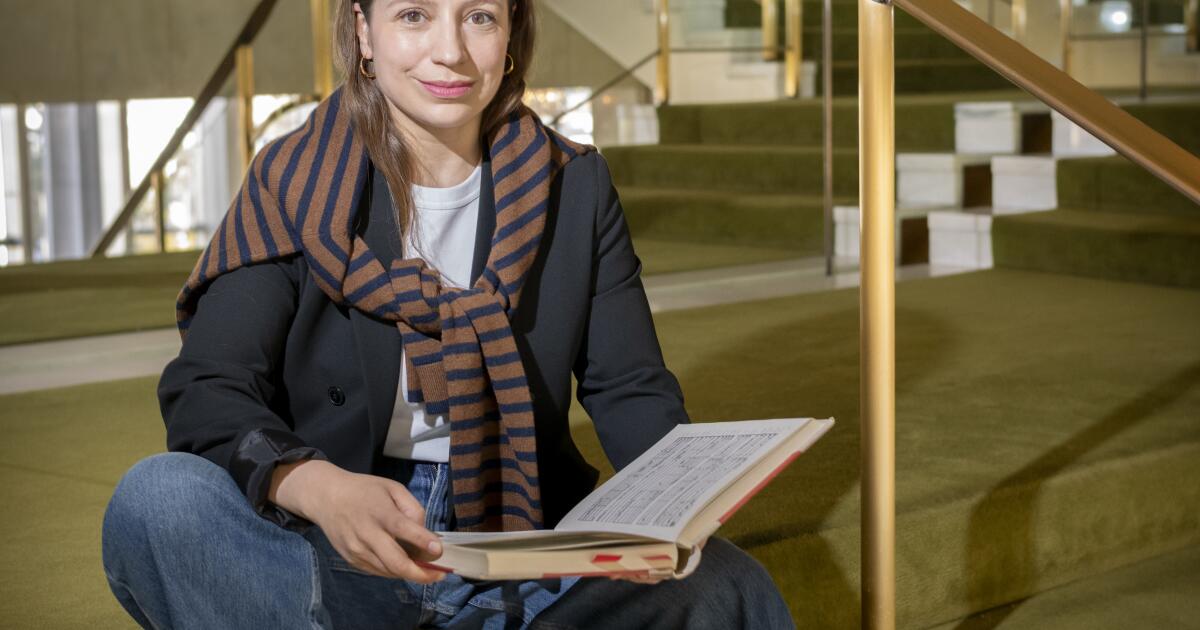
When Dalia Stasevska heard opera music for the first time, it was a moment of profound self-revelation. She was 13, growing up in the factory town of Tampere in the south of Finland, and her school librarian gave her a CD of Puccini’s “Madama Butterfly” along with a translation of its Italian libretto.
“As a teenage girl, this dramatic story touched my soul,” Stasevska says, adding that she still remembers the experience and thinking, “ ‘This music understands me, this is exactly how I feel.’ And that was…when I knew that I wanted to become a musician.”
Stasevska is now chief conductor of Finland’s Lahti Symphony Orchestra and a prodigious conductor of orchestral music in all forms. A busy guest baton with companies around the globe, she will make her L.A. Opera debut this Saturday with a production of “Akhnaten” by Philip Glass, running through late March.
John Holiday in the title role of L.A. Opera’s 2026 production of “Akhnaten.”
(Cory Weaver)
The seminal work by Glass lands at L.A. Opera just a month after the world-famous composer abruptly canceled June’s world premiere of Symphony No. 15 “Lincoln” at the John F. Kennedy Center for the Performing Arts. “While Philip Glass has pulled out of Kennedy Center, his music will be front and center at our production,” a rep for L.A. Opera wrote in an email.
Stasevska, with her razor-sharp appreciation of the power of Glass’ work, is the ideal conductor to bring it there.
Stasevska, 41, walks from the ornate foyer of the Dorothy Chandler Pavilion, with its emerald green carpets and gleaming chandeliers, to the more ordinary hallways and cubicles of L.A. Opera’s offices. She’s been in town rehearsing for a few weeks and jokes with some of the show’s jugglers in a kitchenette, where she makes herself a machine pod coffee.
The conductor is petite with large, expressive eyes and a Cheshire cat’s smile. Her mouth often pulls to the right when she speaks, her admirable non-native English tugged easterly in a Finnish accent.
Opera remains her great love, and it seems a perfect twist of fate that Stasevska was tapped to conduct “Akhnaten.” She saw it for the first time in 2019 at a Helsinki cinema, in a global broadcast of a production by the Met. She couldn’t believe her friend dozed off.
“I was like, ‘How could you fall asleep? This was the best thing I’ve ever seen in my life. I would do anything to conduct this opera,’ ” she recalls saying.
Stasevska was born in 1984, the same year that Glass’ hypnotic, ritualistic opera, about an Egyptian pharaoh who dared to push monotheism onto his polytheistic culture, debuted in Stuttgart, Germany. Eight months later, Stasevska entered the world in the Soviet-controlled city of Kyiv, the child of a Ukrainian father and Finnish mother.

Conductor Dalia Stasevska, who is making her L.A. Opera debut with Philip Glass’ “Akhnaten,” says that opera is her first great love.
(David Butow / For the Times)
It was a fluke that she was born in Ukraine. Her parents, both painters, were living in the Estonian capital of Tallinn, also under Soviet rule, but found themselves in a Kyiv hospital close to family when Stasevska arrived. She’s never lived in Ukraine — she spent her first few years in Tallinn before moving to Finland at age 5— but her life has been infused with its heritage.
Her father, who as a teenager in Tallinn began to rebel against Sovietization, insisted on teaching Stasevska and her two younger brothers to speak Ukrainian at home. Her grandmother, Iryna, lived with the family and was an important caretaker for much of her childhood. Stasevska grew up hearing fantastic stories filled with dreamlike imagery of the homeland.
“She was such a civilized, cultural person,” Stasevska says of her grandmother, adding that she taught her grandkids everything she knew about her home country. That’s why, even though Stasevska was raised in Finland, she grew up eating Ukrainian food and hearing Ukrainian folk tunes. “I know the language and understand the culture,” she says.
Stasevska grew up poor, but music education was mandatory for her and her brothers: “My father said, ‘This is going to be your profession.’ It was no question that this is not a hobby. So we started practicing immediately, very determined. There was maybe some forcing involved,” she says, laughing.
She played the violin from age 8, but it was only after she heard Puccini at 13 that she fell in love with classical music. She became obsessed with the opera and orchestral repertoires and was immediately determined to play in an orchestra. She approached the headmaster at her conservatory who placed her in a string ensemble before advancing her to the symphony orchestra as a violinist.
At 18, Stasevska entered the Sibelius Academy in Helsinki, which is named after Finland’s most famous composer, Jean Sibelius. She couldn’t stop herself from stealing a peek at the school conductor’s score, copying bowings and poring over the details, but she didn’t indulge any dreams of taking the podium herself. “I was going every week to the concerts,” she says, “but it took me so long to see somebody that looked like me.”
She was 20 when she saw a female conductor for the first time, calling it “the second big moment in my life.” When Stasevska expressed interest in trying it herself, she was referred to Jorma Panula, a legendary conductor and teacher in Finland. Panula invited her to attend one of his masterclasses, and on the first downbeat of her first experience conducting, “I knew immediately that this was beyond anything I’ve experienced in my life,” she says. “It became this kind of madness moment.”
She loved the sheer physicality of it, she says, but also “that I can affect the music, and that I can affect the interpretation, because I had so much in my heart that I felt about the music.”
After completing her conducting studies in 2012, Stasevska assisted Panula — who emphasized discovering unique “gestures in such a way that the orchestral musicians know what you mean,” she says. She also worked with her fellow Finn, Esa-Pekka Salonen. Stasevska became principal guest conductor of the BBC Symphony Orchestra in 2019 and chief of the Lahti Symphony in 2020.
When she’s not globetrotting, Stasevska lives in Helsinki with her young daughter and her husband, Lauri Porra — a heavy metal bassist who is also the great-grandson of Sibelius.
She likes to champion new music — her 2024 album, “Dalia’s Mixtape,” featured works by Anna Meredith, Caroline Shaw and other contemporary composers. She is also a vocal supporter of the land where she was born and has spoken out against Russia’s war in Ukraine.

John Holiday as Akhnaten, with So Young Park, at right, as Queen Tye, in L.A. Opera’s 2026 production of “Akhnaten.”
(Cory Weaver)
Stasevska’s L.A. Opera debut arrives on the same week as the fourth anniversary of Russia’s invasion. Both of her brothers — one a film director, the other a journalist — moved to Ukraine and have borne witness to the war, which has given her “another level of experiencing this horror,” she says.
Stasevska has made it her mission to raise funds — more than 250,000 euros to date — to provide basic supplies particularly for children and elders who are without power and huddling in freezing cold homes. She has even driven in supplies herself by truck.
She has also conducted concerts there — and her next album will celebrate the country’s composers in a meaningful way. “Ukrainian Mixtape,” which she recorded with the BBC Symphony Orchestra in London, features works by five composers who range from the 19th century to the 1960s. Three are premiere recordings of artists who have been completely forgotten, which required a year of searching for materials.
“I think that it will not leave anybody cold,” Staveska says, “and I hope that it will inspire everybody to discover Ukrainian music more, and that we will hear it more on main stages of the world — where it deserves to be.”
For now, though, her focus is on ancient Egypt and Philip Glass — and opera. She says her goal, in every concert, is to give audiences the same experience she had when she was 13, that remarkable feeling that the music uniquely understands them.

Video: Prada Peels Back the Layers at Milan Fashion Week

Defense secretary Pete Hegseth designates Anthropic a supply chain risk

UN Human Rights Council chief cuts off speaker criticizing US-sanctioned official

ICE blasts Washington mayor over directive restricting immigration enforcement

‘SuperAgers’ stay mentally sharp well past 80, as scientists reveal the reason

Florida High School Football Rankings: Top 25 teams – Oct. 21

Cleary's 21 help Le Moyne down Central Connecticut State 69-64 in OT

How old is Bo Nix? What to know about Oregon quarterback ahead of 2024 NFL Draft

99th annual Pony Swim held in Virginia

Indiana Members Credit Union announced as new anchor tenant at Bottleworks District
ICE blasts Washington mayor over directive restricting immigration enforcement

Did the EU bypass Hungary’s veto on Ukraine’s €90 billion loan?

How the federal government is painting immigrants as criminals on social media

Where Iran’s ballistic missiles can reach — and how close they are to the US

Has India’s influence in Afghanistan grown under the Taliban?
-

 World2 days ago
Exclusive: DeepSeek withholds latest AI model from US chipmakers including Nvidia, sources say
-

 Massachusetts2 days ago
Mother and daughter injured in Taunton house explosion
-

 Montana1 week ago
2026 MHSA Montana Wrestling State Championship Brackets And Results – FloWrestling
-

 Louisiana5 days ago
Wildfire near Gum Swamp Road in Livingston Parish now under control; more than 200 acres burned
-

 Oklahoma1 week ago
Wildfires rage in Oklahoma as thousands urged to evacuate a small city
-

 Denver, CO2 days ago
10 acres charred, 5 injured in Thornton grass fire, evacuation orders lifted
-

 Technology7 days ago
YouTube TV billing scam emails are hitting inboxes
-

 Technology7 days ago
Stellantis is in a crisis of its own making