

Connect with us

Entertainment

Philip Glass canceled a Kennedy Center show, but this conductor brings his work center stage at L.A. Opera

Published

on

Philip Glass canceled a Kennedy Center show, but this conductor brings his work center stage at L.A. Opera

When Dalia Stasevska heard opera music for the first time, it was a moment of profound self-revelation. She was 13, growing up in the factory town of Tampere in the south of Finland, and her school librarian gave her a CD of Puccini’s “Madama Butterfly” along with a translation of its Italian libretto.

“As a teenage girl, this dramatic story touched my soul,” Stasevska says, adding that she still remembers the experience and thinking, “ ‘This music understands me, this is exactly how I feel.’ And that was…when I knew that I wanted to become a musician.”

Stasevska is now chief conductor of Finland’s Lahti Symphony Orchestra and a prodigious conductor of orchestral music in all forms. A busy guest baton with companies around the globe, she will make her L.A. Opera debut this Saturday with a production of “Akhnaten” by Philip Glass, running through late March.

John Holiday in the title role of L.A. Opera’s 2026 production of “Akhnaten.”

(Cory Weaver)

Advertisement

The seminal work by Glass lands at L.A. Opera just a month after the world-famous composer abruptly canceled June’s world premiere of Symphony No. 15 “Lincoln” at the John F. Kennedy Center for the Performing Arts. “While Philip Glass has pulled out of Kennedy Center, his music will be front and center at our production,” a rep for L.A. Opera wrote in an email.

Stasevska, with her razor-sharp appreciation of the power of Glass’ work, is the ideal conductor to bring it there.

Stasevska, 41, walks from the ornate foyer of the Dorothy Chandler Pavilion, with its emerald green carpets and gleaming chandeliers, to the more ordinary hallways and cubicles of L.A. Opera’s offices. She’s been in town rehearsing for a few weeks and jokes with some of the show’s jugglers in a kitchenette, where she makes herself a machine pod coffee.

The conductor is petite with large, expressive eyes and a Cheshire cat’s smile. Her mouth often pulls to the right when she speaks, her admirable non-native English tugged easterly in a Finnish accent.

Advertisement

Opera remains her great love, and it seems a perfect twist of fate that Stasevska was tapped to conduct “Akhnaten.” She saw it for the first time in 2019 at a Helsinki cinema, in a global broadcast of a production by the Met. She couldn’t believe her friend dozed off.

“I was like, ‘How could you fall asleep? This was the best thing I’ve ever seen in my life. I would do anything to conduct this opera,’ ” she recalls saying.

Stasevska was born in 1984, the same year that Glass’ hypnotic, ritualistic opera, about an Egyptian pharaoh who dared to push monotheism onto his polytheistic culture, debuted in Stuttgart, Germany. Eight months later, Stasevska entered the world in the Soviet-controlled city of Kyiv, the child of a Ukrainian father and Finnish mother.

A woman leans against a wall.

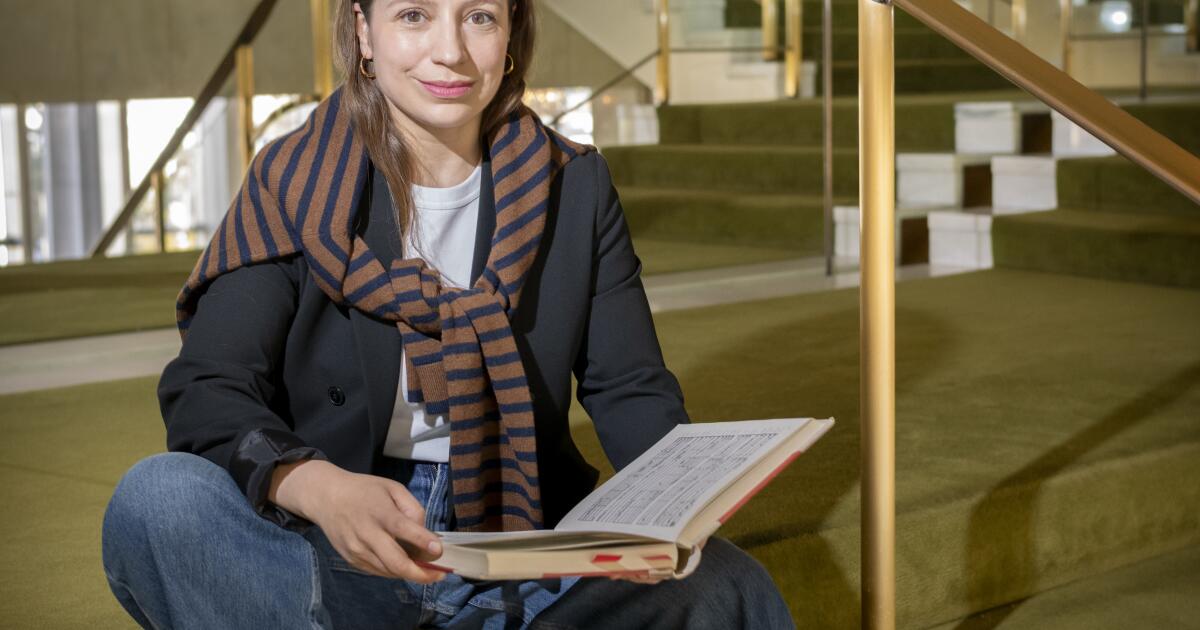
Conductor Dalia Stasevska, who is making her L.A. Opera debut with Philip Glass’ “Akhnaten,” says that opera is her first great love.

(David Butow / For the Times)

Advertisement

It was a fluke that she was born in Ukraine. Her parents, both painters, were living in the Estonian capital of Tallinn, also under Soviet rule, but found themselves in a Kyiv hospital close to family when Stasevska arrived. She’s never lived in Ukraine — she spent her first few years in Tallinn before moving to Finland at age 5— but her life has been infused with its heritage.

Her father, who as a teenager in Tallinn began to rebel against Sovietization, insisted on teaching Stasevska and her two younger brothers to speak Ukrainian at home. Her grandmother, Iryna, lived with the family and was an important caretaker for much of her childhood. Stasevska grew up hearing fantastic stories filled with dreamlike imagery of the homeland.

“She was such a civilized, cultural person,” Stasevska says of her grandmother, adding that she taught her grandkids everything she knew about her home country. That’s why, even though Stasevska was raised in Finland, she grew up eating Ukrainian food and hearing Ukrainian folk tunes. “I know the language and understand the culture,” she says.

Stasevska grew up poor, but music education was mandatory for her and her brothers: “My father said, ‘This is going to be your profession.’ It was no question that this is not a hobby. So we started practicing immediately, very determined. There was maybe some forcing involved,” she says, laughing.

She played the violin from age 8, but it was only after she heard Puccini at 13 that she fell in love with classical music. She became obsessed with the opera and orchestral repertoires and was immediately determined to play in an orchestra. She approached the headmaster at her conservatory who placed her in a string ensemble before advancing her to the symphony orchestra as a violinist.

Advertisement

At 18, Stasevska entered the Sibelius Academy in Helsinki, which is named after Finland’s most famous composer, Jean Sibelius. She couldn’t stop herself from stealing a peek at the school conductor’s score, copying bowings and poring over the details, but she didn’t indulge any dreams of taking the podium herself. “I was going every week to the concerts,” she says, “but it took me so long to see somebody that looked like me.”

She was 20 when she saw a female conductor for the first time, calling it “the second big moment in my life.” When Stasevska expressed interest in trying it herself, she was referred to Jorma Panula, a legendary conductor and teacher in Finland. Panula invited her to attend one of his masterclasses, and on the first downbeat of her first experience conducting, “I knew immediately that this was beyond anything I’ve experienced in my life,” she says. “It became this kind of madness moment.”

She loved the sheer physicality of it, she says, but also “that I can affect the music, and that I can affect the interpretation, because I had so much in my heart that I felt about the music.”

After completing her conducting studies in 2012, Stasevska assisted Panula — who emphasized discovering unique “gestures in such a way that the orchestral musicians know what you mean,” she says. She also worked with her fellow Finn, Esa-Pekka Salonen. Stasevska became principal guest conductor of the BBC Symphony Orchestra in 2019 and chief of the Lahti Symphony in 2020.

When she’s not globetrotting, Stasevska lives in Helsinki with her young daughter and her husband, Lauri Porra — a heavy metal bassist who is also the great-grandson of Sibelius.

Advertisement

She likes to champion new music — her 2024 album, “Dalia’s Mixtape,” featured works by Anna Meredith, Caroline Shaw and other contemporary composers. She is also a vocal supporter of the land where she was born and has spoken out against Russia’s war in Ukraine.

Actors onstage in an opera.

John Holiday as Akhnaten, with So Young Park, at right, as Queen Tye, in L.A. Opera’s 2026 production of “Akhnaten.”

(Cory Weaver)

Stasevska’s L.A. Opera debut arrives on the same week as the fourth anniversary of Russia’s invasion. Both of her brothers — one a film director, the other a journalist — moved to Ukraine and have borne witness to the war, which has given her “another level of experiencing this horror,” she says.

Stasevska has made it her mission to raise funds — more than 250,000 euros to date — to provide basic supplies particularly for children and elders who are without power and huddling in freezing cold homes. She has even driven in supplies herself by truck.

Advertisement

She has also conducted concerts there — and her next album will celebrate the country’s composers in a meaningful way. “Ukrainian Mixtape,” which she recorded with the BBC Symphony Orchestra in London, features works by five composers who range from the 19th century to the 1960s. Three are premiere recordings of artists who have been completely forgotten, which required a year of searching for materials.

“I think that it will not leave anybody cold,” Staveska says, “and I hope that it will inspire everybody to discover Ukrainian music more, and that we will hear it more on main stages of the world — where it deserves to be.”

For now, though, her focus is on ancient Egypt and Philip Glass — and opera. She says her goal, in every concert, is to give audiences the same experience she had when she was 13, that remarkable feeling that the music uniquely understands them.

Advertisement

Movie Reviews

‘Project Hail Mary’ Review: Ryan Gosling and a Rock Make Sci-Fi Magic

Published

on

‘Project Hail Mary’ Review: Ryan Gosling and a Rock Make Sci-Fi Magic

In contrast to other sci-fi heroes, like Interstellar’s Cooper, who ventures into the unknown for the sake of humanity and discovery, knowing the sacrifice of giving up his family, Grace is externally a cynical coward. With no family to call his own, you’d think he’d have the will to go into space for the sake of the planet’s future. Nope, he’s got no courage because the man is a cowardly dog. However, Goddard’s script feels strikingly reflective of our moment. Grace has the tools to make a difference; the Earth flashbacks center on him working towards a solution to the antimatter issue, replete with occasionally confusing but never alienating dialogue. He initially lacks the conviction, embodying a cynicism and hopelessness that many people fall into today. 

The film threads this idea effectively through flashbacks that reveal his reluctance, giving the story a tragic undercurrent. Yet, it also makes his relationship with Rocky, the first living thing he truly learns to care for, ever more beautiful. 

When paired with Rocky, Gosling enters the rare “puppet scene partner” hall of fame alongside Michael Caine in The Muppet Christmas Carol, never letting the fact that he’s acting opposite a puppet disrupt the sincerity of his performance. His commitment to building a gradual, affectionate friendship with this animatronic creation feels completely natural, and the chemistry translates beautifully on screen. It stands as one of the stronger performances of his career.

Project Hail Mary is overly long, and while it can be deeply affecting, the film leans on a few emotional fake-outs that become repetitive in the latter half. By the third time it deploys the same sentimental beat, the effect begins to feel cloying, slightly dulling the powerful emotions it built earlier. The constant intercutting between past and present can also feel thematically uneven at times, occasionally undercutting the narrative momentum. At 2 hours and 36 minutes, the film feels like it’s stretching itself to meet a blockbuster runtime when a tighter cut might have served better.

FINAL STATEMENT

Project Hail Mary is a meticulously crafted, hopeful, and dazzling space epic that proves the most moving friendship in film this year might just be between Ryan Gosling and a rock.

Advertisement
Continue Reading

Entertainment

James Van Der Beek ‘became what we used to just call a good man,’ Joshua Jackson says

Published

on

James Van Der Beek ‘became what we used to just call a good man,’ Joshua Jackson says

Joshua Jackson says he knows he was “really just a footnote” in James Van Der Beek’s life, despite the “amazing” time they spent together as stars of the series “Dawson’s Creek.”

The star of “The Affair” is reflecting publicly for the first time about his former castmate, who died Feb. 11 at age 48 after a battle with colorectal cancer.

The time they shared on set was “formational” for them, Jackson said on “Today.” When the “Dawson’s Creek” pilot aired in January 1998, he was 19 and Van Der Beek was almost 21, playing characters who were 15.

“I know both of us look back on that time with great fondness, but I will also say that I know that I’m really just a footnote in what he actually accomplished in his life.”

Jackson spoke with great respect for his friend, who he said “became what we used to just call a good man, a man of the kind of belief, the kind of faith that allowed him to face the impossible with grace, an unbelievable partner and husband, just a real man who showed up for his family and a beautiful, kind, curious, interested, dedicated father.”

Advertisement

On the one hand, the 47-year-old said, “that’s beautiful.” On the other, “The tragedy of that loss for his family is enormous.”

Since Jackson and Van Der Beek played Pacey Witter and Dawson Leery three decades ago, both men had kids of their own — a 5-year-old daughter for Jackson, born during the pandemic with ex-wife Jodie Turner-Smith, and six kids for Van Der Beek with second wife Kimberly Brook. The latter couple’s children — two boys and four girls, ranging in age from 4 to 15 — were what Van Der Beek said changed everything for him.

“Your life becomes shared, and your joys become shared joys in a really beautiful way that expands your level of circuitry out to other people instead of just keeping it all for your own gratification,” the actor told “Good Morning America” in May 2023. “And the lessons, they keep on coming. It’s the craziest, craziest thing I’ve ever done, and it’s the thing that’s made me happiest.”

Knowing his colleague’s love for his family, Jackson said on “Today” that “for me as a father now, I think the enormity of that tragedy hits me in a very different way than just as a colleague, so I think the processing [of Van Der Beek’s death] is ongoing.”

The “Little Fires Everywhere” actor was on the morning show Tuesday to bring attention to colorectal cancer screenings.

Advertisement

Van Der Beek’s diagnosis, which went public in November 2024, was among the factors prompting Jackson to get involved with drugmaker AstraZeneca’s “Get Body Checked Against Cancer” campaign, which takes a lighter approach to a serious subject — cancer screening — through a partnership with Jackson, the National Hockey League and the Philadelphia Flyers’ furry orange mascot, Gritty.

“It is … true, the earlier you find something,” said “The Mighty Ducks” actor, “the better your possible outcomes are.”

Continue Reading

Movie Reviews

Dan Webster reviews “WTO/99”

Published

on

Dan Webster reviews “WTO/99”

DAN WEBSTER:

It may now seem like ancient history, especially to younger listeners, but it was only 26 years ago when the streets of Seattle were filled with protesters, police and—ultimately—scenes of what ended up looking like pure chaos.

It is those scenes—put together to form a portrait of what would become known as the “Battle of Seattle” —that documentary filmmaker Ian Bell captures in his powerful documentary feature WTO/99.

We’ve seen any number of documentaries over the decades that report on every kind of social and cultural event from rock concerts to war. And the majority of them follow a typical format: archival footage blended with interviews, both with participants and with experts who provide an informational, often intellectual, perspective.

WTO/99 is something different. Like The Perfect Neighbor, a 2026 Oscar-nominated documentary feature, Bell’s film consists of what could be called found footage. What he has done is amass a series of news reports and personal video recordings into an hour-and-42-minute collection of individual scenes, mostly focused on a several-block area of downtown Seattle.

Advertisement

That is where a meeting of the WTO, the World Trade Organization, was set to be held between Nov. 30 and Dec. 3, 1999. Delegates from around the world planned to negotiate trade agreements (what else?) at the Washington State Convention and Trade Center.

Months before the meeting, however, a loose coalition of groups—including NGOs, labor unions, student organizations and various others—began their own series of meetings. Their objective was to form ways to protest not just the WTO but, to some of them, the whole idea of a world order they saw as a threat to the economic independence of individual countries.

Bell’s film doesn’t provide much context for all this. What we mostly see are individuals arguing their points of view as they prepare to stop the delegates from even entering the convention center. Meanwhile, Seattle authorities such as then-Mayor Paul Schell and then-Police Chief Norm Stamper—with brief appearances by Gov. Gary Locke and King County Executive Ron Sims—discuss counter measures, with Schell eventually imposing a curfew.

That decision comes, though, after what Bell’s film shows is a peaceful protest evolving into a street fight between people parading and chanting, others chained together and splinter groups intent on smashing the storefronts of businesses owned by what they see as corporate criminals. One intense scene involves a young woman begging those breaking windows to stop and asking them why they’re resorting to violence. In response a lone voice yells their reasoning: “Self-defense.”

Even more intense, though, are the actions of the Seattle police. We see officers using pepper spray, tear gas, flash grenades and other “non-lethal” means such as firing rubber pellets into the crowd. In one scene, a uniformed guy—not identified as a police officer but definitely part of the security crowd, which included National Guardsmen—is shown kicking a guy in the crotch.

Advertisement

The media, too, can’t avoid criticism. Though we see broadcast reporters trying to capture what was happening—with some affected like everybody else by the tear gas that filled the streets like a winter fog—the reports they air seem sketchy, as if they’re doctors trying to diagnose a serious illness by focusing on individual cells. And the images they capture tend to highlight the violence over the well-meaning actions of the vast majority of protesters.

Reactions to what Bell has put on the screen are bound to vary, based on each viewer’s personal politics. Bell revels his own stance by choosing selectively from among thousands of hours of video coverage to form the narrative he feels best captures what happened those two decades-and-change ago.

If nothing else, WTO/99 does reveal a more comprehensive picture of what happened than we got at the time. And, too, it should prepare us for the future. The way this country is going, we’re bound to see a lot more of the same.

Call it the “Battle for America.”

For Spokane Public Radio, I’m Dan Webster.

Advertisement

——

Movies 101 host Dan Webster is the senior film critic for Spokane Public Radio.

Continue Reading

Trending
