Entertainment
Phil Wickham and ‘David’ face the Goliath of ‘Avatar’

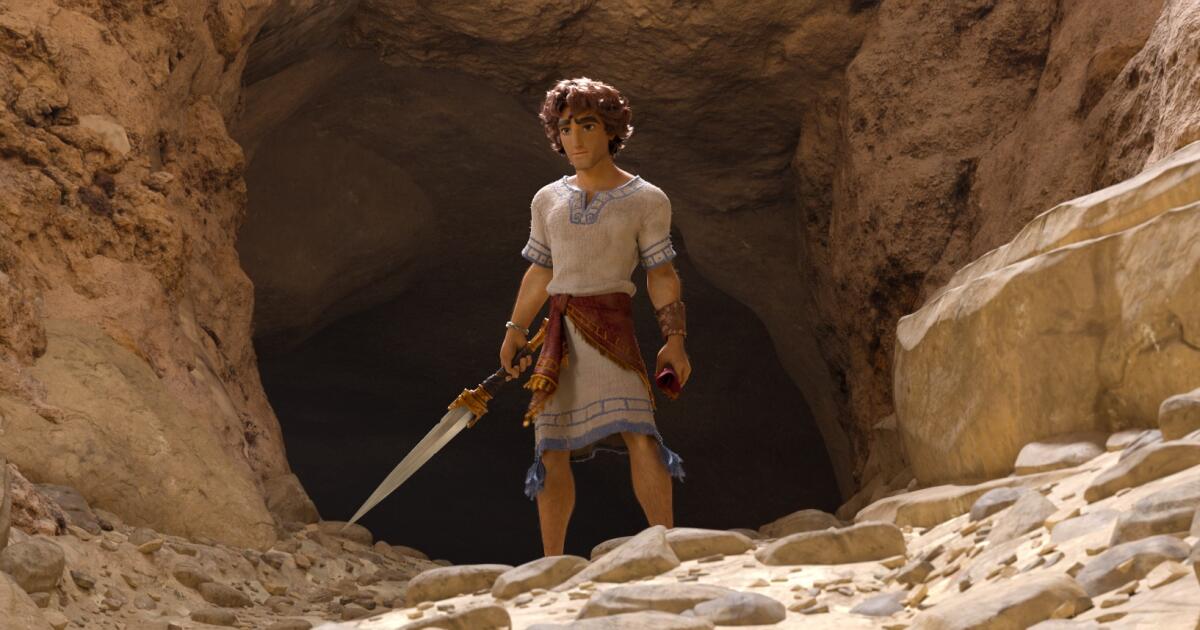
Phil Wickham has released 14 Christian worship albums, has been Platinum certified and nominated for American Music Awards, Dove Awards, Billboard Music Awards and Grammys — but all of his vocal training and performances couldn’t prepare him to step into the shoes of one of his Biblical heroes with the upcoming animated musical film “David.”
Directed by Phil Cunningham and Brent Dawes, “David” marks the second animated film this year for Angel Studios. April’s “The King of Kings” made $60 million and is the second-highest-grossing film from the studio following “Sound of Freedom,” which made $184 million. The film hits theaters on Friday. If the release date sounds familiar, it could be because the third installment in the multibillion-dollar “Avatar” franchise, “Avatar: Fire and Ash,” is released on the same day. Presale numbers for “David” are at $15 million on 3,100 screens, but with “Avatar” tracking to open between $135 million and $165 million, and “The SpongeBob Movie: Search for SquarePants” also tracking between $13 million and $20 million, it would seem to be a true David vs. Goliaths for ticket sales.
That in itself could be daunting, but for Wickham, the biggest obstacles came long before release dates were decided. Despite playing in arenas with thousands of fans, he had a “secret dream” of voicing a character in an animated film. A character “that carried courage and faith and had some grand adventure.” But because he’d never chased that dream, he realistically put a limit on that particular goal. Even when the opportunity arose, he was hesitant when going into a casting meeting.
“I’m unoffendable. [I said to producers], if I suck, then just tell me because I don’t want to waste anybody’s time. And also, I don’t want to be bad in a movie as much as you don’t want to make a bad movie,” says Wickham.
The contemporary Christian artist, who recently finished sold-out concerts at Downey Calvary Chapel and the Wiltern, had never tried his hand at voice acting. Not only did he get the role, but he also had to help bring to (animated) life one of the most well-known stories in the Bible. The tale of David — the boy who was anointed to become the king and along the way felled the giant Philistine warrior Goliath with a rock and a slingshot — has become synonymous as the most famous of underdog representations and tests of faith in the Bible. The character and story is also one of Wickham’s favorites.
Phil Wickham always wanted to voice an animated character, especially after seeing “The Lion King.”
(Colton Dall)
“When this came across my desk, so to speak, I was just like, man, I could tell you that story, but I didn’t know if I had it in me. I didn’t know if I was a good actor. I didn’t know if I could voice a character, but I knew I wanted a shot,” said Wickham.
A curious revelation for Wickham was discovering that the singing that he’d been doing most of his life would not work on-screen, at least not for this project. He was asked to tone down things, to sometimes “talk through” lyrics and to generally make the music more dramatic for the screen.
“I thought, OK, I got this. This is why they hired me, because I’m a singer. But that ended up being the hardest part because they didn’t want me to sound like me,” Wickham said.
“Singing became a background to just being the character, which honestly, in some ways, was the hardest thing. Maybe even for my ego as as an artist.”
It was definitely a process that required lots of fine-tuning and looking at David as not just the king and hero that Wickham had grown up reading about at home and in Southern California churches. Sitting in the pews in Downey, the singer reflected on why he got into music and why Christian entertainment is on the rise.
“I found out really quick that I loved being a part of moments where people were encountering the same hope and faith that I encountered in my room alone,” Wickham said of songwriting and performing. He grew up with Christianity all around him, but has seen a spike in popularity for music and movies dealing with faith-based fandom.
“For this movie ‘David’ to come out at this time … I think that the world is looking for stuff to hope in. I think people are just searching and finding out more and more the truth that if we look around us at the world of man, we’re not going to find real solutions. So that maybe if we look up, we will.”

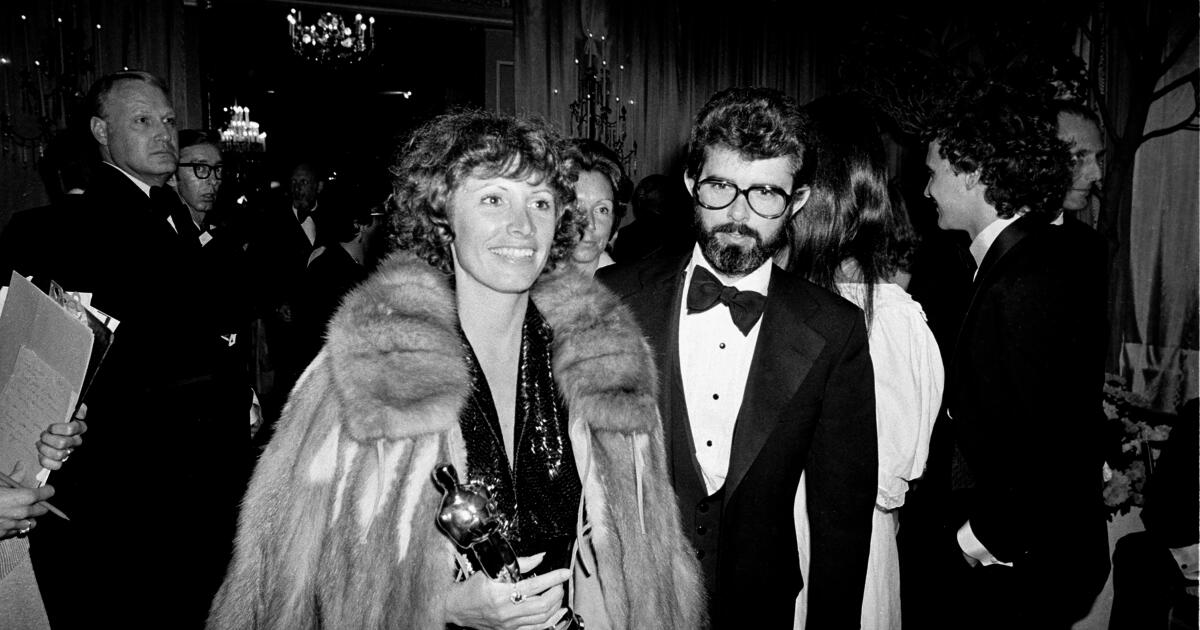
Marcia Lucas, the Oscar-winning film editor of “Star Wars,” died Wednesday in Rancho Mirage after a battle with cancer. She was 80.
“Marcia will be remembered as a brilliant storyteller, a trailblazer for women in film, a loving mother and grandmother, a generous host, and a loyal friend whose humor and sparkle filled every room she entered. Her influence on film is indelible, but those who knew her best will remember the way she made life feel more vivid, more beautiful, more fun, and more full of love,” a family statement said. “Her work was known for its emotional intelligence, rhythm, and humanity — a rare ability to find the truth of a scene and bring heart, momentum, and clarity to the screen.”
Marcia, who was married to George Lucas for more than a decade, was widely regarded as instrumental in making the “Star Wars” trilogy the juggernaut it became. But she garnered urban legend status for making the call to kill off one major and beloved character.
“If there was anything that was dramatic or emotional, George gave it to Marcia and George always said: keep one person whose opinion you trust to the very end, and that was Marcia,” said editor and director Duwayne Dunham.
She also co-edited “American Graffiti,” which nabbed her an Oscar nomination, Martin Scorsese’s “Alice Doesn’t Live Here Anymore,” “Taxi Driver,” “New York, New York,” and then in 1978, she won an Oscar for “Star Wars: Episode IV — A New Hope,” alongside co-editors Richard Chew and Paul Hirsch.
Mark Hamill, who starred as Luke Skywalker in the “Star Wars” franchise, posted a tribute to Lucas on social media, writing that he and his wife, Marilou York, are deeply saddened by the loss of their “lifelong friend, Marcia.”
“Not just a gifted, innovative artist, she also happened to be a genuinely nice person,” he continued. “Smart, funny, & just plain fun to be around. Thankfully, her memory lives on and we will never stop missing her.”
Lucas was born Marcia Lou Griffin on Oct. 4, 1945, in Modesto but was raised in North Hollywood. She told True West Film Center that she was a “real rags to riches story” and was raised by a single mother. “We lived hand to mouth, paycheck to paycheck,” she said. “I never knew anybody in the film business, the music business, the radio business. … I didn’t go to school with people who were kids that were associated with the industry. But when I used to go home after school, I would sit and watch old movies. It was like I was getting an education in movies.”
When she was 18, she landed a job as an apprentice film librarian at the Sandler Film Library in Hollywood. When the library was slow, the assistant editor taught Marcia about post-production and TV commercials. When he left, she took over.
By the mid-1960s, Marcia was ready to move on from the Sandler but was told editors “didn’t want women in the cutting room,” so she worried her ambition to make it big in the field was at a dead end. “But then I had a friend who had a friend who knew a woman in Van Nuys — Verna Fields — who liked to hire women.”
Marcia was hired.
It was while she was working for Fields as an assistant that she met George Lucas, then a USC film student whom Fields considered talented. Because Marcia was the most experienced assistant, Fields asked her to help the young filmmaker.
Marcia described him as “very intense” in the cutting room. “We worked together, and then after the film was done, we started dating,” Marcia told True West Film Center. “I used to say, ‘I don’t understand why you’re such a cold fish,’ and George would say, ‘I may be a cold fish, but you’re full of beans’ — and that was our chemistry. That chemistry worked for us for many years.”
The couple married in 1969 and divorced in 1983, but during their time together they made the original “Star Wars” trilogy. The couple split before “Return of the Jedi” was released but waited to publicly announce their divorce until shortly after the film hit theaters.
“I’m sort of known in Star Wars,” Marcia told True West Film Center. “I killed Obi-Wan Kenobi.”
According to Marcia, George was convinced he’d be laughed out of Hollywood because in the original script characters were running around and shooting at one another and nobody was getting hurt. “I said, ‘What if Obi-Wan Kenobi let Darth Vader strike him down?’ and George said, ‘I kind of like that.’”
Marcia suggested that Obi-Wan Kenobi could then be a ghostly presence. She said that the change to the script added a spiritual strangeness to the film and gave the second act a real climax, because no one expected to lose the Jedi master.
“Anyway,” she said. “I killed him.”
Marcia is survived by daughters Amanda Lucas and Amy Soper; grandchildren Felix Hallikainen, Aeliana Hallikainen, and Knox Soper; and her chosen family Sarah Dyer and Jon Taylor.

I watched Christopher Nolan’s Insomnia before I watched the original. I was in my early twenties. I thought the film was fine and I moved on. It took me until Second Sight dropped this 4K edition to find out what fine had been covering up for twenty four years. I feel pretty bad about that. Not bad enough to not tell you to skip Nolan and start here, but bad.
Erik Skjoldbjærg’s 1997 original is a Norwegian thriller about a Swedish detective named Jonas Engström who goes to Tromsø to investigate a teenage girl’s murder and instead dismantles himself in daylight. Stellan Skarsgård plays Jonas. He is not a good man doing a bad thing. He is a man who was already doing bad things who then does a worse one, and the film is about watching him hold that together under a sun that will not go down.
The Sun Is the Monster Here
Skjoldbjærg called it “a reversed film noir with light instead of darkness as its dramatic force,” and that is exactly right, and also a polite way of saying the Arctic summer is doing something genuinely horrible to this movie. Tromsø in June means no night. No dark corner. No 3am where you can tell yourself it was a dream.
Cinematographer Erling Thurmann-Andersen shoots the whole thing overexposed and grey, and in the new 4K restoration that greyness lands like a fist. Every interior feels too bright. Every window is a problem. Jonas cannot sleep, cannot hide, cannot find a single hour that looks different from the one before it. That is the film’s horror, and it is more effective than it has any right to be.
What Skarsgård Actually Does
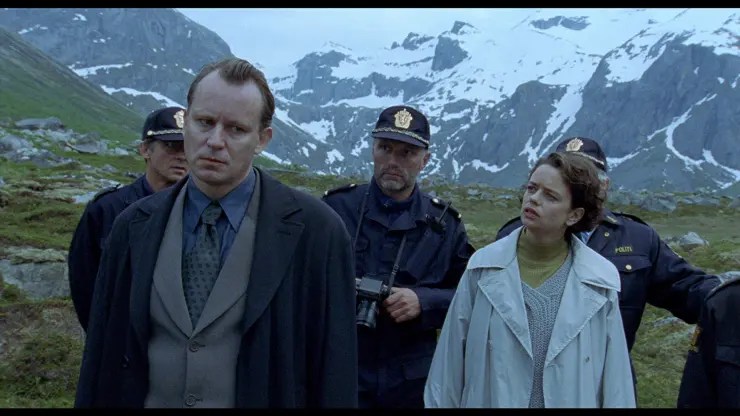
The performance does not announce itself. That is the whole thing. Skarsgård plays Jonas going still when he should flinch, pausing a half-beat too long before answering simple questions, watching every room he enters with the focus of a man who needs to know who in it already knows. He is calculating. He is also dissolving.
Roger Ebert compared the film to Dostoevsky when it opened stateside in 1998. The Crime and Punishment parallel is real, with one difference, Raskolnikov is tormented almost immediately. Jonas keeps choosing not to be. That is the colder read and the better film.
What Nolan Did With It

The 2002 remake moved everything to Alaska, added about 20 minutes, and made the detective a fundamentally decent man destroyed by circumstance. Al Pacino does the thing Pacino does. Robin Williams is genuinely unsettling in a way the film earns. Hilary Swank does more with her role than the script deserves. It is a competent Hollywood thriller and I have not thought about it since I watched it.
The key structural difference, in Nolan’s version, the detective dies. Some weight lifted. In the original, Jonas lives. Goes home. Carries it. That is the correct ending and the more disturbing one, and I will not call it a spoiler because you needed to know.
About This Release

Second Sight did not cut corners. The 4K restoration carries a director-approved HDR grade with Dolby Vision, and Thurmann-Andersen’s washed-out oppressive whites have never looked this punishing. The dual format edition puts the feature and bonus material on both the UHD and Blu-ray, which is a small detail that collectors notice and appreciate.
The physical package is a rigid slipcase with new art by Peter Strain, a 120-page book with essays from Jenn Adams, Mitchell Beaupre, Barry Forshaw, Francesco Massaccesi, Priscilla Page, and Travis Woods, and six collector art cards. The book reads like it was commissioned from people who actually watched the film. That sounds like a low bar. It is not.
What Is on the Discs

The audio commentary with Skjoldbjærg and co-writer Nikolaj Frobenius is the feature you will come back to. A director revisiting his debut nearly thirty years out has usually dropped the defensiveness and kept the honesty, and this one has that quality. Two new interviews accompany it: “Running on Instinct” with Skjoldbjærg, and “Falling Into It” with producer Petter J. Borgli. The producer interview fills in context the film itself never bothers to explain.
Alexandra Heller-Nicholas contributes a piece called “Private Prisons” that treats the film analytically without treating it as a sacred object. Three of Skjoldbjærg’s short films are included: Spor, Close to Home, and Near Winter. Watch those first if you want to know where Insomnia came from.
Buy It or Don’t

If you have never seen this film, the answer is yes. Full stop.
If you own the Criterion edition and you are doing upgrade math. The restoration is the definitive visual presentation and the commentary is new material unavailable anywhere else. Whether that moves the needle depends on you.
Insomnia is a Norwegian film about guilt dressed as a detective story. Jonas Engström did not need the midnight sun to lose his mind. He was already most of the way there.
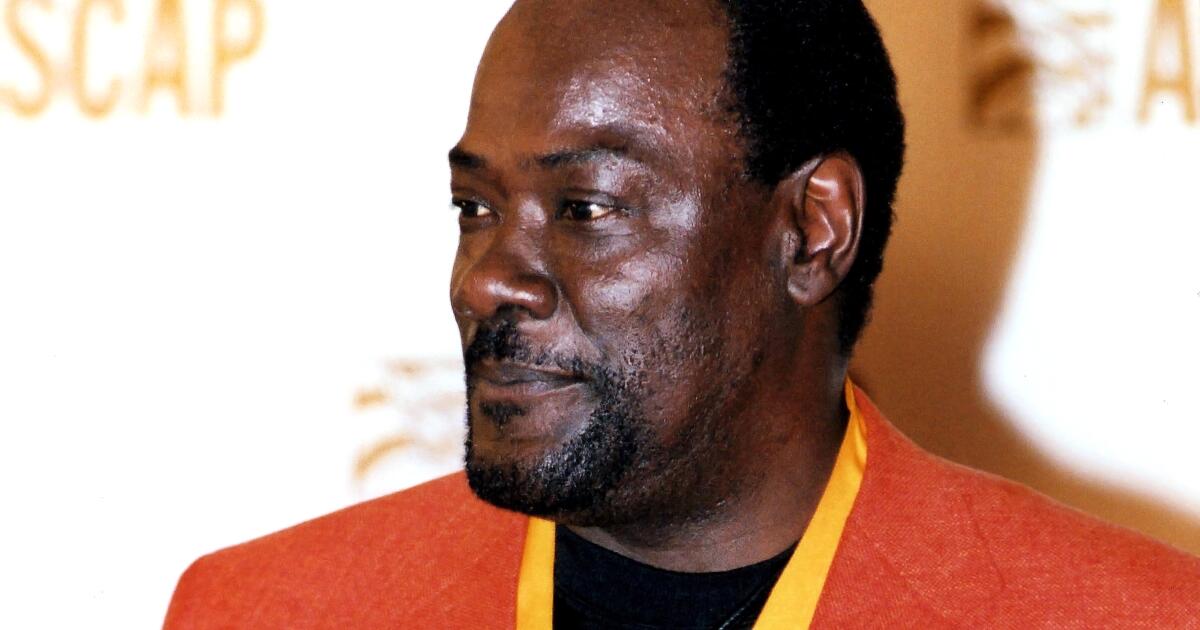
Ronald LaPread, a co-founder and former bassist of the funk and soul group the Commodores, has died. He was 75.
“It is with a very heavy heart that I must announce that my father Ronald LaPread has passed,” LaPread’s daughter Soraya LaPread shared on her Instagram story. “If you know me you know my dad. I am devastated. A piece of me is gone from this world.”
Soraya did not share details about her father’s death, but the New Zealand Herald reported that the longtime resident died of a “sudden medical event.” The Commodores took to Instagram to share their condolences, writing that LaPread “will always be a Commodore.”
Thomas McClary, Milan Williams, William King, Ronald LaPread and Walter Orange in 1986 — the year LaPread left the group.
(BSR Entertainment / Gentle Look / Getty Images)
“Ronald was a phenomenal musician, an accomplished songwriter and a vital part of the Commodores’ sound and success. His contributions to our music and his friendship enriched our lives beyond measure. We were grateful to perform with him again last fall in New Zealand,” the Commodores shared on Instagram. “His legacy lives on through the music he helped create and the countless people he inspired.”
LaPread began playing with the Commodores in 1970 alongside Lionel Richie, William “WAK” King, Milan Williams and Thomas McClary while they were students at Tuskegee Institute. The band initially played shows around campus, performing covers and a handful of original songs.
Their manager Benny Ashburn spent his summer organizing shows for the Commodores on Martha’s Vineyard to test-market the band. In 1971, the group opened for the Jackson 5, helping them gain national exposure and leading them to sign with Motown Records in 1972.
The band released their debut album, “Machine Gun,” in 1974 and reached No. 22 on the Billboard Hot 100. They released a quick succession of albums — “Caught in the Act,” “Movin’ On” and “Hot on the Tracks” — catapulting the band to mainstream success. LaPread played bass on the band’s most memorable songs, including “Easy,” “Three Times a Lady” and “Brick House,” the latter a song that LaPread insisted they put on the album.
“They say, ‘Oh man, it’s too Black.’ I said, ‘Wait a minute. I tell you what, I will give this song to the group. Just put it on the album.’ They say, ‘Okay,’ and they put ‘Brick House’ on the tape recorder,” LaPread explained in a video recently shared on his personal Instagram. “They went crazy. When you hear a hit song, it sends goosebumps all over your body. Before anything happens, you feel it, and that’s the history.”
After working on 11 albums with the band, LaPread left the Commodores in 1986 and moved to New Zealand. During his time with the Commodores, the group earned nine Grammy nominations and won an award for their song “Nightshift.”
LaPread joined the Commodores onstage last October during a tour stop in Auckland, New Zealand. On Instagram, the band called performing with LaPread the “highlight” of their shows in Australia and New Zealand.
In addition to his daughter, LaPread is survived by his wife, Farideh; and children Mark and Ronald Jr.
-

 Health17 minutes ago
What Really Happens When You Drink Alcohol During a Weight Loss Journey? Experts Explain
-
 Lifestyle32 minutes ago
This is what you want to read this summer : It’s Been a Minute
-

 Technology42 minutes ago
Pebblebee’s Halo can help track lost items and keep you safe, and it’s on sale for $50
-

 World47 minutes ago
Hidden tunnel discovered in Tijuana may have supported cross-border trafficking operations
-

 Politics54 minutes ago
Jared Kushner’s overseas luxury resort project faces anti-corruption investigation amid violent protests
-

 Health57 minutes ago
Veterans face surprising threat after cancer diagnosis, study reveals
-

 Sports1 hour ago
Rick Adelman, architect of some of the NBA’s best offenses and Hall of Famer, dead at 79
-

 Technology1 hour ago
Your Microsoft text codes are going away

