Business
‘I got crushed’: AI giants are funding ad wars in races across the country


WASHINGTON — In congressional races across the country, a new crop of super PACs is taking to the air with millions of dollars worth of advertisements to sway voters.
“President Trump said it best, ‘Celeste Maloy will never let you down,’” says one advertisement supporting the Utah Republican representative in her upcoming primary election.
“Standing up to big pharma, fighting for local jobs, Val Hoyle doesn’t back down,” says an ad backing the Oregon Democratic representative ahead of her primary victory last month.
The super PACs have nondescript names — such as Jobs and Democracy PAC and American Mission — and the text is so generic that it almost seems to have been created by artificial intelligence.
That isn’t so far off the mark. The AI industry has funded the ads.
One network of super PACs is linked to Anthropic, maker of the popular AI tool Claude, and the other to Open AI, maker of ChatGPT.
They have been among the most prolific political spenders so far in the 2026 midterm elections, splashing out more than $37 million to date to influence races across the country and making the groups among the biggest outside spenders so far in congressional races. That number could grow exponentially as campaign season heats up closer to the November election — and as the Silicon Valley giants prepare initial pubic offerings that are poised to raise billions of dollars for the companies and their executives.
The AI political spending boom comes as emerging technology companies have become increasingly “comfortable with using their power to achieve a political goal,” said Adam Kovacevich, a former Google public policy executive and founder of Chamber of Progress, a technology trade group with a progressive orientation.
The leading AI companies have a history.
Anthropic was formed by former OpenAI employees who were concerned that the company was less focused on its original mission to safely harness the power of AI.
The companies are now the leading drivers of the burgeoning AI industry, and their competing views about how the technology should be regulated are playing out in a wide-ranging political ad spending war that has targeted congressional races in big cities and rural areas alike.
OpenAI thinks AI should be regulated solely at the federal level.
Anthropic calls for more stringent regulation and supports efforts by states such as New York and California that have passed more aggressive AI laws.
The groups spending in these races are super PACs, which are able to raise and spend unlimited amounts of money in federal races thanks to the 2010 Citizens United Supreme Court decision.
In some races, the AI-backed political groups have spent more than the candidates they are backing.
“There was no way as a grassroots person that I could compete with that kind of money,” said Al Olszewski, whose opponent in a Montana Republican congressional primary beat him by 30 points after getting a boost from $877,000 in ads from a super PAC backed by OpenAI’s co-founder. “I got crushed.”
The AI behemoths have emphasized that they are independent from the political groups.
One group counts $25 million in support from OpenAI co-founder Greg Brockman and his wife, Anna, alongside $100 million tied to one of Silicon Valley’s biggest venture capital firms, which holds a large stake in OpenAI. The global policy chief for OpenAI was reportedly involved in conceiving the group.
The other side has gotten $20 million from Anthropic and millions more from donors whose identities are not public.
This anonymous political cash is commonly known as dark money, and its prevalence is growing.

(Los Angeles Times photo illustration; source photos courtesy of the Tech Oversight Project)
“This has become very normalized now,” said Brendan Glavin, director of insights at OpenSecrets, which tracks campaign spending. “In 2024, we tracked over $1 billion in dark money.”
That total was $350 million higher than the previous presidential election.
The crypto playbook
The political activity of these AI companies and executives reflects a dramatic shift from how emerging technology companies have historically engaged with politics.
Google, for example, didn’t hire its first in-house Washington lobbyist until after the company had gone public in 2005.
“I think that for a long time, the tech industry lobbying strategy was just ‘leave us alone,’” Kovacevich said.
He sees the spending by these AI-linked super PACs as following the recent playbook developed by the cryptocurrency industry, which has funded the only network of political groups that has spent more on congressional races this year than those linked to OpenAI.
“I think what the crypto industry realized was that there’s no substitute for building up political power,” Kovacevich said.
The political stakes for these technology companies are significant.
“AI policy is far from settled,” said Asad Ramzanali, the former deputy director for strategy in the White House Office of Science and Technology Policy during the Biden administration and the director of artificial intelligence and technology policy at the Vanderbilt Policy Accelerator.
Earlier this month, the Trump administration banned foreign nationals from using the most powerful AI model developed by Anthropic — and even banned the company’s own employees from it — which forced the company to restrict access for all users.
Manhattan matchup
The two super PAC networks have largely shied away from producing ads that mention AI and have mostly chosen to avoid competing against each other in the same races.
There’s one big exception.
In the marquee Manhattan Democratic congressional primary to replace retiring Rep. Jerry Nadler (D-N.Y.), each side has spent millions of dollars.
While the field includes Kennedy scion and social media star Jake Schlossberg and former Republican turned Trump critic George Conway, the target of all the AI-backed spending has been Alex Bores, a former Palantir data scientist who now serves in the New York state Assembly.

New York congressional candidate sponsored a state measure Bores requiring major AI companies to be transparent about their safety protocols and promptly report safety incidents.
(Yuki Iwamura / Associated Press)
That’s because Bores sponsored a state bill, known as the RAISE Act, that requires major AI companies to be transparent about their safety protocols and promptly report safety incidents. The bill was signed into law in December 2025.
The ads sponsored by the group tied to OpenAI, which has spent more than $7.5 million in the race, paint Bores as someone who can’t be trusted.

They cite his support from other tech billionaires, including former crypto mogul and convicted financial fraudster Sam Bankman-Fried, whose super PAC spent $100,000 to support Bores in 2022 when he first ran for New York Assembly.
“Is that really who should be shaping AI safety for our kids?” one ad asks.
An ad sponsored by the Anthropic-backed network, which has also spent more than $7.5 million supporting Bores, makes the case that the bill he sponsored is exactly why he should be elected.
“As a computer engineer, Alex Bores saw how dangerous unregulated AI could be and he wrote New York’s RAISE Act to put real safeguards on A.I. and hold big tech accountable,” the ad says.
The AI ad barrage in New York has even included what might be considered a kumbaya moment in the ad wars — another super PAC created to support Bores is most heavily backed by both an employee of Anthropic and an employee of OpenAI, who both focus on AI safety.
The group, Dream NYC, has spent more than $1.7 million supporting Bores.
Bores and fellow New York State Assemblymember Micah Lasher have been atop the most recent polls in the race ahead of the June 23 primary.

A general view of businesses in St. George, Utah, on Wednesday.
(Ian Maule / For The Times)
Rural Republicans
For voters in many parts of the country, the debate over AI policy has played out locally as a debate over the massive data centers required to power the technology.
In Utah, a proposed data center in Box Elder County, backed by “Shark Tank” television personality Kevin O’Leary, has generated controversy because of questions about its impact on resources in the drought-prone state and its environmental effect on the nearby Great Salt Lake.
In the state’s most competitive Republican congressional primary — the vast, newly drawn 3rd Congressional District — both candidates expressed concerns about how the project has been developed and called for greater transparency in this plan and for future data centers in the state.

Utah congressional candidates Phil Lyman and Celeste Maloy in a debate on June 1. A super PAC backed by Anthropic has spent more than $920,000 to support Maloy.
(Rick Egan / Pool / The Salt Lake Tribune Via Associated Press)
Despite their similar position on the project, a super PAC backed by Anthropic has spent more than $950,000 to support Maloy, who is running in the new district after the boundaries of her old district changed.
“It’s a lot of money to throw at a race,” said her opponent, Phil Lyman, a former conservative Republican state Representative who ran to the right of Utah Republican Gov. Spencer Cox in an unsuccessful primary challenge in 2024.
Lyman insists he is no AI skeptic.
“I’m not anti data centers, I’m pro-transparency,” he said. “I think the future is bright with AI.”
The group said it is backing Maloy because it sees her as “someone who’s worked the issue” of AI regulation and who “has demonstrated leadership” with Republicans in Congress.
Maloy’s campaign didn’t respond to request for comment.
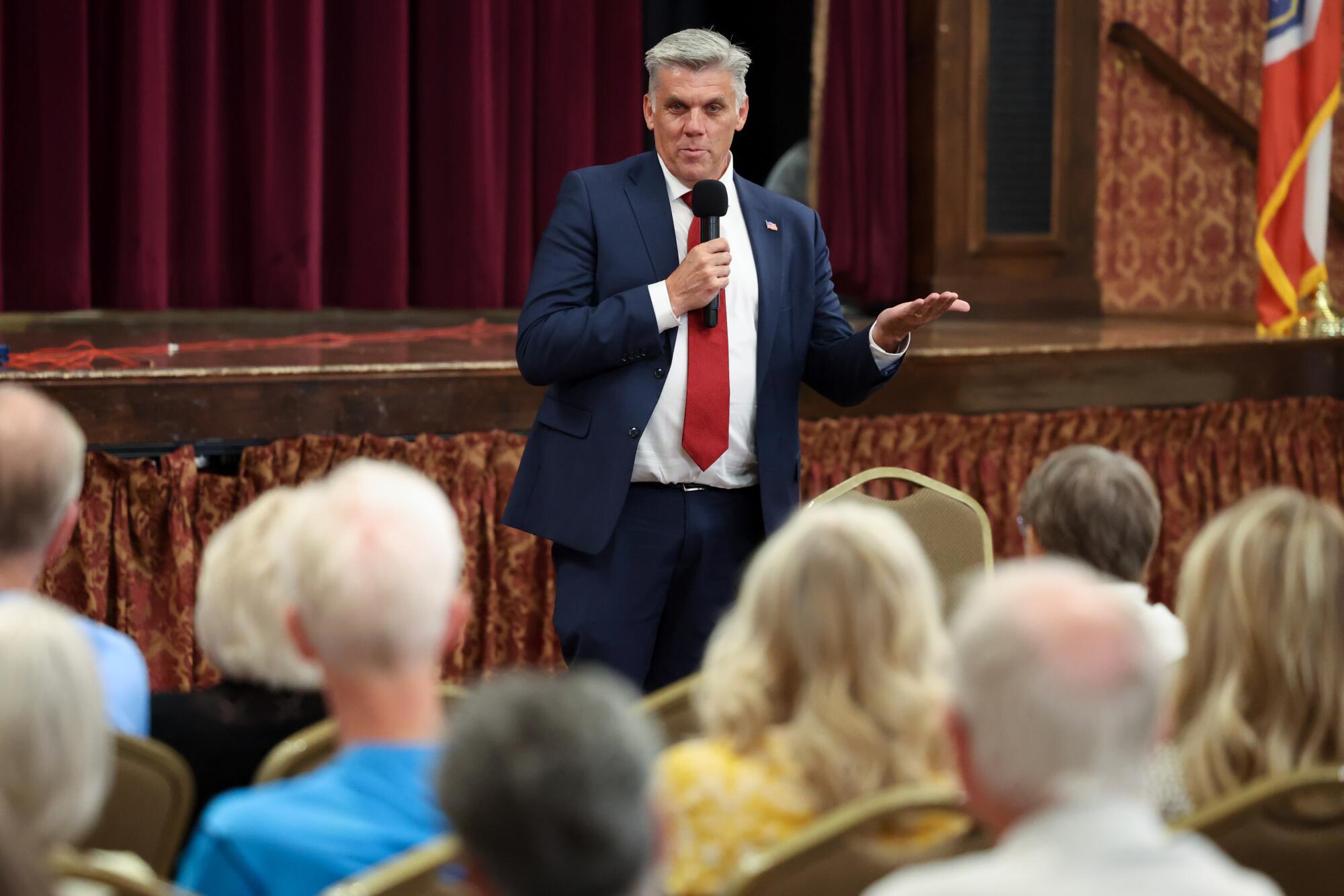
Utah congressional candidate Phil Lyman speaks during a Cottage Meeting at the SunRiver Community Center Ballroom in St. George, Utah, on Wednesday.
(Ian Maule / For The Times)
But Lyman suspects the group’s support for Maloy ahead of their June 23 primary has more to do with old-fashioned politics than any emerging technology.
One of the two co-founders of the political group is Chris Stewart, Maloy’s predecessor in Congress.
“Everything that they’re doing feels very coordinated,” Lyman said. “It makes you wonder if he’s still really controlling that seat.”


Grocery Outlet is opening new locations across California, rebuilding its network in the Golden State after closing stores early this year.
A new branch in Ontario Ranch is scheduled to open July 23, and more openings are planned for later this summer.
The location will be operated by independent owners Gloria and Jason Pineda. By the end of August, the discount grocery retailer plans to open stores in Ramona, San Francisco, Clovis and Petaluma as well.
The Emeryville, Calif.-based chain announced the closure of 36 stores in March, including nine California locations. The closures were an attempt to roll back an overexpansion in the wrong markets, resulting in a loss in 2025. Grocery Outlet did not announce which locations would be closed at the time, but they were listed for sublease by advisory firm Gordon Bros.
Among those listed was an Ontario location closer than seven miles from the soon-to-open site.
Five other Southern California locations were marked for closing in Azusa, Brawley, El Cajon, La Habra, Ontario and Poway. In Central California, the Kerman, Patterson and Ridgecrest stores were also listed for sublease. Outside of California, stores in Idaho, New Jersey, Maryland, Ohio and Pennsylvania also were listed.
In an earnings call in May, Grocery Outlet Chief Executive Jason Potter said the restructuring was helping boost the company’s profit.
“These closures are now complete and have improved fleet quality and will strengthen the earnings profile of the business over time,” he said.
Grocery Outlet was founded in San Francisco in 1946 as a discount grocery store chain selling overstock of limited-time or holiday food items. There are about 280 Grocery Outlet locations in California, accounting for more than half of its total store count.
Though Grocery Outlet has cultivated a dedicated consumer base on TikTok and other social media posts from grocery bargain hunters, it faces fierce competition from other budget grocery chains, including Aldi, which is set to open 180 stores in 2026. It also competes with Trader Joe’s, Walmart and Amazon, which have steadily gained customers.
Last year it was also hurt by the lapse in federal food assistance during the 43-day government shutdown.
In the wake of rising grocery prices and economic anxiety, some low-income customers who would once have shopped at budget grocery chains such as Grocery Outlet are turning to food banks instead. According to Los Angeles Regional Food Bank, 1.2 million people visit its food banks per month.
Grocery Outlet’s net sales rose 4% in the first quarter from a year earlier to $1.17 billion. It recorded a net loss of $180 million for the period.
It said it had closed locations as part of its optimization plan. It also underwent a store refresh program, changing products and is clustering locations to boost profit and customer traffic.
“Our value-oriented product offering continues to resonate with consumers. While we’re encouraged by the progress we’re beginning to see, we’re not satisfied with our current level of performance and are focused on the work we have in front of us,” Potter said on the earnings call.
Grocery Outlet shares have fallen more than 25% over the last 12 months. The Dow Jones industrial average has climbed more than 15% during the same period.

On July 9, the Trump administration delivered a gift to Cadiz Inc., a politically well-connected firm that has been trying for decades to win approval for a scheme to pump water out of the Mojave Desert and market it to water agencies across the Southland.
The administration approved the company’s application to convert an abandoned 220-mile oil and gas pipeline crossing the desert to carry water instead. Susan Kennedy, the chief executive of Cadiz, called the approval “a pivotal milestone” that would enable the project to move into its construction stage.
Here’s betting that Kennedy’s statement was somewhat premature. The project still faces significant opposition from environmentalists, local Indian tribes and the state of California. It has been declared ready to go — and declared dead, too — so often that it could serve as a character in a zombie movie or streaming series.
I haven’t seen anything to persuade me that there’s not going to be any environmental damage.
— Ileene Anderson, Center for Biological Diversity
Indeed, this is the second time that Trump has greenlighted this project. He did so during his first term, but his decision was overturned during the Biden administration; Trump’s most recent approval overturned that action — but there’s no promising that the next president, whoever that is, won’t overturn this one.
I’ve been covering the Cadiz project for nearly 25 years, starting in 2002; I take credit for helping to put the kibosh on a proposal for the Metropolitan Water District, which supplies water to 13 million Southern California residents, to partner with Cadiz.
In fact, there’s reason to wonder whether Cadiz itself still wants to do the project, even though in the past it described it as its potential corporate lifeblood.
Last year Cadiz reported that nearly 90% of its revenue stemmed from the sale of water filtration equipment manufactured by ATEC, a Hollister firm it acquired in 2022. That segment is its only profitable operation, though the $2.5 million in operating income the unit produced in 2025 was swamped by losses in its other operations — mostly the sale of fruits and vegetables grown on its desert tract — producing an overall loss of $25.6 million. The company has never reported a profit.
Kennedy told me this week that she now sees the water treatment business as “the future of our company — an enormous market opportunity.” She said “demand for filtration is skyrocketing,” with cleansed stormwater “the biggest source of new water supply.” Cadiz has doubled its manufacturing capacity for the equipment, and “we expect to double again.” The company has also signed an agreement to produce hydrogen at its desert site by installing a solar array for power.
Meanwhile, Cadiz is taking steps to hive off the infrastructure it has planned to use for its water project, mostly two unused pipelines, into a special purpose subsidiary. These entities are typically aimed at insulating the parent company from the risks and liabilities of a speculative investment.
In this case, Kennedy told me, the idea is to open the water project more broadly to outside investors.
In practice, that means that the pipelines Cadiz proposes to use to transport desert waters to urban, industrial and agricultural users would fall into the hands of private equity firms, which haven’t been known as a class for their devotion to the public interest. Cadiz would end up with a minority stake in the pipelines, Kennedy says.
Transporting water out of the desert faces so many headwinds that it may make more sense to divest the business and shift over into less controversial enterprises, like filtering poisonous minerals out of reclaimed stormwater and producing hydrogen.
It’s worth reacquainting ourselves with the company’s discreditable history. The Cadiz project was the brainchild of British-born Keith Brackpool, who had a checkered record as an investment promoter. As I wrote in 2002, he pleaded guilty in London in 1983 to criminal charges that included dealing in securities without a license.
Brackpool’s pitch was that by stockpiling water from the Colorado River under the Cadiz sands in years when a surplus was available and delivering it during droughts, the company could assuage the supply crisis confronting Southern California.
I wrote years ago that the project boasted “a sort of shimmering authenticity” — if one didn’t look too closely. Yes, the state faces a long-term water shortage. But the problem is that there’s no surplus water in the Colorado available for California. Cadiz has never made a conclusive case that it could withdraw as much water from its desert tract as it proposed without draining its underground aquifer to a dangerous level or causing its contamination with carcinogenic minerals.
After he started pitching the project in the mid-1990s it began to look as though the company’s principal asset was political juice. Former Rep. Tony Coelho, an important Democratic Party fundraiser, served on the Cadiz board. Cadiz and Brackpool were leading campaign contributors to former Gov. Gray Davis, who was thought to be the source of pressure on the Metropolitan Water District to make a deal with Cadiz. Brackpool hobnobbed with former Los Angeles Mayor Antonio Villaraigosa, who received campaign contributions from him and Cadiz. (Brackpool is no longer associated with Cadiz.)
Kennedy herself had been associated with Cadiz since before she became chief of staff to former Gov. Arnold Schwarzenegger in 2005. Before her appointment, and while she was serving on the state Public Utilities Commission, the firm paid her $120,000 in consulting fees. In 2009, Schwarzenegger endorsed the water scheme as “a path-breaking, new, sustainable groundwater conservation and storage project.”
For years, Cadiz shares traded as a sort of plaything for water investors hoping for a big score over the horizon — what craps players call “betting on the come.” In this case the bet is on the distant prospect that government approvals would eventually make the project real.
For these players, the investments tended to be cheap compared to the potential gains. The largest shareholder of Cadiz, with a 35% stake, is Netherlands-based Heerema International Services, a global industrial infrastructure company. Its holding is worth about $115 million at the current stock price — peanuts for a company that collects revenue of about $5 billion a year.
Then there’s Trump. In March 2017, his Interior Department reversed two Obama administration rulings that had blocked Cadiz’s ability to use a 43-mile pipeline to carry water from the desert to Southern California users. Biden’s Interior Department canceled those rulings. The July 9 action applies to a separate 220-mile pipeline.
In its recent ruling, the Interior Department’s Bureau of Land Management stated that the pipeline conversion would have “no significant impact … on the quality of the human environment” and therefore no environmental impact statement was even needed.
Environmental groups and other plaintiffs who have been fighting the project are “looking at all our options” for legal challenge, says Ileene Anderson, a senior scientist at the Center for Biological Diversity, a plaintiff in lawsuits challenging the project. “I haven’t seen anything to persuade me that there’s not going to be any environmental damage,” she says.
When I spoke with Kennedy in January 2024, a few weeks after she took over as Cadiz CEO, she acknowledged that the company’s name had become a “poison pill.” Her plan was to “change the company so people think about it differently.”
At that time, this amounted to refocusing its water supply program on serving users in San Bernardino County rather than urban users throughout Southern California. The idea was to counteract what she called a “political” claim that its goal was to drain the desert to “fill swimming pools in L.A.”
Kennedy didn’t mention ATEC then, but she talks about it today with unalloyed enthusiasm. Indeed, she asserted that the water filtration and hydrogen production businesses together could use as much of the company’s available water as it would pipe miles across the desert.
Kennedy is correct to maintain that government, which once built Hoover Dam, the Central Valley Project and Glen Canyon Dam as crucial pieces of our water infrastructure, “has gotten out of the business.”
But it’s wrong to say that it’s because government can’t afford such projects. Ceding them to private equity is a choice. Given Americans’ dependence on water as a life-giving commodity, do we really want to establish private firms as toll-takers on the water highway, permitted to charge what they wish to maximize their profits? Cadiz may be beating a path to that future, but it may not be a happy journey.

Hollywood’s fascination with YouTube creators is going to the next level.
Los Angeles-based investment firm Content Partners and media entrepreneur Ed Simpson announced Tuesday that they are launching a new company, Wonderloom Media, that will acquire YouTube-creator led businesses.
Wonderloom’s first acquisition is YouTube true-crime channel Dr. Insanity, which has more than 5 million subscribers and more than 1.3 billion total views.
Content Partners owns or licenses more than 800 films and more than 3,000 hours of television content. The company co-owns the “CSI” franchise.
“This is a kind of next step evolution in the type of IP we will be acquiring,” Alphonse Lordo, a partner at Content Partners, said in an interview.
The effort comes as the film industry continues to struggle to bring more people into movie theaters and has had recent success with the YouTube creator-led films “Obsession” and “Backrooms.” As studios and TV networks have shed jobs over the years, more entertainment workers are applying their expertise at major YouTube creator-led businesses, which have continued to grow their audiences.
YouTube’s audience has shifted from smartphones to TVs, on which many U.S. consumers watch YouTube videos with their families. That in turn has attracted streamers such as Netflix to partner with YouTube creators to bring their content to the same platform that has high-budget television shows and movies.
Simpson, a former TV producer who will be Wonderloom’s chief executive, said Dr. Insanity was the “perfect first acquisition” because it had a loyal audience, proven storytelling and meaningful room to expand. “True crime is an incredibly sticky genre of programming that works just as well as it does on YouTube, as it does on Netflix and linear and cable channels,” he said in an interview.
Financial terms of the deal were not disclosed.
Wonderloom, based in L.A., also will assist entrepreneurs who started YouTube channels grow their businesses.
The new company also is eyeing possible acquisitions in food, travel and general entertainment programming, added Simpson, a former chief strategy officer at Wheelhouse, a production firm behind “America’s Sweethearts: Dallas Cowboy Cheerleaders.”
“This is about building the next generation studio, so we think of this as the beginnings of Paramount, of Warner Bros., of those great studios,” Simpson said. “We see this space following in that very same pattern right now.”
Other Hollywood companies also are getting into the creator business acquisition space. Last month, Century City-based Creative Artists Agency said it was partnering with Integrated Media Co. to form a $250-million holding company called Compound Creative Holdings that will acquire and operate a portfolio of creator economy businesses.
-
 Sports6 minutes ago
Magical Lionel Messi leads Argentina past England for trip back to World Cup final
-

 World18 minutes ago
Toronto engulfed by wildfire smoke as US cities threatened
-
 News48 minutes ago
Argentina is back in the World Cup final after a thrilling semifinal win over England
-

 Los Angeles, Ca2 hours ago
Remains of murder victim identified as missing Southern California millionaire
-

 Detroit, MI3 hours ago
4Warn Weather Alert: Wildfire smoke leading to ‘unhealthy’ air quality in Metro Detroit
-

 San Francisco, CA3 hours ago
San Francisco fishermen recount harrowing rescue after boat capsizes near Alcatraz
-

 Dallas, TX3 hours ago
Timothée Chalamet ‘Starstruck’ by Dallas Cowboys Cheerleaders
-

 Miami, FL3 hours ago
Wives of detained men allege inhumane conditions at federal detention center in Miami

