Movie Reviews
Keeper review – romance goes to hell in effectively eerie horror


For the past few years, horror cinema has sometimes felt as fraught with toxic romance as a particularly cursed dating app. From manipulated meet-cutes (Fresh; Companion) to long-term codependence (Together) to the occasional success story (Heart Eyes), it’s clear that romantic relationships are mostly blood-stained hell, and a couple going to a secluded location together is a fresh level of it.
So it’s not surprising when Liz (Tatiana Maslany) starts to feel uneasy on her weekend away with Malcolm (Rossif Sutherland) early on in the new and much-concealed horror movie Keeper. Liz and Malcolm have been together for about a year, which we gather early on has marked the time Liz has bolted from past relationships. Still, she seems optimistic about this one. She thinks she knows Malcolm pretty well, and their early scenes together are neither as dotted with red flags nor as suspiciously idyllic as other recent characters in the doomed-couple genre. Liz has a wary, deadpan sense of humor, and Malcolm has a slightly slurred-together accent as he explains some oddities about his family-owned cabin in the woods (like the fact that he has a creepy cousin who lives nearby). But their awkwardness levels are complementary. They seem comfortable together.
Osgood Perkins, the director, introduces discord through his shot choices, rather than micro-aggressions or backstory. Liz and Malcolm’s faces are rarely outright hidden, but they’re often partially obscured, shown from odd angles, or framed in shots with a disconcerting amount of headroom. This establishes a pattern of disorientation that continues as Liz thinks she hears faint noises through the house’s vents. When she relaxes in the house’s posh tub, there’s an intensely memorable superimposition of the nearby river rushing all around her, as if she’s about to transcend space and time. “I feel like I took mushrooms,” she tells a friend she calls when she’s left alone at the cabin. Her friend asks if she did, in fact, take mushrooms; Liz doesn’t answer directly.
For a while, Keeper – named for Liz’s supposed status as the woman in Malcolm’s life – seems like it could go in any number of directions, its horror elements mixed together in a dreamlike jumble. Is it a ghost story, a slasher-in-the-woods movie, or just a really bad trip? Perkins, a horror specialist who has been on a prolific run for the past 18 months with another movie due out next year, makes it difficult to tell, both in-movie (so many of the creepiest early moments are moments just out of focus or in the corner of the eye) and extra-textually; his last two films were the tonally distinct serial-killer freakout Longlegs and the Final Destination-ish horror comedy The Monkey. This eclecticism, combined with Keeper’s elusive and spoiler-averse ad campaign, could make the new film feel to some like a shell game designed to dress up what is, at its core, a pretty simple horror story.
Maybe it is that. But part of what makes Perkins’ film so refreshing is the way it prioritizes its visceral effect on an audience over a desire to bend that story into a modern relationship parable. As clever as so many contemporary horror movies are, they often write toward theme rather than shooting toward immediacy. As a result, some are starved for original imagery, unexpected juxtapositions or a sense of genuine, uncanny mystery. Keeper has all of this, and Perkins knows just how far to push those elements without allowing the movie to become abstract woo-woo self-indulgence.
He also seems to know what a powerful grounding element he has in Maslany, who isn’t called upon to do the usual virtuoso demo reel of a woman on the verge of oblivion. Liz does get freaked out by the strange things that happen around her, and the character is written and performed with a certain directness. (She’s not one of those horror heroines who inexplicably avoids asking what the hell is going on.) Yet Maslany delivers a second level to her performance in her unguarded moments: a cynical flick of her eyes in one direction or another, the tenuousness of her more polite smiles, the shorthand of both her familiarity and quickness to irritation with her unseen friend on the phone. Though no particular skeleton key to her traumatic past awaits, the character still feels complete.
That’s true of the movie as a whole, too. It’s not as rich as Sinners nor as narratively ambitious as Weapons, two of 2025’s standard-bearers for original horror. But when Keeper finishes up, its tight confines feel satisfying, correct and unlikely to spawn a sequel. That tidiness drives home some of its themes in a way that the more overt messaging of other dating-hell stories don’t always manage: maybe it takes a fable-like horror for the messy business of relationships to stay so neatly kept.


Let’s just say that the wedding band has never occupied the most exalted rung of the ladder in music.
Playing “September” and “Celebration” is often what’s most required. As one member of the Bride and the Groove, the band at the center of John Carney’s new film, puts it: They’re not rock stars. They’re human jukeboxes.
But in “Power Ballad,” a wedding band singer and pop star cross paths. For one night, all of the stratification of the music world falls away. “Power Ballad” starts like a fairy tale.
Since 2007’s “Once,” the Irish writer-director has focused his films on the redemptive capacity of music. Carney, who was once a bassist for the Frames, knows from experience. From “Sing Street” to “Flora and Son,” he has made unabashedly earnest tales where a song, or just picking up an instrument, changes lives.
This can, undoubtedly, lead Carney into sentimental territory. Lucky for him, his chosen subject — music — is more worthy of sentiment than almost anything else. Yet the song doesn’t quite remain the same in “Power Ballad,” a movie that begins with the gentle sweetness Carney is known for, but detours into something more discordant.
Rick (Paul Rudd) is an American musician who gave up on his once-promising rock band’s future to instead live with his wife (Marcella Plunkett) and teenage daughter (a spunky, underused Beth Fallon) in Dublin. His former group was called Octagon, a perfect former band name if there ever were one.
But for years, Rick has fronted the Bride and the Groove. It’s an unromantic day job (or rather a night one) that hasn’t entirely sapped his belief in his own songwriting. During an encore at one wedding, he plays an original tune and is mentally transported to an arena full of swaying fans. When he snaps out of it, he’s staring at an empty dance floor and faces that say: That wasn’t Kool & the Gang.
At another wedding at at a castle, the band is asked to let a friend of the newlyweds sit in. They reluctantly agree, and are surprised to see the very popular boy band veteran, Danny (Nick Jonas), step on stage. He sings Stevie Wonder’s “I Wish,” and it’s great. Though Rick had just dismissed Danny’s music as “manufactured content for young, excitable teens,” he discovers Danny is a genuine musician.
But, later that night, something even more remarkable transpires. Rick bumps into Danny, and the two quickly hit it off. They begin jamming together and sharing songs that need work. They are both so jazzed by their unlikely collaboration that they play into the next morning.
The actual moment of artistic creation, and the craft it requires, is something the movies almost always skip over. But capturing collaborative juices flowing is exactly what Carney excels at. You can feel his joy in it. So it’s fitting that one of the unfinished songs Rick plays for Danny, “How to Write a Song (Without You),” is about creative invention.
It’s here when you wonder where “Power Ballad” is headed. Is this, for Rick, the beginning of a beautiful friendship? Will they turn into the next great songwriting duo, lifting Rick out of weddings and proving to the world that Danny is more than a boy-band pretty face?
That is very possibly the movie Carney might have made a decade ago. But “Power Ballad,” which he co-wrote with Peter McDonald (who also co-stars as a band member), shifts six months ahead in time. Rick is standing in a shopping mall when the familiar lyrics of “How to Write a Song” softly float through the stores. He stands dumbfounded in the gleaming halls of commerce, a befuddlement that slowly turns into outrage the bigger and bigger Danny’s smash hit grows.
“Power Ballad” loses some of its steam in its second half, which follows Rick’s struggle for justice. Making things considerably harder is that he can find no recorded demo of the song. His family and his band don’t even really believe him.
But even as the movie struggles to sustain its opening refrain, Carney’s film is always riffing on ideas of authenticity and aspiration in music. That Jonas is, himself, a former boy band star who has at times gone it alone, lends the movie a direct connection to contemporary music, where tussles over authorship are increasingly common.
Jonas has been good in other films (notably the “Jumanji” movies), but this is his most ambitious and convincing performance to date. It’s a testament to the movie that Danny’s theft isn’t a purely villainous act. He gives the song a bridge and the vocal power to take it to another level. He’s under mounting pressure from his label to deliver a hit. An executive (Jack Reynor) wants “Danny 2.0” but has little faith he can supply it.
But it’s an even more well-tailored role for Rudd. He memorably and very goofily played a bassist in the 2009 comedy “I Love You, Man.” But while he sings well, it’s not his musical chops that lift the performance. It’s more that Rick, a contented family man with unrealized rock-star dreams, gives the exceptionally genial Rudd more notes to play as an actor. Rudd makes for a very likeable everyman out to convince the world he is capable of a beautiful song.
And that’s the abiding belief of Carney’s. No matter all the struggles, the artistic injustices, the corporate hegemony, he still believes that if you make something truly soulful, it will break through. It will claw its way to the surface, and move people. It’s undoubtedly gotten harder since “Once,” this movie seems to admit. The world is against you. But what one person can offer, a ballad or otherwise, still has power. Fairy tale or not, that’s worth believing in.
“Power Ballad,” a Lionsgate release in theaters Friday, is rated R by the Motion Picture Association for “language throughout and some drug use.” Running time: 108 minutes. Three stars out of four.

NEW YORK (OSV News) – As America’s Catholic bishops prepare to mark the semiquincentennial by consecrating the nation to the Sacred Heart of Jesus, a French docudrama that can aid viewers in understanding the full significance of such an action makes its timely appearance.
A Fathom Entertainment presentation, “Sacred Heart: His Reign Has No End” will have a limited theatrical run June 9-11 and June 14. The version screening on June 10 will be dubbed in Spanish.
Following its initial release in France last fall, the film proved to be phenomenally popular, with ticket sales reaching the half-million mark in a country usually regarded as deeply secular. This unusual development clearly indicates that the movie resonated with audiences in a way that even its creators may not have expected.
Filmmakers Sabrina and Steven J. Gunnell examine the origins, meaning and enduring relevance of devotion to the Sacred Heart. They begin their exploration even before the landmark revelations received in the 1670s by St. Margaret Mary Alacoque, a Burgundian Visitation nun, showing that earlier saints had focused on the subject in medieval times.
Using reenactments, interviews and archival images, the Gunnells also highlight the theological connection between the Sacred Heart and the Eucharist. This is done, in part, by recounting a few of the many Eucharistic miracles granted to the Church over the centuries.
By profiling contemporary devotees of the Sacred Heart, including formerly inactive Catholics, the picture demonstrates the impact the insights given to St. Margaret Mary continue to have on the lives of people around the world. Locations visited range from the gang-infested streets of a Parisian suburb to the once war-torn Central American country of El Salvador.
An excellent and enjoyable catechetical resource, the feature is also both moving and uplifting. It can be recommended for all but the youngest kids.
For theater locations and showtimes, go to: sacredheartfilm.us
Dubbed into English.
The film contains gory images of the Crucifixion. The OSV News classification is A-II — adults and adolescents. Not rated by the Motion Picture Association.
Read More Movie & Television Reviews
Copyright © 2026 OSV News

There’s a photo of me (below) from the mid-1980s, when I was around age 5, standing on the hood of an old Plymouth in the overgrown field behind my childhood home. I’m holding He-Man’s shield in one hand and his sword, made of yellow plastic, in the other. (Unrelatedly, I’m also wearing an Incredible Hulk shirt in the picture.) And I’m grinning with pride because I have thoroughly conquered the jalopy. The vehicle never ran again, probably because I fucking destroyed it with my sword and shield. Around that time, I also had a He-Man birthday cake and a sizable collection of Mattel’s Masters of the Universe action figures. They were my first foray into toys of this kind, later replaced by G.I. Joe, Teenage Mutant Ninja Turtles, and X-Men. However, my nostalgia for He-Man remains almost nonexistent today, perhaps because, looking back at the material, the mythology remains at once weird and unmemorable, and neither the popular animated series nor the 1987 film, Masters of the Universe, starring Dolph Lundgren and Frank Langella, holds up well.
Over the years, Mattel has tried to revive the toy line and cartoon, but the company’s biggest effort thus far is the new feature from Amazon MGM Studios, which reportedly spent upwards of $200 million on a blockbuster-sized Masters of the Universe. If the 1980s versions of this franchise unabashedly targeted the preadolescent boy demographic, the new iteration has been reconfigured (by a sausage fest of credited screenwriters: Chris Butler, Aaron Nee, Adam Nee, and David Callaham) to adopt a more conventional mold. The movie also incorporates the last three decades of ironic reassessment: the series’ very 1980s obsession with bulging muscles; the loincloth-centric costumes, all of which look like rejected designs from Zardoz (1974); the vague eroticism between He-Man and several characters, including his nemesis, Skeletor; and the eccentricities of the cartoon, from the many heads thrown back in laughter to the bizarre characters—all of which started first as action figures (Stinkor, Mantenna, etc.), around which the writers built a lame storyline.
Despite its origins, Masters of the Universe sets out to become a four-quadrant feature, appealing to everyone, and in that, no one in particular. The story is too bloated for little children, with a 142-minute runtime that challenged the attention spans of the kids in my prescreening, who became restless after an hour. Admittedly, so did I. The material’s self-awareness and humor aren’t memorable enough to distinguish it from other, better examples in this genre, such as Dungeons & Dragons: Honor Among Thieves (2023)—a movie that I enjoy more with each subsequent viewing. And director Travis Knight can’t decide whether the audience should take these characters seriously or laugh at their inherent silliness. He attempts both and does neither very well. The result did not rekindle my nostalgia for this chapter of my childhood; it didn’t create an exciting new take for audiences of all ages, either.
A protracted opening establishes the distant realm called Eternia, where sword-and-sandal heroes stand alongside robots and flying ships with laser guns. Eternia’s resident baddie, Skeletor (voiced by Jared Leto, doing an R-rolling master-thespian thing), wants the Sword of Power, which imbues its wielder with, as you might guess, power. But it’s kept in Castle Grayskull, home of King Randor (James Purefoy), who’s disappointed by his son, Adam (Artie Wilkinson-Hunt), a young boy more interested in goofing around than learning to fight. When Skeletor attacks the castle and proves victorious, the Enchantress (Morena Baccarin), the magically inclined protector of Grayskull, sends Adam away to Earth along with the coveted sword. What happens then? Did a couple of farmers adopt him à la Superman? Or did he grow up in the foster system? The writers ignore such practical questions, picking up the story years later, when the adult Adam (now a hulking Nicholas Galitzine) works in corporate human resources. After Adam finally locates his sword, which was lost when he was transported from Eternia to Earth, he eventually finds his way home with the help of his childhood friend, Teela (Camila Mendes), to retake Grayskull from Skeletor.
Knight’s main source of inspiration, besides the cartoon and earlier movie, seems to be the similarly themed cult classic Flash Gordon (1980). Masters of the Universe’s music features identical-sounding Howard Blake-style guitar riffs and, to echo the original songs Queen wrote for Flash Gordon, the production uses Queen’s “Princes of the Universe” on the soundtrack. In other areas, Knight directs a conventional franchise movie with choppily edited and CGI-heavy battle scenes full of anonymous violence, lifeless chase sequences, digital backdrops resembling video-game environments, and shameless product placements for Coca-Cola and Amazon. The VFX sometimes look impressive; at other times, they look cheap and generic. Fortunately, Knight’s production also offers practical effects and prosthetics for some characters, most memorably the cyborg Trap Jaw. Knight’s secret weapon is costume designer Richard Sale, who visualizes the inherently absurd look of these characters, for better or worse, in tangible garb. The actors inhabiting the excellent costumes don’t have much to do, though. Ask yourself why they hired Kristen Wiig to voice Roboto, a bland robot character whose dialogue could have easily been performed by anyone else, or even just replaced with the beeps and boops of a Star Wars droid. When you have Kristen Wiig, use her.

Elsewhere, Masters of the Universe attempts to be self-aware in its irony and sexually suggestive underpinnings. There’s a running gag about how practically everyone can’t keep their eyes off Adam after he becomes his heroic alter-ego, He-Man, given his oiled-up muscles and blonde locks. But under Adam’s pink shirt, he still looks buff, making his eventual Hulk-like transformation into a muscle-bound barbarian unremarkable. Elsewhere, I liked the detail of Adam growing up on Earth and forgetting everyone’s names on Eternia, so he makes up their names based on their physical characteristics. A man with a big metal hand becomes Fisto (Jóhannes Haukur Jóhannesson), and another with a metal head-butting helmet becomes Ram-Man (Jon Xue Zhang). The writers take advantage of this with veiled dirty jokes about fisting and Ram-Man “giving head” to Skeletor’s goons. That’s about as clever as the movie gets. As for character development, there’s almost none. Skeletor, for instance, wants to be bad for the sake of being bad. His motivations are nonexistent, resulting in an obvious, uninteresting, and one-dimensional villain.
A key series in the conservative, Reagan-era 1980s, the Masters of the Universe cartoon and previous movie valued strength and power, muscles and might. Today, that message has negative, regressive associations with the political right, which often looks at this period from a fond standpoint. To avoid alienating any part of their audience, the filmmakers desperately try to please everyone with a mild progressive commentary to counter the franchise’s original themes. Adam’s character must learn to “be a man” to please his father, King Randor, and his makeshift father figure, Man-at-Arms (Idris Elba, in a chummy reformed drunk role). But there’s also a half-hearted message that Adam, having worked in human resources, knows the value of empathy and emotional intelligence. For a while there, the movie even claims you can’t solve every problem with muscles—that is, until He-Man resolves the conflict by pummeling Skeletor with his fists. The movie’s message is ultimately nonexistent. The committee making this movie has carefully avoided any line-in-the-sand worldview, all in an attempt to manufacture a box-office hit that will please everyone and offend no one.
That’s exactly the problem with Masters of the Universe. It’s so afraid to have a perspective or be about something that nothing onscreen has an impact. This is not to say every movie must have a substantive message. Sometimes, a mindless adventure is enough. However, even on those terms, there’s no tension or danger here because Skeletor is never all that menacing, and Adam alternates between self-parody and earnest heroism. None of the emotional beats land, not the many father-son dynamics nor the hero’s journey. And the production’s competing tones, from its intentional camp to its sword-swinging adventure, lack the balance of wit and scope that Dungeons & Dragons: Honor Among Thieves so delightfully captured. For much of the runtime, I felt bored and, aside from a few chuckles at the childish humor, disengaged from everything happening. Perhaps Roboto describes the movie best when referring to life as “a series of absurdities leading to infinite nothingness.”
Photo: Brian the Barbarian

-
 Lifestyle8 seconds ago
How having zero points in tennis — or ‘love’ — came to sound so sweet
-

 Technology12 minutes ago
Amazon develops a warehouse robot workers can speak to
-

 World15 minutes ago
Albino buffalo nicknamed ‘Donald Trump’ becomes sensation at Bangladesh’s national zoo for its blond hair
-

 Politics20 minutes ago
The growing list of controversies threatening Democrat Graham Platner’s Maine Senate bid
-

 Health27 minutes ago
New cancer vaccine delivers stunning result against one of the deadliest skin cancers
-

 Sports30 minutes ago
Fan disrupts NBA Finals Game 1 while trying to take selfie with Spurs’ Victor Wembanyama
-
 Business42 minutes ago
How Google’s 32-million mosquito project could change California’s battle against dengue
-
 Entertainment44 minutes ago
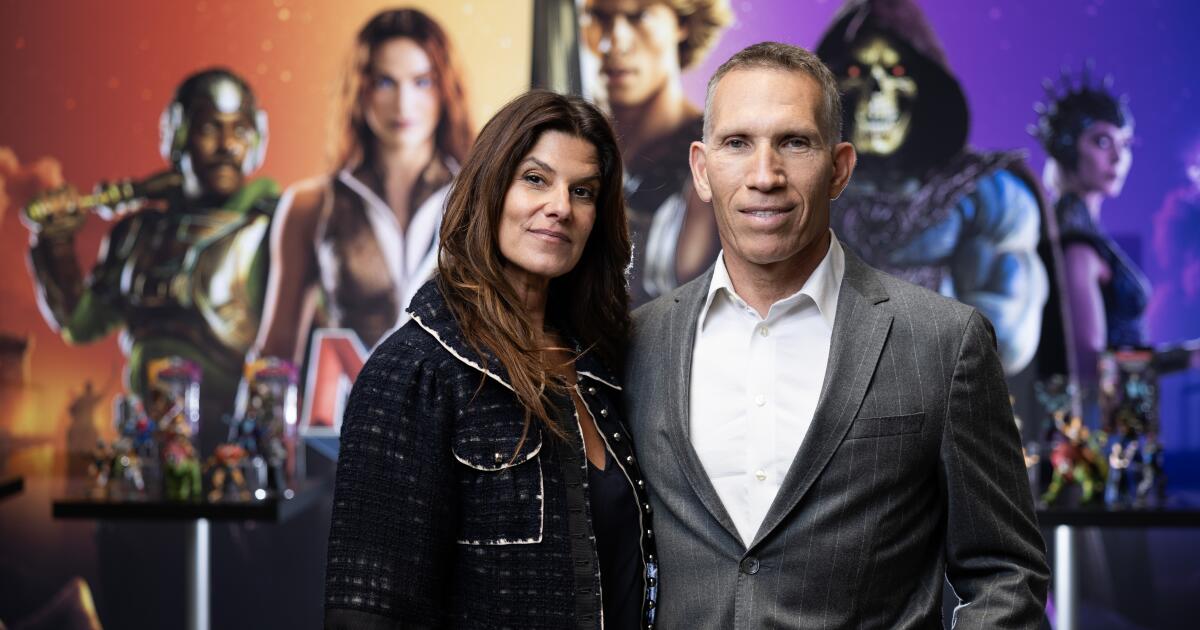
After ‘Barbie’ success, Mattel looks to He-Man for another box-office lift

