Movie Reviews
Drop Review: A Slick, High-Stakes Thriller with a Beating Heart


In Drop, director Christopher Landon (Happy Death Day, Freaky) trades supernatural body-swaps for a grounded, nerve-shredding thriller set in a single, sleek high-rise restaurant. Working from a taut script by Jillian Jacobs and Chris Roach, Landon crafts a tightly wound chamber piece with digital-age paranoia, emotional stakes, and escalating dread. Anchored by a commanding performance from Meghann Fahy, Drop isn’t just a thriller—it’s a ticking time bomb of psychological torment, familial love, and corporate corruption.
A Date Gone Wrong:
At its center is Violet (Fahy), a widowed mother navigating the early stages of dating after the traumatic suicide of her abusive husband, Blake. The emotional vulnerability of Violet’s character is crucial to the film’s success, and Fahy brings a compelling balance of strength, fear, and subtle optimism. Her attempt at re-entering the dating world leads her to “Palate,” an upscale rooftop restaurant where she’s arranged to meet Henry (Brandon Sklenar), a charming, soft-spoken city photographer she’s been chatting with online.
But things begin to unravel before he even arrives. Violet is plagued by mysterious “Digi-Drops”—a blend of harmless memes and progressively menacing messages that shift from unsettling to outright horrifying. While the term “drop” may sound benign, the film makes it ominous through clever pacing, ominous audio cues, and the growing realization that someone in the restaurant is watching Violet. The sleek, almost too-pristine atmosphere of Palate—complete with a smooth pianist (Jeffery Self) and a scattering of diners—starts to feel increasingly claustrophobic as Violet is ensnared in an elaborate cat-and-mouse game.
Excellent directing and cinematography:
Landon masterfully builds tension with spatial precision. Every table, glance, and corridor feels suspect. The cinematography, cool and composed, contrasts sharply with Violet’s growing internal panic, making the setting itself feel like a silent predator. When Henry finally arrives, the story shifts gears from flirtatious awkwardness to tense suspicion. Brandon Sklenar’s performance as Henry walks a careful line: is he the only ally Violet has, or is he somehow involved?
Rather than leaning solely on whodunnit mechanics, Drop is more interested in the how and why. The film thrives in its ability to slowly peel back the layers of Violet’s trauma and strength. As her situation worsens—eventually witnessing a home invasion through her own security cameras and being blackmailed into silence—we see a woman being pushed to the brink in real time. Fahy captures every flicker of hesitation and resolve, carrying the film through even its most implausible twists.
Supporting cast and the use of technology:
There’s a fascinating interplay between Violet and the cast of characters around her, particularly the enigmatic Richard (Reed Diamond). Meanwhile, Violett Beane as Jen provides some grounded human warmth that serves as both a red herring and an emotional tether. Jeffery Self’s Phil, too, provides an intriguing counterweight—his scenes, light on dialogue but heavy on mood, add subtle texture to the ensemble.
The film’s use of technology is notable and highly effective. Rather than relying on gimmicky visualizations of texts and apps, Landon and the writers integrate modern tech anxiety organically into the plot. The concept of “Digi-Drops”—a fictionalized but plausible evolution of digital messaging—feels right at home in a world where surveillance and data manipulation are everyday concerns. The idea that Violet can’t even trust her own phone, her date, or the people around her lends Drop a chilling, Black Mirror-like undertone.
Pacing and other issues:
Where the film truly excels is in its pacing and structure. Though confined to mostly one location for much of its runtime, the film never feels stagnant. Each new development raises the stakes, and just when the situation seems to plateau, it jolts forward again with a new revelation or threat. The tension is sometimes suffocating, particularly in the film’s second act, where Violet is forced to make increasingly difficult decisions with impossible stakes.
If there’s a drawback, it’s that Drop occasionally edges toward the melodramatic. Some twists, particularly in the final act, require a mild suspension of disbelief. A few characters are underdeveloped—specifically some of the diners and side figures whose motivations feel more like plot devices than fully fleshed-out individuals. But these are minor criticisms in a film so confident in its tone and so carefully constructed.
A well-rounded experience with payoff:
The emotional payoff in the third act—without getting into spoilers—is well-earned. Violet’s arc, from a cautious woman afraid to re-enter the world to someone forced to confront both internal and external threats head-on, is compelling and cathartic. The relationship between her and her young son Toby is understated but essential. The stakes are never abstract—there’s a child’s safety and a family’s future on the line—and that gives Drop a grounding, emotional anchor that’s missing from many thrillers of this kind.
Brandon Sklenar’s Henry turns out to be more than a pretty face, and the chemistry between him and Fahy adds a bittersweet layer to the escalating danger. The film doesn’t need to lean into romance, but it does, gently and effectively, never forgetting that vulnerability and connection are just as dangerous—and necessary—as deceit and power.
The technical elements—score, lighting, and editing—are all top-notch. The music subtly morphs throughout the film, moving from elegant ambiance to urgent pulses without drawing too much attention to itself. The use of camera angles and close-ups heightens Violet’s isolation without it feeling gimmicky. It’s a confident, sleek production that knows when to hold back and when to go all in.
Overall:
Drop is a smart, stylish thriller that understands the fears of the digital age but roots them in very human emotions: grief, love, and trust. It balances its high-concept tension with grounded performances, particularly from Meghann Fahy, whose turn as Violet deserves recognition. Christopher Landon once again proves he’s not just a genre director—he’s a filmmaker who knows how to use suspense as a tool to explore deeper truths. It’s a harrowing night out—and one that audiences won’t soon forget.
Drop Review: A Slick, High-Stakes Thriller with a Beating Heart
-
Acting – 8.5/10
-
Cinematography/Visual Effects – 8.5/10
-
Plot/Screenplay – 7.5/10
-
Setting/Theme – 7.5/10
-
Watchability – 8.5/10
-
Rewatchability – 7.5/10
User Review
( votes)
Summary
Drop is a smart, stylish thriller that understands the fears of the digital age but roots them in very human emotions: grief, love, and trust. It balances its high-concept tension with grounded performances, particularly from Meghann Fahy, whose turn as Violet deserves recognition. Christopher Landon once again proves he’s not just a genre director—he’s a filmmaker who knows how to use suspense as a tool to explore deeper truths. It’s a harrowing night out—and one that audiences won’t soon forget.
Pros
Christopher Landon continues to prove himself as a great director
Meghann Fahy and Brandon Sklenar deliver fantastic performances
Excellent lighting and cinematography
Tense all the way through
Cons
Some of the scenes that involve the use of memes are a bit silly
Slight bit of having to suspend disbelief in the third act



By and large, the zombie subgenre has bitten off more than it can chew in modern times. Between George Romero survival films and camp comedies, the well has become pretty infected. But once in a while, along comes a movie like This Is Not A Test.
Let’s sink our teeth into this new release and see how it stacks up against the classics.
The tone and tenor of this film represent the classic survival movies like Night Of The Living Dead. But the thing that grabs the audience about This Is Not A Test is the trauma of the characters. Holt shines as a withdrawn survivor of an abusive home, trying to cut through the wreckage to reunite with her sister. Each of the main characters have standout traits, and they bathe in strongly acted moments as the stress of the situation changes who they are.
The gore in This Is Not A Test is pretty strong. The attacks spring quickly and when they do, the special effects team does a good job showcasing the battle scars. The camera work is also frenetic in a good way, because the chaos of the chase scenes puts the viewers in a first-person perspective. This film lets you feel like a part of the survivors, so their journeys are interactive.

Longtime fans may say that there’s nothing new in This Is Not A Test, and maybe they’re right. There’s no fresh take on the monsters here, no crazy origin, nothing that we haven’t seen in the past fifty-eight years. But the pacing nails a great balance between getting to know the characters and getting the zombie splatter fest. The mental meltdowns of the characters feel well earned, and the arc of Sloane and her sister brings a lot of heart and investment to the story. Even the most jaded zombie horror fans will find something to appreciate here, even as a background movie.
Adam MacDonald has made another intense hit here, and This Is Not A Test is currently available to stream on Shudder.

- THE ODYSSEY
- Starring: Matt Damon, Tom Holland and Anne Hathaway
- Directed by: Christopher Nolan
- Rated: R
- Running time: 2 hrs 45 mins
- Universal
Our score: 4.5 out of 5
EPIC. If I was asked to describe Christopher Nolan’s latest film, that is the word I would use. He has mounted a film that rivals the greatest achievements of filmmakers like Cecil B. DeMille or David Lean. And, like the films of those mentioned, it’s runs a tad too long.
I was shocked, but pleased, to see that my 12-year-old granddaughter recently did a school paper on King Agamemnon. Thank goodness they’re still teaching History in our schools. Based on Homer’s “The Odyssey,” the film tells the story of King Odysseus (Damon) and his adventures which, if you’ve read “The Odyssey,” include the Trojan Horse, the Cyclops and assorted angry Greek gods. The film covers each of these adventures in great detail, sparing nothing in the production design department. While Odysseus is away – and he’s gone for a l-o-n-g time, his wife Penelope (Hathaway) has to endure a never ending string of “suitors,” men lining up in the hopes of replacing the King should he not return. The men are nothing more then scavengers, taking advantage of the law of Zeus, which decrees no one should be turned away. This angers the Queen’s son, Telemachus (Holland), who must control his temper when the men try to bait him into a fight, the idea being if Telemachus is killed, the new husband would become the King. It’s all very interesting and complicated. And long.
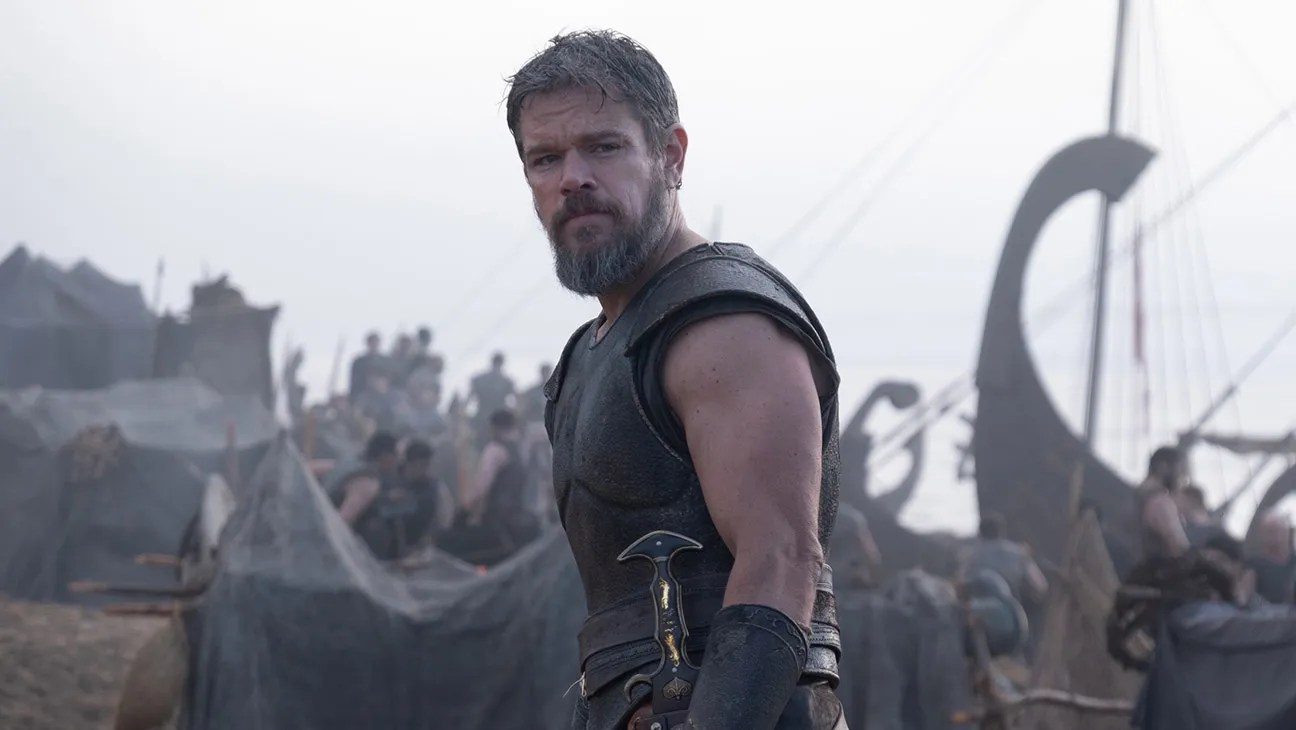
Director Nolan is one of the rare filmmakers who, in my opinion, has never made a bad film. From “Memento” to the “Dark Knight” trilogy to the Oscar-winning “Oppenheimer,” he has proven himself a true master of cinema. “The Odyssey” only adds to that distinguished resume’
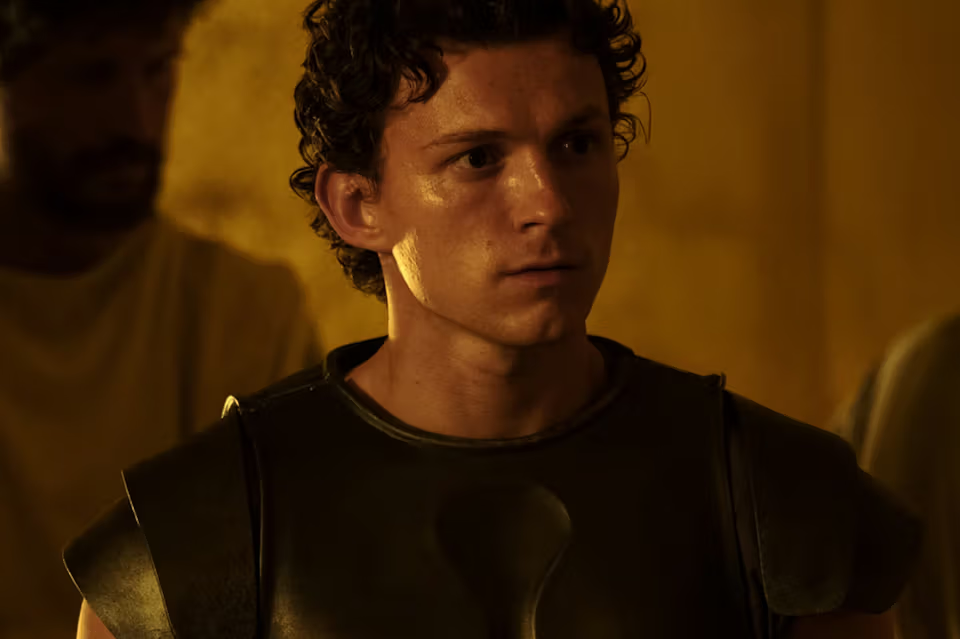
The cast is a tribute to Nolan himself who, like Woody Allen, can pretty much get anyone he wants for his films because, as an actor, why wouldn’t you want a credit in one of his films. Besides the three stars named above, the cast includes Robert Pattinson, John Leguizamo, Zendaya, James Remar, Jon Bernthal, Oscar nominees Samantha Morton and Elliot Page as well as Oscar winners Charlize Theron and Lupita Nyongo. As MGM used to advertise, “more stars than there are in heaven.”
The script and story are pretty faithful to the source material, though for some reason it bothered me whenever Telemacus referred to Odysseus as “dad.” Never father. The weird things you notice. Visual.y the film is stunning and the Trojan Horse and battle of Troy are worth the price of admission alone. I will add that I did see the film in 70 mm and, if that format is playing in your town, I urge you to see it in that format.
On a scale of zero to five, “The Odyssey” receives ★★★★ ½
Movie Reviews
Saari Review: Memory, Betrayal and Identity Converge at River Valley Film Festival – Hollywood Times


Premiering at the 2026 River Valley Film Festival, Saari uses fragmented memories, Finnish landscapes and restrained performances to explore betrayal, identity and reconciliation.
By Valerie Milano
Palm Springs, CA (The Hollywood Times) 7/14/26 – In the visually striking short film Saari—Finnish for “island”, a peaceful family retreat becomes the setting for the slow collapse of a relationship.
Co-written by Justin Seegmueller, Corey L’Esperance and Suvi Härkönen, the film follows Daniel, played by Seegmueller, as he reflects on the choices that damaged his relationship with Liina, portrayed by Ilona Karppanen. Told through fragments of the past, present and future, Saari gradually reveals how secrecy and betrayal can transform a place of safety into one of emotional confinement.
The nonlinear structure was not simply a stylistic choice. The project was developed and filmed over more than a decade, with footage captured in Finland, Boston and the desert. L’Esperance explained that the filmmakers divided the story into “past, present and future,” allowing audiences to experience the relationship from both characters’ perspectives.
Click below for our exclusive interview:
He described Daniel and Liina as two people who are “stuck in these moments in time,” making the fragmented narrative especially appropriate.
Seegmueller said Daniel’s internal struggle is rooted in the questions, “Am I that person? Am I still that person?” His restrained performance captures a man attempting to reconcile his current identity with the damage caused by earlier decisions.
For Seegmueller, the film is fundamentally about choice.
“It’s all about decision-making,” he said. “Are you an accumulation of all your decisions?”
Finland’s lush island scenery contrasts sharply with Daniel’s later isolation in the barren desert. Seegmueller described the progression as “lush and then dead,” a simple but effective visual representation of a relationship moving from intimacy and possibility to emotional aftermath.
For Liina, the island represents family history, comfort and security. By inviting Daniel there, she welcomes him into her sanctuary. His secrets, however, begin to contaminate that protected space.
“You let me into your life,” Seegmueller explained, “and now I’m here almost ruining your sense of security.”

 Because the couple reaches the island by rowboat, the setting also creates a sense of entrapment as suspicion and resentment begin to surface. L’Esperance noted that once they are there, “there’s not really anywhere you can go.”
The film’s cross-cultural perspective was strengthened by the collaboration between American co-director L’Esperance and Finnish co-director Härkönen. Their responsibilities shifted according to which character dominated a scene. L’Esperance generally led sequences centered on Daniel, while Härkönen took a stronger role when Liina’s experience was at the emotional forefront.
That approach helps prevent Liina from existing only as a reaction to Daniel’s behavior. Her journey eventually becomes more compelling than his guilt.
Karppanen traveled to the United States for the first time to film the Boston scenes, which were completed approximately three years after the original Finland footage. Seegmueller said the friendship they developed during production can be seen in the warmth between their characters during the relationship’s happier moments.
The filmmakers deliberately avoid explaining every detail of Daniel’s betrayal. Earlier edits revealed even less, but test audiences needed additional narrative guidance.
“We do need to have some breadcrumbs,” L’Esperance said, explaining that without them, the story became “a little too lost on the audience.”

 The challenge was to provide enough information while maintaining the film’s quiet, interpretive tone. L’Esperance said they wanted to leave room for viewers to “fill in some of the blanks.”
The lengthy production process also changed how the filmmakers viewed Daniel. L’Esperance acknowledged that they initially saw him as “this hero,” but over time recognized that “he is kind of a bad guy in some of these aspects.”
That evolving perspective gives the film greater moral complexity. Daniel is not granted an easy redemption, and his introspection does not erase the harm he caused.
Karppanen brings strength and emotional restraint to Liina, who emerges from the experience as what L’Esperance called “a completely different person.” A final city scene suggests that she is beginning to reclaim her identity and imagine a future beyond Daniel and the relationship that betrayed her.
Subtle, atmospheric and open to interpretation, Saari asks whether people are defined by their worst decisions, and what reconciliation means when the damage cannot simply be undone.
After more than 10 years of work, the film’s world premiere at the River Valley Film Festival is especially meaningful. Both L’Esperance and Seegmueller attended film school in Philadelphia, making the Pennsylvania premiere a return to the state where their filmmaking journeys began.

 Seegmueller hopes the film encourages audiences to examine their own choices and personal histories.
“What does that say about you?” he asked. “What does that say about your story and your own narrative?”
Saari will have its world premiere at the 2026 River Valley Film Festival. Seegmueller will attend the premiere in person, while members of L’Esperance’s family are expected to represent him at the festival.
-

 New Hampshire36 seconds ago
N.H. police chief placed on leave after video released of him grabbing someone by the throat inside police station
-

 New Jersey7 minutes ago
Cyclists are frustrated, upset. Is NJ’s new e-bike law already broken?
-
 New Mexico13 minutes ago
The Chinese immigrants trafficked on New Mexico’s weed farms – High Country News
-

 North Carolina19 minutes ago
North Carolina’s Charming Raleigh Suburb Is A Fast-Growing Town With River Views And A Historic Downtown – Islands
-

 North Dakota25 minutes ago
‘I think I was cheated’: Men speak out after birth switch discovery
-
Ohio31 minutes ago
Ohio Lottery Powerball, Pick 3 Midday winning numbers for July 15, 2026
-

 Oklahoma36 minutes ago
Failed report, recorded calls offer look inside Oklahoma County Jail
-
Oregon43 minutes ago
Oregon Lottery Powerball, Pick 4 results for July 15

