

Connect with us

Movie Reviews

AutoMatters & More: Movie review: Thumbs up for The Fall Guy

Published

on

AutoMatters & More: Movie review: Thumbs up for The Fall Guy

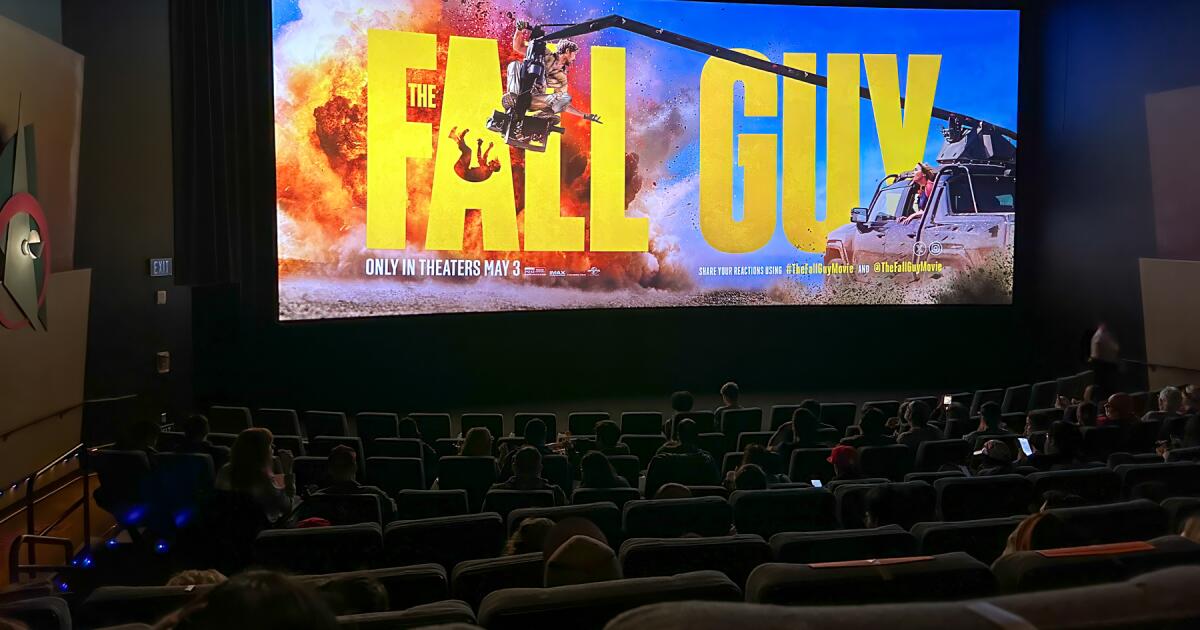
Returning to the big screen after his starring role in the Barbie movie, Ryan Gosling stars in The Fall Guy — an action-packed tribute to stunt performers in the movies.

Gosling plays the role of Colt Seavers — a stuntman who “gets blown up, shot, crashed, thrown through windows and dropped from the highest of heights, all for our entertainment. And now, fresh off an almost career-ending accident, this working-class hero has to track down a missing movie star, solve a conspiracy and try to win back the love of his life (Emily Blunt starring as Jody Moreno, director of the movie) while still doing his day job. What could possibly go right?”

Ryan Gosling and Emily Blunt

(Universal Pictures)

Advertisement

The Fall Guy includes the movie industry’s first-ever film credit of Stunt Designer, received by Chris O’Hara, president of Stunts Unlimited, and who is renowned as a Stunt Coordinator and second unit director. The Stunt Designer moniker goes beyond the traditional title of Stunt Coordinator (an official Screen Actors Guild credit that is also recognized by the Directors Guild of America). This credit represents a new benchmark that accurately reflects “the high-level artistic contribution of world-class Stunt Coordinators like O’Hara. These are artists who do more than coordinate the logistics of stunts; they design and create them.”
“Stunt Designers are the creative architects behind fight scenes, high falls, and more, and deserve to be recognized for the creative leadership of their contributions,” said David Leitch, director, blockbuster filmmaker and a former stunt coordinator.

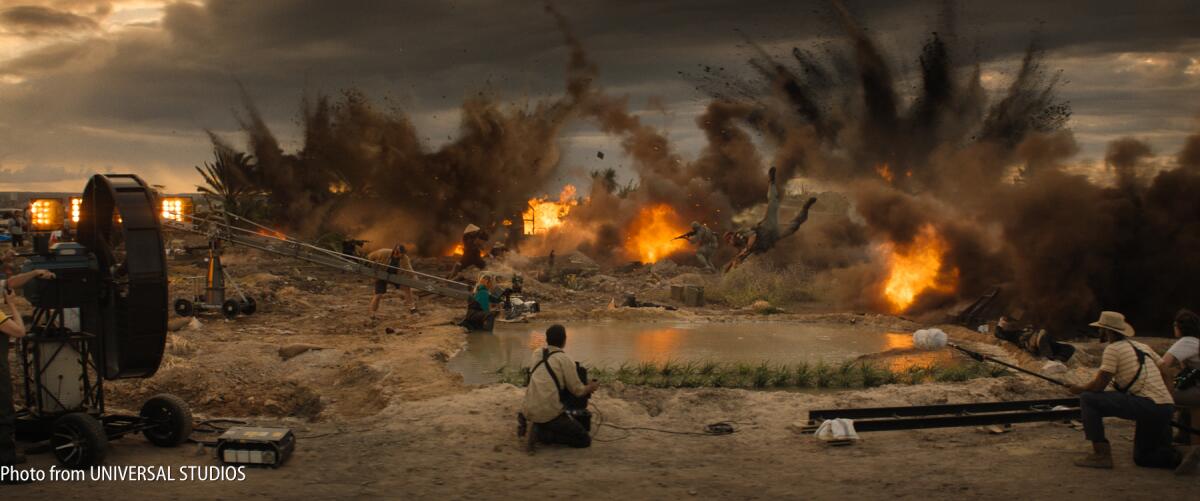
The fall guy on a vehicle-mounted arm.

The fall guy on a vehicle-mounted arm.

(Universal Pictures)

The Fall Guy was originally a TV series from the ‘80s. It “was a reflection of that era, celebrating the cowboy spirit of stunt work,” director David Leitch says. “Back then, stunts were about sheer toughness, fearlessness, and guts. While there were tricks of the trade, these stunts still came with a lot of pain. My journey in the stunt world began during the transition from this old-school era to the modern era where stunt work began embracing new technologies and practices. As I entered the industry, visual effects and special effects were starting to revolutionize the stunt world. Wire rigs, the removal of those wires via VFX and other innovations were transforming the way stunts were performed. While shooting The Matrix, I had the opportunity to witness the cutting edge of technology and the collaborative efforts that were shaping the future of stunts. For me, it was natural to embrace both sides of stunt performing—the old-school toughness and the evolving world of visual effects. So, now, with The Fall Guy, I’m paying tribute to my early career journey as a stunt performer. While we incorporate some nods to the role of visual effects, the film maintains a raw and practical element in every stunt. With this film, we aimed to deliver action that was true to the spirit of the stunt community by incorporating techniques that have become somewhat of a lost art.”

THE FALL GUY, directed by David Leitch

THE FALL GUY, directed by David Leitch

(Universal Pictures)

Advertisement

The cannon roll was a particularly spectacular stunt featured in The Fall Guy. “Stunt double Logan Holladay broke the Guinness World Record for cannon rolls in a car with eight and a half rolls.”

These days, sequences like the Alma/Colt chase sequence, in which a garbage truck dragged Ryan Gosling on a spinning bin through the streets of Sydney, Australia, included a thrilling scene on the iconic Sydney Harbour Bridge that “would normally be done with blue screen,” but “the team decided to film the scene entirely practically” — old school.

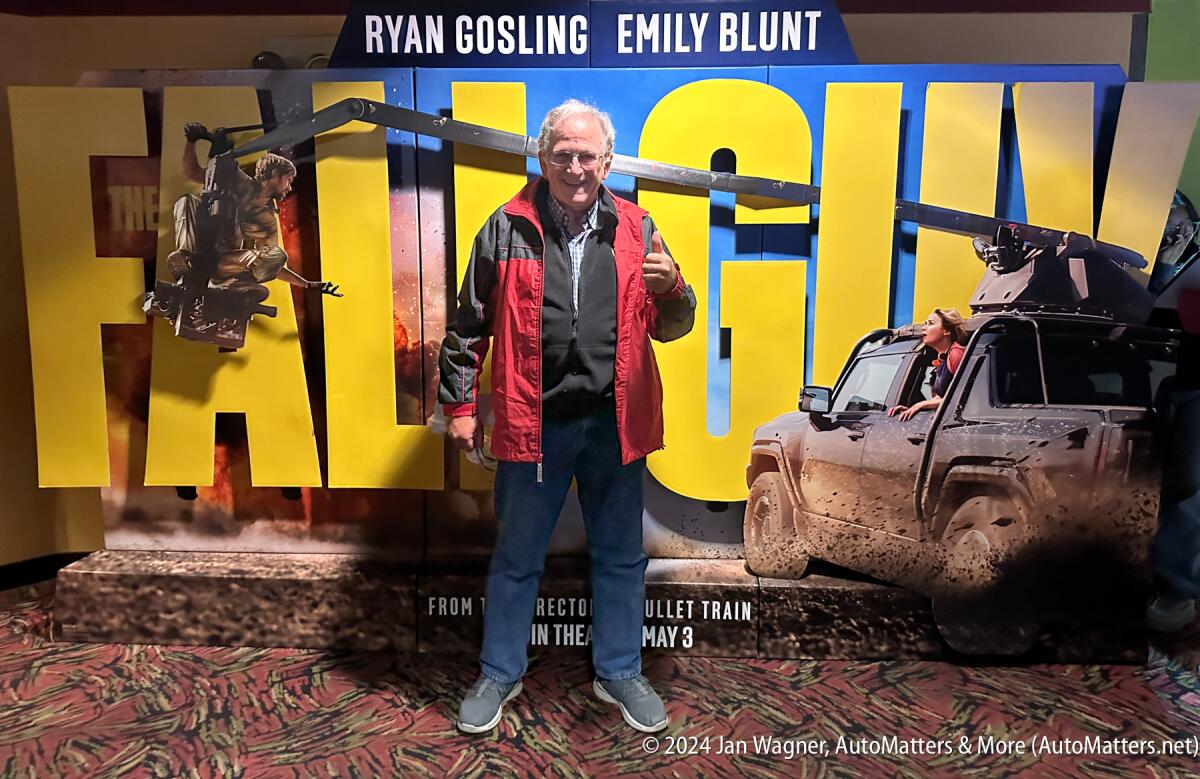
Jan Wagner in the theater lobby.

Jan Wagner in the theater lobby.

(Jan Wagner)

Advertisement

Another exciting stunt was a jaw-dropping 225-foot car jump, “performed by seasoned driver Logan Holladay in a specially designed vehicle, crafted for practical, in-camera authenticity that could handle such an extreme leap. At the apex of the jump, the truck was close to 80 feet in the air.

Other wild stunts included a boat jump, a high fall from a helicopter, numerous fights, fiery explosions and much, much more. Multiple costume variations were required “to address the complexity of action scenes.” Oh, and be sure to stick around for the credits to see a cameo that you will not want to miss. Thumbs up!

To see a trailer for The Fall Guy and to purchase tickets, visit the official site at: https://www.thefallguymovie.com.

To explore a wide variety of content dating back to 2002, with the most photos and the latest text, visit “AutoMatters & More” at https://automatters.net. Search by title or topic in the Search Bar in the middle of the Home Page, or click on the blue ‘years’ boxes and browse.

Copyright © 2024 by Jan Wagner – AutoMatters & More #838

Advertisement

Continue Reading
Click to comment

Leave a Reply

Your email address will not be published. Required fields are marked *

This site uses Akismet to reduce spam. Learn how your comment data is processed.

Movie Reviews

Review | Paper Tiger: Adam Driver and Scarlett Johansson lead dark gangster movie

Published

on

Review | Paper Tiger: Adam Driver and Scarlett Johansson lead dark gangster movie

3.5/5 stars

Back in official competition at the Cannes Film Festival for the sixth time, writer-director James Gray returns to his roots with Paper Tiger.

The American filmmaker started his career with 1994’s Little Odessa, starring Tim Roth as a Russian-Jewish hitman operating in the Brighton Beach area of New York. His next two films, The Yards (2000) and We Own the Night (2007), kept him ensconced in the world of low-life criminals.

Paper Tiger also casts the Russian mob as the antagonists. Set in 1986 in Queens, New York, it stars Miles Teller and Adam Driver as the Pearl brothers, Irwin and Gary.

Irwin (Teller), an engineer, is married to Hester (Scarlett Johansson) and has two teenage sons: Scott (Gavin Goudey), who is about to turn 18, and the younger Ben (Roman Engel), who is diligently studying for his exams.

Adam Driver (left) and Miles Teller attend the 79th Cannes Film Festival for the screening of Paper Tiger on May 17, 2026. Photo: AP

Gary (Driver), a former policeman who still has connections on the force, encourages Irwin to team up and create an environmental clean-up business involving the filthy Gowanus Canal.

Advertisement
Continue Reading

Movie Reviews

‘Avedon’ Review: Ron Howard’s Admiring Profile of Groundbreaking Photographer Richard Avedon Embraces His Genius, Flair and Mystery

Published

on

‘Avedon’ Review: Ron Howard’s Admiring Profile of Groundbreaking Photographer Richard Avedon Embraces His Genius, Flair and Mystery

For Richard Avedon, as with most significant artists, work and life were inseparable. When the photographer died in 2004, at 81, he was on the road, mid-project — “with his boots on,” in the words of Lauren Hutton, one of the many beautiful people he helped to immortalize over a 60-year career. Hutton and the two dozen or so other interviewees in Ron Howard’s admiring documentary make it clear how much affection the New York native inspired while reinventing fashion photography and putting his iconoclastic stamp on fine-art portraiture.

The profile Avedon paints is that of a relentless seeker and high-flying achiever, and a deliciously unapologetic contrarian. How can you not adore an image-maker who says, “Beautiful lighting I always find offensive,” and, regarding little kids as potential photographic subjects: “I find them intensely boring.” Avedon’s interest in the grown-up human face, in what it conceals and reveals, was his lifelong project, one that he pursued within circles of rarefied fame, on the backroads of the American West, and in a poignant late-in-life connection with his father.

Avedon

The Bottom Line

A solid mix of glitz and angst.

Advertisement

Venue: Cannes Film Festival (Special Screenings)
Director: Ron Howard

1 hour 44 minutes

As confrontational as his images could be, the camera was Avedon’s way of experiencing the world, a way of seeking truth through invention. Howard, whose previous doc subjects include Jim Henson and Luciano Pavarotti, and whose fiction movies are designed more to engage rather than to confront, seems particularly inspired here by Avedon’s auteur approach to still photography — it was a narrative impulse, not a documentary one, that shaped his vision, a drive to create moments and mise-en-scènes for the camera.

Avedon built his career at magazines in an era when magazines mattered. He was only 21 when he joined Harper’s Bazaar, where he stayed for 20 years, leaving to follow fashion editor Diana Vreeland to Vogue, where he stayed even longer. And when Tina Brown took the helm at The New Yorker and overturned its age-old no-photos policy, she hired Avedon as its first staff photographer.

Advertisement

When Harper’s sent him to Paris in 1947 with an edict to summon some of the battered capital’s prewar glamour, he turned to movies for inspiration and conjured visions of romantic fantasy amid the ruins. It was his first significant assignment, and a turning point for fashion photography. The doc emphasizes how, at a Dior show, the images he captured of the designer’s voluminous skirts mid-twirl expressed an ecstatic moment after years of wartime rationing. “People were weeping,” recalls Avedon, a vivid presence in the doc thanks to a strong selection of archival material.

The kinetic energy of those shots would become a defining element of his approach. Injecting movement and a theatrical edge into fashion photography, he lifted it out of the era of posed mannequins. To get models into the spirit of his concepts, he often leapt and danced alongside them. It’s no wonder that in Funny Face, the romantic musical loosely inspired by his career and first marriage, Fred Astaire played the photographer. Eventually Avedon shifted to a large-format camera, an 8×10, that allowed him to interact with his subjects directly, rather than through a viewfinder. There would be more scripted and carefully choreographed moments in his TV spots for Calvin Klein jeans and Obsession, collaborations with the writer Doon Arbus (daughter of Diane and Allan Arbus) that took chances (and which, for some viewers, are inseparable from memorable spoofs on SNL).

Fashion and advertising were mainstays, but he also became a notable portraitist. Positioning his subjects against a plain white background, he removed flattery from the equation. It was an artist-subject relationship in which he held all the power, and he didn’t pretend otherwise; on that point, Brown offers a trenchant anecdote. Remarkably, even though his refusal to sugarcoat was well established — not least by his notorious photo of the Daughters of the American Revolution — an Avedon portrait carried such cachet that establishment figures including the Reagans, Henry Kissinger and George H.W. Bush all submitted themselves to his crosshairs.

The film suggests that a moral imperative was as essential to Avedon’s work as his unconventional aesthetic vocabulary. He threatened to sever his contract with Harper’s when the magazine didn’t want to publish his photos of China Machado, and he prevailed: In 1959, she became the first model of color to appear in the editorial pages of a major American fashion magazine. Howard looks beyond the catwalks and salons to Avedon’s portraits of wartime Saigon, Civil Rights leaders and patients at Bellevue, many of those images collected in Nothing Personal, the book he did with James Baldwin, a friend from high school. A superb clip from a D.A. Pennebaker short of the book launch encapsulates the painfully awkward disconnect between the artist and the corporate media contingent. Most surprising, though, is how hard Avedon took it when the book was lambasted by critics. A later book, In the American West, would also meet harsh criticism; Avedon was, in the eyes of some, a condescending elitist.

Howard’s film is a celebration of a complicated man. It acknowledges Avedon’s naysayers, as well as his struggles and doubts, but this is very much an official story, made in association with the Richard Avedon Foundation, and steering clear of the disputed 2017 biography by Avedon’s business partner. The commentary, whether from models (Hutton, Isabella Rossellini, Twiggy Lawson, Penelope Tree, Beverly Johnson) or writers (Adam Gopnik, John Lahr, Hilton Als) or Avedon’s son, John, can be gushing, but it’s always perceptive.

Advertisement

The connection he sought with his subjects wasn’t about star worship but the instant when the ego lets down its guard, yet at the same time he was more interested in what he called “the marriage of the imagination and the reality” than straight documentation. Without putting too fine a point on it, Avedon links those twinned yet seemingly contradictory impulses to certain formative experiences. There was the devastation of extreme mental illness for Avedon’s sister and his second wife. There was the pretense of happiness in his childhood home in Depression-era New York (the city is captured in terrifically evocative clips). He recalls, discerning and exasperated, the staged domestic harmony — “the borrowed dogs!” — in family photos.

Avedon doesn’t aim to unsettle, like Avedon himself did, but neither does it tie things up neatly. There’s nothing simple or reductive about the emotional throughlines the documentary traces. It embraces the complexities of a man who turned artifice into a kind of superpower, whether he was dreaming up scenarios for fashion spreads or confronting an America as far removed from haute couture Manhattan as you could get.

Continue Reading

Movie Reviews

‘Hokum’ movie review: Damian McCarthy’s nasty little ghost story is undone by its own explanations 

Published

on

‘Hokum’ movie review: Damian McCarthy’s nasty little ghost story is undone by its own explanations 

A stil from ‘Hokum’
| Photo Credit: NEON

For those of you already familiar with Damian McCarthy’s work, the Irish filmmaker has spent the past few years turning cramped Irish spaces into elaborate, nerve-racking machines for dread. His 2020 debut, Caveat, trapped us inside a decaying rural house with a chained protagonist and a grotesque toy rabbit, while 2024’s Oddity transformed an isolated farmhouse into a relay system for jump scares built from negative space and the sound of somebody knocking at the wrong moment. His latest, Hokum, pushes that approach into a larger setting without sacrificing the intimate unpleasantness that makes his work so effective. 

The film takes place almost entirely inside the Bilberry Woods Hotel, a fading property buried in the Irish countryside where the final few guests arrive for a Halloween celebration. At the same time, staff members quietly prepare to shut the building down for winter. Into this atmosphere walks Ohm Bauman, played by Adam Scott, an American novelist carrying two urns containing his parents’ ashes and a personality abrasive enough to make even the resident ghouls feel hospitable.

Hokum (English)

Director: Damian McCarthy

Cast: Adam Scott, Peter Coonan, David Wilmot, Florence Ordesh, Michael Patric, Will O’Connell, Brendan Conroy, Austin Amelio

Runtime: 107 minutes

Advertisement

Storyline: When novelist Ohm Bauman retreats to a remote inn to scatter his parents’ ashes, he’s consumed by tales of a witch that haunts the honeymoon suite

McCarthy introduces Ohm through his work. The opening sequence shows him writing the conclusion to a historical adventure novel about a conquistador stranded in the desert with a dying child, and the scene initially appears disconnected from the main story until the camera pulls back to reveal that the entire episode exists inside Ohm’s manuscript.

This intro establishes the emotional logic driving the film. Ohm writes stories where people wander toward death because he has spent most of his adult life emotionally entombed inside the loss of his parents, who died shortly after honeymooning at the same Irish hotel he now visits. McCarthy avoids turning this into a tidy psychological diagnosis and attempts to reveal the damage through behaviour — Ohm humiliates a bellhop named Alby by heating a spoon over an open flame and pressing it against the young man’s hand after Alby asks him to read an aspiring manuscript.

That ugliness becomes central to Scott’s performance. Hokum strips away the comic cushioning that often softens his cynicism, especially in his recent Severance escapades. Scott keeps Ohm emotionally rigid even as the character begins to unravel inside the hotel’s sealed honeymoon suite, and the refusal to chase sympathy lends the film a sourness that works in its favour. When Ohm eventually risks himself to search for the hotel bartender Fiona, the motivation grows from guilt and loneliness over his botched suicide attempt. Fiona disappears after warning him about the suite’s resident witch, a local legend the hotel staff accepts with weary practicality, and her absence pushes Ohm deeper into the building’s sinister secrets.

A stil from ‘Hokum’

A stil from ‘Hokum’
| Photo Credit:
NEON

Cinematographer Colm Hogan lights the hotel with weak lamps, muddy greens, and heavy shadows that preserve spatial clarity even when characters crawl through near-total darkness. Production designer Til Frohlich fills the honeymoon suite with damp wallpaper, antique furniture, and cramped architectural dead ends that make it feel physically hostile before anything malicious even appears. McCarthy then uses sound with vicious precision, as ringing bells ring, creaking floorboards, and a mutated, uncanny-valley children’s TV program begin flooding the ominous silence.

The film loses some momentum once McCarthy begins unpacking the mystery behind Fiona’s disappearance and the crimes attached to the hotel’s past. Several supporting characters remain thinly drawn, particularly the hotel management, and the screenplay occasionally mistakes withholding information for complexity. The final stretch also leans too heavily on explanatory reveals and heightened confrontations, with the climactic encounter involving the witch pushing the film toward bluntness when the earlier sections had earned their power through suggestion alone.

Advertisement

Even so, Hokum succeeds because McCarthy understands the mechanical pleasures of horror filmmaking at a level many contemporary prestige directors seem embarrassed by. Though the scares land with diminishing returns this time, McCarthy still stages them with the acute understanding of just how long we will stare into a dark hallway before resenting ourselves for it. His folklore imagery still carries the grubby charm of an R.L. Stine paperback pulled from a damp school library shelf, which gives the film a pulpy nastiness that suits it well. McCarthy never fully organises many of these elements into a clean mythology. What he does create is a horror film with texture and personality, even if it barely holds up against the mastery of its predecessors.

Hokum is currently running in theatres

Continue Reading
Advertisement

Trending
