Entertainment
How the Grinch went from a Yuletide bit player to a Christmas A-lister


It takes a lot for sweet-tempered 28-year-old Nick Darnell to transform himself into Christmas’ most sought-after sourpuss.
There’s colored contacts and facial prosthetics, a protruding belly and at least an hour of makeup. But for the devout Christian and preternaturally cheerful young actor, the real metamorphosis is psychological.
“People today love to connect with the villain,” said the viral Grinch impersonator. “The world is just a darker world now.”
Darnell called the chartreuse baddie he portrays “the modern-day Santa.”
Dr. Seuss’ holiday parable “How the Grinch Stole Christmas!” has been a seasonal favorite since it was published in 1957, ranking among the most popular and profitable of the author’s iconic rhyming picture books.
The story’s sassy, brassy antihero has likewise adorned Christmas trees and school library shelves for generations. His hornlike fur forelocks and pathological refusal to assimilate have led some critics to call the Grinch ambiguously antisemitic, but those concerns have largely been glossed over by years of nostalgia.
Experts say 2025 heralds the Grinch’s ascent from Yuletide bit player to Christmas A-lister. He now crowds out Kris Kringle in store displays, social media feeds and holiday meet-and-greets.
Unlike Santa, who ho-ho-hos his way through the holiday season, Grinches twerk and pout and scream in kids’ faces. Compilations of their antics on YouTube and TikTok routinely rack up millions of views.
“I do the things that people think,” Darnell said of the role. “I’m not restrained.”
Despite the Grinch’s anti-consumerist zeal, the market for his visage has exploded in recent years.
Target touts its “Grinchmas,” while Walmart has “WhoKnewVille.” McDonald’s sells Grinch fries, Starbucks features a “secret menu” frappuccino. Hanna Andersson, a popular purveyor of holiday pajamas, boasts roughly a dozen different Grinch patterns, compared to three Hanukkah options and just one Santa design in two colorways.
“I’m not restrained,” Grinch impersonator Nick Darnell, 28, says of his role.
(Christina House/Los Angeles Times)
Ownership of the Grinch’s likeness is guarded as jealously as the villain protects his lair: Dr. Seuss Enterprises holds the rights to the children’s book, Warner Bros. Discovery the 1966 animated TV special, and Universal Studios the 2000 live-action Jim Carrey film, which ranks among the highest-grossing Christmas movies of all time.
But impersonators, academics and even working Santas agree: Americans’ embrace of the Grinch in 2025 goes far beyond consumerism.
“It’s definitely more popular,” said ‘Santa’ Ed Taylor, the famed Los Angeles Santa behind the Worldwide Santa Claus Network, a training camp for the art of Christmas cheer. “It’s a little yin and yang. Maybe we need a little bit of both.”
Costume companies across Los Angeles say they’ve seen a deluge of demand for the Grinch this year. At Etoile Costume & Party Center in Tarzana, nearly half of Christmas costume rentals are now furry green villains.
“It’s about equal to Santa,” one employee said. “Maybe 40% Grinch and the rest Santa.”
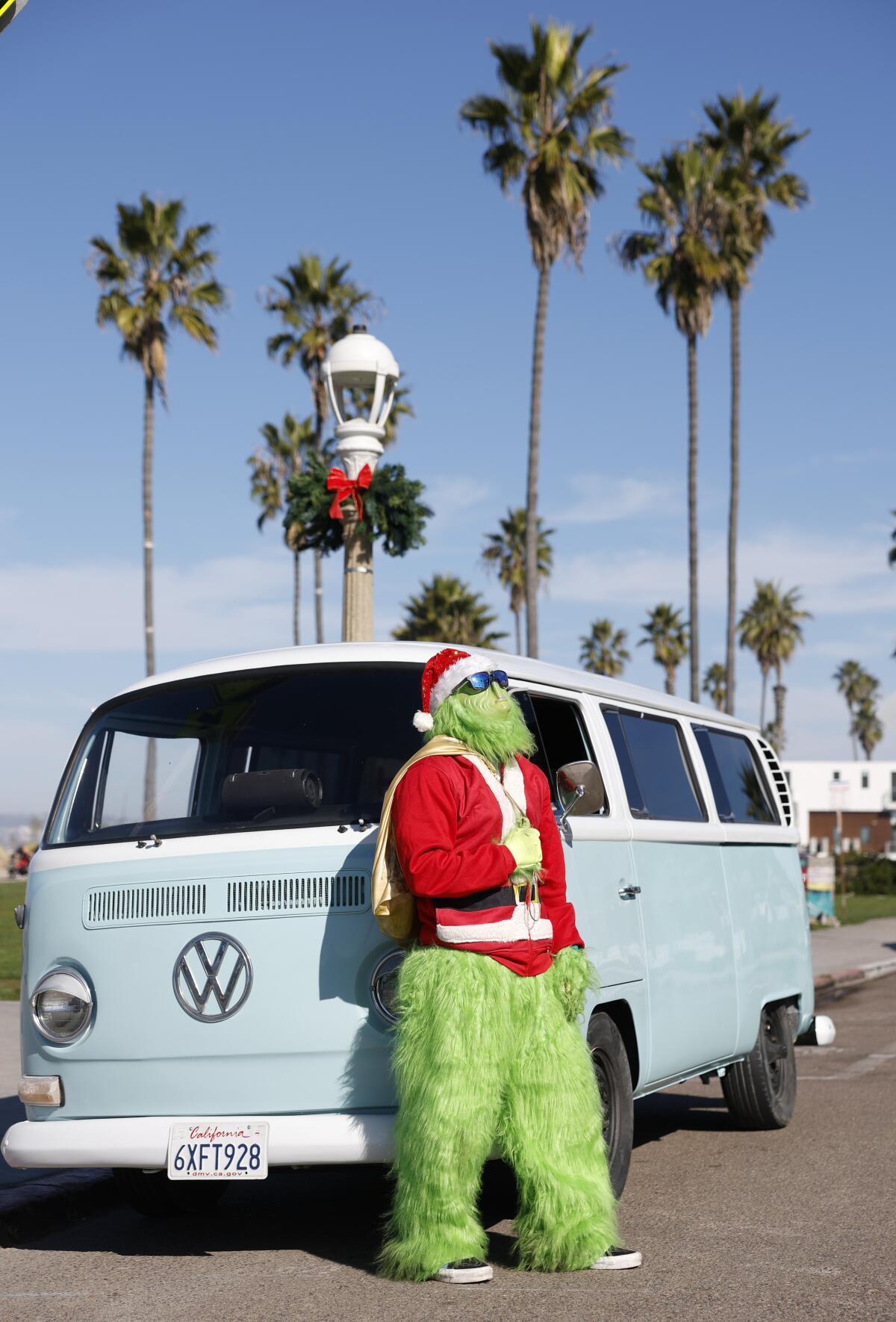
Ryan Ortiz, dressed in a Grinch costume, stands next to his 1969 Volkswagen Bus in San Diego on Dec. 21.
(K.C. Alfred / The San Diego Union-Tribune via Getty Images)
Fans of the hirsute sourpuss seek him out for his in-your-face edge — the opposite of Santa’s remote joviality. Santa enforces his regime of goodness through lists and surveillance. The Grinch will get in your face and yell at you to shut up.
“[Santa]’s supposed to be mysterious and unknown,” said Darnell’s fiancee JadaPaige. “He’s supposed to just come in the night and you’re never supposed to see him.”
“I grew up obsessed with Santa Claus — I did not grow up obsessed with the Grinch,” Darnell said. “I was the kid waiting up in the middle of the night, peeking, wondering if Santa’s down there. A lot of modern day kids aren’t having that journey.”
Instead, many Gen Alpha youths look to the Grinch for his views on “corruption or poverty or the oversaturation of commercialism,” Darnell said.
“Santa is looked at more like a godly figure, while the Grinch is a more everyday man,” the actor explained. “The world is so sinister and negative. [The Grinch] tells you how it is, rather than telling you everything is going to be fine.”
TikTok turbocharged that trend, with the infamous green meanie matching or beating his red rival in holiday clout.
“He has aura,” Darnell said.

Grinch impersonator Nick Darnell said the character he plays has become popular because, “He has aura.”
(Christina House/Los Angeles Times)
Today’s professional Santas are often retirees with a bit of a belly and some time on their hands. Grinches, by contrast, are more likely to be working actors like Darnell, who look reverently to Carrey’s performance as a blueprint for the character’s slapstick antics and snarky reads.
Still, experts say the Grinch’s 2025 glow-up likely owes as much to holiday exhaustion and broad consumer pessimism as it does vertical video virility.
“The Grinch is the opposite side of Christmas,” said Oscar Tellez, who owns Magic Dream Costumes and Party Rentals in East Los Angeles and says he’s seen a spike in Grinch requests even as overall holiday rentals have sagged.
“Especially with the Latino community, I don’t think they feel the enthusiasm to celebrate,” Tellez said. “They are more worried about what’s gonna happen next.”
Pop culture experts agreed.
“The economy is in big trouble, our political situation is chaotic, there’s a lot of hate — it’s no wonder that we would seek to express that through the embodiment of a monster like the Grinch,” said Michael M. Chemers, director of the Center for Monster Studies at UC Santa Cruz.
“You’ve seen these nativity displays popping up all over the country that have the Jesus figures removed and it says ‘ICE was here,’ ” he added. “I think there’s just a lot of Grinchy feeling right now in the world.”
Chemers and other scholars say the emergence of the Grinch as a foil to Santa is less a departure than a return to form: the Grinch is a “PG version” of the mythical Krampus, a shaggy, fork-tongued Germanic goat man who beats and even abducts naughty children, working as an enforcer for Father Christmas.
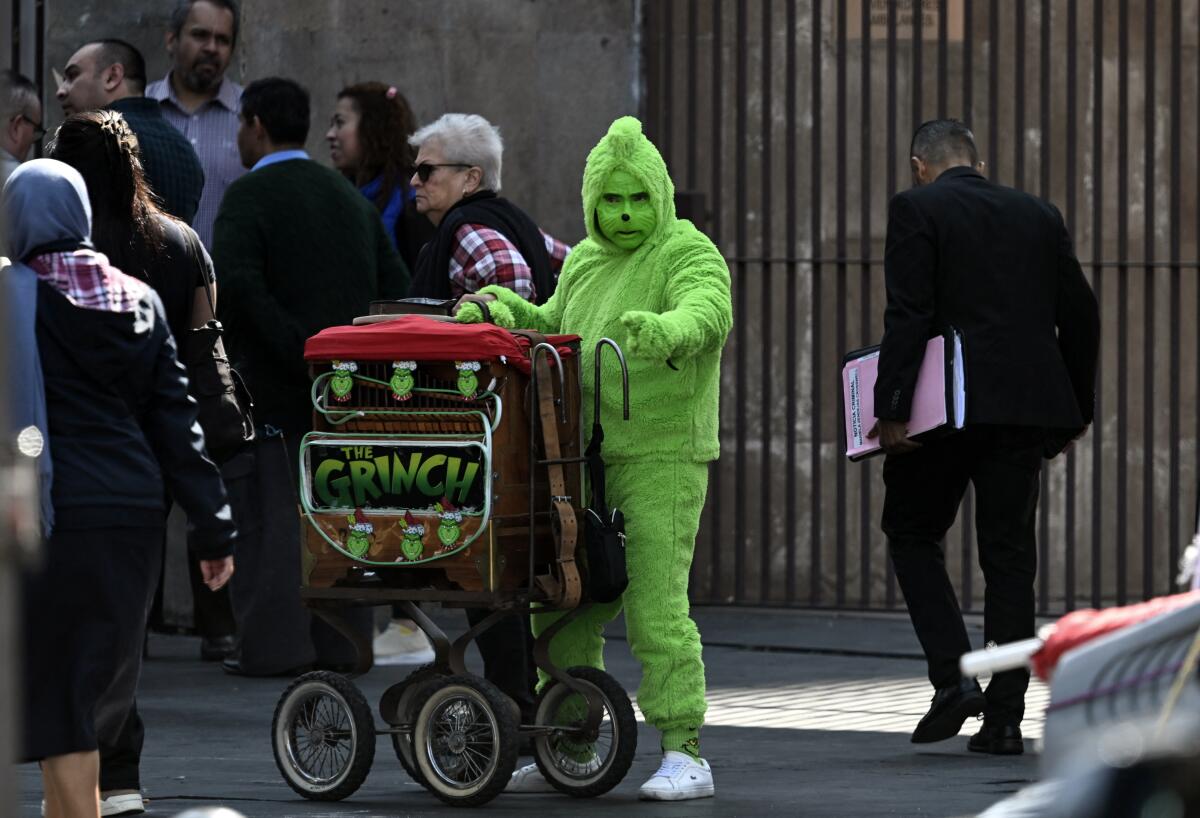
An “organillero,” or traditional street musician, dressed as the anti-Christmas character known as the Grinch plays on a central street in Mexico City on Dec. 9.
(Yuri Cortez/AFP via Getty Images)
“He’s been called the Christmas devil,” said Jeff Belanger, author of “The Fright Before Christmas,” a compendium of so-called “Yuletide monsters.”
“[Krampus] represented the consequence of bad behavior, while St. Nick rewards good behavior,” he said.
Krampus likely evolved from older, pre-Christian deities, just as Christmas absorbed solstice and midwinter customs, the author explained. The Christmas most Americans grew up with only emerged as a national holiday in the wake of the Civil War, he said, about a decade after the formal introduction of Thanksgiving in 1863. It was around this time that Christmas trees became popular in the United States.
“In 1867, Charles Dickens came over to Boston and that’s when he read his ‘Christmas Carol’ for the first time in America,” spurring President Ulysses S. Grant to declare Christmas a federal holiday, Belanger said. “It was truly on the back of that story.”
The holiday’s corpulent, white-bearded dandy arrived even later, his schmaltzy persona skimmed from bony St. Nicholas between Reconstruction and 1931, when Coca-Cola debuted its iconic, brandy-flushed Santa Claus.
“That’s when Christmas turned purely commercial, and there was no room for consequences anymore,” Belanger said.
Seuss’ Grinch sits somewhere in the middle — cuddlier than Krampus and pricklier than Santa — making him the perfect avatar for a moody, uncertain age.

Workers check Grinch inflatables ready for export at a factory in Suixi County in central China’s Anhui Province on March 19.
(Wan SC/Future Publishing via Getty Images)
Grinch boosters point out that the villain repents and reforms at the end of the story, shedding his pathological hatred of Christmas.
“I always tell people, ‘Don’t you just love how his heart grew three sizes?’ ” Taylor, the famous Santa, said of his increasingly popular crossover events.
Others note that it’s never the repentant Grinch who marauds through schools and holiday parades or blows up on social media.
“Once he’s rehabilitated, he’s no fun anymore,” Chemers said.
That makes it hard for the holiday villain to visit sick kids in the hospital, as legions of Santas do every year, or comfort children who confide in him about bullying.
“The message is one of encouragement and positivity and acknowledgment of accomplishments and encouragement to strive harder,” Taylor said. “It’s these beautiful personal development messages that Santa gets to be the conduit for.”
The Grinch, by contrast, can affirm where you are, without ever asking you to be better.
“He can hear you and know what you’re thinking, because he has the same thoughts,” Darnell said of his beloved version of the character. “People want to know his heart and his mind, and that’s something they wouldn’t be able to ask Santa.”

Entertainment
Review: Alicia Keys’ glorious music fuels blazing ‘Hell’s Kitchen’ at the Hollywood Pantages

“Hell’s Kitchen,” the Alicia Keys musical that has landed at the Hollywood Pantages Theatre in a blaze of rousing sound, deploys the R&B star’s glorious treasure trove of work in the service of a semi-autobiographical version of her coming-of-age story in the Manhattan neighborhood that gives the show its title.
The Hell’s Kitchen of Alicia Keys’ story, set in the 1990s, isn’t the gang-ridden Hell’s Kitchen of West Side Story, set in the 1950s. Keys grew up in Manhattan Plaza, a federally subsidized residential complex that provides affordable housing for artists. But for a teenager in rebellion from her watchful mother, the vibrant, music-filled street life comes with its share of dangers.
Kennedy Caughell as Jersey and Maya Drake as Ali in the North American Tour of Alicia Keys’ “Hell’s Kitchen” at the Hollywood Pantages Theatre.
(Marc J. Franklin)
Ali (Maya Drake, who’s making her professional debut in this North American tour production) is a 17-year-old ready to break out of the cage her mother, Jersey (Kennedy Caughell), has placed her in. Jersey, a single mom, isn’t a tyrant. She just doesn’t want to see her daughter make the same mistakes that she did, namely get pregnant at a young age before she’s had a chance to realize her own dreams.
The book by playwright Kristoffer Diaz (“The Elaborate Entrance of Chad Deity”) is structured around a loving but combustible mother-daughter relationship amid the creative ferment of New York. This artistic neverland is crystallized in the apartment building that has music pouring out of every floor when Ali rides the elevator.

Maya Drake as Ali and the company of the North American Tour of Alicia Keys’ “Hell’s Kitchen” at the Hollywood Pantages Theatre.
(Marc J. Franklin)
The story isn’t the strong suit of “Hell’s Kitchen,” which is powered by Alicia Keys’ versatile catalog, which has been supplemented with original material. The hits — “You Don’t Know My Name,” “Girl on Fire,” “Fallin’,” “If I Ain’t Got You,” “Like You’ll Never See Me Again,” “No One” and “Empire State of Mind,” among them — reverberate inside the Pantages with a thrilling exuberance.
What’s most impressive, however, is the way these tracks have been arranged both musically and dramatically. Jukebox musicals are notorious for shoe-horning in beloved songs without regard for storytelling integrity. “Mamma Mia!,” which crammed in as many ABBA hits as possible, hardly even bothered to find pretext for their inclusion. The lucrative example paved the way for more than two decades of musical theater shamelessness.

The company of the North American Tour of Alicia Keys’ “Hell’s Kitchen” at the Hollywood Pantages Theatre.
(Marc J. Franklin)
“Hell’s Kitchen,” directed by Michael Greif, takes a more dignified approach, raiding Keys’ greatest hits in a way that doesn’t cause dramatic offense and better yet, adds a layer of surprise to music that is so well known.
The songs are allocated in unexpected ways. Numbers that you might think belong to Ali are divided among the company. Jersey is first in line, and Caughell makes the most of her opportunities. But sharing in the bounty are Davis (Desmond Sean Ellington), Ali’s mostly absent and chronically unreliable father; Knuck (Jonavery Worrell), Ali’s forbidden love interest; or Miss Liza Jane (Roz White), a pianist who lives in the building and becomes Ali’s formidable mentor.
There are other characters who offer luminous assistance, but these are the principals in a musical tale built around Ali’s central relationships. Keys’ origin story is more dynamic on an atmospheric than dramatic level. A mother having difficulty with her boy-crazy teenage daughter isn’t exactly breaking any ground, and Diaz avoids venturing into more turbulent territory. Ali’s divided identity, stemming in part from an all-too-present white mother and all-too-missing Black father, sets up issues that are touched on but never deeply engaged.

Desmond Sean Ellington as Davis and Kennedy Caughell as Jersey and the company of the North American Tour of Alicia Keys’ “Hell’s Kitchen” at the Hollywood Pantages Theatre.
(Marc J. Franklin)
Miss Liza Jane spots Ali’s musical gift right away and fills her with a sense of pride and responsibility in her Black heritage. But her character’s role is somewhat earnestly compartmentalized. Knuck recognizes that Ali’s fascination with him stems in part from the way she sees him, much as her mother does, as a “thug.” But their tentative affair is secondary to the complex bond between Ali and Jersey, whose troubled connection with Davis helps Ali understand why her mother is so paranoid about her romantic choices.
But these concerns fall away when the performers start singing. Drake has a beautiful voice, but her Ali is slighter than that of Maleah Joi Moon, who won a Tony for her Broadway debut performance. I didn’t mind that Davis sings “Fallin’,” as Ellington has a voice of luscious thunder. Worrell’s Knuck more than holds his own with his duets with Ali. (In fact, I was more taken by his velvety interpretation of “Like You’ll Never See Me Again” than Ali’s more straightforwardly pretty version.) White’s Miss Liza Jane takes the Pantages audience to church in her numbers. And when Caughell magnificently directs “No One” to Ali, I can’t imagine there’s a dry eye in the house.

Desmond Sean Ellington as Davis and Maya Drake as Ali in the North American Tour of Alicia Keys’ “Hell’s Kitchen” at the Hollywood Pantages Theatre.
(Marc J. Franklin)
This tour production isn’t crisp in all areas. The dancing isn’t always smooth, the costumes struck me as a road show idea of New York cool, and the acting didn’t do much to compensate for some of the book’s less subtle moments.
But the energy of the production is infectious. “Hell’s Kitchen,” a New York story of a wunderkind discovering her gift, helped me get over my allergy to the jukebox genre. The soaring quality of the orchestra and the delectable company of voices pay exhilarating homage to a singular artist, who seems right at home at the Pantages.
‘Hell’s Kitchen’
Where: Hollywood Pantages Theatre, 6233 Hollywood Blvd., Los Angeles
When: 7:30 p.m. Tuesdays-Thursdays, 8 p.m. Fridays, 2 and 8 p.m. Saturdays, 1 and 6:30 p.m. Sundays. (Check for exceptions.) Ends June 21
Tickets: Start at $57
Contact: BroadwayInHollywood.com or Ticketmaster.com
Running time: 2 hours, 35 minutes

Starring: Marshall Williams, Richard Harmon and Alex Essoe
Directed by: James Kondelik
Rated: NR
Running Time: 108 minutes
Our Score: 1.5 out of 5 Stars
Survival horror is the ultimate guilty pleasure because you can amplify any life-or-death situation into the paranormal, horrific, thrilling, or cruelly dramatic extremes it finds itself in. So why doesn’t “Pitfall” come close to tickling “The Ritual,” “The Blair Witch Project,” or “Wolf Creek” vibes?
Woods and grief feel like a ritualistic trope at this point as “Pitfall” opens on Scott (Marshall Williams) and Ashley (Alex Essoe) mourning the death of their parents. For reasons that may or may not be revealed later, they join three friends on an ominous trip that quickly introduces the titular pitfall, a massive trap designed to kill prey.
The movie constantly battles convention with unpredictability. The problem is that at more than 100 minutes long, there’s plenty of time to sit around and wonder where the story is heading. If “Pitfall” moved with the frantic pace of a Tuesday afternoon soap opera on meth, maybe I’d be swept up in the chaos. Instead, I found myself waiting for reveals that felt more eye-rolling than shocking.
I really wanted to like “Pitfall” because of how invested it is in physical violence, emotional trauma, and psychological brutality. Unfortunately, the movie never convinced me it knew what to do with those ideas. By the time it arrives at its revelations and ultimate purpose, “Pitfall” feels less like a title and more like a review.

After eating a lot of fast food, some of it on roller coasters, YouTuber Allen Ferrell has been banned by Six Flags from all of its amusement parks nationwide. For life.
McDonald’s chicken nuggets were apparently an ultra-processed food item too far for the folks at Six Flags’ Cedar Point in Sandusky, Ohio.
“This guest has been banned from all Six Flags parks for life,” a Cedar Point spokesman explained in an email Thursday to Cleveland TV station WKYC. “Safety is a cornerstone of our business and we have zero tolerance for inappropriate and unsafe behavior.”
Zero tolerance for inappropriate behavior? Zero? Where’s the fun in that?
“Our ride safety policy strictly prohibits all loose articles on rides, including food which can become a choking hazard,” the spokesperson continued.
“I had no idea that eating a 10-piece chicken nugget on a roller coaster would be a national headline, but here we are,” Ferrell told Fox 8 News in Cleveland.
He said he gets the park’s point with the ban, even though he’s been going there since he was a kid and is a huge fan of the operation.
“I understand. And we kind of worked it out,” he told Fox 8 News. “They just don’t want other people getting hurt on the ride. But me personally, it was a really fun challenge.”
Ferrell’s shtick on social media is accepting challenges from his followers and then taping himself attempting to do what they propose. Eat a McDonald’s Big Mac inside a Burger King. Throw a plunger at a Target sign. Bowl blindfolded until he gets a strike.
“If anyone asks,” Ferrell tells one apparently bored ride operator in the video that documented this particular coaster crime, “I do not have chicken nuggets in my underwear.”
Ferrell decided to try the challenge on the park’s Millennium Force ride, a “looming giant amongst a park full of them,” a coaster that was “designed for the purpose of proving bigger is better.” A roller coaster that when it was created in 2000 “demanded an all-new category just to classify its one of a kind nature,” giving rise to the “giga-coaster.” According to Cedar Point, as all of this verbiage is, Millennium Force “shoots riders over hills, past lagoons and through tunnels, all at unthinkable speeds.”
The ride actually tops out at 93 mph, a speed often thought about on freeways in the Los Angeles area when traffic is going 8 mph. It’s quite thinkable to eat fast food in a car in L.A. But it turns out what was really unthinkable was Ferrell getting all 10 nuggets down the hatch before the Six Flags ride was over.
In the video, which had almost 800,000 views on YouTube as of Friday afternoon, he morphs from happy snacking dude to dude moaning in discomfort, struggling to shove nuggets in his mouth while unintentionally applying dipping sauce to his face via G-force.
“Oh, I failed,” Ferrell says, wiping off the face-sauce as the coaster pulls up to the platform and someone in line blurts, “Are those chicken nuggets?”
Turns out he snarfed seven of them, he confesses to the two guys in front of him in the coaster car. Ferrell said later that he was glad to be in the back row because it meant nobody behind him got sauced.
That said, watching the sweet-and-sour sauce flying in slow motion is actually quite amusing. But eating nuggets that have been in one’s underwear?
The perma-ban sounds like the least of his problems.
-
Education1 second ago
Video: Can California Convince Teens to Work in Construction?
-

 Technology12 minutes ago
Backrooms is a certified blockbuster with a $38 million opening day
-

 World15 minutes ago
Hamas struggles to fill leadership ranks as Israel hunts Oct 7 terrorists
-

 Politics20 minutes ago
Anti-ICE agitator charged with allegedly biting officers during Delaney Hall clashes
-

 Health27 minutes ago
What to do if someone is having a stroke, after Jill Biden revealed debate-night fears
-

 Sports30 minutes ago
Dispatch audio reveals what was heard inside Josh Jacobs’ home before alleged domestic violence arrest
-

 Technology35 minutes ago
Cab-less electric trucks hit Ohio roads
-
 Business42 minutes ago
Vince McMahon and others are sanctioned for destroying evidence in WWE shareholder lawsuit

