Tuner, now playing in theaters throughout Israel, is an offbeat, interesting drama and crime caper, with some funny moments.
Entertainment
How IHeartComix's super creativity took the event company from the L.A. music scene to Marvel

Things were getting weird again between mission control and the space station S.A.B.E.R. For one thing, both places were crawling with cats, turning a high-concept livestream from Marvel Entertainment into a chaotic scene of tumbling, jumping, eating, purring felines that just might have been extraterrestrials in disguise (a.k.a. “flerkens”).
Mission control was on the back patio of the CatCafé Lounge in West Los Angeles, where creative marketing agency IHeartComix positioned a row of video monitors and computer gear amid dozens of wandering cats. Jesus Rivera directed the day’s cosmic live broadcast on YouTube, clad in a burgundy tracksuit and white fedora, a scorpion ring on his right hand. “Cue music,” he said to the crew around him, his monitor showing a closeup of a cat’s furry face. “Throw the balls in!”
Fans of the Marvel Cinematic Universe were introduced to flerkens in the 2019 hit movie “Captain Marvel,” starring Brie Larson; the creatures are back for a sequel, “The Marvels.” But at the time, with the end of the Hollywood actors’ strike still weeks away, and no cast members available to promote the film’s November release, the MCU turned to a different kind of hero: IHeartComix, a company known for inventive and immersive events for Adult Swim, Vice and Hulu, colliding the epic and ridiculous, the flamboyant and sublime.
For IHC, herding flerkens was just another strange day at the office.
Hype and marketing are nothing new in Los Angeles, but when major artists and movie studios want to roll out their new music, film or TV project and make a memorable (and viral) splash, they frequently turn to the creative team at IHeartComix. The firm didn’t emerge from a traditional business plan, rising organically from L.A.’s indie-dance scene.
IHeartComix founder Franki Chan, right, sits for a portrait with co-workers, from left, Sarah Fleisher, Carina Gutierrez, Jesus Antonio Rivera and Jess Doren on Dec. 14, 2023.
(Brian van der Brug / Los Angeles Times)
“They’ve come to appreciate us for the ideas that we come up with that are usually pretty wild or wacky or unique,” says Franki Chan, IHC’s soft-spoken founder, at the CatCafé clad in a “Love and Rockets” comics T-shirt, with traces of black and red polish on his fingernails. “It’s not so traditional.”
This month, IHeartComix marks its 20th anniversary, two decades after the name first appeared on a flier for a party called “F— Awesome” at Beauty Bar in Hollywood. From there, the company evolved into a promoter and producer of various L.A. parties, concerts and content. Now as a marketing and culture agency, IHC found a sweet spot by bringing their energy and style from the music scene into the movie world.
While competing agencies are often great at making things to order, says Chan, 45, “We’re the opposite. We want to have a point of view. We want to have a voice. We only want to work on the things that we like.”
IHeartComix created this Guardians of the Galaxy Knowhere pop-up bar and screening in Los Angeles
(David Morrison)
Last spring, the firm built a space-traveler’s cantina in the desert en route to the Coachella Valley Music and Arts Festival to promote the third “Guardians of the Galaxy” film, giving festival-goers a roadside attraction for Instagram snapshots and TikTok posts. And when the Rolling Stones prepared for the October release of their album “Hackney Diamonds,” the classic rock legends had IHC create an elegant rock ‘n’ roll setting in Manhattan for a surprise performance on a small cabaret stage at the 650-capacity club Racket NYC.
The main directive from frontman Mick Jagger was simple, recalls IHC project manager Sarah Fleischer: “It needs to be like a sexy club show, not a toothpaste launch.” So there was flowing red drapery, tabletops decorated with flowers and smashed crystal hearts (echoing the album cover art), and animated graphics on video screens.
Things have only gotten bigger for the firm since 2018, when it created a party at New York Fashion Week for Marvel’s “Black Panther” film, drawing inspiration from the fictional African nation of Wakanda. Chan’s team collaborated with Disney Consumer Products and a group of Bronx-based chefs called Ghetto Gastro to create a night called “The Taste of Wakanda,” with six different dishes, one desert and three beverages, offering an imagined cultural experience from the country.
“We created all the serving utensils from scratch, the forks, the spoons, the cups, the plates, the serving trays, the bars, and then the environment around it,” Chan recalls. “All of the cast was there. They actually ended up spending most of the time in the kitchen with us because they just loved the food.”
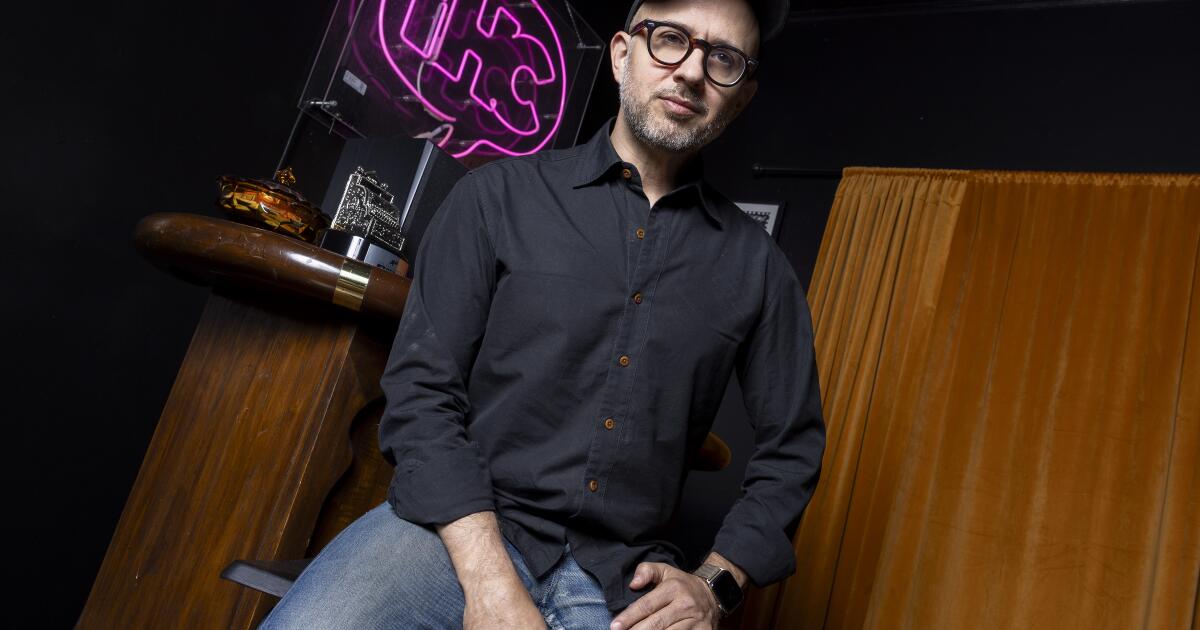
IHeartComix founder Franki Chan sits for a portrait on Thursday, Dec. 14, 2023.
(Brian van der Brug / Los Angeles Times)
It was a transformational event for company, says Chan, a knockout production that showed the range of IHeartComix stretched far beyond the music scene that birthed it. “It was really unique and different,” says Dustin Sandoval, Disney’s vice president of digital marketing, who often calls on IHC for promotional events for Disney, Marvel and more. “That’s the kind of thinking the IHeartComixteam brings to the table, and their passion just shines through because they are true fans of this more than anything.”
At the height of the pandemic, IHC moved its offices into an old Hollywood house near Sunset Boulevard. Chan also lives there, like a flashback to his early years living and working out of a small apartment or warehouse space. The living room shelves are filled with vinyl records, and in the corner is an ancient “Pac-Man” machine. On top is a dragon made of leather named Chester. A replica of Thor’s hammer rests nearby.
Handmade props from past events are everywhere. The firm only recently cleared out a garage filled with layers of ephemera from a few years of projects, but the backyard is still guarded by a green statue of a Tyrannosaurus rex.
Over two decades, Chan has steadily expanded beyond his early role as a force on the L.A. club scene to conceiving these high-concept events with his creative team. The goal is always to reach well beyond the experience of the party itself.
“None of it matters if no one posts,” says Chan, noting the viral imperative. “It’s all about creating the press headline: ‘Guardians of the Galaxy goes to Coachella.’”
On the other hand, a room filled only with influencers is not much fun either. “That party’s going to be boring because those people don’t know each other. There’s no relationship there,” Chan explains. “They’re all people that only care about themselves and want to take pictures of themselves. There’s not going to be any vibe.
“People respond to genuine things. You can tell if someone’s genuinely having a good time and having a real experience versus posting something for money.”
The name of IHeartComix means exactly what it says: Chan relocated from Seattle to Los Angeles in 2003 with dreams of becoming a comic book artist. He landed in L.A. after selling out a self-published comic book at Comic-Con International in San Diego, expecting more success to follow. When that didn’t happen, he was soon broke and sleeping in his car most nights.
In Seattle, he’d been in punk bands and then a promoter-DJ, but now was scraping by as a holiday temp at the Virgin Megastore in West Hollywood. He sometimes got gigs as a background extra on TV series. (He appeared on “The OC” as either “high school student” or “pedestrian.”) By chance, the brother of a Seattle friend was manager of a new club in Hollywood called Beauty Bar, and he needed DJs.
Chan immediately signed up. The idea then was just “to help pay the bills (and mainly to meet people so we had couches to crash on).”
The bar quickly took off, and by the next month, the DJ nights became a hot event, with Chan, Har Mar Superstar and DJ Steve Aoki at its core. That evolved into the larger Cinespace Tuesdays. The nights were documented with style in the pre-Instagram era by a teenage photographer calling himself the Cobrasnake (a.k.a. Mark Hunter). Chan and Aoki, among others, became characters in the Cobrasnake’s popular nightlife photographs.
“You’re taking pictures and you’re posting it on the internet, and people could see what the party looked like, which was a radical idea at the time. He was the first person to do that,” says Chan.
Within a year of that first night, they were also hosting parties in New York, and being hired to create events at Sundance and for various corporate entities. On the decks, Chan’s playlist mingled eclectic tunes from Jay-Z, the Neptunes and Beyoncé to Daft Punk, LCD Soundsystem and Le Tigre.
IHeartComix was the name of Chan’s indie record label, which had early success with the Brooklyn duo Matt & Kim, and their playfully raw pop single “Yea Yeah.” His partnership with Aoki split in 2006 into competing parties as Chan created Check Yo Ponytail under his new IHeartComix banner. Aoki was on his way to becoming a superstar DJ, and there was real tension between the camps, but it had the effect of helping the scene double in size.
Check Yo Ponytail landed an open-ended residency in 2010 at Echoplex, hosting a wide range of cutting-edge DJs and live acts, from the rediscovered Detroit protopunk act Death to haunting singer-songwriter Chelsea Wolfe. Chan also continued to promote events at Sundance, South By Southwest and other major gatherings across the country.
“We didn’t want to be a local party,” Chan says now. “We wanted to be a national brand.”
The Rolling Stones were joined by Lady Gaga at their “Hackney Diamonds” album release show at Racket in New York City.
(Kevin Mazur)
In 2013, as the Rolling Stones were celebrating 50 years as a band, they wanted to play a Los Angeles warm-up show in a small L.A. venue a week before launching a U.S. tour. The Stones chose the Echoplex, on a night already reserved for Check Yo Ponytail, which put Chan in a key role for hottest ticket in town that week.
“We didn’t tell the Echoplex who was playing” until two nights before the show, Chan remembers. “It was so secret.” It was also a milestone for what IHC would become.
Chan calls the stretch of time between 2013 and early 2017 “our puberty years,” a time of left turns and general risk-taking, with streaming content and even developing a TV pilot with Seth Rogen. “We were always on the verge of going out of business and experimenting a bunch and trying to start the engine of something new without really understanding what we were trying to do.”
When the COVID-19 pandemic landed in March 2020, all live entertainment stopped. IHeartComix revenue was down 60% that year. Rather than lay off staff, IHC experimented with four streaming shows that covered music, comedy, politics, and a talk show called “Hot Chats” hosted by Chan. No money changed hands for those shows, but they led to opportunities later.
“In February of 2021, I was more poor than the day I moved to Los Angeles,” Chan recounts now. “IHeartComix was totally broke. I put all my money in because we didn’t fire anybody. Even though the money was bad, we were having so many conversations. I was like, ‘I just gotta hold on long enough.’ Then we ended up at the end of ‘21 doing better than we had the last five years combined.”
The first big job as the pandemic receded that year was creating an immersive, action-packed premiere event for the Bob Odenkirk thriller “Nobody,” which unfolded on the Universal Studios backlot with speeding cars, guns, explosions and a dozen stuntmen from the movie. Because of the lingering coronavirus work slowdown, the lot was surprisingly available, along with first-rate cast and crew. Among the guests to witness it was singer Billie Eilish.
That led to an invitation to pitch ideas for the release party for Eilish’s highly anticipated second album, “Happier Than Ever.” IHC came back with a lavish party on an eight-acre private estate in Beverly Hills, designed around lyrical themes on the album. There was a 1950s bedroom with ancient TV sets showing Eilish footage, a koi pond and red footbridges, a palm tree painted blue, green grand piano, a creamy white 1955 Thunderbird, and a pool surrounded by dolphin-shaped fountains. At the party, Eilish welcomed her guests and then dove into the pool fully clothed.
“That’s Franki’s Midas touch: He knows how to throw a good party with good music,” says booking agent Tom Windish, who counts Eilish among his clients. “The Billie one was fantastic, but it seems like they’re generally pretty great, with really nice production. They don’t have a corporate feel to them.”
Chan is contemplating a movie from IHeartComix, and a documentary to recollect its history. But even as the firm celebrates in 2024, its roots in the indie music scene are as important as ever, says Chan, who still DJs a few times a month.
“It’s definitely not a career, but since the pandemic I’ve found a renewed love for it,” he says of performing. “We can never go backwards. It makes more sense for us to move forward with the lessons that we’ve learned and the tools that we’ve built — to take the essence of the scene that we’re from and the things that we love and contribute back to it in new ways.”


By ABBIE BERNSTEIN / Staff Writer
Posted: June 26th, 2026 / 08:03 PM
SUPERGIRL movie poster | ©2026 Warner Bros./DC Studios
Rating: PG-13
Stars: Milly Adcock, David Corenswet, Eve Ridley, Matthias Schoenaerts, Diarmaid Murtagh, Jason Momoa, David Krumholtz, Emily Beecham
Writer: Ana Nogueira, based on characters created by Jerry Siegel & Joe Shuster
Director: Craig Gillespie
Distributor: Warner Bros./DC Studios
Release Date: June 26, 2026
The new SUPERGIRL doesn’t have that “Eureka! This is how you do this now” spark that galvanized its immediate franchise predecessor, last year’s SUPERMAN. Director Craig Gillespie and screenwriter Ana Nogueira, basing the film on characters created by DC Comics’ Jerry Siegel & Joe Shuster, probably wisely, aren’t going for that.
Instead, the SUPERGIRL makers are intent on providing a lively adventure, getting to the point quickly and letting the action unspool with unquestionably strong motivation, abetted by plenty of punch-ups, kicking and frequent explosions.
Supergirl, aka Kara Zor-El (Milly Adcock), is from the now-dead planet Krypton, just like her cousin Clark/Kal-El/Superman (David Corenswet). However, where Clark has chosen to remain on Earth, where the yellow sun gives him superpowers that allow to help Earth’s residents, Kara likes to party on planets that have a red sun, where she has no unusual abilities.
This is because Kara seems to have taken to heart a dictum from a different comic book universe – with great power comes great responsibility – and decided the inverse is true: with no power comes no responsibility.
We get insight into exactly why Kara is so duty-averse over the course of SUPERGIRL, and it’s probably not a spoiler to say that she re-examines some attitudes as events unfold.
Kara plans to celebrate her twenty-third birthday on a backwater red sun planet. The bar where Kara chooses to drink is entered by preteen Ruthye Knoll (Eve Ridley), whose family has been murdered by brigands, led by the horrendous Krem (Matthias Schoenaerts). Ruthye is out for revenge. Kara thinks Ruthye is a bit young and pure-hearted to be on a murderous quest.
Even on a planet with a red sun, though, Kara is still handy with fists and feet. Ruthye sees what Kara can do and concludes she is the ideal ally. Kara absolutely refuses to help. Then something occurs that credibly rouses Kara to do whatever it takes to achieve her aims, which sort of line up with Ruthye’s.
No explanation is needed for why Kara feels such urgency, which we easily share. Her concern for Ruthye is understandable and her connecting to larger purpose is shown rather than spoken.
Intriguingly, the aesthetics of SUPERGIRL are largely those of STAR WARS, with some MAD MAX and BLADE RUNNER thrown in. The filmmakers have a good time with all sorts of utterly nonhuman alien people and figuring out how to make interplanetary versions of familiar items like vending machines.
The pace is pleasingly brisk and the structure doesn’t require much exposition. When they hit a hard-to-answer question like why Kara is Supergirl while Clark is Superman, they acknowledge it and then get out from under without irritating anybody.
For anyone wondering about the veracity of the recording from Superman’s parents that appeared in SUPERMAN, a quick line of dialogue here confirms it (sorry, Jor-El supporters).
There is the expected amount of CGI involved, including a great motion-capture performance by Kara’s dog Krypto (modeled upon executive producer/SUPERMAN director James Gunn’s dog), but a lot of the stunts and makeup appear gratifyingly practical.
Adcock is fine in all of Kara’s moods, from wasted to resistant to determined, with a delightful reaction to feeling her body’s response to the yellow sun. Ridley is an appealing young hero, and Corenswet offers wholesome support. Schoenaerts lets Krem revel in his own soft-spoken vileness, and Jason Momoa enthusiastically portrays an intergalactic bounty hunter. David Krumholtz is affecting as Kara’s scientist father.
SUPERGIRL isn’t going to redefine superhero movies, but it’s a perfectly enjoyable example of the form.
Related: Movie Review: THE GET OUT
Related: Movie Review: CAMP
Related: Movie Review: LEVITICUS
Related: Movie Review: DISCLOSURE DAY
Related: Movie Review: KRAKEN
Related: Movie Review: FIND YOUR FRIENDS
Related: Movie Review: CHUM
Related: Movie Review: CAROLINA CAROLINE
Related: Movie Review: THE SUMMONING
Related: Movie Review: BACKROOMS
Related: Movie Review: SPEED DEMON
Related: Movie Review: PRESSURE
Related: Movie Review: PASSENGER
Related: Movie Review: I LOVE BOOSTERS
Related: TV Review: GREAT PERFORMANCES: STAGEBOUND
Related: Movie Review: OBSESSION
Related: Movie Review: LIFEHACK
Related: Movie Review: IS GOD IS
Related: Movie Review: AFFECTION
Related: Movie Review: ITCH!
Related: Movie Review: HOKUM
Related: Movie Review: ANIMAL FARM
Related: Movie Review: OVER YOUR DEAD BODY
Related: Movie Review: LEE CRONIN’S THE MUMMY
Related: Movie Review: HAPPY HALLOWEEN
Related: Movie Review: NORMAL
Related: Movie Review: FACES OF DEATH
Related: Movie Review: EXIT 8
Related: Movie Review: READY OR NOT 2: HERE I COME
Follow us on Twitter at ASSIGNMENT X
Like us on Facebook at ASSIGNMENT X
Article Source: Assignment X
Article: Movie Review: SUPERGIRL
Related
Related Posts:

In 2015, musician Roberto Carlos launched Boleros de Noche, an annual concert series held in Los Angeles that aimed at preserving and showcasing the Latin American bolero music genre.
This year, the event is celebrating its 10th anniversary with performances at the Ford on Aug. 1 by Puerto Rican singer and former Calle 13 member iLe and L.A.-based bolero trio Voz Bohemia
On Friday, the city of L.A. honored the series’ decade-long run and legacy of uplifting bolero music by declaring Aug.1 “Día del Bolero.”
Boleros are ballads noted for their slow tempo and romantic lyrics accompanied by a crooning vocal style. Though the genre originated in Cuba, it quickly gained popularity across Latin America, with each culture putting their own spin on it. In the early 20th century, the evolving sound of boleros was shaped by the Cuban group Trio Matamoros, Mexican composer Agustín Lara, Puerto Rican artist Rafael Hernández and Ecuadorian singer Julio Jaramillo.
The genre saw a resurgence in popularity in the 1980s and ‘90s when famed Mexican artists Juan Gabriel and Luis Miguel embraced the bolero sound. In recent years, the bolero movement has been modernized and electrified by artists such as Mon Laferte, Romeo Santos, Adrian Quesada and Kali Uchis. In the last five years, Quesada has released two bolero albums, “Boleros Psicodélicos” and “Boleros Psicodélicos II,” that mix the genre’s classic sounds with elements of psychedelic rock.
“Over the past decade, Boleros de Noche has presented numerous concerts featuring both local and international artists, has brought together thousands of people across the city to bask in the lush orchestration of this music,” said City Councilmember Nithya Raman, who presented Carlos with the honor. “For so many in the Latino community and beyond, this isn’t just music, it’s memory, it’s home, and perhaps most importantly, it’s heritage being carried forward.”
Raised in L.A. County by parents who immigrated from the Mexican state of Oaxaca, Carlos says he first fell in love with live performance and bolero music in his midteens, when he would frequent the now-defunct Teatro los Pinos in South Gate.
He yearned for that same level of comfort and awe at music and wanted to share that with a larger audience. The first iteration of Boleros de Noche took place in 2015 at an art gallery in Echo Park.
“Over the years, I have heard countless stories from audience members who tell me how this music reminds them of their parents, grandparents, first loves and family traditions,” Carlos said Friday at City Hall. “Ten years ago, bolero was rarely part of our city’s cultural conversation, and today bolero programming can be found across Los Angeles, and I’m honored that Boleros de Noche has been a driving force behind its growth.”
Boleros de Noche has sold out shows at the Ford over the last few years and has featured artists such as Gaby Moreno, Marisoul and the legendary trio Los Panchos. In 2025, the event made its debut at Chicago’s historic Symphony Center.
The bolero genre’s popularity and cultural significance has been spotlighted outside of L.A. in recent years as well.
On Dec. 5, 2023, UNESCO, the United Nation’s agency aimed at safeguarding social and cultural foundations, recognized the musical genre as an Intangible Cultural Heritage of Humanity.
As part of Friday’s ceremony, Carlos and his bolero group Los Rebeldes Románticos performed several tunes, including the Mexican bolero classic “Sabor a Mí.”
Last year, Carlos spoke with The Times about his ambitions for Boleros de Noche and the mentality that drives the event series.
“At Boleros de Noche, [I want] for us to speak in Spanish, to feel recognized, to do this music as a celebration for all these artists that unfortunately became background music for a lot of like weddings and quinceañeras,” he said. “How about if we celebrate them and give them recognition? How about if, through my events, I can take people back to the 1940s to my experience at Teatro los Pinos?”
Given recent attacks on Latinos on the local and national levels, Carlos said he hoped his events would create a safe and welcoming gathering place.
“It’s about bolero music. It’s about community. It’s about people. It’s about the musicians,” he said. “Many of the musicians were undocumented. They brought this music to L.A. through their hometowns.”
Movie Reviews
Film review: ‘Tuner’ mixes classical music, crime, and Dustin Hoffman | The Jerusalem Post

It co-stars Dustin Hoffman in a story of a young piano tuner, Niki (Leo Woodall), a former music prodigy with perfect pitch who suffers from hyperacusis, a condition that makes him extraordinarily sensitive to loud noises.
In a series of events that are a bit improbable but that seem quite credible while you’re watching, Niki discovers his finely tuned hearing gives him a great talent for safecracking, which brings him to the attention of a crime gang.
It features a clever, often surprising screenplay, co-written by its director, Daniel Roher (who won an Oscar for the documentary, Navalny) and Robert Ramsey. There are also wonderful performances from the cast, which also includes distinguished actress Tovah Feldshuh of Nobody Wants This and Fauda star Lior Raz.
The characters have a nice, funny raport
When Tuner opens, Niki is working in a piano-tuning business in New York with a former musician, Harry Horowitz (Hoffman).
The beefy, laconic, young man treats the garrulous, wisecracking Harry with respect, listening patiently to all his jokes and stories about the good old days when he worked with jazz greats.
These two have a nice rapport, as Niki drives Harry all over the New York area in an old van and eats in diners with him.
Niki does the work while Harry sits on a sofa, critiquing him.
The two stick out like sore thumbs in the many mansions where they work on spectacular pianos that haven’t been played in decades, for clients who ask them if they can also repair toilets and modems.
Harry, who never made much of a living despite his talent, has fallen on hard times, and he and his wife, Marla (Feldshuh), are barely scraping by. Niki is also broke.
Recognizing what a great musician Niki is, Harry tries to cajole him into playing again, but the younger man refuses, living an isolated life and trying not to draw attention to himself.
The three incidents that set the plot in motion
Harry has forgotten the combination to his safe and needs to open it. When Niki goes on YouTube to look at a video on how to do it, he discovers that his sensitive hearing makes him a genius at safecracking.
Harry becomes ill and, due to a mess with Medicare, suddenly falls into a huge debt; and Niki meets Ruthie (Havana Rose Liu), an extremely ambitious pianist and composing student, who is astounded by his perfect pitch.
Soon, Niki’s talent for safecracking draws the attention of Uri (Lior Raz), an Israeli who runs a bogus security company, where he uses his knowledge of his client’s homes and passwords to steal what he contends are minor trinkets, but which add up to big money for his gang, much like Jon Hamm’s character in the Apple TV series, Your Friends and Neighbors.
Raz hams it up as a character who fits the stereotype of the obnoxious Israeli in the US, and lords it over his supposedly bright accomplice, Yoni (Gil Frank), and his much dimmer nephew, Benny (Nissan Sakira).
Much of the comedy in the movie comes from Uri browbeating the two, and if you can understand the Hebrew, it’s even funnier than the subtitles.
Criticisms of Tuner
Niki’s romance with Ruthie, which develops quickly, feels a little convenient at times, though the screenplay paints a realistic picture of the competitive world of high-level music students. You know, for most of the movie, that eventually Niki will reveal to her that he was once a great pianist, and when it comes, it’s something of an anti-climax.
After Hoffman’s character gets sick, he disappears from the rest of the movie except for a couple of scenes, and that’s too bad. It’s great to see Hoffman having fun as Harry, and the scenes where he and Niki banter help humanize the younger man, making him more likable and less self-centered.
Woodall is one of the most in-demand young actors. He played a hunky love interest in both Bridget Jones: Mad About the Boy and the Netflix series Vladimir; he also appeared in the second season of The White Lotus.
He has a buff body and conventional leading-man good looks, and generally plays confident, happy-go-lucky guys, which means he is cast against type here.
Niki is the kind of role that might seem better suited for actors like Josh O’Connor, Jeremy Allen White, or Timothée Chalamet. Woodall has to work hard to convince us he is withdrawn and feels out of place in all the mansions where he tunes pianos, but his charm wins out, and soon, you come to accept him in the role.
Mixed music and mixed genres
The soundtrack features a mix of classical music and jazz, and it’s clear it was made by a director who appreciates both.
Tuner settles neatly into a mini-genre of movies that feature plot lines that combine piano-playing characters and crime, that include James Toback’s Fingers with Harvey Keitel, and Jacques Audiard’s remake of it, The Beat that My Heart Skipped with Romain Duris; Francois Truffaut’s Shoot the Piano Player with Charles Aznavour; and Eugenio Mira’s Grand Piano with Elijah Wood. It also recalls the spirit of Bob Rafelson’s Five Easy Pieces, which features Jack Nicholson in one of his best performances; here as a piano prodigy who has rejected his oppressive family and become an oil field worker.
Tuner shares some of the bleakness typical of 1970s films, like Fingers and Five Easy Pieces. At times, the movie moves jarringly between brooding, almost noir-like darkness and scenes with the chatty Harry or the bumbling gangsters.
It might have been a stronger film if Roher had gone in one direction instead of mixing genres, but it would likely have been less entertaining.
-

 Los Angeles, Ca1 hour ago
About 20 detained after armed suspect call sparks LAPD response in Koreatown
-

 Detroit, MI2 hours ago
With Jack Flaherty returning, AJ Hinch ponders Tigers’ starting rotation
-
 San Francisco, CA2 hours ago
Serving up a slice of Palestine at Old Jerusalem in the Mission District
-

 Dallas, TX2 hours ago
All-day restaurant and patio coming to Dallas’ Knox and more top stories
-

 Miami, FL2 hours ago
Bugtopia takes center stage at Zoo Miami
-

 Boston, MA2 hours ago
What JJ Peterka Will Add to the Bruins’ Roster, ‘He’s Got an Elite Shot’ | Boston Bruins
-

 Denver, CO2 hours ago
This Boulder farm dinner serves up midsummer Slavic vibes with James Beard-worthy fare
-

 Videos2 hours ago
Destruction in Venezuela after deadly earthquakes | BBC News

