Entertainment
Chicana feminist Judithe Hernández draws complex humanity at the Cheech


In a revealing video interview that accompanies her captivating 50-year survey at the Riverside Art Museum’s Cheech Marin Center for Chicano Art & Culture, artist Judithe Hernández recounts how she became the anomalous fifth member of Los Four, the groundbreaking L.A. art collective. Following the group’s ambitious 1974 exhibition at the Los Angeles County Museum of Art, Hernández prevailed upon them to admit her into their ranks.
An activist colleague and friend of Los Four’s Frank Romero, Beto de la Rocha, Gilbert “Magú” Luján and, especially, Carlos Almaraz, the painter with whom she had been among just five Chicano students at Otis Art Institute (now Otis College of Art & Design), she pressed an irrefutable point: Being all male, Los Four was inherently compromised in its insistence on full Chicano equality in American life. Hernández provided them with a portfolio of her work, so Los Four could see that it was artistically satisfactory.
“She draws like a man,” Los Four approvingly decided, happily accepting her entreaty to join the group. Hernández, in a deadpan recounting of that rationale in the video, offers up an affectionate and knowing smile.
The wry anecdote underscores two qualities of her work that run throughout “Judithe Hernández: Beyond Myself, Somewhere, I Wait for My Arrival” at the Cheech. First, a feminist framework structures everything. Second, drawing is fundamental. The exhibition demonstrates, as if proof were needed, that social activism and individual artistic freedom are anything but incompatible.
In more than 80 drawings and several sketchbooks, which date from the 1970s to the present, women are almost always pictured. Men turn up in just a tiny handful — a 2010 series on the Christian origin story of Adam and Eve — but only to clarify the structural foundations of routine, often unacknowledged chauvinism.
Adam’s body is a chilly blue in Judithe Hernández’s 2010 series on the Genesis origin story, “Adam and Eve.”
(Christopher Knight / Los Angeles Times)
She renders Adam as a veritable boy-toy, handsome and naked, like a Madison Avenue model picked to sell cologne. Hernández often employs iconic compositions for her work, with just one or two figures shown frontally or in profile and located in a shallow, often decorative space. In “The Surrender of Adam,” the first man reclines naked in a tangle of deep green vegetation, Eden now a knot of San Pedro cactus.
In “The Birth of Adam,” he lies on a ground strewn with pebbles and lily pads, born of the soil that gave him his name (the Hebrew adamah). His eyes are shut, a flower pressed against his chest. His skin is blue, at once chilly but also the color of divine favor, from Hinduism’s Vishnu to Christianity’s mantle for the Virgin Mary.
“The Beginning of Sin” shows Adam from behind lying stock-still on top of Eve, his arms spread wide across the page and beyond its edges, in what can only be described as a prophecy of crucifixion. With her arms wrapped around him, she wears the mask of a luchador — a theatrical Mexican professional wrestler — crowned with branching horns. It’s like Frida Kahlo’s self-portrait as a wounded deer but without any injurious arrows to be seen. This Eve is robust, not distressed. She’s no martyr.
Lying on her back, she stares straight past Adam’s adjacent head and into the viewer’s eyes, wholly indifferent to the deadly red-and-black striped coral snake slithering nearby. Her lips are as crimson as the demonic serpent. Hernández is a brilliant colorist, the vivid hues sometimes functioning in suggestive symbolic mode while always reveling in pure decorative joy.
The decorative element is as feminist as her subject. For whatever reason, a pejorative implication always shrouded decoration in the modern era — even around such an important artist as Matisse. (It’s one reason Matisse was foolishly regarded for so long as secondary to Picasso.) But not here. Hernández, like other artists as different from her and from one another as Valerie Jaudon and Merion Estes, empowers decoration in the service of empowering women. She remade the Genesis story into a colorful visual narrative of complex humanity, rather than a fall from grace.
Judithe Hernández, “Soy la Desconocida,” 2022, pastel on paper.
(Riverside Art Museum)
Hernández was born in Los Angeles in 1948. At 22, her arrival at Otis coincided with the 1970 Chicano Moratorium, the huge antiwar demonstration in East L.A. that forged a broad-based coalition of Mexican American groups in opposition to the Vietnam conflict. Her mentor at Otis was Charles White, the esteemed Black artist whose 1946 study with David Alfaro Siqueiros and Diego Rivera at Mexico City’s Taller de Gráfica Popular (the People’s Print Workshop) cemented his commitment to socially and politically conscious graphic art.
The exhibition, organized by the museum’s artistic director, María Esther Fernández, is divided into four loosely thematic sections, rather than unfolding in a strict chronology. “The Evolution of the Female Archetype” is the closest to providing background — unfortunately, publication of a reference catalog is not expected until the fall — with observant if generally uninspiring genre scenes of humdrum daily life.
Next comes “Ni una más: Bearing Witness,” which gets up to speed fast. The section emphasizes work related to the shocking serial murders of women in and around the Mexican border city of Juarez, which has seen bloodshed for more than 30 years. (Appropriately, in September the Hernández survey will travel to the El Paso Museum of Art, just across the border from Juarez.) “Reimagining Eve” then pictures women as something other than subordinates — forget about Adam’s rib — while a final gallery marked by hallucinatory and dreamlike probing looks at the “Surrealist Landscape” as a dominant psychic, sociocultural context for Hernández. The organization works well.
Hers is a world where logic does not reign, independence is essential and the unconscious is a mechanism for self-knowledge. Mysterious outside forces are evoked by a red hand that, in numerous works, intrudes on the scene from the picture’s edge. The fateful hand reaches toward Eve on her final night before expulsion from the garden, for example, and elsewhere wields a knife blade to cut a flower rising from the sea next to a floating body.
One lush drawing shows a woman sleeping on the ground before a formidable wall of prickly pear cactus, an entangled piñata floating above like a tantalizing, delight-filled dream that is just out of reach. In the United States, California has always held promises of self-reinvention, and Hernández brings Chicana feminism into the enterprise.
More than 80 pastel drawings are in the 50-year Judithe Hernández retrospective at the Cheech.
(Christopher Knight / Los Angeles Times)
Mexican mysticism, inflected by pre-Columbian and Catholic cultures, informs much of the work. Most notably, the young woman standing before a hot pink wall in the coming-of-age icon “Juarez Quinceanera” sports enormous Aztec spools in her ears. The spools frame her mask-like open mouth, decorating voids in the human skull that signaled the soul’s vivacity in pre-Columbian culture. She’s crowned with an elaborate, off-kilter sculptural headdress reminiscent of the dragon-like feathered serpent Quetzalcoatl, the creator deity. A pair of calla lilies grasped in her hands acknowledges fertility.
Yet amid all the elaborate cultural festivity around the girl’s arrival at womanhood, there’s a sobering catch. White is the traditional color for an extravagant quinceanera dress, but hers is a funeral black. Behind her she casts a looming dark shadow against the bright pink wall. The fateful red hand that intrudes into other works here smears blood on that wall, as if left behind by a slumping body. For “Juarez Quinceanera,” life and death collide and intertwine.
What makes this and many other Hernández works especially compelling is their medium. These are drawings. The show surveys pastels, their details sometimes inflected with colored pencil, meticulously drawn on large sheets of paper or canvas. Hernández gives her drawings a scale more commonly encountered in easel paintings, but the form is marked by a visual intimacy different from paint applied with a brush. Drawing is about touch, the hand pressed directly to the sheet. Touch holds your eye, inviting close scrutiny.
Hernández is often referred to as a painter, and she has in fact painted numerous public murals. Yet, like her late mentor Charles White, drawing represents her most powerful gift. The urgency of her subject matter is given voice. Hernández doesn’t draw like a man; she draws like an important artist.
Judithe Hernández, “Santa Desconocida,” 2016, pastel on paper.
(Riverside Art Museum)
‘Judithe Hernández: Beyond Myself, Somewhere, I Wait for My Arrival’
Where: The Cheech Marin Center at the Riverside Art Museum, 3581 Mission Inn Ave., Riverside
When: Through Aug. 4. 10 a.m.–5 p.m. Wednesday-Saturday. 12 p.m.–5 p.m. Sunday
Info: (951) 684-7111, www.riversideartmuseum.org








Movie Reviews
‘The Ballad of Judas Priest’ Review: Leather-Clad Heavy Metal Pioneers Are Nice Working-Class English Lads Who Enjoy a Good Cup of Tea

The studded leather stage garb, the ear-splitting falsetto and thrashing guitars of a bunch of heavy metal gods suggest a stereotype bordering on satanic. Even the name given to the industrial birthplace of this lovingly assembled rock doc’s subjects, “The Black Country,” sounds like a demonic spawning ground. But one of the chief takeaways from fanboy co-directors Sam Dunn and Tom Morello’s entertaining legacy salute, The Ballad of Judas Priest, is how endearingly this canonical band comes across.
Sure, they helped define heavy metal culture by dressing like a biker gang, sparked a culture war trial over accusations of subliminal death messaging and superfan Jack Black describes their sound as “the song you want to fuckin’ play on the electric chair; it’s the song you want to play before you fuckin’ head off into oblivion.” But these guys seem approachable, unpretentious and refreshingly uninclined toward bad-ass macho-aggressive posturing. They are the kind of nice, self-deprecating working-class English lads you could take home to meet Mum and Dad. Maybe it’s the delightful Birmingham accents.
The Ballad of Judas Priest
The Bottom Line The sweeter side of hardcore headbangers.
Venue: Berlin Film Festival (Berlinale Special Midnight)
With: Rob Halford, K.K. Downing, Glenn Tipton, Ian Hill, Scott Travis, Richie Faulkner, Tom Morello, Jack Black, Darryl McDaniels, Dave Grohl, Lzzy Hale, Billy Corgan, Scott Ian, Kirk Hammett, Ozzy Osbourne, Andy Sneap
Directors: Sam Dunn, Tom Morello
1 hour 38 minutes
That’s not to imply that Dunn and Morello’s film makes the pioneering metallurgists seem in any way inauthentic or soft. But when you partly frame a Judas Priest doc with longtime frontman Rob Halford, now a cheerful septuagenarian, strolling down to his local to order fish and chips with mushy peas and a pickled egg, you inevitably demystify your Metal Lords.
Then again, Judas Priest appear never to have cared much about cultivating an offstage mystique to match their hard-edged, high-energy performance style. Any band in their genre that would craft a metal power anthem out of Joan Baez’s introspective folk ballad “Diamonds and Rust” clearly isn’t just playing to expectations.
The movie has surprising warmth and heart, notably so in its handling of Halford’s sexuality. The singer was never in the closet with his bandmates or management, but he was encouraged to hide that side of himself as their popularity grew in the 1970s. Halford acknowledges that metal was an alpha male-dominated sphere in which he himself believed there was no place for an openly gay man.
That created a struggle between success and fame on one side and loneliness and angst on the other, leading to a period of alcoholism, which he kicked with a 30-day rehab stint. But when Halford casually came out during a 1998 MTV interview, and the news traveled round the world in 24 hours, he was astonished at the outpouring of love and acceptance from the metal community.
The doc makes wry points about going back and looking for hidden queer meaning in the band’s lyrics, yielding not exactly subtle clues like Halford strutting around the stage singing “Grinder! Looking for meat!”
Earlier, they switched from sequins and satin into their defining leatherwear look, finding the initial pieces in a gay sex shop in London’s Soho. There’s humor in Metallica lead guitarist Kirk Hammett, a San Francisco native, recognizing the look from late 1970s Castro leather boys: “I was thinking, huh, maybe it’s different in Britain.” But Halford drolly specifies: “There was never any equation to S&M, because I’m the most vanilla guy in the gay world.”
The doc mixes present-day interviews with the band, archive material and input from contemporaries like Ozzy Osbourne and next-gen rockers Dave Grohl and Hammett. Black’s contributions are both reverential and light-hearted.
But some of the most insightful and witty commentary comes from co-director and Rage Against the Machine guitarist Morello. He talks about starting a heavy metal appreciation club while he was at Harvard, which would meet every week to discuss Harvardian topics like “The social impact of the twin axe attack on ‘80s metal post Defenders of the Faith.”
In subsequent years, Morello started organizing similar gatherings of like-minded friends to discuss metal at the Rainbow Bar & Grill in Los Angeles. One such meeting, extensively excerpted here, is a “Judas Priest Round Table,” at which Morello is joined by Run-DMC vocalist Darryl McDaniels, Smashing Pumpkins frontman Billy Corgan, Scott Ian from Anthrax and Halestorm’s Lzzy Hale.
The group’s Priest love is contagious, and there’s a nice note of inclusivity in the fact that two Black musicians, Morello and McDaniels, were instrumental in getting Judas Priest into the Rock & Roll Hall of Fame after the band had been passed over on two previous ballots.
Perhaps the most interesting chapter looks back on the “Satanic Panic” period, when mainstream America’s fear of the heavy metal subculture peaked. Concerned mothers formed the PMRC (Parents Music Resource Center) to scapegoat hard rock as a pollutant of their children’s minds, while Senate subcommittee hearings pushed for censorship.
The most significant offshoot of all this came in 1990, when a Nevada civil action funded by Christian conservatives went after Judas Priest for $6 million, alleging that subliminal messages in the band’s music prompted the suicide pact of two young males. This would seem ludicrous today if not for the far right’s habitual moral hysteria. But watching a courtroom full of people straining to hear vague signals like “Do it” in a Priest song raises eyebrows, especially when it’s determined that the subliminal words were never there. “The common-sense thing is, why would you tell your fans to fucking kill themselves?” observes Halford.
While the band was cleared of any suspicion, the experience of their music being put on trial left behind a heavy cloud. They argue that, rather than feeding loneliness and despair, metal allowed misfits to find their communities. Hammett gets emotional talking about it, calling the music “medicine.”
This is more of a celebration than a warts-and-all study, with relatively little on the personal side. Conflicts are glossed over, line-up changes happen without drama and any life or relationships outside the band are mentioned only in passing. LGBTQ audiences might wish to know if Halford ever managed a clandestine relationship over the 25 years of fame during which he remained closeted, or indeed since. But Dunn and Morello make no apologies for sticking to the music and the rapport among the band members.
As with any group that’s been recording and performing in various configurations for more than half a century (Morello calls them “the Willie Nelson of heavy metal”), time takes its toll.
Longtime guitarist K.K. Downing’s departure in 2011 was a blow, though he’s vague about the reasons, beyond saying it started to feel more like hard work than joy. Even more saddening was the Parkinson’s disease diagnosis that struck Glenn Tipton, Downing’s other half in the twin axe “guitarmony” component so essential to the band’s dynamic. (The late Osbourne makes touching comments about the sense of solidarity he felt as a fellow Parkinson’s sufferer.)
The biggest change to the band came in 1992 when Halford decided to step away for a while to pursue solo projects. That lasted 11 years, but despite any rancor the break might have caused, when the time came for him to return, Tipton says, “He didn’t need to ask.” Nevertheless, that negotiation took place, in quintessentially British style, over a cup of tea.
I confess that aside from a handful of Led Zeppelin bangers, I’ve never been much of a metal fan and before The Ballad of Judas Priest, I couldn’t have named even one of the band’s hits. But watching them perform at the 2022 Hall of Fame ceremony, with all four core members — Halford, Downing, Tipton and bassist Ian Hill — together again on stage, I found myself thinking “Priest! Fuck, yeah!” as my index and pinky fingers involuntarily formed devil horns.
Entertainment
Review: With his first ‘Missa Solemnis,’ Gustavo Dudamel takes on Beethoven’s ultimate spiritual challenge
Beethoven’s “Missa Solemnis” is a grand mass for large orchestra, chorus and four vocal soloists that lasts around 80 minutes. It was written near the end of Beethoven’s life and is his most ambitious work musically and spiritually. “Coming from the heart, may it go to the heart,” he wrote on the first page of the score.
The Beethoven biographer Jan Swafford put it this way: “ ‘Missa Solemnis’ is Beethoven talking to God, man to man. And what they talked about is peace. Creation was for Beethoven’s the magnificence in the world which we inhabit; ‘Missa Solemnis’ is meant to keep it thus.”
Yet among Beethoven’s major works, “Missa Solemnis” is, by far, the least performed, and not merely because of the need for large forces. Conductors struggle to get a handle on its mysteries and intricacies. Upon turning 70 last year, Simon Rattle contended “Missa Solemnis” remains beyond him. Upon his reaching 70, Michael Tilson Thomas made a momentous meal of “Missa Solemnis” 11 years ago with a staged performance with the Los Angeles Philharmonic at Walt Disney Concert Hall.
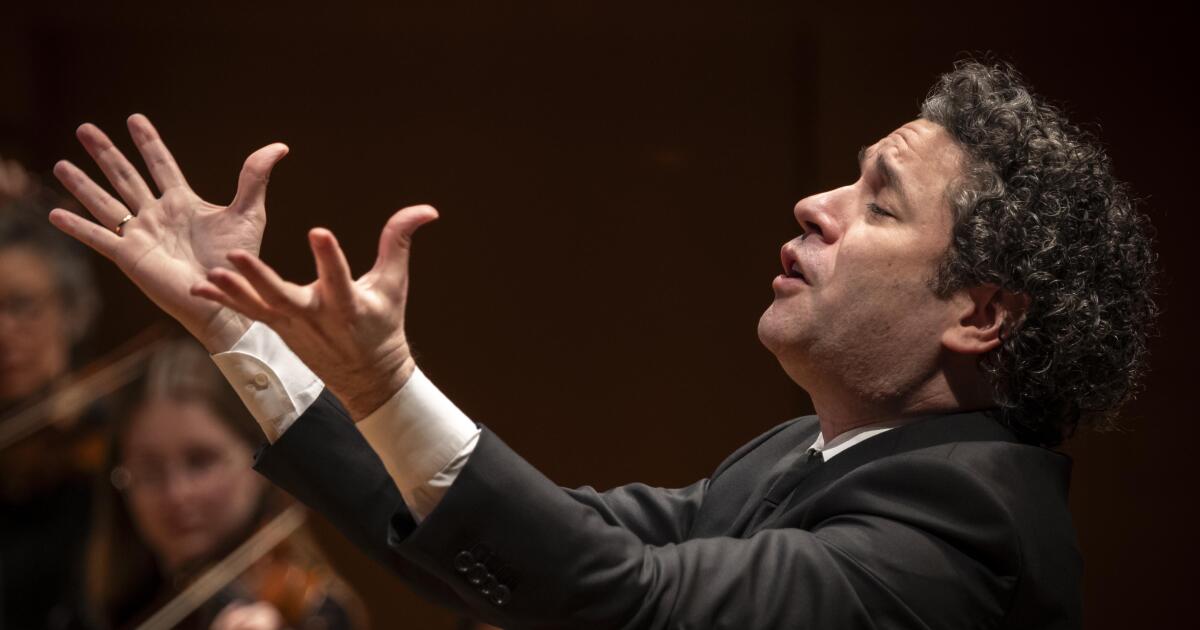
Gustavo Dudamel, who has been conducting Beethoven since he was a teen, waited until he passed his 45th birthday last month. His first “Missa Solemnis” performances over the weekend at Disney were the centerpiece of his month-long L.A. Phil focus on Beethoven.
That venture began a week earlier with a political statement. Beethoven’s incidental music to Goethe’s drama of liberation, “Egmont,” was updated with a new text that served as an urgent call for protest in our own era of authoritarianism and militarism. Here, Beethoven exerts a compulsion for triumphant glory.
The glory in “Missa Solemnis” is that of stupefaction. By this point in his life, Beethoven has had it with weapons, the drumbeat of soldiers, the addictive emotion of trumpet calls to action. His man-to-man with God is celestial diplomacy. There is no compromise. We either care, at all costs, for our magnificent world or nothing matters.
Dudamel clearly cares. He conducted the massive mass from memory. And costs be damned. He imported from Spain two spectacular choruses — Orfeó Català and Cor de Cambra del Palau de la Música Catalana — a total of some 130 singers who sounded like they had rehearsed for months under their impressive director, Xavier Puig. The four soloists — soprano Pretty Yende, mezzo-soprano Sarah Saturnino, tenor SeokJong Baek and bass Nicholas Brownlee — were needfully robust and powerful. They were placed mid-orchestra, behind the violas and bravely in front of the timpani.
“Missa Solemnis” follows the standard mass text but doesn’t necessarily follow the liturgical narrative. It is a work of theater, dramatizing feelings, as the earlier Disney staging attempted. Director Peter Sellars and conductor Teodor Currentzis have also been promising a major staged “Missa Solemnis” for many years.
The Kyrie opens with a strong D-major chord in the large orchestra that seems an obvious downbeat but turns out to be an upbeat. Down is up. Eighty or more minutes later at the end of the Agnus Dei, when the great plea for peace reaches its ultimate transcendence, up becomes, in one of the most profoundly unsettling moments in all music, down again. We never fully know where we stand in “Missa Solemnis.” Every expectation is thwarted. Beethovenian peace is a nearly superhuman endeavor.
Gustavo Dudamel conducts L.A. Phil, vocal soloists and Catalan choruses in Beethoven’s ‘Missa Solemnis’ at Walt Disney Concert Hall.
(David Butow / For The Times)
Dudamel‘s approach is to attempt the all-encompassing. He conducted without a baton but with his body. His arms were often open and wide as if embracing the musician masses on the stage, holding the whole world in his hands. Tidiness wasn’t necessarily the issue. Grandeur was. Molding sound was. And, of course, awe.
Throughout his career, Beethoven was the overwhelming master of awe. In “Missa Solemnis,” he out-glories the Gloria. His fugues are a draftsman’s rendering of heavenly splendor. Such awe asks for the superhuman from singers, especially in this ensemble from their ravishing high notes.
But Beethoven also questions every sentiment in the Mass. Grandeur can so suddenly turn solemn that it feels almost a ceremonial sleight of hand. In the Sanctus, a solo violin sails in from nowhere (“descending like a dove from heaven,” Hugh MacDonald nicely puts it in the program note), and suddenly we’re in a violin concerto with vocal soloists of transcendent allure.
The Agnus Dei begins in glum realization that there may be no compensation for humanity’s great sins when, again astonishingly without expectation, one of Beethoven’s uniquely wondrous melodies takes over. Saber-rattling trumpet and timpani intrude and are shushed away as worthless. Peace returns but just as it is about to climax it weakens. There is no grand Beethoven ending. “Missa Solemnis” just stops.
Dudamel’s approach was not, as his Beethoven has generally become, filled with fervent intensity in the moment. That may happen as he gains more experience with Beethoven’s most exigent score. The big moments were still huge, especially with the help of his fabulous chorus. The somber moments were well of the heart. There was eloquent solo playing in the orchestra, and extravagance from the solo singers.
Most unusual was the violin solo. The L.A. Phil is in a concertmaster search, and Alan Snow, the associate concertmaster of the Minnesota Symphony, sat in. He brought silken “descending dove” tone to his solo playing, but at low tone becoming more a voice from afar than soloist. Whether that is simply his sound or what Dudamel was after is, like so much in the “Missa Solemnis,” up to question. Still, its quiet exemplified the elusive essence of peace.
When Dudamel first walked on stage, he got, as he always does and especially in his last season as music director, a strong ovation. At the end of “Missa Solemnis,” the reaction was a respectful standing ovation, unlike the de rigueur rapturous reception he always earns with Beethoven.
Dudamel earned something far more rewarding. It wasn’t a moment for cheering but reflection. True peace in “Missa Solemnis” comes not from winning but from ending conflict, be it between nations, nature or among ourselves. We have as yet too little to celebrate.

Building on the foundation of the original, I Can Only Imagine 2 offers the same inspiration as its predecessor, but on a bigger scale and with a better-developed storyline and cast of characters.
About the Film
They say sequels are never as good as the original, but this film proves them wrong. Building on the foundation set by the first film, I Can Only Imagine 2 offers the same inspiration as its predecessor, but on a bigger scale and with a better-developed storyline and cast of characters.
Set over a decade after the first movie, Bart Millard is back with a family of his own and a fragile relationship with his eldest son, Sam, which he must fight to mend. Sam’s existence in this film adds depth to Bart’s character, echoing Bart’s complicated relationship with his own father. Fear of hurting his son the way his own dad hurt him prevents Bart from developing a deep, personal relationship with Sam. At the film’s heart is the relationship between father and son and how they learn to move forward despite the hurts of the past.
This movie follows the same structure as the first, but the filmmakers are more confident in their approach this time, which results in a more fully fleshed out plot. They created the “successful Christian movie formula,” and they’re sticking to it. The appearance of Tim Timmons (Milo Ventimiglia) as MercyMe’s opening act saves this movie from being an exact copy-paste of the original. His is a relentlessly optimistic, selfless, joyful presence that provides a foil to the depressed, heavy demeanor Bart carries throughout the majority of the film.

The band’s personality comes through more clearly this time. They come up with plenty of fun antics that make audiences feel like they’re part of the band. One example is Timmon’s induction, so to speak. He decides to use the bathroom while the bus is moving, and as soon as he steps inside, the bus driver slams on the brakes. Timmons walks out with what we hope is just toilet water covering his shirt, causing the other passengers to laugh. This scene sets the tone for the band’s relationship and provides comedic relief in an otherwise heavy story.

One of my biggest critiques of Christian movies is that they tend to end with an ineffective evangelistic sermon. I Can Only Imagine 2 concludes with Bart reading from his journal in a grief support group, which is a type of sermon. But because it’s part of his personal testimony and relates to the story in a real way, it feels earned.
This film is a prime example of how Christian movies should be made. Both I Can Only Imagine films address real problems without giving easy answers. The sequel offers a more fleshed out plot and cast of characters, providing the audience with a better constructed yet equally as inspiring movie experience. If you enjoyed the original, you will love this one, too.
On the Surface
For Consideration
On the Surface—(Profanity, Sexual content, violence, etc.).
Language: None.
Violence: One character has a rare form of cancer that causes him to cough up blood, which is visible in a few scenes.
Sexuality: None.
Other: A character passes out a few times, scaring his parents and everyone in the room. One child with the same issue is unable to be stabilized and passes away. His body is shown briefly on a gurney as he is rolled into a back room. His parents are shown grieving in an elevator.
Beneath The Surface
Engage The Film
Gratitude
Whether death, illness, or a broken relationship, tragedies are a part of life. How should Christians handle these trials? In 2 Corinthians 12:9-10, Paul writes, “Therefore I will boast all the more gladly of my weaknesses, so that the power of Christ may rest upon me. For the sake of Christ, then, I am content with weaknesses, insults, hardships, persecutions, and calamities. For when I am weak, then I am strong.” Furthermore, Romans 5:3-5 says, “Not only that, but we rejoice in our sufferings, knowing that suffering produces endurance, and endurance produces character, and character produces hope, and hope does not put us to shame, because God’s love has been poured into our hearts through the Holy Spirit who has been given to us.”

The leading song of this film, Even If, was co-written by Tim Timmons and Bart Millard. It is about worshipping through doubt and pain and finding gratitude even in dark moments. It came from a place of profound suffering. The cornerstone of this song is the chorus, “I know You’re able/ And I know You can/ Save through the fire/ With your mighty hand/ But even if You don’t/ My hope is You alone.” We must find our hope in God and his goodness, even when we don’t understand his plan. When we look to Jesus in every situation, we can approach life with unexplainable, unending gratitude despite our circumstances.


Iran pushes back against Trump ahead of Geneva talks in face of major US military deployment

Blue city mayor’s official SUV stolen after thief breaks into office, swipes keys: police

Fmr American Idol contestant, husband of Ohio teacher charged with wife’s murder after she was found in home

Arizona man detained in SWAT operation denies link to Nancy Guthrie abduction

Florida Senate passes Teddy Bridgewater Bill, allowing coaches to use personal funds for student welfare

Florida High School Football Rankings: Top 25 teams – Oct. 21

Cleary's 21 help Le Moyne down Central Connecticut State 69-64 in OT

How old is Bo Nix? What to know about Oregon quarterback ahead of 2024 NFL Draft

99th annual Pony Swim held in Virginia

Indiana Members Credit Union announced as new anchor tenant at Bottleworks District
Iran pushes back against Trump ahead of Geneva talks in face of major US military deployment

CNN’s first reactions to Trump’s State of the Union 2026
“Under Biden and his corrupt partners in Congress and beyond, it reached a breaking point with the green new scam, open borders for everyone. They poured in by the millions and millions from prisons, from mental institutions. There were murderers, 11,088 murderers.”

Al Green returns to House chamber for Trump SOTU after dramatic 2025 ejection

EU Commission urges MEPs to pass EU-US deal despite fresh tariffs
-

 Montana5 days ago
2026 MHSA Montana Wrestling State Championship Brackets And Results – FloWrestling
-

 Oklahoma1 week ago
Wildfires rage in Oklahoma as thousands urged to evacuate a small city
-

 Technology4 days ago
YouTube TV billing scam emails are hitting inboxes
-

 Louisiana2 days ago
Wildfire near Gum Swamp Road in Livingston Parish now under control; more than 200 acres burned
-

 Technology4 days ago
Stellantis is in a crisis of its own making
-

 Culture1 week ago
Test Your Knowledge of the Authors and Events That Helped Shape the United States
-

 Politics4 days ago
OpenAI didn’t contact police despite employees flagging mass shooter’s concerning chatbot interactions: REPORT
-

 News4 days ago
World reacts as US top court limits Trump’s tariff powers