Entertainment
At L.A. Times Book Prizes ceremony, winners advocate for hope in the face of uncertainty


It was a night of literary excellence at the 45th Los Angeles Times Book Prizes ceremony Friday night at USC’s Bovard Auditorium.
As winners in 12 competitive categories and three special prizes took the stage, many addressed the fraught political climate in the U.S. as well as L.A. rebuilding after January’s devastating firestorms.
Writers also addressed the dire need to use their voice to reflect the present moment — from poetry winner Remica Bingham-Risher contemplating the abuse her grandmothers endured (in another time and place, their narrative would have been hers, she said), to current interest winner Jesse Katz urging the audience to recognize the individuality of often-stigmatized MacArthur Park residents.
Pico Iyer — who has written 15 books translated into 23 languages — accepted the Robert Kirsch Award for lifetime achievement, which honors a writer with a substantial connection to the American West. The author’s latest novel, “Aflame: Learning From Silence,” recounts his mother’s home in Santa Monica burning during a wildfire in 1990. The book was published on Jan. 14, in the immediate aftermath of the Palisades and Eaton fires.
“I know that many people in this room have been through tremendous losses in the last few months,” he said sharing that he lost handwritten drafts for three books in progress in the 1990 fire. “What initially presented itself mostly as loss began to open doors … and make possible many things that might have never happened otherwise. I really hope that might be the case for some of you.”
“Writing still seems the deepest way of inhabiting another soul and the very best way, therefore, of rescuing us from black and white,” he added.
Investigative journalist Emily Witt accepted the Christopher Isherwood Prize for Autobiographical Prose for her memoir “Health and Safety: A Breakdown,” about her exploration of New York’s nightlife scene.
In her acceptance speech, Witt cited Isherwood’s writing about pre-WWII Berlin as a major influence. Like his milieu, she said the characters of her memoir, which takes place in Brooklyn from 2016 to 2020, lived in acute awareness of the “ideological bankruptcy” of their time.
Celebrated L.A.-born poet Amanda Gorman accepted the Innovator’s Award for bringing “books, publishing and storytelling into the future.”
Amanda Gorman received the Innovator’s Award at the L.A. Time Book Prizes.
(Varon Panganiban)
“Love is no silent harbor, no haven,” Gorman recited. “Still, it is the roaring thing that tugs away from the very shores we clutch. There is no better compass than this compassion.”
Iyer and Gorman will speak Saturday at the Festival of Books about their respective books.
The biography prize went to Laura Beers for “Orwell’s Ghosts: Wisdom and Warnings for the Twenty-First Century.” The book, written on the 75th anniversary of “1984,” explores George Orwell’s prescient and radical teachings. Beers, who was surprised by the win, said the world “seems to become slightly more Orwellian with each passing day.”
Journalist Rebecca Boyle won the science and technology award for “Our Moon: How Earth’s Celestial Companion Transformed the Planet, Guided Evolution, and Made Us Who We Are,” which traces the moon’s role in our biological and cultural evolution.
“The moon, my subject, does remind us that there are cycles,” she said while accepting the prize. “Inherent in the meaning of a cycle or a phase is a return. Things go away and they come back. Fascism went away and now is back. Authoritarianism went away, we thought, and now it is back. But there’s a flip side to that. Every phase that leaves brings something new. There’s also hope and renewal. And I think part of our job — the most important job we have as writers — is to remind us of the positive phases, the return of good, the return of new cycles and hope.”
In her closing remarks, she quoted Pope Francis, whose funeral is tomorrow: “Hope is a gift and a task.”
Kim Johnson, whose “The Color of a Lie” won the award for young-adult literature, said she set her book, about a white-passing Black teen, in 1955 Levittown, Penn., after her first novel was banned in Bucks County, where Levittown is located.
“Writers write in a lot of spaces where we’re doing resistance,” she said. “I’m thinking about reckoning, trying to untangle the roots of racism and systemic factors in this country that are so embedded and baked in our society.”
Achievement in audiobook production went to Dominic Hoffman (narrator) and Linda Korn (producer) for “James: A Novel.” Presented in collaboration with Audible, the award — the ceremony’s newest — honors performance, production and innovation in storytelling.
Jiaming Tang took home the Art Seidenbaum Award for First Fiction for “Cinema Love.” The decades-spanning epic follows gay Chinese immigrants. The novel also has won the Edmund White Award for Debut Fiction and the Ferro-Grumley Award for LGBTQ+ Fiction.
Jesse Katz’s “The Rent Collectors: Exploitation, Murder, and Redemption in Immigrant L.A.” won the award for current interest. The book explores the exploitation of undocumented Angelenos by both gang overlords and local law enforcement.
The fiction award went to Jennine Capó Crucet for “Say Hello to My Little Friend.” Brimming with dark humor, the novel follows a failed Pitbull impersonator’s encounter with a captive orca at the Miami Seaquarium.
Danielle Trussoni’s “The Puzzle Box” received the award for mystery/thriller. The second of Trussoni’s Mike Brink series, the book follows a puzzle master invited to Tokyo to try his hand opening the legendary Dragon Box, which contains a priceless Imperial secret.
The ceremony, which opened with remarks by Times Executive Editor Terry Tang and was emceed by Times columnist LZ Granderson (who also provided updates from the Lakers playoff game), serves as a kickoff to this weekend’s Festival of Books.
“In a world that is now feeling so confusing and distressed, this weekend gives all of us a chance to find a sense of unity, purpose and support,” Tang said.
The 30th annual celebration brings more than 550 storytellers to the USC campus across seven outdoor stages and 15 indoor venues. While some panels are ticketed, general admission to the festival is free.
Saturday’s events include conversations and panels with Amor Towles, Jay Ellis, Claire Hoffman, Stacey Abrams, Joanna “JoJo” Levesque, Griffin Dunne, E.A. Hanks, Rebecca Yarros, Amanda Knox, Rachel Kushner, Krysten Ritter, Max Greenfield and “Giggly Squad” podcast hosts Hannah Berner and Paige DeSorbo, as well as a cooking demo from Roy Choi, a reading by Alison C. Rollins and a performance by singer Aspen Jacobsen.
Sunday’s authors and entertainers include Percival Everett, Jenny Slate, Steve Wasserman, Maureen Dowd, Wilmer Valderrama, Jon M. Chu, Rachel Lindsay, Chelsea Handler, Jennifer Haigh, Gretchen Whitmer, Attica Locke, Janelle Brown, Kristen Ciccarelli and Mike Campbell. A special screening of PBS series “Miss Austen” and an appearance by children’s entertainer Blippi are also among the highlights.
Here’s the full list of finalists and winners for the Book Prizes.
Robert Kirsch Award
Pico Iyer, “Aflame: Learning From Silence”
The Christopher Isherwood Prize for Autobiographical Prose
Emily Witt, “Health and Safety: A Breakdown”
Innovator’s Award
Amanda Gorman
The Art Seidenbaum Award for First Fiction
Jiaming Tang, “Cinema Love: A Novel”
Pemi Aguda, “Ghostroots: Stories”
Joseph Earl Thomas, “God Bless You, Otis Spunkmeyer: A Novel”
Jessica Elisheva Emerson, “Olive Days: A Novel”
Julian Zabalbeascoa, “What We Tried to Bury Grows Here”
Achievement in Audiobook Production, presented by Audible
Matt Bomer (narrator), Kelly Gildea (director, co-producer), Lauren Klein (producer); “Giovanni’s Room: A Novel”
Narrators: Clare Brown, Ayanna Dookie, Korey Jackson, Andrea Jones-Sojola, Brittany Pressley, Emana Rachelle, Malika Samuel, Heather Alicia Simms, Diana Bustelo, Tyla Collier, Alejandra Reynoso, David Sadzin, André Santana, Shaun Taylor-Corbett; Producer: Allison Light; “New Nigeria County”
Narrators: Andrew Garfield, Cynthia Erivo, Andrew Scott, Tom Hardy, Chukwudi Iwuji, Romesh Ranganathan, Natasia Demetriou, Francesca Mills, Alex Lawther, Katie Leung; Producers: Chris Jones, Mariele Runacre-Temple, Robin Morgan-Bentley, Nathan Freeman; “George Orwell’s 1984: An Audible Original adaptation”
Dominic Hoffman (narrator), Linda Korn (producer); “James: A Novel”
Michele Norris With a Full Cast (narrator), Mike Noble (producer); “Our Hidden Conversations: What Americans Really Think About Race and Identity”
Biography
Laura Beers, “Orwell’s Ghosts: Wisdom and Warnings for the Twenty-First Century”
Cynthia Carr, “Candy Darling: Dreamer, Icon, Superstar”
Alexis Pauline Gumbs, “Survival Is a Promise: The Eternal Life of Audre Lorde”
Pamela D. Toler, “The Dragon From Chicago: The Untold Story of an American Reporter in Nazi Germany”
Jessica Goudeau, “We Were Illegal: Uncovering a Texas Family’s Mythmaking and Migration”
Current Interest
Jonathan Blitzer, “Everyone Who Is Gone Is Here: The United States, Central America, and the Making of a Crisis”
Ta-Nehisi Coates, “The Message”
Jesse Katz, “The Rent Collectors: Exploitation, Murder, and Redemption in Immigrant L.A.”
Robin Wall Kimmerer, “The Serviceberry: Abundance and Reciprocity in the Natural World”
Wright Thompson, “The Barn: The Secret History of a Murder in Mississippi”
Fiction
Rita Bullwinkel, “Headshot: A Novel”
Jennine Capó Crucet, “Say Hello to My Little Friend: A Novel”
Percival Everett, “James: A Novel”
Yuri Herrera translated by Lisa Dillman, “Season of the Swamp: A Novel”
Miranda July, “All Fours: A Novel”
Graphic Novel/Comics
Kris Bertin and Alexander Forbes, “Hobtown Mystery Stories Vol. 2: The Cursed Hermit”
Taiyo Matsumoto, “Tokyo These Days, Vol. 1”
Bhanu Pratap, “Cutting Season”
Miroslav Sekulic-Struja, translated by Jenna Allen, “Petar & Liza”
Ram V and Filipe Andrade, “Rare Flavours”
History
Andrea Freeman, “Ruin Their Crops on the Ground: The Politics of Food in the United States, From the Trail of Tears to School Lunch”
Andrew W. Kahrl, “The Black Tax: 150 Years of Theft, Exploitation, and Dispossession in America”
Aaron Robertson, “The Black Utopians: Searching for Paradise and the Promised Land in America”
Joseph M. Thompson, “Cold War Country: How Nashville’s Music Row and the Pentagon Created the Sound of American Patriotism”
Michael Waters, “The Other Olympians: Fascism, Queerness, and the Making of Modern Sports”
Mystery/Thriller
Christopher Bollen, “Havoc: A Novel”
Michael Connelly, “The Waiting: A Ballard and Bosch Novel”
Attica Locke, “Guide Me Home: A Highway 59 Novel”
Liz Moore, “The God of the Woods: A Novel”
Danielle Trussoni, “The Puzzle Box: A Novel”
Poetry
Remica Bingham-Risher, “Room Swept Home”
Andrea Cohen, “The Sorrow Apartments”
Cindy Juyoung Ok, “Ward Toward”
Pam Rehm, “Inner Verses”
Alison C. Rollins, “Black Bell”
Science Fiction, Fantasy & Speculative Fiction
Jedediah Berry, “The Naming Song”
Lev Grossman, “The Bright Sword: A Novel of King Arthur”
Kelly Link, “The Book of Love”
Jeff VanderMeer, “Absolution: A Southern Reach Novel”
Nghi Vo, “The City in Glass”
Science & Technology
Rebecca Boyle, “Our Moon: How Earth’s Celestial Companion Transformed the Planet, Guided Evolution, and Made Us Who We Are”
Ferris Jabr, “Becoming Earth: How Our Planet Came to Life”
Daniel Lewis, “Twelve Trees: The Deep Roots of Our Future”
Kyne Santos, “Math in Drag”
Zoë Schlanger, “The Light Eaters: How the Unseen World of Plant Intelligence Offers a New Understanding of Life on Earth”
Young-Adult Literature
Traci Chee, “Kindling”
K.A. Cobell, “Looking for Smoke”
Safia Elhillo, “Bright Red Fruit”
Carolina Ixta, “Shut Up, This Is Serious”
Kim Johnson, “The Color of a Lie”




Entertainment
Tommy Lee Jones’ daughter reportedly found dead at San Francisco hotel on New Year’s Day

Victoria Jones, the daughter of Academy Award-winning actor Tommy Lee Jones, was reportedly found dead at a hotel in San Francisco on New Year’s Day. She was 34.
According to TMZ, the San Francisco Fire Department responded to a medical emergency call at the Fairmont San Francisco early Thursday morning. The paramedics pronounced Victoria dead at the scene before turning it over to the San Francisco Police Department for further investigation, the outlet said.
An SFPD representative confirmed to The Times that officers responded to a call at approximately 3:14 a.m. Thursday regarding a report of a deceased person at the hotel and that they met with medics at the scene who declared an unnamed adult female dead.
Citing law enforcement sources, NBC Bay Area also reported that the deceased woman found in a hallway of the hotel was believed to be Jones and that police did not suspect foul play.
“We are deeply saddened by an incident that occurred at the hotel on January 1, 2026,” the Fairmont told NBC Bay Area in a statement. “Our heartfelt condolences are with the family and loved ones during this very difficult time. The hotel team is actively cooperating and supporting police authorities within the framework of the ongoing investigation.”
The medical examiner conducted an investigation at the scene, but Jones’ cause of death remains undetermined. Dispatch audio obtained by TMZ and People indicated that the 911 emergency call was for a suspected drug overdose.
Jones was the daughter of Tommy Lee and ex-wife Kimberlea Cloughley. Her brief acting career included roles on films such as “Men in Black II” (2002), which starred her father, and “The Three Burials of Melquiades Estrada” (2005), which was directed by her father. She also appeared in a 2005 episode of “One Tree Hill.”
Page Six reported that Jones had been arrested at least twice in 2025 in Napa County, including an arrest on suspicion of being under the influence of a controlled substance and drug possession.

Just when you think that you’ve seen and heard all sides of the human migration debate, and long after you fear that the cruel, the ignorant and the scapegoaters have won that shouting match, a film comes along and defies ignorance and prejudice by both embracing and upending the conventional “immigrant” narrative.
“I Was a Strranger” is the first great film of 2026. It’s cleverly written, carefully crafted and beautifully-acted with characters who humanize many facets of the “migration” and “illegal immigration” debate. The debut feature of writer-director Brandt Andersen, “Stranger” is emotional and logical, blunt and heroic. It challenges viewers to rethink their preconceptions and prejudices and the very definition of “heroic.”
The fact that this film — which takes its title from the Book of Matthew, chapter 25, verse 35 — is from the same faith-based film distributor that made millions by feeding the discredited human trafficking wish fulfillment fantasy “Sound of Freedom” to an eager conservative Christian audience makes this film something of a minor miracle in its own right.
But as Angel Studios has also urged churchgoers not just to animated Nativity stories (“The King of Kings”) and “David” musicals, but Christian resistence to fascism (“Truth & Treason” and “Bonheoffer”) , their atonement is almost complete.
Andersen deftly weaves five compact but saga-sized stories about immigrants escaping from civil-war-torn Syria into a sort of interwoven, overlapping “Babel” or “Crash” about migration.
“The Doctor” is about a Chicago hospital employee (Yasmine Al Massri of “Palestine 36” and TV’s “Quantico”) whose flashback takes us to the hospital in Aleppo, Syria, bombed and terrorized by the Assad regime’s forces, and what she and her tween daughter (Massa Daoud) went through to escape — from literally crawling out of a bombed building to dodging death at the border to the harrowing small boat voyage from Turkey to Greece.
“The Soldier” follows loyal Assad trooper Mustafa (Yahya Mahayni was John the Baptist in Martin Scorsese Presents: The Saints”) through his murderous work in Aleppo, and the crisis of conscience that finally hits him as he sees the cruel and repressive regime he works for at its most desperate.
“The Smuggler” is Marwan, a refugee-camp savvy African — played by the terrific French actor Omar Sy of “The Intouchables” and “The Book of Clarence” — who cynically makes his money buying disposable inflatable boats, disposable outboards and not-enough-life-jackets in Turkey to smuggle refugees to Greece.
“The Poet” (Ziad Bakri of “Screwdriver”) just wants to get his Syrian family of five out of Turkey and into Europe on Marwan’s boat.
And “The Captain” (Constantine Markoulakis of “The Telemachy”) commands a Hellenic Coast Guard vessel, a man haunted by the harrowing rescues he must carry out daily and visions of the bodies of those he doesn’t.
Andersen, a Tampa native who made his mark producing Tom Cruise spectacles (“American Made”), Mel Gibson B-movies (“Panama”) and the occasional “Everest” blockbuster, expands his short film “Refugee” to feature length for “I Was a Stranger.” He doesn’t so much alter the formula or reinvent this genre of film as find points of view that we seldom see that force us to reconsider what we believe through their eyes.
Sy’s Smuggler has a sickly little boy that he longs to take to Chicago. He runs his ill-gotten-gains operation, profiting off human misery, to realize that dream. We see glimpses of what might be compassion, but also bullying “customers” and his new North African assistant (Ayman Samman). Keeping up the hard front he shows one and all, we see him callously buy life jackets in the bazaar — never enough for every customer to have one in any given voyage.
The Captain sits for dinner with family and friends and has to listen to Greek prejudices and complaints about this human life and human rights crisis, which is how the worlds sees Greece reacting to this “invasion.” But as he and his first mate recount lives saved and the horrors of lives lost, that quibbling is silenced.
Here and there we see and hear (in Arabic and Greek with subtitles, and English) little moments of “rising above” human pettiness and cruelty and the simple blessings of kindness.
“I Was a Stranger” was finished in 2024 and arrives in cinemas at one of the bleakest moments in recent history. Cruelty is running amok, unchecked and unpunished. Countries are being destabilized, with the fans of alleged “strong man” rule cheering it on.
Andersen carefully avoids politics — Middle Eastern, Israeli, European and American — save for the opening scene’s zoom in on that Chicago hospital, passing a gaudily named “Trump” hotel in the process, and a general condemnation of Syria’s Assad mob family regime.
But Andersen’s bold movie, with its message so against the grain of current events, compromised media coverage and the mostly conservative audience that has become this film distributor’s base, plays like a wet slap back to reality.
And as any revival preacher will tell you, putting a positive message out there in front of millions is the only way to convert hundreds among the millions who have lost their way.

Rating: PG-13, violence, smoking, racial slurs
Cast: Yasmine Al Massri, Yahya Mahayni, Ziad Bakri, Omar Sy, Ayman Samman, Massa Daoud, Jason Beghe and Constantine Markoulakis
Credits: Scripted and directed by Brandt Andersen. An Angel Studios release.
Running time: 1:43
Related

Missouri Lottery Pick 3, Pick 4 winning numbers for Jan. 4, 2026

Photos: Past and present Montana State Bobcats meet in Nashville

Apex Receives Exploration Permit for Rift REE Project, Nebraska; Drill Program Preparation Underway

Westbound I-80 closed at Nevada Stateline and Truckee due to spin-outs

On This Day, Jan. 5: New Hampshire adopts first state constitution – UPI.com

Florida High School Football Rankings: Top 25 teams – Oct. 21

Cleary's 21 help Le Moyne down Central Connecticut State 69-64 in OT

How old is Bo Nix? What to know about Oregon quarterback ahead of 2024 NFL Draft

99th annual Pony Swim held in Virginia

Video: ‘It Didn’t Have to Happen This Way:’ U.Va. Faculty Call for Review of Police Response to Protests

Trump vows US ‘in charge’ of Venezuela as he reveals if he’s spoken to Delcy Rodríguez

Trump’s abduction of Maduro escalates concerns over potential war with Iran

Cuba says 32 Cuban fighters killed in US raids on Venezuela

Dan Bongino officially leaves FBI deputy director role after less than a year, returns to ‘civilian life’
Hundreds march in silence to honour Crans-Montana fire victims
-

 World1 week ago
Hamas builds new terror regime in Gaza, recruiting teens amid problematic election
-

 Indianapolis, IN1 week ago
Indianapolis Colts playoffs: Updated elimination scenario, AFC standings, playoff picture for Week 17
-
 Business1 week ago
Google is at last letting users swap out embarrassing Gmail addresses without losing their data
-
 Southeast1 week ago
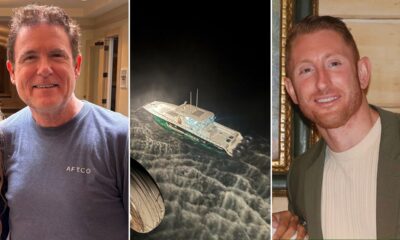
Two attorneys vanish during Florida fishing trip as ‘heartbroken’ wife pleads for help finding them
-

 Politics1 week ago
Most shocking examples of Chinese espionage uncovered by the US this year: ‘Just the tip of the iceberg’
-

 News1 week ago
Roads could remain slick, icy Saturday morning in Philadelphia area, tracking another storm on the way
-

 World1 week ago
Podcast: The 2025 EU-US relationship explained simply
-
 News1 week ago
Marijuana rescheduling would bring some immediate changes, but others will take time