Entertainment
At Comic-Con, Marvel hits the reset button with Robert Downey Jr., Fantastic Four


It was a big weekend for Marvel Studios.
Marvel Studios President Kevin Feige returned to San Diego Comic-Con’s hallowed Hall H on Saturday to hype the studio’s upcoming projects armed with exclusive footage, surprises and more. (Just a couple days earlier, the same hall in the Anaheim Convention Center was the site of revelry celebrating “Deadpool & Wolverine.”)
The presentation highlighted upcoming releases including “Captain America: Brave New World,” “Thunderbolts,” “Fantastic Four” and a couple of “Avengers” films.
Marvel’s biggest surprise was the reveal that Robert Downey Jr. will be making his return to the MCU as Doctor Doom in the next “Avengers” film. After helping kick off the franchise in 2008’s “Iron Man,” Downey portrayed the billionaire playboy Tony Stark, one of the leaders of the Avengers, in more than nine films over the course of his 11-year tenure. He last appeared in 2019’s “Avengers: Endgame,” in which Stark died to save the universe.
But “Avengers 5” marks not only the return of Downey — it also sees Anthony and Joe Russo back in the Marvel fold. The Russo Brothers have previously helmed four MCU films: “Captain America: The Winter Soldier” (2014), “Captain America: Civil War” (2016), “Avengers: Infinity War” (2018) and “Avengers: Endgame” (2019). It’s almost as if Marvel Studios is hitting a bit of a reset after a rocky few years.
Here are the biggest takeaways from Marvel’s presentation.
Marvel is forging its future by mining its past
By bringing Downey and the Russos back into the fold, Marvel Studios is signaling that it sees its path forward in the halcyon days of its past. The Russos helmed two of the MCU’s biggest box office hits — “Avengers: Endgame” has grossed more than $2.7 billion worldwide in its lifetime — and Downey was the face of the franchise for more than a decade.
It’s no secret that Marvel has struggled to find its footing since “Endgame.” Both Phases Four and Five have been lackluster, with some onlookers dubbing it Marvel’s “flop era” after a few underwhelming releases. To break out of the slump, the MCU is changing course.
The audience response to “Deadpool & Wolverine,” which opened to $205 million at the domestic box office and more than $438 million worldwide, signals that this could be a winning strategy, at least in the short term. “Deadpool & Wolverine,” like “Spider-Man: No Way Home” (2021) before it, wielded nostalgia as a superpower and was packed to the brim with cameos and callbacks to superhero comic book movies past.
The logo for “Avengers: Doomsday” was revealed during Marvel Studios’ Hall H panel at SDCC 2024.
(Marvel Studios)
Kang, dynasty no more
“Avengers 5,” previously known as “Avengers: Kang Dynasty,” has officially been renamed to “Avengers: Doomsday.” It is expected to hit theaters in 2026.
There had been questions about how the film would move forward after Marvel fired Jonathan Majors last year following his conviction on assault and harassment charges. Would the role be recast or the entire film (and MCU trajectory) be overhauled?
The new title indicates that the MCU is shifting its focus to a new big bad: Doctor Doom. In the comics, Victor von Doom is an evil genius best known for his clashes with the Fantastic Four, but he’s also faced off against the Avengers and the X-Men in his quests to take over the world.
The MCU is leaving Kang in its rearview mirror, at least for now.
Focus on the First Family
Pedro Pascal, Vanessa Kirby, Joseph Quinn and Ebon Moss-Bachrach were on hand in Hall H to tease their upcoming movie, “The Fantastic Four: First Steps,” slated for a 2025 release. The film, which officially begins production this week, will be set in 1960s New York, though its exact place in the Marvel multiverse remains unknown.
It was also confirmed that Marvel comics’ first ever superhero team will be seen in “Avengers: Doomsday” and “Avengers: Secret Wars,” meaning the MCU is going all in on the Fantastic Four now that they’ve regained the film rights to the characters. Considering the official Avengers roster for the upcoming films remains a mystery, building excitement around the team that will launch the MCU’s Phase Six makes sense.

Joseph Quinn, left, Vanessa Kirby and Pedro Pascal — stars of the upcoming “The Fantastic Four: First Steps” — onstage during the Marvel Studios’ Hall H presentation at SDCC 2024.
(Jesse Grant / Getty Images for Disney)
Silence speaks volumes?
One of the glaring omissions in Feige’s presentation was “Blade,” which was part of a big Marvel Studios surprise in a past Hall H presentation. The film, which will star Mahershala Ali as the eponymous daywalker, at one point was attached to a 2025 release date but has experienced some creative shake-ups since. Yann Demange, the second director attached to the project, departed the film last month.
Also absent in the presentation were Marvel’s upcoming television shows such as “Agatha All Along,” “Daredevil: Born Again” and “Iron Heart.” Perhaps Feige is saving some news for Disney’s own convention, D23 Expo, which will be held in August.








NEW YORK (OSV News) – “Goat” (Sony) is an animated underdog sports comedy populated by anthropomorphized animals. While mostly inoffensive, and thus suitable for a wide audience — including teens and older kids — the film is also easily forgotten.
The amiable proceedings center on teen goat Will Harris (voice of Caleb McLaughlin). As opening scenes show, it has been Will’s dream since childhood to play for his hometown team, the Vineland Thorns.
The inhabitants of Vineland and the other areas of the movie’s world, however, are divided into so-called bigs and smalls, with professional competition dominated, unsurprisingly, by the former. Though Will stoutly maintains that he’s a medium, those around him regard him as too slight and diminutive to go up against the towering bigs.
Despite this prejudice, a video showing Will more or less holding his own against a famous and arrogant big, Andalusian horse Mane Attraction (voice of Aaron Pierre), goes viral and inspires the Thorns’ devious owner, warthog Flo Everson (voiced by Jenifer Lewis), to give the lad a shot. Though Will is understandably thrilled, his path forward proves challenging.
Will has idolized the Thorns’ sole outstanding player, black panther Jett Fillmore (voice of Gabrielle Union), since he was a youngster. But Jett, it turns out, is not only frustrated by her situation as a star among misfits but scornful of Will’s ambitions and resolute in helping to deprive her new teammate of playing time.
Given such divisions, the Thorns’ fortunes seem destined to continue their long decline.
“Roarball,” the invented game featured in director Tyree Dillihay’s film, is essentially co-ed basketball by another name. As produced by, among others, NBA champion Stephen Curry, the movie — adapted from an idea in Chris Tougas’ book “Funky Dunks” — is an unabashed celebration of hoop culture both on and off the court.
Viewers’ enthusiasm may vary, accordingly, depending on the degree to which they’re invested in the real-life sport.
Moviegoers of every stripe will appreciate the fact that the script, penned by Aaron Buchsbaum and Teddy Riley, shows the negative effects of self-centeredness as well as the value of teamwork and fan support. Plot developments also showcase forgiveness and reconciliation.
Will’s story is, nonetheless, thoroughly formulaic and most of the screenplay’s jokes feel strained and laborious. Still, while hardly qualifying as the Greatest of All Time, “Goat” does provide passable entertainment with little besides a few potty gags to concern parents.
The film contains brief scatological humor and at least one vaguely crass term. The OSV News classification is A-II — adults and adolescents. The Motion Picture Association rating is PG — parental guidance suggested. Some material may not be suitable for children.
Read More Movie & TV Reviews
Copyright © 2026 OSV News
Entertainment
Philip Glass canceled a Kennedy Center show, but this conductor brings his work center stage at L.A. Opera
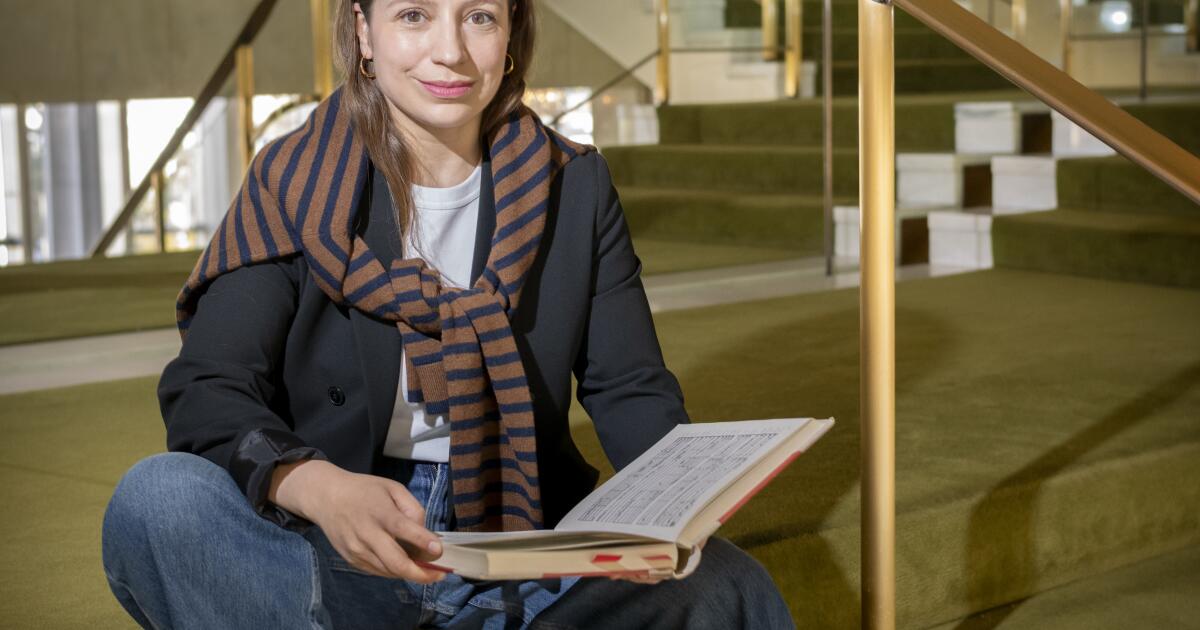
When Dalia Stasevska heard opera music for the first time, it was a moment of profound self-revelation. She was 13, growing up in the factory town of Tampere in the south of Finland, and her school librarian gave her a CD of Puccini’s “Madama Butterfly” along with a translation of its Italian libretto.
“As a teenage girl, this dramatic story touched my soul,” Stasevska says, adding that she still remembers the experience and thinking, “ ‘This music understands me, this is exactly how I feel.’ And that was…when I knew that I wanted to become a musician.”
Stasevska is now chief conductor of Finland’s Lahti Symphony Orchestra and a prodigious conductor of orchestral music in all forms. A busy guest baton with companies around the globe, she will make her L.A. Opera debut this Saturday with a production of “Akhnaten” by Philip Glass, running through late March.
John Holiday in the title role of L.A. Opera’s 2026 production of “Akhnaten.”
(Cory Weaver)
The seminal work by Glass lands at L.A. Opera just a month after the world-famous composer abruptly canceled June’s world premiere of Symphony No. 15 “Lincoln” at the John F. Kennedy Center for the Performing Arts. “While Philip Glass has pulled out of Kennedy Center, his music will be front and center at our production,” a rep for L.A. Opera wrote in an email.
Stasevska, with her razor-sharp appreciation of the power of Glass’ work, is the ideal conductor to bring it there.
Stasevska, 41, walks from the ornate foyer of the Dorothy Chandler Pavilion, with its emerald green carpets and gleaming chandeliers, to the more ordinary hallways and cubicles of L.A. Opera’s offices. She’s been in town rehearsing for a few weeks and jokes with some of the show’s jugglers in a kitchenette, where she makes herself a machine pod coffee.
The conductor is petite with large, expressive eyes and a Cheshire cat’s smile. Her mouth often pulls to the right when she speaks, her admirable non-native English tugged easterly in a Finnish accent.
Opera remains her great love, and it seems a perfect twist of fate that Stasevska was tapped to conduct “Akhnaten.” She saw it for the first time in 2019 at a Helsinki cinema, in a global broadcast of a production by the Met. She couldn’t believe her friend dozed off.
“I was like, ‘How could you fall asleep? This was the best thing I’ve ever seen in my life. I would do anything to conduct this opera,’ ” she recalls saying.
Stasevska was born in 1984, the same year that Glass’ hypnotic, ritualistic opera, about an Egyptian pharaoh who dared to push monotheism onto his polytheistic culture, debuted in Stuttgart, Germany. Eight months later, Stasevska entered the world in the Soviet-controlled city of Kyiv, the child of a Ukrainian father and Finnish mother.

Conductor Dalia Stasevska, who is making her L.A. Opera debut with Philip Glass’ “Akhnaten,” says that opera is her first great love.
(David Butow / For the Times)
It was a fluke that she was born in Ukraine. Her parents, both painters, were living in the Estonian capital of Tallinn, also under Soviet rule, but found themselves in a Kyiv hospital close to family when Stasevska arrived. She’s never lived in Ukraine — she spent her first few years in Tallinn before moving to Finland at age 5— but her life has been infused with its heritage.
Her father, who as a teenager in Tallinn began to rebel against Sovietization, insisted on teaching Stasevska and her two younger brothers to speak Ukrainian at home. Her grandmother, Iryna, lived with the family and was an important caretaker for much of her childhood. Stasevska grew up hearing fantastic stories filled with dreamlike imagery of the homeland.
“She was such a civilized, cultural person,” Stasevska says of her grandmother, adding that she taught her grandkids everything she knew about her home country. That’s why, even though Stasevska was raised in Finland, she grew up eating Ukrainian food and hearing Ukrainian folk tunes. “I know the language and understand the culture,” she says.
Stasevska grew up poor, but music education was mandatory for her and her brothers: “My father said, ‘This is going to be your profession.’ It was no question that this is not a hobby. So we started practicing immediately, very determined. There was maybe some forcing involved,” she says, laughing.
She played the violin from age 8, but it was only after she heard Puccini at 13 that she fell in love with classical music. She became obsessed with the opera and orchestral repertoires and was immediately determined to play in an orchestra. She approached the headmaster at her conservatory who placed her in a string ensemble before advancing her to the symphony orchestra as a violinist.
At 18, Stasevska entered the Sibelius Academy in Helsinki, which is named after Finland’s most famous composer, Jean Sibelius. She couldn’t stop herself from stealing a peek at the school conductor’s score, copying bowings and poring over the details, but she didn’t indulge any dreams of taking the podium herself. “I was going every week to the concerts,” she says, “but it took me so long to see somebody that looked like me.”
She was 20 when she saw a female conductor for the first time, calling it “the second big moment in my life.” When Stasevska expressed interest in trying it herself, she was referred to Jorma Panula, a legendary conductor and teacher in Finland. Panula invited her to attend one of his masterclasses, and on the first downbeat of her first experience conducting, “I knew immediately that this was beyond anything I’ve experienced in my life,” she says. “It became this kind of madness moment.”
She loved the sheer physicality of it, she says, but also “that I can affect the music, and that I can affect the interpretation, because I had so much in my heart that I felt about the music.”
After completing her conducting studies in 2012, Stasevska assisted Panula — who emphasized discovering unique “gestures in such a way that the orchestral musicians know what you mean,” she says. She also worked with her fellow Finn, Esa-Pekka Salonen. Stasevska became principal guest conductor of the BBC Symphony Orchestra in 2019 and chief of the Lahti Symphony in 2020.
When she’s not globetrotting, Stasevska lives in Helsinki with her young daughter and her husband, Lauri Porra — a heavy metal bassist who is also the great-grandson of Sibelius.
She likes to champion new music — her 2024 album, “Dalia’s Mixtape,” featured works by Anna Meredith, Caroline Shaw and other contemporary composers. She is also a vocal supporter of the land where she was born and has spoken out against Russia’s war in Ukraine.

John Holiday as Akhnaten, with So Young Park, at right, as Queen Tye, in L.A. Opera’s 2026 production of “Akhnaten.”
(Cory Weaver)
Stasevska’s L.A. Opera debut arrives on the same week as the fourth anniversary of Russia’s invasion. Both of her brothers — one a film director, the other a journalist — moved to Ukraine and have borne witness to the war, which has given her “another level of experiencing this horror,” she says.
Stasevska has made it her mission to raise funds — more than 250,000 euros to date — to provide basic supplies particularly for children and elders who are without power and huddling in freezing cold homes. She has even driven in supplies herself by truck.
She has also conducted concerts there — and her next album will celebrate the country’s composers in a meaningful way. “Ukrainian Mixtape,” which she recorded with the BBC Symphony Orchestra in London, features works by five composers who range from the 19th century to the 1960s. Three are premiere recordings of artists who have been completely forgotten, which required a year of searching for materials.
“I think that it will not leave anybody cold,” Staveska says, “and I hope that it will inspire everybody to discover Ukrainian music more, and that we will hear it more on main stages of the world — where it deserves to be.”
For now, though, her focus is on ancient Egypt and Philip Glass — and opera. She says her goal, in every concert, is to give audiences the same experience she had when she was 13, that remarkable feeling that the music uniquely understands them.

2.5/5
01 Hrs 59 Mins | Romantic Comedy | 27-02-2026
Cast – Sree Vishnu, Nayana Sarika, Satya, Brahmaji, Praveen, Murali Sharma, Srikanth Iyyengar, Satyam Rajesh, Srinivasa Reddy, Goparaju Ramana and others
Director – Yadunaath Maruthi Rao
Producer – Sumanth Naidu G
Banner – Sree Subrahmanyeshwara Cinemas
Music – Radhan
Since 2023, with three commercial hits and one critically acclaimed film, Sree Vishnu has established himself as a minimum guarantee hero and built a loyal audience. To continue the success streak, he chose yet another romantic comedy film, directed by debutant Yadunaath Maruthi Rao. ‘Aay’ fame, Nayana Sarika, played the female lead role and Radhan, scored the music for the film. After creating enough curiosity among the audience with the teaser and trailer, the film was finally released in theatres today. Did Sree Vishnu, deliver yet another hit with a romantic comedy film? Did Nayan Sarika, score a hit in Telugu, after AAY & KA? How does the debutant director, Yadunaath Maruthi Rao, do? Did the music director, Radhan, come up with memorable songs and score? Let’s figure it out with a detailed analysis.
What is it about?
Vishnu(Sree Vishnu), works as a junior lecturer at a college, where Manisha(Nayan Sarika), works as the head of the department(HOD/faculty). Manisha, with her eccentric characteristics, intrigues Vishnu and both of them eventually fall in love with each other. When everything is going well for the couple to get married, Manisha informs Vishnu about a flaw in her Jathakam. What was the Dosham(flaw) in Manisha’s jathakam? How did it impact her prospects of getting married before meeting, Vishnu? Why did Vishnu initially get reluctant to marry Manisha, after hearing about her Jathaka Dosham? Will the couple sort out all the issues and get married eventually? Forms the rest of the story.
Performances:
Sree Vishnu, with his comedy timing generated a few fun moments that worked in favour of the film. However, in an attempt to appear effortless, he went overboard at times and appeared monotonous at a few places. Nayana Sarika got a good role and she delivered a good performance. She looked good throughout the film and appeared confident.
Satya, got a full-length role and he was able to generate a few laughs here and there with his comedy timing. Srikanth Iyyengar’s performance looked over the top and his portions looked rushed and very artificial. Srinivasa Reddy played a role similar to Mallikarjuna Rao’s role in Raviteja’s movie, Venky. He did an ok job but it seemed like he did dub for his role in the film? The film had Brahmaji, Praveen, Murali Sharma, Satyam Rajesh, Goparaju Ramana and a few others, in character roles. All of them made their presence felt but none of their roles gave the desired impact and extra mileage.
Technicalities:
Cinematography by Sai Sriram, is a major plus to the film. The visuals looked colourful, vibrant and gave a pleasant look to the film throughout. Radhan’s music should have been better. The songs scored by him were below par and the background score was pretty standard. Editing by Karthikeyan Rohini, was alright. He tried to cut the film with a very crisp runtime of around two hours and yet, ended up having a few repetitive sequences. Production values by, Sree Subrahmanyeshwara Cinemas, were decent and were within the limitations of a midrange romantic comedy film. Let’s discuss the work of the writer and the director, Yadunaath Maruthi Rao, in detail in the analysis section.
Positives:
1. First Half
2. Comedy Portions
3. Sree Vishnu & Satya’s Timing
4. Cinematography
Negatives:
1. Second Half
2. Lack of Strong Emotions
3. Music
Analysis:
The debutant writer and the director, Yadunaath Maruthi Rao, wrote a so-called peculiar characterisation of the female lead in the film and tried to generate enough fun moments using the comedy timing of his lead actor, Sree Vishnu and the lead comedian, Satya. Right from the word go, the writer intended only to make the audience laugh at any cost, and in doing so, he succeeded in parts but would have done a better job in other parts, especially the latter part of the second half. The film had at least five to six notable actors but for some reason, the director only concentrated on generating fun by using his lead actor.
The entire first half of the film unfolded without any major complaints. There were enough comedy sequences in the first half that engaged the audience in a fairly decent manner and the revelation of the conflict point during intermission, worked as well. However, after the initial few minutes of the second half, the film got into repetitive mode and the drama during the last thirty minutes was the film was written and executed in a very unexciting manner without any proper emotional depth. The twist during the climax was very predictable and it was narrated in a bland and rushed manner. Better care in writing and execution during the second half would have elevated the film’s overall graph.
The bare minimum that the audience expects from debutant writers and directors is original characters and characterisations, isn’t it? In Vishnu Vinyasam, to a crucial character, it was surprising to see a debutant director use the characterisation of ‘Jagadamba Chowdary’, a character from Ravi Teja’s movie Venky. Also, at just around two hours of runtime, the film makes the audience feel monotonous with a few repetitive sequences. One of the major negative points of the film is the songs. For a romantic comedy film to work, it is necessary to have at least one or two chartbuster songs. Unfortunately, none of the songs composed by, Radhan, helped the film in any way.
Overall, the core point of, Vishnu Vinyasam, has enough potential to become a very engaging romantic drama film. But, the half-hearted effort from the writer, director and the music director, ended up making it a decent watch. You may give it a try watching for a few well-executed comedy portions, Sree Vishnu and Satya’s timing.
Final Verdict – Partly Entertaining
Rating – 2.5/5
Related

How the federal government is painting immigrants as criminals on social media

Newsom staffer who told California reporter to ‘f— off’ is raking in massive taxpayer-funded salary

Walz slams Trump admin for temporarily halting Medicaid funding to Minnesota: ‘Campaign of retribution’

Trump introduces Cornyn, Paxton but stays mum on endorsement in heated GOP primary

Illegal immigrant arrested after showing up to Florida Border Patrol office for contract IT work

Florida High School Football Rankings: Top 25 teams – Oct. 21

Cleary's 21 help Le Moyne down Central Connecticut State 69-64 in OT

How old is Bo Nix? What to know about Oregon quarterback ahead of 2024 NFL Draft

99th annual Pony Swim held in Virginia

Indiana Members Credit Union announced as new anchor tenant at Bottleworks District
How the federal government is painting immigrants as criminals on social media

Where Iran’s ballistic missiles can reach — and how close they are to the US

Has India’s influence in Afghanistan grown under the Taliban?

Bill Clinton to testify before House committee investigating Epstein links

Read Judge Schiltz’s Order
-

 World2 days ago
Exclusive: DeepSeek withholds latest AI model from US chipmakers including Nvidia, sources say
-

 Massachusetts2 days ago
Mother and daughter injured in Taunton house explosion
-

 Montana1 week ago
2026 MHSA Montana Wrestling State Championship Brackets And Results – FloWrestling
-

 Louisiana5 days ago
Wildfire near Gum Swamp Road in Livingston Parish now under control; more than 200 acres burned
-

 Oklahoma1 week ago
Wildfires rage in Oklahoma as thousands urged to evacuate a small city
-

 Denver, CO2 days ago
10 acres charred, 5 injured in Thornton grass fire, evacuation orders lifted
-

 Technology7 days ago
YouTube TV billing scam emails are hitting inboxes
-

 Technology6 days ago
Stellantis is in a crisis of its own making