Entertainment
At a Cannes Film Festival of big swings and faceplants, real life takes a back seat


“Is it too real for ya?” snarls the Gang of Four-soundalike punk band Fontaines D.C. over a thrumming bass line on the soundtrack to “Bird” as we cruise the streets of Gravesend, Kent, east of London. How’s this for too real? Piloting an e-scooter is the shirtless, much-tatted Bug, played by Barry Keoghan, last seen in “Saltburn” wearing significantly less. Hanging onto him is 12-year-old Bailey (Nykiya Adams), his daughter from a previous relationship (something of a stretch, age-wise, but sure).
Ever the optimist, Bug is planning to sell the hallucinogenic slime he skims off the back of a toad he’s imported from Colorado to fund his imminent wedding to a fling of three months. And despite having an elaborate, curling centipede inked on his face and neck, he’s crestfallen that Bailey would let a friend cut off her locks before the big day. She’s entering surly adolescence like a hot comet and not thrilled to have a new stepmother.
It’s all in keeping with the studied miserablism of British director and Cannes darling Andrea Arnold (“American Honey”). Every interior in “Bird” is more squalid than the last; every door seems designed to be busted down by a violent boyfriend.
Nykiya Adams in the movie “Bird.”
(Atsushi Nishijima)
Is it too real for ya?
Actually, no, not really. And that’s before Arnold introduces us to Bailey’s creepy Boo Radley-ish friend, the mysterious title character (Franz Rogowski of “Passages,” deepening his brand of bug-eyed strangeness), who, in a long-telegraphed moment of protective vengeance, sprouts huge CGI wings that were already painfully suggested.
“Bird” is part of what might be described as Cannes’ reality problem. Or so it seems — it’s only the halfway mark — as we ping-pong between screenings of revered directors leaping off the deep end, their former penchants for verisimilitude tossed aside. Emerging from the raves for George Miller’s “Furiosa: A Mad Max Saga” came the admission, shared by many, that it just wasn’t convincing physically: too lacquered and digitally finessed, the grungy tactility of “The Road Warrior” long gone. Any hope of Francis Ford Coppola reproducing the warmth of his best films was dashed by the sprawling “Megalopolis,” a Rome-as-New-York urban fantasia that, for all its delightful looniness, could have used some subway grit.
Maybe realness is overrated. It’s tempting (but too easy) to impose a coordinated aesthetic on any one edition of a film festival, the early responders hoping to collate their scattered experience of seeing multiple movies a day into a larger sense of coherence. Still, this was restless work. Many of Cannes’ first-week offerings felt like products of the pandemic and, as such, exuded an air of desperation.
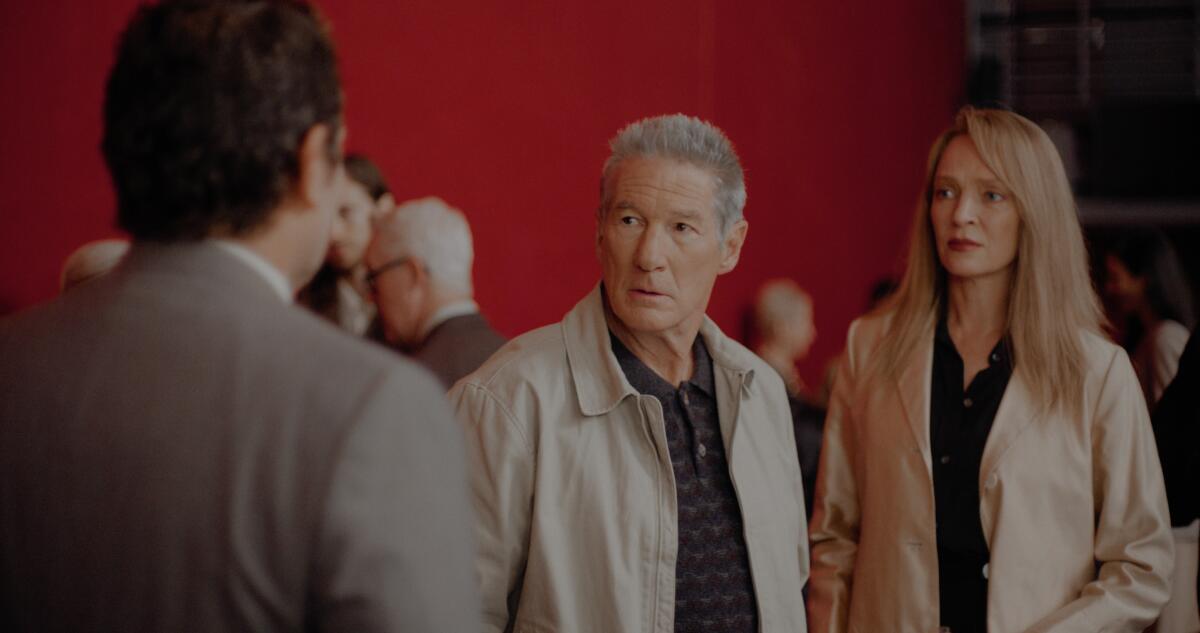
Richard Gere and Uma Thurman in the movie “Oh, Canada.”
(Festival de Cannes)
Paul Schrader’s flashback-heavy “Oh, Canada” — sluggish even at 95 minutes — is expressly about notions of reputational realness unraveling. A Hollywood lion in a fascinating winter, the always-watchable Richard Gere plays Leonard Fife, a celebrated Errol Morris-like lefty documentarian, who, though suffering through the final stages of cancer, agrees to a filmed interrogation by some of his most devoted students. Already you anticipate that some of these interviews aren’t going to go Leonard’s way as Schrader’s métier, the language of self-excoriating doubt, finds voice.
Was he a draft dodger who fled to Canada on principle to escape military service? Was he a faithful family man? No points for guessing correctly on those two. Meanwhile, a deeper truth emerges, more about the inexorable march of time than integrity. Gere, reuniting with Schrader for their first collaboration since the exuberant strut of 1980’s “American Gigolo,” is a fragile, vulnerable presence here, playing up Leonard’s thickened voice and dimmed virility. “I have a Genie and a Gemini!” he sputters, clinging to his awards while the rest of his life tips into fabrication.
Please, Yorgos Lanthimos, show us how it’s done: If we’re going to have a Cannes overrun with fantasy, let one come from the maker of “Poor Things” and “The Lobster.” The Greek director has chosen an unfortunate moment to do a faceplant. “Kinds of Kindness,” though it gets its audience pumped with opening credits set to Eurythmics’ snaky, pounding “Sweet Dreams (Are Made of This),” slackens into a tiresome trio of subpar mini-films lacking the emotive weirdness that Lanthimos usually serves on tap.
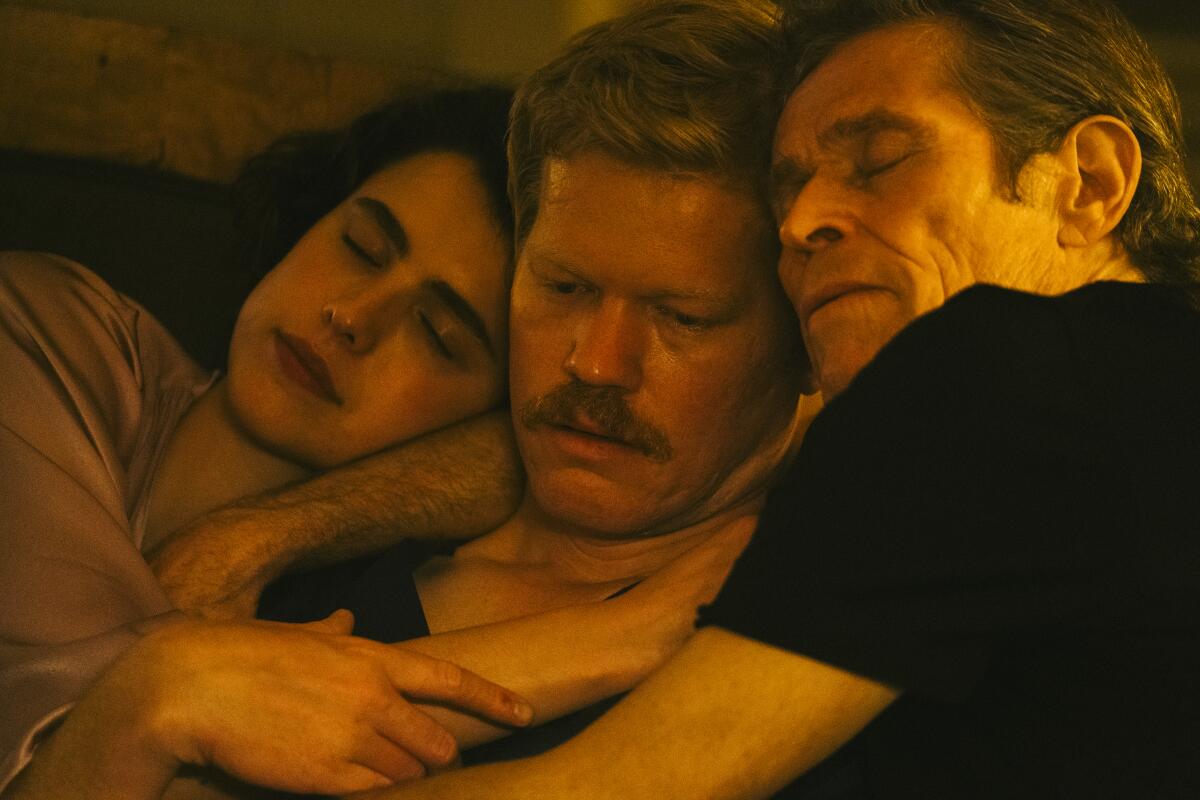
From left, Margaret Qualley, Jesse Plemons and Willem Dafoe in the movie “Kinds of Kindness.”
(Atsushi Nishijima / Searchlight Pictures)
It’s not the actors’ fault, many of whom take on triple duty in three brittle, gruesome tales about, sequentially, murderous micromanagement, cannibalistic survival and obsessive cultdom. The cast launches gamely into the flat-toned violence: Jesse Plemons, Emma Stone, Willem Dafoe, Hong Chau and a particularly committed Margaret Qualley (who hopefully filed for worker’s comp). The weak link, however, is the script by Lanthimos and Efthimis Filippou, who, despite the hope they’d steer back to their darkly suggestive “Dogtooth” days, can’t seem to link their customary meanness to any kind of profundity.
Lanthimos has never made a movie this gratuitously brutal (brace for a fried thumb served on a dinner plate), nor has he made one this dumbly obvious, relying on that ominous, pinging piano note from “Eyes Wide Shut” and a frisky cast to sock it over. He’s clearing his throat. It’s more a collection of memes than a sustained piece of thinking.
One filmmaker, though, has nailed the free-floating dreaminess that Cannes seems to be lost in, the Zambia-born Rungano Nyoni, whose confidence summoning a mood clarifies in the exquisitely haunting “On Becoming a Guinea Fowl.” (Playing in the Un Certain Regard section, her drama runs circles around several others in the official competition.) It begins in the middle of the night — a sequence you’ll never want to end — as Shula (Susan Chardy), driving home from a party, pulls over. There’s a dead body on the road. Turns out it’s her uncle Fred. A garrulous, drunk cousin, Nsansa (Elizabeth Chisela), shows up, lending her some unwanted company.
The movie then eases into the rituals of mourning: mounting a funeral, cooking for the bereaved, grieving performatively, so much of it conducted in a state of shock. Nyoni’s debut, the surreal 2017 comic satire “I Am Not a Witch,” poked a sharp stick in the eye of African mysticism, drafting a solemn girl into unwanted witchery while other women remained tethered to traditional roles. Here, the connection is cooler and more disturbing. As Shula steps into rooms flooded with water, the film pivots to a trance-like menace, echoed by Lucrecia Dalt’s scraping experimental synth score.
We also learn more about guinea fowl than ever imagined, including how the plump species warns the rest of the herd of danger. Shula, lost in her stubbornly vague half-memories, can’t quite shake free of her uncle’s past. And when a final showdown arrives — several women and girls chirping out an animalistic warning — the hair on the back of your neck pricks up.
Suddenly, Cannes was too real after all.

Entertainment
Alannah Keyser is latest fired ‘Love Island USA’ contestant to apologize for using a racist slur

Another former bombshell has apologized for past use of a racist slur that got her ousted from the villa.
Fired “Love Island USA” contestant Alannah Keyser posted a video to TikTok on Saturday addressing a past video that showed her using the N-word as she sang along to the Roddy Ricch song “The Box.” On Friday, Peacock confirmed to The Times that Keyser had been dismissed from the hit reality dating show after the resurfaced video began circulating online.
“I do want to begin by addressing the video of me singing along to a Roddy Ricch song that contains a racial slur,” Keyser says in her video. “I’m sorry to whoever has seen that video and has been offended by it; that was never my intention. The video is from six years ago, and that word is just not in my vocabulary anymore.”
A USC film student from Miami, Keyser also addressed some of the other social media chatter about her that had been making the rounds prior to her dismissal. Included were accusations of racism due to screenshots of her alleged use of the racist slur on Snapchat and Instagram as well as observations that alleged she had interacted less with Black men on the show.
She said those screenshots had been “falsified.”
“What has been shared does not reflect the truth, and it’s never been in my character to discriminate against anybody’s skin color,” Keyser said. “I do want to say directly that I do not support racism or discrimination of any kind, and I never have.
“When I first found out that these things were going around online, it really broke my heart, and I couldn’t do anything about it. But this has definitely been a learning lesson for me, and it sucks that I didn’t get a chance to really show my personality and who I am,” she added.
In the caption of her TikTok video, Keyser wrote that “reality tv is HEAVILY edited & [her] chats/kisses with the other boys were unfortunately not aired.”
Keyser was the second “Love Island USA” contestant who was dismissed from the show this season after video of them using the N-word surfaced on social media. Earlier this month, Peacock axed Oregon-based beauty technician Vasana Montgomery just days after it announced its slate of Islanders for the show’s eighth season. She has since apologized, saying, “There is no excuse” for her use of the slur.
Last year, contestants Cierra Ortega and Yulissa Escobar were dismissed from the show for their use of racist slurs. Ortega had been caught repeatedly using a derogatory slur for Chinese people (and Asian people in general) on social media, while Escobar had used the N-word in a couple of podcasts. Both have since apologized.

The Invite is a remake of the Spanish film The People Upstairs, itself based on a play by the same director Cesc Gay. With all remakes, the question is: What’s this version bringing to the table. In this case, it’s a rock solid cast with great chemistry and some very snappy direction by Olivia Wilde.
Joe (Seth Rogen) and Angela (Olivia Wilde) are a dysfunctional couple with some noisily amorous upstairs neighbours. They invite Hawk (Edward Norton) and Piña (Penélope Cruz) to dinner and hijinks ensue.
There’s a lot to like about The Invite. Each member of the cast is funny in their own way. Rogen plays his usual schlub but his character is more nuanced than usual, with the rapid-fire jokes masking a deep frustration and melancholy. Wilde‘s Angela is a persnickety neurotic, but it’s not hard to see why. Cruz plays a sultry therapist who’s in permanent flirt mode but is also holding something back. Norton steals the show with a quietly hilarious performance as a retired firefighter who is all too eager to share his new age insights. The way each person interacts with the other results in a rollercoaster of cringe comedy, acerbic satire and genuine gut-busters. This is a film that relies entirely on performance and actually succeeds.
The story itself is a little masterpiece. Adapted from Gay’s original by Rashida Jones and Will McCormack, the dialogue is quick, laden with not-very-subtextual motivations and always up to something. It’s very even-handed, and all the characters are sympathetic but flawed in amusing ways. Watching the increasingly desperate Joe and Angela bouncing off the Hawk and Piña is both funny and excruciating. Joe’s attraction to Piña is played fairly straight, but Angela’s attraction to Hawk becomes side-splitting as she pours out her soul to his Zen-calm ears and gets responses that make her even more attracted to him and by the end she’s practically hyperventilating.
The Invite does take something of a turn towards the end, although the film is in a state of continual twist throughout. This final shift throws the couples’ dysfunction into stark terms but doesn’t ruin anything. In the end, it moves from a somewhat misanthropic tone to a sincere and compassionate one. It skillfully makes you complicit in Joe and Angela’s spatting and then forces you to reconsider. The comedy is so intense throughout the film that when this happens it might lose some viewers, but it’s well-earned, true to the characters and it’s a very satisfying payoff.
The Invite is a small film that feels like a return to a better era in cinema. It’s a remake that is worth watching for its performances, and it’s very, very funny. It’s the sort of film that can be watched at home given its confined setting, but it generates enough laughs that seeing with an audience is a real pleasure.
Entertainment
Jesús Ortiz Paz and Jimmy Humilde took their legal dispute to Instagram. Here’s the breakdown

What started off as a trailblazing music partnership between música mexicana band Fuerza Regida and L.A. label Rancho Humilde has now fizzled into a sticky online drama.
On Saturday, Fuerza Regida frontman Jesús Ortiz Paz, better known as JOP, took to his personal Instagram account to post a statement addressing the band’s ongoing legal battle with the independent label led by music mogul Jimmy Humilde, who signed the band in 2018.
“To everyone who supports Fuerza Regida, you deserve to hear our music,” Ortiz Paz wrote in a public statement. “You deserve to see us perform at the World Cup. You deserve to listen to us on the MLB [Major League Baseball] album.”
This statement, which has since disappeared from JOP’s Instagram post, alleged that music created by the música mexicana group “keeps disappearing.”
Among the songs that have been taken down from streaming platforms by Rancho Humilde are “Triston,” “Todos nos Shipean” and “67,” according to the band’s publicist.
In September 2025, Rancho Humilde filed a lawsuit against Fuerza Regida, alleging breaches of contract for unilaterally collaborating with artists outside the label — such as Chino Pacas and Drake — and signing exclusive live performance deals with Apple Music and Live Nation.
Fuerza Regida countersued, alleging that Rancho Humilde withheld millions in royalties and attempted to “sabotage” the band’s success, including by neglecting to submit its music for consideration ahead of the 2024 Latin Grammys.
The case is still making its way through the courts.
“Everyone knows [what’s] going on[.] [You see] it [in the] media, [that’s] why I’m going to let justice do its job, everyone is going to know who you really are,” the post by JOP continued in both English and Spanish. “[He who has nothing to hide has nothing to fear], go let [Jimmy Humilde] & [Rancho Humilde] know how you feel, make your voice heard. Our story isn’t over I promise.”
Humilde responded to the artist in the comment section shortly after the post was made public.
“You asked me for a bigger [deal], I got it done. You asked me for your [masters], I fought to make it happen. You wanted to become one of the biggest artists in the [world], I have everything I had to help build that dream,” wrote Humilde.
“When you needed help, I didn’t just bring business. I brought my lawyers, my doctors, my relationships, my time, and my heart. I stood by you when it mattered the most,” Humilde continued. “You walked away with the biggest check of your [life,] over $50 million. I never complained. I was happy to see you win because your success was our success.”
“What hurts is seeing everything we’ve built together reduced to a public narrative that doesn’t tell the whole story. If you believe people deserve the truth, then honor the agreement we made. Complete the contract the same way I honored every commitment I made to you. I never stopped looking out for you. I only ask that you do the same. [He who has nothing to hide has nothing to fear].”
In a separate comment — which Humilde uploaded to his own Instagram account with Fuerza Regida’s own song “El Dinero Los Cambio” (which describes how money can change someone) — the label head pushed back on allegations of robbery: “I robbed you? Robbed you of what, fool. You didn’t even have a dollar for me to rob.”
The music mogul also accused JOP — who founded his own label Street Mob Records in 2018 — of sabotaging his own bandmates. “Let’s talk about [how] your own band members went from partners to being employees. They didn’t have much of a choice.”
“And let’s not forget I helped you land a $15 million deal for your label. After that, how you choose to take care of your artists is on you. [Let’s] ask Chinito [Pacas], Calle [24] and Armenta!!” added Humilde, including the names of artists signed to Street Mob Records.
JOP of Fuerza Regida performs at South By Southwest on March 13 in Austin, Texas.
(Cat Cardenas / For De Los)
In an email to De Los, Humilde’s lawyer, Mike Trauben, pushed back on claims that Rancho Humilde is trying to stop Fuerza Regida from making music and obtaining other opportunities.
They cite two recent deals that were approved by Rancho Humilde, including Fuerza Regida’s appearance on “Grand Theft Auto” and in the online video game “Fortnite,” which aligns with the contractual framework both parties had negotiated.
With regards to the proposed MLB and FIFA collaborations, Humilde’s council said that Fuerza Regida sought to prevent Rancho Humilde from exercising its claimed contractual rights, which was ultimately denied by a federal court.
The reason certain songs were removed from streaming platforms is because Fuerza Regida chose to release music outside the agreed Rancho/Sony distribution structure and without the approvals required under the parties’ agreements, per Humilde’s lawyers.
“Ultimately, this case is not about stopping an artist from succeeding,” wrote Trauben to The Times. “It is about whether sophisticated parties are required to honor the agreements they voluntarily negotiated after success had already arrived.”
According to Trauben, Rancho Humilde and Fuerza Regida, both parties entered a completely new agreement in 2022 that fundamentally restructured their entire business relationship, fully terminating the initial 2018 contract in place. As a result, Fuerza Regida received a flat million-dollar bonus, Rancho Humilde converted its ownership of existing masters into a 50/50 structure and the two entered into a new agreement, which Humilde’s lawyers claim favors Fuerza Regida.
“This case is not about whether artists should have rights. They absolutely should. Nor is it about preventing Fuerza Regida from making music,” wrote Trauben. “Rather, this case asks a much broader question that affects the entire music industry: Do contracts still matter after artist success arrives?”
The Times reached out to Fuerza Regida’s attorney but did not hear back as of this publication.
-
 Business8 minutes ago
Comcast is spinning off NBCUniversal media and entertainment assets
-
Entertainment13 minutes ago
Alannah Keyser is latest fired ‘Love Island USA’ contestant to apologize for using a racist slur
-

 Lifestyle20 minutes ago
Chanel’s Bruno Pavlovsky on Reengineering an Iconic Brand
-
 Politics23 minutes ago
Supreme Court limits police use of cellphone data to find crime suspects
-
 Sports35 minutes ago
Teoscar Hernández returns, and Dodgers unleash 17-hit barrage in win over Athletics
-

 World43 minutes ago
DR Congo says 1,307 Ebola cases confirmed, including 377 deaths
-
 News1 hour ago
Michigan governor threatens to pull troops from D.C. if used for Trump task force
-

 New York2 hours ago
Metropolitan Diary Challenge Day 2: How to Write Your N.Y. Story

