Entertainment
Angelina Jolie, Brad Pitt finally settle divorce after 8 years in court. Why so long?


Angelina Jolie and Brad Pitt have finally reached a divorce settlement more than eight years after announcing the end of their two-year marriage back in 2016.
The fellow Oscar winners and former Hollywood power couple, who were together for 12 years before their split, signed off on a default declaration filed in Los Angeles County Superior Court on Monday. The document said they have entered into a written agreement on their marital and property rights, according to records obtained Tuesday by The Times, and that they gave up the right to any future spousal financial support. A judge still needs to sign off on the agreement.
The high-profile split — among the longest and most contentious splits in Hollywood history — has been years in the making and four times as long as their marriage.
“More than eight years ago, Angelina filed for divorce from Mr. Pitt. She and the children left all of the properties they had shared with Mr. Pitt, and since that time she has focused on finding peace and healing for their family,” her attorney James Simon said Tuesday in a statement to The Times.
“This is just one part of a long ongoing process that started eight years ago. Frankly, Angelina is exhausted, but she is relieved this one part is over,” said Simon, of Hersh Mannis LLP.
People first reported on the split late Monday.
Representatives for Pitt did not immediately respond Tuesday to The Times’ request for comment.
Jolie, who is currently in the Oscar running for the Maria Callas biopic “Maria,” does not speak ill of her ex privately or publicly and she’s “been trying hard to be light after a dark time,” a person close to Jolie who was not authorized to speak publicly on the matter told The Times.
“The kids have grown up seeing that some people have so much power and privilege that their voices don’t matter,” the person said. “Their pain doesn’t count. They have wanted her to speak up for herself, to defend herself over these years but she reminds them to focus on changing laws over telling public stories.”
Jolie, 49, and Pitt, 61, used a private judge — an increasingly common practice among estranged celebrity couples — to settle the divorce. That strategy has allowed them to keep the details of their split out of the public eye, for the most part. No official court action in their case has occurred since last February.
Jolie and the “Once Upon a Time … in Hollywood” Oscar winner met while working on the 2005 action film “Mr. & Mrs. Smith,” when Pitt was still married to “Friends” star Jennifer Aniston and after Jolie had already adopted two children. The pair welcomed their first child together, daughter Shiloh, in Namibia in 2006. A few years and a few more kids later, the pair decided to get married at the behest of their six children. The two legally wed Aug. 14, 2014, after a two-year engagement and celebrated the marriage on Aug. 23 of that year with a nondenominational ceremony held at their chateau and winery in Provence.
Then the “Girl, Interrupted” Oscar winner abruptly filed for divorce from Pitt on Sept. 19, 2016, days after they allegedly had a physical altercation on a private plane flight home from Europe. Several of the actors’ children were also allegedly involved in the incident, according to an FBI report. After investigations, Pitt was not charged by authorities.
Jolie cited irreconcilable differences in her petition for dissolution and listed the date of separation as Sept. 15, 2016. She requested sole physical custody and joint legal custody of their six children but indicated she was willing to give her husband visitation rights.
Since that filing, four of their children have become adults, negating the need for a custody agreement for them. The former couple still share two minor children, 16-year-old twins Knox and Vivienne. In August, daughter Shiloh, who submitted a petition to remove her father’s surname from hers in May, filed a decree asking the court to officially recognize the change. She is now legally known as Shiloh Nouvel Jolie instead of by her birth name, Shiloh Nouvel Jolie-Pitt.
The strained divorce negotiations and fiery counterclaims played out for months until the pair released a joint statement in 2017 saying that they had agreed to handle the divorce privately and would use a private judge to settle the matter. They had the divorce bifurcated, separating the marriage itself from other contentious issues in the split such as child custody and splitting of assets, and were declared legally single in 2019.
However, in 2019 Jolie filed to have an earlier private judge, John W. Ouderkirk, removed from the case after Ouderkirk reached a decision that included equal custody of their children. Jolie alleged that he had an unreported conflict of interest, arguing that he was too late and not forthcoming enough about other cases he was hired for involving Pitt’s attorney Anne C. Kiley. An appeals court upheld the decision to disqualify him from the case in 2020, resulting in the removal of that judge and the couple starting the proceedings over.
In 2022, more details about the family’s 2016 private plane confrontation emerged in a lawsuit that Jolie filed against the FBI. The alleged incident was also brought up during Jolie and Pitt’s protracted battle over Chateau Miraval, their winemaking estate and family home in the south of France that also served as the site of their 2014 wedding celebration.
Pitt’s legal team claimed that Jolie “vindictively” sold her stake in the winery without his agreement and alleged that she “sought to inflict harm on Pitt,” subsequently revealing more details about the unraveling of their relationship. Jolie’s attorney in that lawsuit has since accused Pitt of “unrelenting efforts to control and financially drain” Jolie, as well as “attempting to hide his history of abuse, control, and coverup.” Pitt’s team has denied those allegations.
This is the second divorce for Pitt and the third for Jolie, who is the daughter of actor Jon Voight and Marcheline Bertrand, who died in 2007 after battling breast and ovarian cancer and whose health struggle prompted Jolie to get a preventative double mastectomy in 2013. Jolie was previously wed to English actor Johnny Lee Miller from 1996 to 2000 and to “Landman” actor Billy Bob Thornton from 2000 to 2003.
Pitt was married to Aniston from 2000 to 2005.
Times staff writer Christie D’Zurilla and the Associated Press contributed to this report.



Just when you think Pixar’s petting-zoo cute new movie “Hoppers” is flagrantly ripping off James Cameron, the characters come clean.
movie review
HOPPERS
Running time: 105 minutes. Rated PG (action/peril, some scary images and mild language). In theaters March 6.
“You guys, this is like ‘Avatar’!,” squeals 19-year-old Mabel (Piper Curda), the studio’s rare college-age heroine.
Shoots back her nutty professor, Dr. Fairfax (Kathy Kajimy): “This is nothing like ‘Avatar!’”
Sorry, Doc, it definitely is. And that’s fine. Placing the smart sci-fi story atop an animated family film feels right for Pixar, which has long fused the technological, the fantastical and the natural into a warm signature blend. Also, come on, “Avatar” is “Dances With Wolves” via “E.T.”
What separates “Hoppers” from the pack of recent Pix flix, which have been wholesome as a church bake sale, is its comic irreverence.
Director Daniel Chong’s original movie is terribly funny, and often in an unfamiliar, warped way for the cerebral and mushy studio. For example, I’ve never witnessed so many speaking characters be killed off in a Pixar movie — and laughed heartily at their offings to boot.
What’s the parallel to Pandora? Mabel, a budding environmental activist, has stumbled on a secret laboratory where her kooky teachers can beam their minds into realistic robot animals in order to study them. They call the devices “hoppers.”
Bold and fiery Mabel — PETA, but palatable — sees an opportunity.
The mayor of Beaverton, Jerry (Jon Hamm), plans to destroy her beloved local pond that’s teeming with wildlife to build an expressway. And the only thing stopping the egomaniacal pol — a more upbeat version of President Business from “The Lego Movie” — is the water’s critters, who have all mysteriously disappeared.
So, Mabel avatars into beaver-bot, and sets off in search of the lost creatures to discover why they’ve left.
From there, the movie written by Jesse Andrews (“Luca”) toys with “Toy Story.” Here’s what mischief fuzzy mammals, birds, reptiles and insects get up to when humans aren’t snooping around. Dance aerobics, it turns out.
Per the usual, “Hoppers” goes deep inside their intricate society. The beasts have a formal political system of antagonistic “Game of Thrones”-like royal houses. The most menacing are the Insect Queen (Meryl Streep — I’d call her a chameleon, but she’s playing a bug), a staunch monarch butterfly and her conniving caterpillar kid (Dave Franco). They’re scheming for power.
Perfectly content with his station is Mabel’s new best furry friend King George (Bobby Moynihan), a gullible beaver who ascended to the throne unexpectedly. He happily enforces “pond rules,” such as, “When you gotta eat, eat.”
That means predators have free rein to nosh on prey, and everybody’s cool with it. Because of bone-dry deliveries, like exhausted office drones, the four-legged cast members are hilarious as they go about their Animal Planet activities.
No surprise — talking lizards, sharks, bears, geese and frogs are the real stars here. They far outshine Mabel, even when she dons beaver attire. Much like a 19-year-old in a job interview, she doesn’t leave much of an impression.
Yes, the teen has a heartfelt motivation: The embattled pond was her late grandma’s favorite place. Mabel promised her that she’d protect it.
But in personality she doesn’t rank as one of Pixar’s most engaging leads, perhaps because she’s past voting age. Mabel is nestled in a nebulous phase between teenage rebellion and adulthood that’s pretty blasé, even if a touch of tension comes from her hiding her Homo sapien identity from her new diminutive pals. When animated, kids make better adventurers, plain and simple.
“Hoppers” continues Pixar’s run of humble, charming originals (“Luca,” “Elio”) in between billion-dollar-grossing, idea-starved sequels (“Inside Out 2,” probably “Toy Story 5”). The Disney-owned studio’s days of irrepressible innovation and unmatched imagination are well behind it. No one’s awed by anything anymore. “Coco,” almost 10 years ago, was their last new property to wow on the scale of peak Pixar.
Look, the new movie is likable and has a brain, heart and ample laughs. That’s more than I can say for most family fare. “A Minecraft Movie” made me wanna hop right out of the theater.
Entertainment
Ulysses Jenkins, Los Angeles artist and pioneer of Black experimental video, dies at 79
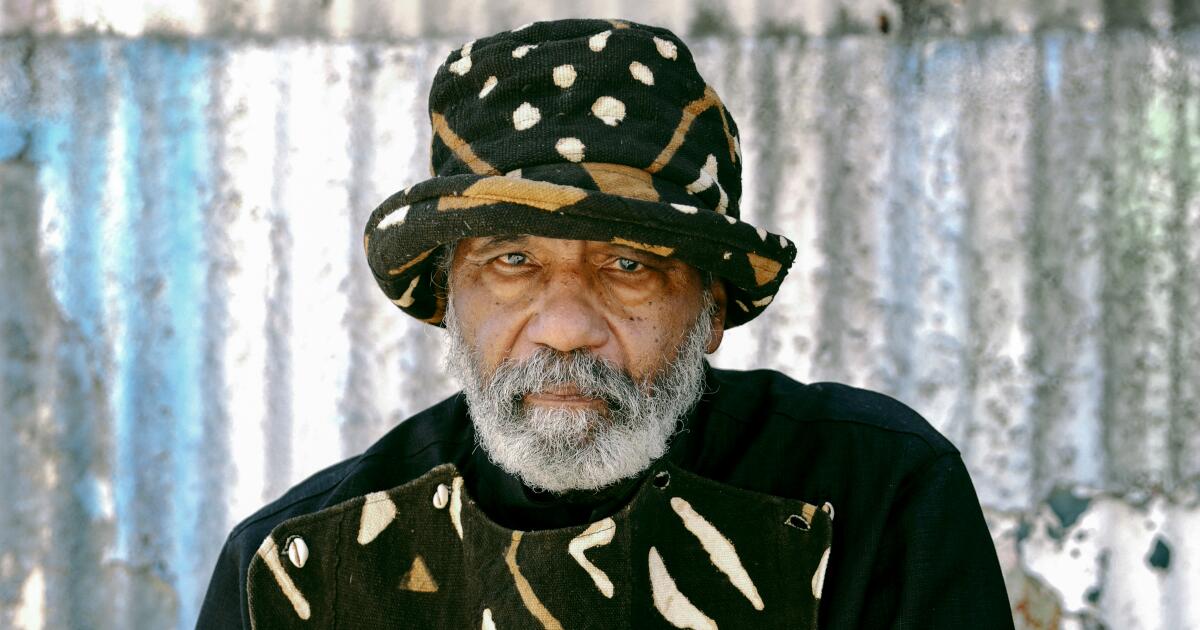
Ulysses Jenkins, the pioneering Los Angeles-born video artist whose avant-garde compositions embodied Black experimentalism, has died. He was 79.
Jenkins’ death was confirmed by his alma mater Otis College, where he studied under renowned painter and printmaker Charles White in the late 1970s and returned as an instructor years later. The Los Angeles art and design school shared a statement from the Charles White Archive, which said, “Jenkins had a profound impact on contemporary art and media practices.”
“A trailblazing figure in Black experimental video, he was widely recognized for works that used image, sound, and cultural iconography to examine representation, race, gender, ritual, history, and power,” the statement said.
A self-proclaimed “griot,” Jenkins throughout his decades-spanning career maintained an art practice grounded in the tradition of those West African oral historians who came before him. Through archival documentaries like “The Nomadics” and surrealist murals like “1848: Bandaide,” he leveraged alternative media to challenge Eurocentric representations of Black Americans in popular culture.
He was both an artist and a storyteller who sought to “reassert the history and the culture,” he told The Times in 2022. That year, the Hammer Museum presented Jenkins’ first major retrospective, “Ulysses Jenkins: Without Your Interpretation.”
“Early video art was about the problems with the media that we are still having today: the notions of truth,” Jenkins said. “To that extent, early video art was a construct that was anti-media … a critical analysis of the media that we were viewing every night.”
Born in 1946 to Los Angeles transplants from the South, Jenkins was ambivalent about the city, which offered his parents some refuge from the blatant systemic racism they encountered in their hometowns, but housed an entertainment industry that had long perpetuated anti-Black sentiment.
“What Hollywood represents, especially in my work, is the classic plantation mentality,” Jenkins told The Times in 1986. “Although people aren’t necessarily enslaved by it, people enslave themselves to it because they’re told how fantastic it is to help manifest these illusions for a corporate sponsor.”
Jenkins, who participated in a group of artists committed to spontaneous action called Studio Z, was naturally drawn to video art over Hollywood filmmaking. “I can address any issue and I don’t have to wait for [the studios’] big OK. I thought this was a land of freedom, and video allows me that freedom and opportunity that I can create for myself and at least feel that part of being an American,” he said.
Jenkins went on to deconstruct Hollywood’s vision of the Black diaspora in experimental video compositions including “Mass of Images,” which incorporates clips from D.W. Griffith’s notoriously racist “The Birth of a Nation,” and “Two-Tone Transfer,” which depicts, in Jenkins’ words, a “dreamscape in which the dreamer awakens to a visitation of three minstrels who tell the story of the development of African American stereotypes in the American entertainment industry.”
Jenkins’ legacy is not only artistic but institutional, with the luminary having held teaching appointments at UCSD and UCI, where he co-founded the digital filmmaking minor with fellow Southern California-based artists Bruce Yonemoto and Bryan Jackson.
As artist and educator Suzanne Lacy penned in her social media tribute to Jenkins, which showed him speaking to students at REDCAT in L.A., “he has been an important part of our histories here in Southern California as video and performance artists evolved their practices.”

4/5 stars
Bounding into cinemas just in time for spring, the latest Pixar animation is a pleasingly charming tale of man vs nature, with a bit of crazy robot tech thrown in.
The star of Hoppers is Mabel Tanaka (voiced by Piper Curda), a young animal-lover leading a one-girl protest over a freeway being built through the tranquil countryside near her hometown of Beaverton.
Because the freeway is the pet project of the town’s popular mayor, Jerry (Jon Hamm), who is vying for re-election, Mabel’s protests fall on deaf ears.
Everything changes when she stumbles upon top-secret research by her biology professor, Dr Sam Fairfax (Kathy Najimy), that allows for the human consciousness to be linked to robotic animals. This lets users get up close and personal with other species.

No. 2 Arizona tops Iowa State to win outright Big 12 title

Arkansas Library Board approves funding for public libraries after initially declining to do so | Arkansas Democrat Gazette

Supreme Court blocks California law limiting schools from telling parents about trans students

Weiss keeps focus on job as Colorado AHL assistant, not historic promotion | NHL.com

The Great Westport Sandwich Contest kicks off with event at Old Mill Grocery

Florida High School Football Rankings: Top 25 teams – Oct. 21

Cleary's 21 help Le Moyne down Central Connecticut State 69-64 in OT

How old is Bo Nix? What to know about Oregon quarterback ahead of 2024 NFL Draft

99th annual Pony Swim held in Virginia

Indiana Members Credit Union announced as new anchor tenant at Bottleworks District

Trump sends official notification to Congress on strikes against Iran

Unexpected birth brings hope to near-extinct Amazon tribe

Supreme Court blocks redrawing of New York congressional map, dealing a win for GOP

Map: Earthquake Shakes Central California

Gas prices could jump as Middle East tensions threaten global oil supply
-

 World5 days ago
Exclusive: DeepSeek withholds latest AI model from US chipmakers including Nvidia, sources say
-

 Massachusetts6 days ago
Mother and daughter injured in Taunton house explosion
-

 Denver, CO5 days ago
10 acres charred, 5 injured in Thornton grass fire, evacuation orders lifted
-

 Louisiana1 week ago
Wildfire near Gum Swamp Road in Livingston Parish now under control; more than 200 acres burned
-

 Technology1 week ago
YouTube TV billing scam emails are hitting inboxes
-

 Politics1 week ago
OpenAI didn’t contact police despite employees flagging mass shooter’s concerning chatbot interactions: REPORT
-

 Technology1 week ago
Stellantis is in a crisis of its own making
-

 Oregon4 days ago
2026 OSAA Oregon Wrestling State Championship Results And Brackets – FloWrestling