Entertainment
A fool’s journey: Notes from a clowning workshop


We all have an inner clown, a wild self whose yearning for delight is greater than the fear of failure. A little one who wants to play during nap time, convenience to others be damned. Underneath layers and layers of socialization, we each have a clown willing to risk heartbreak for joy. Or at least that’s the idea.
Clowning, an ancient art form that includes but is not limited to the red wigs and big shoes of the circus, is difficult to define. Filed under “physical comedy,” a clown communicates primarily through their body rather than words.
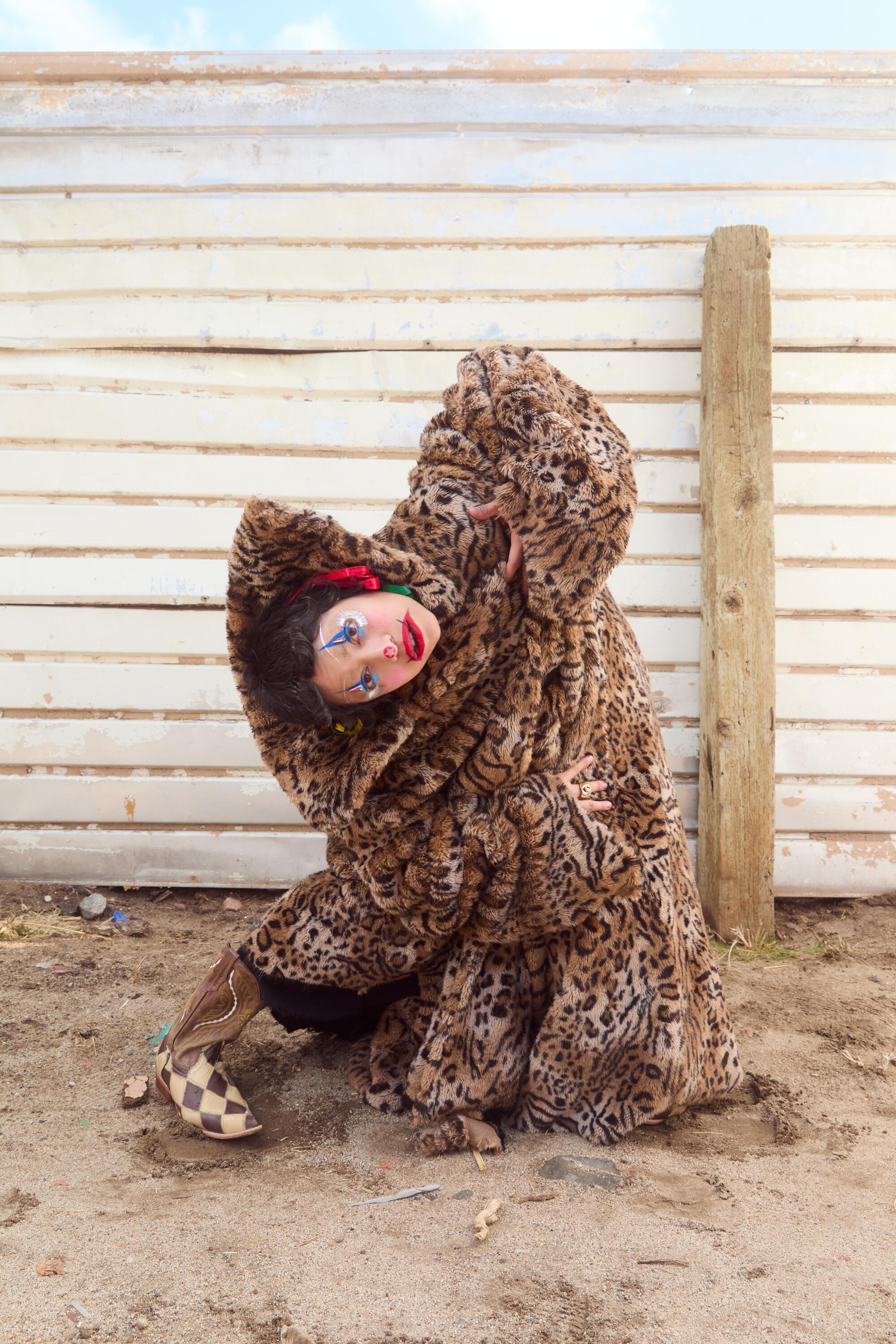
Yulissa wears Balenciaga jacket and skirt, talent’s own shoes.
All I’m sure of is that without an audience — to play with, to laugh or not laugh, and hopefully cry and transform — there is no clown. I’ll admit: When I started, I wanted the benefits of clowning, namely feeling comfortable and even coming to enjoy reading my work in public, without any of the scary bits (and clowns in America have quite a scary reputation). I had asked my first clown teacher for private (read: audience-free) lessons. She chuckled over the phone: “It doesn’t work that way.” Thus began my fool’s journey, if you will, from scared and lost to scared and lost with a dash more openness to being vulnerable.

I was glad I was wearing sneakers because I ended up running from the subway station to the midtown Manhattan building. I arrived at Room 315 on time and out of breath. It was a Saturday, and I was there for a two-day workshop, from noon to 5 p.m., with an hour break for lunch, with Christopher Bayes. His credentials, in a field where it feels funny to have them, include studying under clown masters Philippe Gaulier and Jacques Lecoq and working as the head of physical acting at Yale’s David Geffen School of Drama. While this all sounds technique-heavy, Bayes is known for valuing a heart-forward approach over an intellectual one. This was an honor for which I somehow justified paying $300.


We began with introductions — names, pronouns, why we were there. “I’m a writer,” I said, picking one job, out of the three I had, most suited to the moment. “And I’m writing a piece on clowning.” I scanned the room and my eyes landed on A, whom I recognized from another workshop. Our faces lighted up. We smiled — and clowns must smile only when they’re actually happy since, as I learned in workshop, a smile is a mask — and waved to each other. When it was A’s turn, they explained that whatever they were seeking from psychoanalysis, they were finding in clowning.
In this group of about 25 people, there was also a theater director who flew all the way to New York from San Francisco to take this workshop. There were a lot of people who loved theater and hoped a more honest connection with audiences would bring them back.
Next were the warm-up exercises. We started shaking our bodies, and I made another mental note: Actors and musicians all did warm-up exercises. What was the equivalent for writers? My thought was interrupted when Bayes instructed us to laugh very hard. It had been a confusing week, a mix of macro tragedy and micro wins. I cracked up, and it felt like sobbing. The group entered a frenzied state. I acclimated to the cacophony of primal sounds. We sounded like the animals we tend to forget we are.
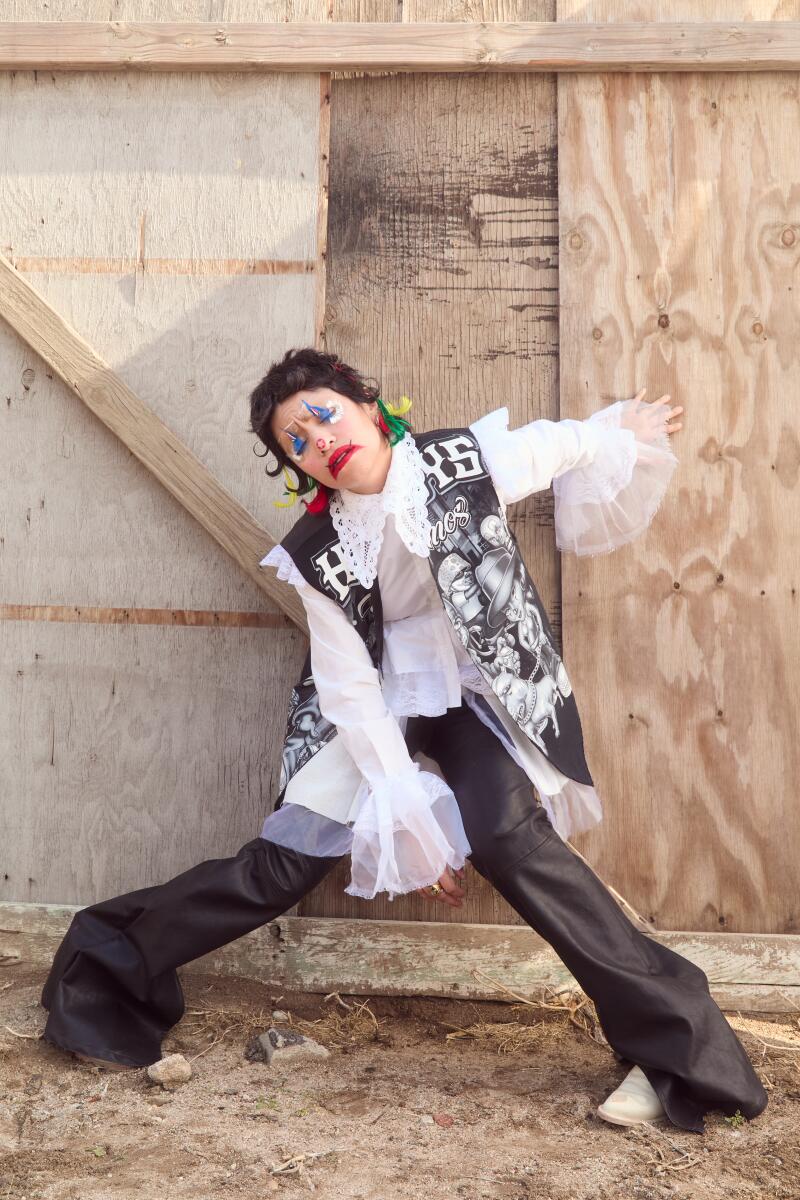

Yulissa wears Rio shirt and vest, Elena Velez pants, Pskaufman… shoes.
“Now cry!” Bayes shouted. I wailed and made my ugliest face. I was screaming so loud my voice cracked and I had to cough to clear it. I said, “Why, oh why?” I slapped my hands down on my quads. I headed toward the floor. I curled into a ball and cried with my face hovering an inch above the wooden floor. I heard a voice from above: “Don’t hide your sadness.” I stood up awkwardly having just been reprimanded for crying the polite way. I needed to cry the clown way, that is, take up space. I balled my hands into fists and stretched my arms out and up. I turned my face toward the ceiling and blamed it for all that was wrong with the world. Sobbing from the belly and feeling like some sort of tragic figure, I doubled over in laughter and now I couldn’t tell the difference between the two.
Afterward, we separated into groups of four. We were given 10 minutes to devise a song, along with a dance. My group chose the chorus “I love it.” We all had solos when we sang about something we genuinely loved. I sang about my apartment, how I loved it. I got the instructions mixed up and tried to rhyme but learned I wasn’t supposed to, so I sang, “Ohhhhhh, that’s easieeeeerrrr.” My solo came to a dark end: I loved my apartment, but I couldn’t afford it on my own, without roommates, and even if I could, it would be selfish to live there alone because of the city’s housing crisis. I sang about how the rental vacancy rate was 1.4% and that 5% was considered an emergency. There was nowhere else to go, so I sang to the audience to think about that. Some of the faces in the audience looked scared. My group sang, all together, “I love it, I love this love, I love love love love, yeah I like it!” We broke for lunch, and someone added me to the “Clown NYC” WhatsApp group. It has 712 members, and there are multiple threads, including “Shows & Mics,” “Meetup & Hangouts,” “Prop/Costume Exchange” — and “Housing.”
When I saw my first clown show, Julia Masli’s “Ha Ha Ha Ha Ha Ha Ha,” my first words might have been, “What the f—?” Masli emerged on a blueish dark stage amid the haze of fog. I recall a Medusa-like nest of wires around her head with a light illuminating her face. A gold mannequin’s leg with an attached microphone substituted as Masli’s left arm. She was bundled in a witchy outfit resembling a duvet cover. Masli looked extraterrestrial, complete with the wide, innocent stare of a being looking upon our society and its problems from a fresh perspective.

As a clown, it’s ideal if you wear something so stupid, people laugh just glancing at you. A performer’s costume signals to the audience that they’re in a space operating outside of societal norms, a place of amplification. While a clown’s “look” can be idiosyncratic and interesting, what starts off as funny and absurd gives way to the profound. In this way, clowning appears light and gets deep. With the support of aesthetics, a clown communicates, “Isn’t being human with all of its striving for status and repression in order to fit in kind of ridiculous?”
In “Nothing Doing,” a work-in-progress, clown Alex Tatarsky announced at the top that they didn’t believe in work or progress. They entered the stage in a top hat, white sequined leotard, rhinestone heels, sporting a long, thick braid attached to their hair. When they turned around for the first time, I was treated to a grotesque mask at the back of Tatarsky’s head and prosthetic cleavage that might have also been the plastic molding of butt cheeks. By the close of their show, after having mimed chasing after the performance’s nonexistent plot, Tatarsky sat at the head of a table, facing the audience, eating Life cereal with milk, with their hands, out of an empty skull, and at one point chewed and swallowed a cigarette. They said something like, “Darling, I just want you to love me, but it’s repulsive when I’m this desperate.” This desperation, rather than repelling me, became a source of connection. I found myself falling in love with this clown and, in turn, with the parts of myself I tend to reject.
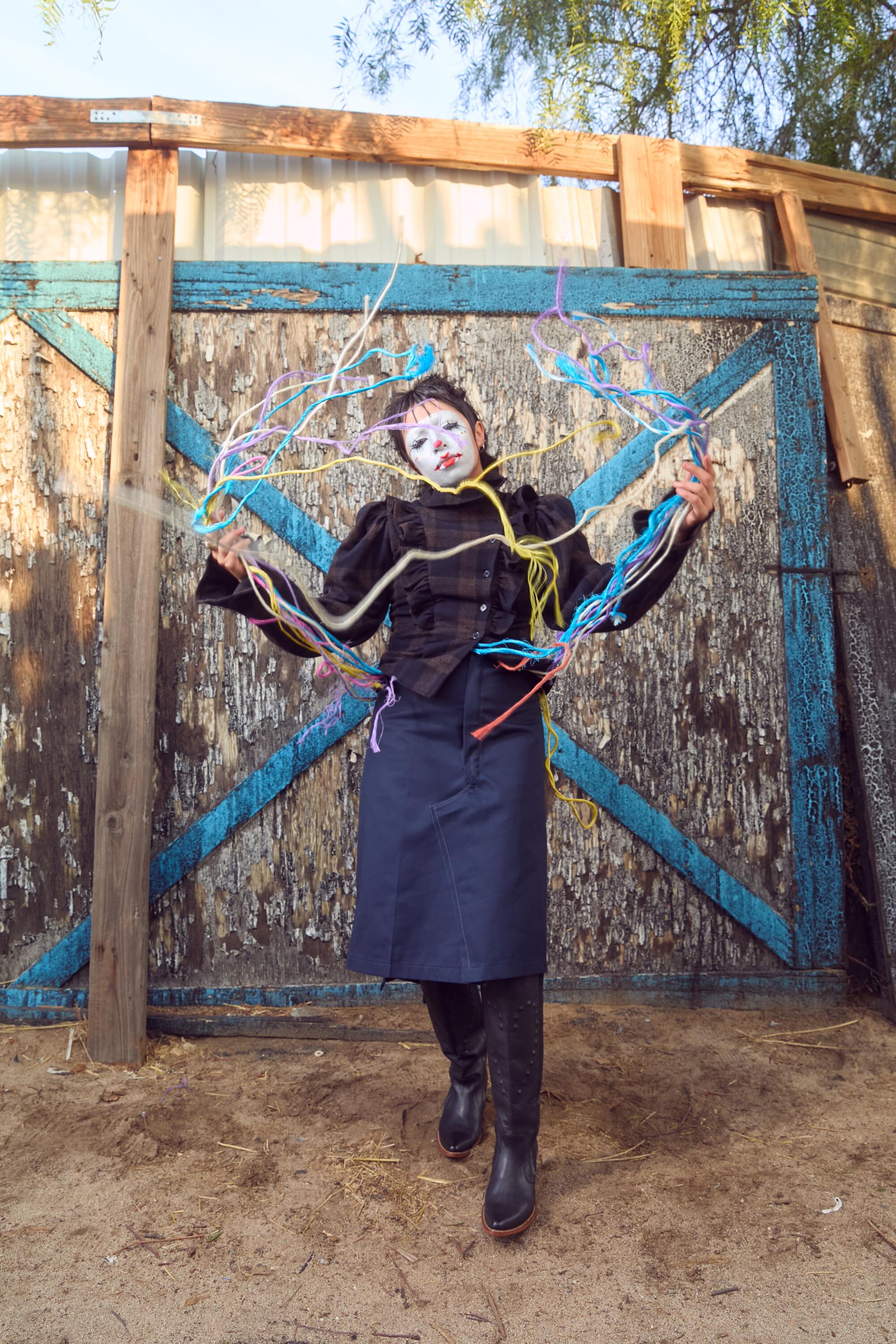
Yulissa wears Willy Chavarria shirt, Rio skirt, Pskaufman… shoes.
In the environment of a clown workshop, practicing loss of control (a clown can’t plan for an audience’s response) and being present with what is (a clown works with whatever they’ve got) can feel good. One eases off expecting specific results and being disappointed when things don’t turn out according to a rigid vision of success and delights in surprises no one could have imagined. If clowning is on the rise, and it certainly feels that way, it might be because it provides relief from having to keep it together.
On the second day of the workshop, we tried a different exercise. Two conventionally attractive men were onstage, and I was prepared to hate them both. Why? Because conventionally attractive men send me hurtling back in time to when I was an awkward preteen, and I’ve since developed an aversion. Bayes instructed them to get to know each other. They looked uncomfortable. One extended a handshake to the other. The crowd booed at the predictably masculine, business-like gesture. Then, Bayes told them to turn away from each other and walk to opposite ends of the room. One faced stage left, the other stage right.

They had to jump around to face each other and land at the exact same time. They kept failing. “Oh, come on,” I jeered. Ten minutes passed. The audience was exasperated. An eternity passed. One would turn around while the other didn’t move. Was I cursing them somehow? One wore a crisp white T-shirt that looked expensive with black wide-leg trousers. He had shoulder-length hair parted down the middle, like a model. The other, a white T-shirt that looked worn-in, black joggers and a delicate hoop earring. Both were barefoot. They kept missing even though they could technically cheat and set a pattern for the other to follow. It was agony. Bayes, who was sitting next to me, drew my attention to the man on the right. He was twitching. His eyebrows, his legs. The impulses were all confused. I laughed. I thanked the heavens that my performance of the same exercise didn’t go this badly.
Bayes told them, “You’re not getting it because you haven’t tucked in your shirts and raised your pants all the way up.” The two clowns followed the instructions. Now, they looked more ridiculous and endearing. We waited. We breathed. Finally. They jumped. They landed at the exact same time. People erupted in applause. A great tension was released. I rose from my seat along with others for a standing ovation. No matter how hopeless it seems, a clown can always win back the audience.

Yulissa wears Elena Velez shirt, pants, and hat, Pskaufman… shoes.
Now, the two men were facing each other. There were more boos. They lost us because they were “trying” again. I joined in, feeling like I was at a wrestling match where I wanted neither party to win. Now they were holding hands and squatting up and down vigorously. “Say, ‘Oh, yeah,’ ” shouted Bayes. They complied in unison. “Now say, ‘Oh, daddy,’ ” Bayes shouted. Again, the two complied, but they missed a beat and now they were saying “Daddy, O” in a guttural way as they continued holding hands and squatting up and down. I was laughing hard and clapping my hands. I was full of glee. In less than 30 minutes, I’d seen myself mirrored and altered. I could be someone who was afraid of being in front of others. Cocooned in the safety of a crowd, I could be cruel. I could be extravagantly generous. The clown wanted my love regardless. The clown was there to hold it all. I learned things that words fail to capture.
You had to be there. And that’s what I love most about clowning — it brings you into the now. Everything else fades away. It’s no longer about the shape something takes but about the attempt. No one is ever done as a clown.
Later that week, I found myself singing a stupid-sweet song from the workshop called “Open Like a Little Flower.” The next line was “Open like a different type of flower.” I remembered Bayes saying that when you go looking for beauty, you find it. I remembered too my pounding heart. Breathing hard from physical exertion. Buzzing with the high of a collective response, with the feeling of wholeness.

Priscilla Posada is a writer living in New York City. Her work can be found in the Los Angeles Review of Books, BOMB and the Brooklyn Rail, among other places.
Photography & Talent Yulissa Mendoza
Styling Erik Ziemba
Hair & Makeup Jaime Diaz
Art Direction Jessica de Jesus
Production Alexis de la Rocha
Photography assistant Lily Soleil Lewites
Styling assistant Nathan Alford
Content assistant Perry Picasshoe
Special thanks Ricardo Mendoza



Movie Reviews
Movie Review: In ‘Midwinter Break,’ a quiet marriage story with Lesley Manville and Ciarán Hinds

Stella and Gerry might not have a bad marriage, but they don’t have especially healthy one either. In the new film “Midwinter Break,” out Friday, these two Irish empty nesters beautifully portrayed by Lesley Manville and Ciarán Hinds have become the embodiment of the words “alone together” in their late 60s and early 70s. She goes to church. He reads, and drinks, and passes out on the recliner. Repeat. But one Christmas Eve, Stella decides to break the monotony: She books a trip for two to Amsterdam, departing as soon as possible. Gerry beams that it’s a fantastic idea and off they go to try to get out of their routine and maybe remember why they made this lifelong commitment in the first place.
An adaptation of a Bernard MacLaverty novel of the same name, “Midwinter Break” is a delicate film that stays in a minor key, but whose impact is profound if you can get on its level. Directed by theater veteran Polly Findlay making her feature debut, the film parachutes the audience into the current state of this relationship, in all its quietly contradictory beauty.
These are two people who have walked through most of their adult lives together, raising a child, living a self-imposed exile in Glasgow and now sort of watching the clock tick down on their lives. The film teases that something violent and traumatic happened many years ago in Belfast, but that they don’t talk about that, or the Troubles, at all.
We gather that nothing quite so dramatic has happened since, but you can see the distress in Stella’s face as she sits down for the nth time to remove the plastic wrap to eat some sandwiches she prepared while Gerry sleeps. It seems both then and now, they’ve opted for a change of location instead of a serious chat about things. But there’s nothing like a new location to bring all that buried discontent to the surface.
One of the loveliest things about “Midwinter Break” is how it lets Stella and Gerry be all things at once. In some moments, they’re loving and intimate, sharing a sweet before their flight takes off, laughing in the red-light district and resting their tired feet in their nice hotel room. Other times, they seem like strangers. Stella has only grown more devout as they’ve gotten older, while Gerry can’t be bothered to even accompany her to church. Later in the film, they’ll both explain why, though not to each other.
Amsterdam in winter is expectedly picturesque, and the film makes sure to have Stella and Gerry out in the fresh air as much as possible visiting real sites around town (though the interiors of the Anne Frank House were a recreation). It’s tempting to draw comparisons to the “Before” series, but Jesse and Celine are a little chattier than these two.
This is a relationship that’s all about the small moments and what’s left unsaid, which is tricky to compellingly execute on film. There aren’t big fights or particularly mean words said: And yet when Stella, nearly shaking with nerves, quietly proposes a possible change to their lives, it feels earth shattering. You’re relieved later when she wants to go out and have some fun; Gerry is too.
This image released by Focus Features shows Ciarán Hinds, right, and Lesley Manville in a scene from “Midwinter Break.” Credit: AP/Mark de Blok
These may just be the ordinary, dull rhythms of a relatively stable relationship, and yet these actors make the mundane so much more. It was a brilliant stroke to let “Midwinter Break,” which could have been deadly in the transition from the page to the screen, rest on these two actors in particular, sharing the big screen for the first time. Our investment in Stella and Gerry raises real questions about long-term commitment, assumptions of stability and the possibility of change. It might also have you planning your own Amsterdam getaway in your head, hopefully with fewer weighted silences on the schedule.
“Midwinter Break,” a Focus Features release in theaters Friday, is rated PG-13 by the Motion Picture Association for “some strong language, bloody images, alcoholism, suggestive material and thematic material.” Running time: 90 minutes. Three stars out of four.

UCLA has canceled an upcoming lecture featuring CBS News editor-in-chief Bari Weiss.
Weiss was scheduled to give the annual Daniel Pearl Memorial lecture on Feb. 27, about “The Future of Journalism.” But according to the university, the program will not move forward as scheduled, after Weiss’ team withdrew from the event.
A source familiar with the UCLA program said the lecture was canceled due to security concerns from Weiss, despite the public university offering to obtain additional security for the event, the source said. The Daniel Pearl Memorial lecture series honors the late journalist and is considered the capstone of the university’s Burkle Center for International Relations. Previous speakers include journalists Jake Tapper, Anderson Cooper and Bob Woodward.
According to the source, several employees at both the Burkle Center and the International Institute expressed opposition to Weiss speaking on campus. The university was also expecting a large number of students to protest the event.
Neither Weiss nor CBS immediately responded to a request for comment.
Weiss founded the media company, The Free Press, which was purchased in October by Paramount, CBS’ parent company. Following the $150 million purchase, Weiss was installed as editor-in-chief of CBS News.
Two months after taking on the new role, Weiss made the widely panned decision to pull a “60 Minutes” episode that examined the alleged abuse of deportees sent from the U.S. to an El Salvador prison. The decision earned Weiss heavy criticism and accusations that the move was politically motivated.
The canceled UCLA lecture comes at a time of ongoing organizational upheaval at CBS, which this week made headlines amid an escalating battle with its own late-night talk host, Stephen Colbert, over the FCC’s effort to enact stricter enforcement of the equal-time rule.

NEW YORK (OSV News) – “I need a Xanax!” declares a victim-in-waiting in the bloodsoaked slasher flick “The Strangers – Chapter 3” (Lionsgate). Moviegoers unwise enough to patronize the film may end up echoing that sentiment.
By turns sadistic and stupid, this wrap-up concludes the story of Maya (Madelaine Petsch), the protagonist of the series, and the masked killers who have been chasing her since the 2024 reboot of a horror franchise that dates back to 2008. Although her face may not be hidden, Maya’s identity is as sketchily established as those of her seemingly motiveless stalkers.
Having slain one of her pursuers at the end of the last installment, Maya is eventually recruited by the group’s leader as a potential replacement for her would-be murderer. The notion underlying this plot development seems to be that anyone is capable of becoming a dab hand at disemboweling. Call it the Bob Ross approach to grisly slaughter.
Toward the beginning of the movie, a church with a scary crucifix is used as a neutral setting, a sort of sanctuary, and there are vague ruminations on religion. These are too inconsequential, however, to do more than irk Christian believers.
At the other end of the running time, the returning filmmakers — director Renny Harlin and screenwriters Alan R. Cohen and Alan Freedland — dabble in ridiculously unrealistic psychology amid the predation.
They somehow end up mixing absurdly ill-motivated momentary eroticism with the ongoing mayhem, all to the tune of the Moody Blues’ classic song “Nights in White Satin.” Rest assured, your eyes won’t be missing any beauty at all if you prudently choose to steer clear of this senseless dud.
The film contains excessive gory violence, at least one mild oath and several rough terms. The OSV News classification is O — morally offensive. The Motion Picture Association rating is R — restricted. Under 17 requires accompanying parent or adult guardian.
Read More Movie & TV Reviews
Copyright © 2026 OSV News

Cause of explosion at Ypsilanti Township facility remains unknown

What Gonzaga coach Mark Few said after dominant win over San Francisco

Teenage boy is hospitalized after a drive-by shooting in southwest Miami-Dade, the sheriff’s office says

Organizers reverse route of South Boston St. Patrick’s Day Parade

Denver area events for Feb. 19

Florida High School Football Rankings: Top 25 teams – Oct. 21

Cleary's 21 help Le Moyne down Central Connecticut State 69-64 in OT

How old is Bo Nix? What to know about Oregon quarterback ahead of 2024 NFL Draft

99th annual Pony Swim held in Virginia

Indiana Members Credit Union announced as new anchor tenant at Bottleworks District

Democrats risk FEMA disaster funding collapse as DHS shutdown hits Day 5

Fact check: Will Spain’s regularised migrants be allowed to vote?

Zuckerberg grilled about Meta’s strategy to target ‘teens’ and ‘tweens’

What Trump’s Latest East Wing Designs Show

Immigration judge blocks deportation of Columbia anti-Israel agitator
-

 Illinois1 week ago
2026 IHSA Illinois Wrestling State Finals Schedule And Brackets – FloWrestling
-

 Culture1 week ago
Try This Quiz on Passionate Lines From Popular Literature
-

 Science1 week ago
Video: Why Mountain Lions in California Are Threatened
-

 Oklahoma1 day ago
Wildfires rage in Oklahoma as thousands urged to evacuate a small city
-

 Health1 week ago
James Van Der Beek shared colorectal cancer warning sign months before his death
-
![“Redux Redux”: A Mind-Blowing Multiverse Movie That Will Make You Believe in Cinema Again [Review]](https://i1.wp.com/www.thathashtagshow.com/wp-content/uploads/2026/02/Redux-Redux-Review.png?w=400&resize=400,240&ssl=1 "“Redux Redux”: A Mind-Blowing Multiverse Movie That Will Make You Believe in Cinema Again [Review]")
![“Redux Redux”: A Mind-Blowing Multiverse Movie That Will Make You Believe in Cinema Again [Review]](https://i1.wp.com/www.thathashtagshow.com/wp-content/uploads/2026/02/Redux-Redux-Review.png?w=80&resize=80,80&ssl=1 "“Redux Redux”: A Mind-Blowing Multiverse Movie That Will Make You Believe in Cinema Again [Review]") Movie Reviews1 week ago
Movie Reviews1 week ago“Redux Redux”: A Mind-Blowing Multiverse Movie That Will Make You Believe in Cinema Again [Review]
-

 Technology7 days ago
HP ZBook Ultra G1a review: a business-class workstation that’s got game
-
 Politics6 days ago
Culver City, a crime haven? Bondi’s jab falls flat with locals