Culture
Sinner parts company with fitness coach, physiotherapist after doping ruling


Three days after the International Tennis Integrity Agency (ITIA) announced that world No. 1 Jannik Sinner had tested positive for a performance-enhancing drug, the Italian confirmed that he had parted ways with the two men at the heart of the doping case that rocked the tennis world this week. In a press conference Friday, he said he was relieved the news was out after months of investigation.
In his first public comments, Sinner said he had taken solace in knowing that he had never intentionally done anything wrong, but needed to break from the trainer and physiotherapist responsible for allowing the prohibited substance to enter his system.
“Because of these mistakes, I’m not feeling that confident to continue with them,” Sinner said of Umberto Ferrara, his fitness coach, and Giacomo Naldi, his physiotherapist, during a news conference ahead of the U.S. Open. “I was struggling a lot in the last months. Now I was waiting for the result, and now I just need some clean air.”
Ferrara and Naldi had been part of the close-knit crew that has helped Sinner, the 22-year-old Italian reach the pinnacle of the sport.
“We have decided to part ways and are not working together anymore,” Sinner’s spokesperson stated on behalf of the team. “We wish them the best of luck.”
Naldi had not accompanied Sinner to any events since Halle, a June grass-court tournament in Germany that serves as a tuneup for Wimbledon. Ferrara had not been with Sinner since Wimbledon, which ended in mid-July.
During all those months, Sinner has been balancing the stress of trying to clear his name through the arduous anti-doping litigation process with being the world’s top-ranked tennis player and trying to win actual tournaments.

Sinner first tested positive during Indian Wells, where he lost in the semifinals to Carlos Alcaraz (George Walker/Icon Sportswire via Getty Images)
“It was a long process,” Sinner said. “I was always concerned that it might come out at some point. In the beginning it was a different view, but then after, you know, it was a little bit more complicated. I went through, me and my team and the lawyers, I’m just a simple tennis player.”
Since testing positive for clostebol, a banned anabolic steroid in March, Sinner has learned that being a top tennis player can be anything but simple.
He received a provisional suspension for each failed test, the first on March 10, during the BNP Paribas Open in Indian Wells, California, and the second on March 18 in an out-of-competition test.
An independent tribunal convened by the International Tennis Integrity Agency (ITIA) accepted Sinner’s explanation that his two adverse analytical findings (AAF) for clostebol were caused by the actions of Naldi and Ferrara. It found “no fault or negligence” on Sinner’s behalf, but stripped the Italian of his ranking points, prize money, and results from California. Two independent review boards, also convened by the ITIA, reached the same conclusion after Sinner appealed against the two provisional suspensions that are mandatory in the case of an AAF.

GO DEEPER
What players’ reaction to Sinner’s doping case says about their trust in their sport
The review boards upheld those appeals, which meant that Sinner could continue to play while under investigation. It also meant that those provisional suspensions remained undisclosed to the public.
According to the full decision of the tribunal, released by the ITIA on Tuesday after a hearing on August 15, Ferrara purchased a product called Trofodermin in Italy in February. This is a spray that is used to heal cuts, and it is available over-the-counter in Italy. Clostebol is one of the ingredients.
Naldi then cut himself using a scalpel that he used to treat callouses on Sinner’s feet at the tournament, before using that spray to help heal the cut. He subsequently gave Sinner a massage on his back and applied treatments to his feet. Sinner suffers from a skin condition that causes itching, and when he scratches himself he causes small cuts.
Clostebol is an old steroid that was once at the center of the notorious East German doping scandals of the 1970s and 1980s. It can help build muscle mass and expedite recovery from intense workouts. Its presence in those healing creams available in Italy and other countries has been well-known to those who stay up to date with anti-doping information for several years, especially among Italian sports figures who have tested positive for it for similar reasons.
Sinner said Ferrara has long approached his job with a great deal of care, especially when it comes to nutrition and medication.
When the ITIA informed him of the positive test, he went immediately to Ferrara and he was certain his spray had caused it.
He said they went right back to the ITIA with the explanation, which led to him being allowed to keep playing.
“We had to figure out what would happen then in the future,” he said. “They believed in me and in us, and that’s why I could have played.”
That was a relief, he said, especially because he knew he hadn’t done anything wrong.
“I knew that I was very clean, and I knew that I was always very looking forward to be a fair player,” he said, though he knows that the positive tests will inevitably cause a hit to his reputation; a hit that he will carry it through this tournament and perhaps beyond.
“It might change a couple of things, but whoever knows me very well knows that I haven’t done and I would never do something what goes against the rules,” he said. “Obviously it has been a very tough moment for me and my team. It still is, because it’s quite fresh.”
(Andy Cheung/Getty Images)



Where do you turn when you need advice? A chatbot? A life coach? A wise and trusted friend?
How about a poet? Poets may not be famous for making the best life choices, but because they subject the mess of human existence to the discipline of language, they can be as helpful as any therapist or mentor.
Good poets know the rules and when to break them, which is something they can teach the rest of us.
To wit:
Giving advice is a peculiar literary undertaking. It flourishes in certain popular genres — graduation speeches, newspaper columns, country and western songs and poems like this one — but what, in these contexts, is it really for?
I’m thinking of situations when you don’t urgently need help but nonetheless enjoy reading answers to questions you may not have thought to ask. What interests you isn’t the content of the advice — you could get all the life hacks you want from A.I. — so much as the voice of the person dispensing it.
Wendy Cope is an English poet, born in 1945, who has been a fixture of her country’s literary scene since the 1980s. More recently, her short, buoyant poem “The Orange” has been widely memed online, bringing her to the attention of new readers beyond Britain.
Cope favors rhyme, meter, brisk jokes and tart aperçus. She addresses romance, friendship and the petty absurdities of modern life with disarming good humor. The last line of “The Orange” is “I love you. I’m glad I exist.” Somehow she makes it the opposite of cringe.
This isn’t the kind of poetry you would describe as “confessional.” And yet …
Question 1/7
Stop, if the car is going “clunk”
Or if the sun has made you blind.
Don’t answer e–mails when you’re drunk.
Tap a word above to fill in the highlighted blank.Want to learn this poem by heart? We’ll help.
Fill in the missing words below. You can always refer to the reading by A.O. Scott and full
text above.Let’s start with the first stanza.

A strong sense of place can deeply influence a story, and in some cases, the setting can even feel like a character itself. This week’s literary geography quiz highlights places where authors were born (or lived) that later became locations in their books. To play, just make your selection in the multiple-choice list and the correct answer will be revealed. At the end of the quiz, you’ll find links to the works if you’d like to do further reading.

AMERICA, U.S.A.: How Race Shadows the Nation’s Anniversaries, by Eddie S. Glaude Jr.
For those of us in the national memory-keeping business, anniversaries hold near-totemic power. Satisfyingly round units of time, ideally bearing fancy, Latin-derived names, serve as the overburdened pegs on which to hang think pieces and museum exhibits, revisionist documentaries and maudlin public ceremonies. The arbitrary nature of such occasions is precisely what gives them their charge, inviting us to set aside complacency and submit to a comprehensive check-in.
In his new book, “America, U.S.A.,” Eddie S. Glaude Jr. presents an intriguing variation on the genre, seeing the country’s 250th birthday as an anniversary of anniversaries: 50 years since the malaise-ridden, schlock-heavy Bicentennial. A century since the subdued Prohibition-era Sesquicentennial. A century and a half since telegraphed reports of George Armstrong Custer’s defeat by the Lakota and Cheyenne at Little Bighorn rudely interrupted the Gilded Age Republic’s 100th birthday party.
If an anniversary offers a snapshot of a moment, the core of Glaude’s book is an old-timey photo album, a collection of notable episodes from earlier national reckonings, long-ago glances in the mirror. An estimable scholar of Black history, politics and religion at Princeton — best known for “Begin Again,” his 2020 meditation on James Baldwin’s relevance for our times — Glaude focuses, as his subtitle puts it, on “how race shadows the nation’s anniversaries.”
Such celebrations, he contends, have never really been the moments for honest self-reflection they are often advertised to be. Instead, the nation usually shatters the mirror, refusing to accept what it prefers not to see. “American anniversaries are often moments to turn a blind eye to the evils of the past and the present,” Glaude writes, “to suppress the fact of America’s divided soul.”
It’s a clever concept, and, needless to say, perfectly timed. Last year, Glaude notes, the Trump administration executed a hostile takeover of the government’s studiously bipartisan 250th anniversary planning. It is now preparing a program that is certain to conceal more than it reveals about the country ostensibly being celebrated.
Glaude, in no mood for celebration, argues that such omissions and evasions also defined commemorations in the past. In 1875, Frederick Douglass predicted “one grand Centennial hosannah of peace and good will to all the white race of this country.” He was right: The nation reached 100 years old at a crucial moment in the post-Civil War fight over racial equality, with white Northerners ready to give up on Southern Reconstruction. The occasion would help the once-warring sections to reunite around a shared commitment to white supremacy. On May 10, 1876, at the opening of the Centennial Exposition in Philadelphia, the police tried to bar Douglass from the grandstand, until a white politician vouched for him.
The 150th anniversary came soon after a resurgent Ku Klux Klan successfully pushed for a restrictive immigration law aimed at keeping America a “Nordic” nation. At the lavishly funded, lightly attended celebrations in Philadelphia, Black veterans of World War I were excluded from marching in the opening parade. A writer with The Associated Negro Press wondered “what was in the breast of those black men who fought to make America safe for Democracy and on Monday stood on the sidelines, forgotten, as the Nordic strode by in all his vain pride.”
By 1976, when the nation marked its Bicentennial, the violence of the ’60s had destroyed any semblance of consensus. Vietnam and Watergate had eroded trust in the government. The commission initially tasked with organizing the anniversary was disbanded amid reports of corruption. Corporations filled the vacuum, Glaude explains, with “star-spangled whoopee cushions; patriotic toilet seats; Liberty hamburgers; red, white and blue beer cans.” The author, around 8 years old at the time, dimly remembers donning a pair of tricolor trousers.
A half-century later, Glaude is refreshingly honest about the depths of his despair. “I do not love America, and never have, especially now,” he writes in one of the more startling opening sentences I’ve read in some time. He dismisses this year’s Semiquincentennial as reaching back “to a storybook America that requires either the banishment of Black people from view or the reduction of our role in the country’s history, so as to affirm America’s ongoing quest to be a more perfect union.”
Undoubtedly true. But Trump doesn’t own the country, at least not yet, nor the 250th anniversary of one of the most radically liberatory and confusingly contradictory events in world history — an inspiration, as Glaude shows, even to critical observers of the American experiment, like Douglass. Far from the revanchist MAGA-palooza in Washington, I suspect this summer’s unasked-for invitation to national soul-searching may surprise us yet.
Despite his despair, Glaude concludes that “the past still offers resources for us to freedom-dream.” So, too, does this book.
AMERICA, U.S.A.: How Race Shadows the Nation’s Anniversaries | By Eddie S. Glaude Jr. | Crown | 270 pp. | $31
-

 Sports3 minutes ago
Former IndyCar driver Rick Treadway dies in motorcycle crash at 56
-

 Technology10 minutes ago
AI helped researchers bypass Apple M5 defenses
-
 Business13 minutes ago
AI company Anthropic files to list shares, heating up race with OpenAI
-
 Entertainment18 minutes ago
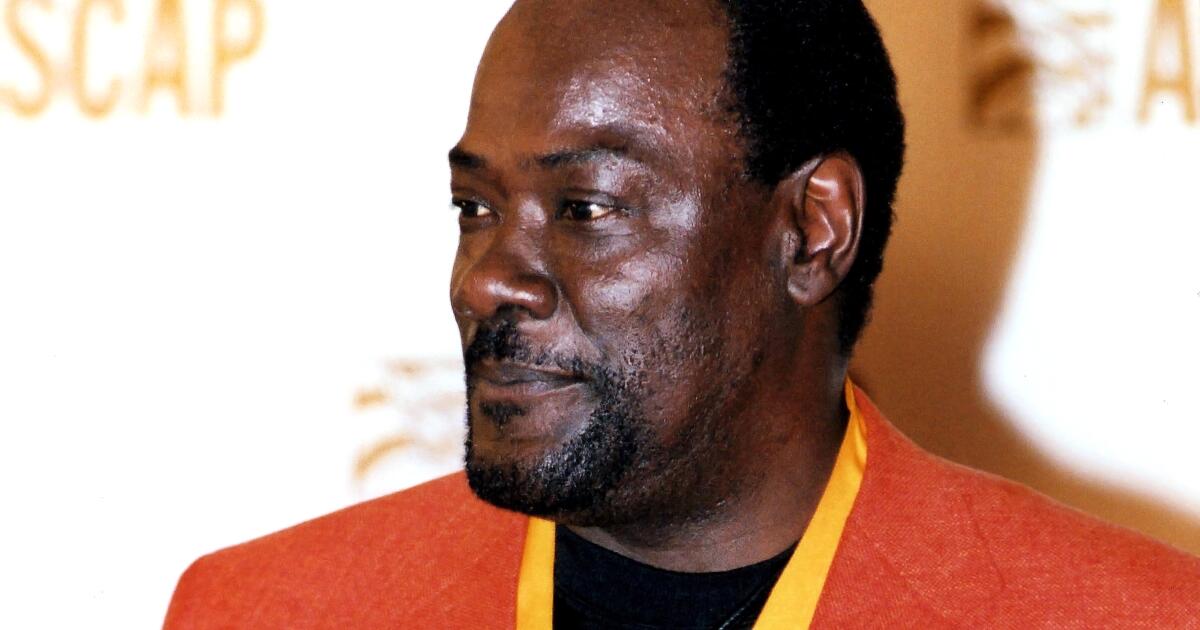
Ronald LaPread, Commodores’ co-founder and bassist, dies at 75
-
 Lifestyle25 minutes ago
Hoover Dam, challenged by drought, now wears a U.S. flag the size of a football field
-
 Politics28 minutes ago
’60 Minutes’ veteran Scott Pelley rips CBS News bosses, saying they are ‘murdering’ the program
-
 Sports40 minutes ago
Rams acquire Myles Garrett for Jared Verse and draft picks in blockbuster trade
-

 World48 minutes ago
EU approves strictest-ever migration law, including return hubs

