Business
Younger daters are tired of swiping. A host of new L.A. startups is vying for their attention


When Joseph Feminella matched with his would-be wife on Hinge in 2020, he was already growing tired of traditional dating apps. He told her he’d like to meet in person right away, and they met that night.
The pair were married three years later, and Feminella launched his dating app First Round’s on Me nationwide in August after a four-year incubation period. The app is designed to help people meet in real life and was inspired by his own experiences, Feminella said.
The El Segundo-based app skips the swiping and encourages users to schedule a time and place for a date. Any user can send a date invite to another user, and the chat opens only 24 hours before the planned meeting time.
Feminella’s venture is one of several in Los Angeles and beyond that are trying to challenge the traditional dating app format by introducing innovative ways to encourage in-person interactions. In an industry that relies on the steady demand for human connection, new players are emerging as younger daters are starting to use the major apps less.
Los Angeles has become a hotbed for dating app startups that hope to gain attention in a crowded market and take advantage of cracks beginning to form within the most popular apps.
Joseph Ferminella, founder of dating app First Round’s on Me, runs the El Segundo startup with his wife, Hannah, who he met on Hinge in 2020.
(Christina House / Los Angeles Times)
A select handful of apps including Tinder, Bumble and Hinge dominate the online dating market but have recently been struggling to grow, experts say (Match Group owns both Los Angeles-based Tinder and New York-based Hinge; Bumble is headquartered in Austin, Texas).
One reason: Gen Z uses online dating less than the broader population by about 11%, according to Match Group survey data from financial services firm Oppenheimer Holdings.
“The online dating industry is still making money, but from a growth perspective, they’re facing challenges right now,” said Andrew Marok, an industry analyst at Raymond James. “The customer base is changing and there are differences in the ways Gen Z and millennials want to meet people.”
Bumble, which once distinguished itself from other dating apps by requiring the woman to send the first message, has seen its shares plummet 55% so far this year after missing revenue expectations. Its share price closed Thursday at $6.57, up 1.08%.
Tinder — the dating app giant launched in 2012 — recorded the highest number of paying users in 2022, which peaked at 10.8 million after years of rapid growth. The number of paying users on the app dropped by 5% in 2023, and declined 8% in the second quarter from a year ago.
Match Group, which owns Match.com, reported a 5% drop in operating income in the second quarter to $205 million.
Still, Chief Executive Gary Swidler said in an earnings call this year he believes the company is on track to reach $1 billion a year in annual revenue.
A move away from the ‘swipe model’
When online dating got its start in the mid-’90s, the platforms were largely profile-based and matched users with shared interests and values. It was common for users to take a personality quiz or fill out a questionnaire in order to meet matches.
The release of Los Angeles-based Tinder introduced a swipe model in which users can decide if they “like” or “dislike” a potential date based on photos and a short bio. Other apps such as Grindr, which is headquartered in West Hollywood and caters to gay men, use a location-based model where users can browse potential dates in their area.
“You’re continuing to see some product evolution in the marketplace, but over the last few years the swipe-based model has been the one that’s attracted the lion’s share of attention,” Marok said. “We’re seeing that that doesn’t resonate quite as well with younger users.”
Gen Z daters prefer a slower, more intentional approach to finding a partner, Marok said, one based more on substance and less on split-second decisions. Younger daters are also more likely to turn friends into partners, he said.
“When you look at the swipe-based apps, their objective is to get a large volume of strangers in front of the user, which is kind of antithetical to how Gen Z wants to meet people,” Marok said.
Newer dating apps are trying to offer users a break from swipe fatigue and an abundance of startups in L.A. are embracing more advanced matchmaking services and group events for singles.
Feminella’s First Round’s on Me hosts group social events, such as a recent pickleball gathering in West Hollywood that attracted around 100 singles. The privately held app has garnered about 175,000 users and, like its competitors, has a freemium model in which customers can elect to pay for certain features.
Feminella, 34, hopes his app can offer users a different experience than what they’ve already found on the most popular cohort of dating apps.
“I saw that dating apps were becoming non-intentional and validation driven,” Feminella said. “I think they’re missing the point.”
Several other apps hold in-person events in Los Angeles, including London-based Feeld, which has been available in California since its inception in 2014.
“We strongly believe that people unlock people, not apps, so it was important to create another dimension in real life for our members to connect,” said Feeld Chief Executive Ana Kirova.
Summer, a dating app launched in 2022 by Marina del Rey-based tech company 9count, also aims to prioritize in-person meetups and is creating a members-only social club. When a user matches with someone on the app, they only have 25 messages to arrange a date before the conversation locks.
Based in Venice, Lox Club hosts regular events for its members such as weekly Shabbat dinners. The company recently released two more community-based dating apps: Jade Club for East Asian daters and Amara Club for South Asians. Lox Club is also getting ready to introduce a matchmaking service powered by artificial intelligence and human matchmakers, which has attracted a wait list of 10,000 people, according to Head of Marketing Samantha Ratiner.
“The consensus is that people are over using all these apps and doing all this swiping,” Ratiner said. “It’s so overwhelming and it can be a waste of time.”
Other tech-enabled matchmaking services that stray away from traditional dating app formats already exist in Los Angeles, like the self-described “modern matchmaking” company Three Day Rule.
There’s seemingly a dating app for everyone and every niche. The League is a platform for students and alumni of elite colleges to find each other; Kippo is a dating app for video gamers; the Fruitz app allows users to search for others seeking the same kind of relationship.
“There’s definitely room for apps that are focused on specific interest groups or specific demographics,” Marok said. “In the app-based dating market, the barriers to entry are relatively low but the barriers to scale are pretty high.”
Despite the plethora of smaller apps, the vast majority of the market remains dominated by Grindr, Bumble and Match Group, the three publicly traded dating app companies, said Oppenheimer & Co. analyst Jason Helfstein.
Tinder serves approximately 50 million monthly average users, a scale that no other app in the category has reached, according to a Match Group spokesperson. A 2023 poll conducted by OnePoll on behalf of Tinder showed that 55% of singles between the ages of 18 and 25 in the U.S., U.K., Australia and Canada have been in a serious relationship with a partner they met on Tinder.
Match Group is building its own assortment of community-based dating apps, making the space even more crowded for startups. Between 2020 and 2023, Match Group’s apps for gay men, single parents, Christians and the Black and Latino communities saw direct revenue grow at an annual compound rate of more than 70%, the spokesperson said.
Feminella said his company First Round’s on Me sees subscription and revenue growth month over month and has had success with in-person events. He did not disclose financial details, but said he knows he can’t realistically compete with apps such as Tinder and Hinge.

Tinder user, logo on a cellphone.
(Match Group / Tinder)
“For me to even get to that point, they would probably just buy me out,” Feminella said.
After a certain amount of growth, smaller dating app companies are likely to fizzle out or be sold to one of the major players, Helfstein said.
“For the private companies that focus on a small niche, it eventually gets too expensive to grow,” he said. “There will never be another publicly traded dating company.”
Helfstein described the dating app industry as profitable but somewhat stagnant — Match Group had 37% profit margins last year and is on track for 36% this year.
But Tinder downloads fell for the third year in a row this year and Bumble shares dropped 30% in August after missing Wall Street estimates. Artificial intelligence and other new technology could completely transform the industry and offer revitalization, Helfstein said.
“Maybe in five years from now, online dating will be reborn through virtual reality,” he said. “Right now it’s a healthy business, but what the market likes is growth.”

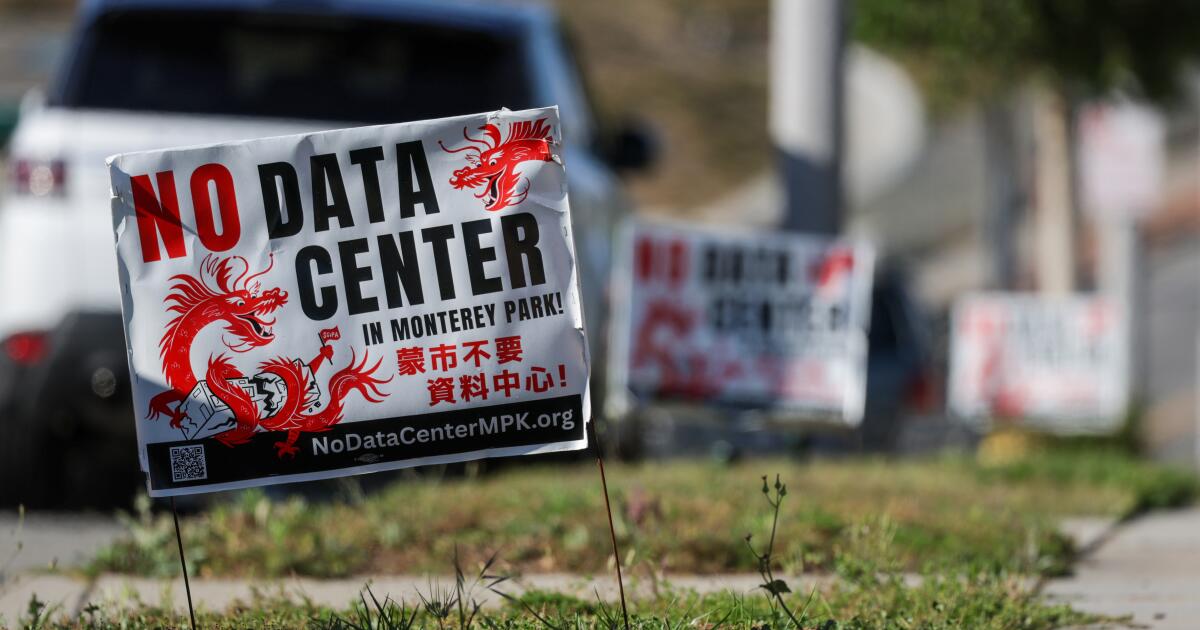
Residents of Monterey Park voted overwhelmingly to ban data centers on election day, making the San Gabriel Valley city the first in the nation to do so by public vote.
As of Wednesday, 86% of votes were in favor of Measure NDC, the city ban, according to the Los Angeles County registrar-recorder/county clerk.
Other cities and towns have passed moratoriums on data centers, as a wave of opposition sweeps the country. But the Monterey Park vote can only be overturned by another ballot measure, making it the most permanent data center ban in a jurisdiction.
Monterey Park’s City Council had already banned data centers by ordinance, after a proposed 247,000-square-foot data center met an outpouring of public anger and concern. The developer withdrew that plan.
That facility would have been less than 500 feet away from the nearest home, and would have used three times the electricity of the entire 60,000-person city. Residents said it would have caused noise and air pollution and driven up electricity rates.
“This ensures long-lasting protections for current and future generations,” Amy Wong, co-founder of the group San Gabriel Valley Progressive Action, said of the vote. “It means that future city councils cannot overturn a data center ban, even if data center developers wanted to spend money to fund pro-data center candidates.”
The measure had no formal opposition. The developer of the proposed facility, investment firm HMC StratCap, said it wouldn’t engage in the ballot fight when it withdrew in March.
The Data Center Coalition, an industry trade group, expressed disappointment in the vote.
“It sends a signal that the area is closed for business, both for data centers and for other significant economic development projects,” state policy director Khara Boender said.
“It deprives local residents of the opportunity to compete for jobs and investment, while also causing the area to relinquish substantial long-term economic investment, high-wage jobs, and critical tax revenue to neighboring areas or other states.”
SGV Progressive Action worked with hyperlocal groups including No Data Center Monterey Park to rally support for the measure.
The group is now focused on stopping data center proposals in the City of Industry and fighting a move by City of Industry, Santa Fe Springs, Vernon and City of Commerce to welcome data centers and other industry with fast-tracked permitting and tax incentives.
City of Industry, in the San Gabriel Valley, and Vernon, south of downtown L.A., are primarily industrial areas, each with around 300 permanent residents. They are employment centers, and tens of thousands of workers commute in daily.
There has been little vocal opposition to data centers among the few residents of these cities. Wong said the protest is primarily coming from the surrounding neighborhoods.
“If a data center gets built in City of Industry, residents across the region would bear the brunt of pollution and increased utility costs,” Wong said, noting that it is surrounded by 16 other cities and unincorporated communities.
Data center proposals have been limited in California compared to Virginia, Texas, Georgia, Illinois and Arizona, which sit at the center of a recent boom in hyperscaler facilities to power artificial intelligence.
California has the third-most data centers in the country, with 300, but high electricity rates, expensive land and regulatory hurdles mean that fewer, and smaller, facilities are currently planned than in other hotspots.
That doesn’t mean opposition hasn’t been fierce. In Coachella and Imperial County, residents are showing up in droves to protest local proposals.
In the San Gabriel Valley, Montebello, El Monte and Baldwin Park have all enacted temporary moratoriums, and Alhambra recently banned data centers as part of a zoning code update.
Wong said she hoped the ballot measure vote would galvanize the opposition. “The vote is a testament to the people power of our region,” she said. “Our region is worth protecting, and we won’t let data centers determine our future.”

A rule intended to prevent rent gouging in the wake of the Eaton and Palisades fires has lapsed in Los Angeles County, possibly exposing some renters to hikes.
The executive order that blocked rent increases was issued by Gov. Gavin Newsom amid the devastating wildfires last year. Under the order, landlords couldn’t increase rents by more than 10% above their prefire levels.
The rule, which was supposed to be temporary and was repeatedly extended, ended Friday after a vote to extend it again failed to garner enough votes. Supervisor Lindsey Horvath, whose district includes Pacific Palisades, sounded the alarm in a motion to extend price protections that failed to pass at the Board of Supervisors’ May 19 meeting.
“These price gouging protections continue to be necessary as construction and rebuilding continue, and as thousands of people remain displaced,” the motion said. “Families which signed short-term leases could face drastic price increases of 50% or more without further price gouging protection.”
Los Angeles County is home to more than 1 million rental properties, though not all of them needed protection from the new rule. There are already stricter rent increase caps for many residences, depending on the location, type and age of the building. Despite the rent control in the region, the people of Los Angeles pay among the highest rents in the country.
It is uncertain whether renters will face rapidly rising rents now that the protection has lapsed. But some real estate experts and policymakers said there was no need for the temporary rule that was part of the governor’s state of emergency.
Supervisors Kathryn Barger, Janice Hahn and Holly Mitchell abstained from voting on the motion to extend the protection, while Supervisors Hilda Solis and Horvath supported it.
“I abstained because I did not see sufficient evidence to justify extending this emergency ordinance, nor did I see evidence to eliminate it entirely,” Hahn said.
Barger’s office said she supported allowing the protections to sunset while waiting to see whether new information emerged.
“Market data already shows countywide rents are only about 2% above pre-emergency levels and rental inventory has grown,” Barger representative Helen E. Chavez Garcia said. “The Supervisor is also mindful of the burden these ongoing protections place on small property owners throughout the county.”
Mitchell did not immediately respond to a request for comment.
There haven’t been steep rent hikes in neighborhoods within three miles of the Palisades fire, according to a Times analysis of data from Zillow, the property listing company.
In ZIP Codes within three miles of the Palisades fire, rent increased 4.8% from December 2024 to April 2025. In areas around the Eaton fire, which destroyed swaths of Altadena, rent jumped 5.2% in the same period.
In L.A. County, ZIP Codes farther from the fires saw only about a 2% increase.
A landlords representative, Jesus Rojas of the Apartment Owners Assn. of Greater Los Angeles, told the supervisors during public comment at the meeting that the county’s rent-gouging rules have “long outlived the emergency they were intended to address” and are now being “wrongfully used to harm thousands of rental housing providers throughout the county.”
“There is no proof that multifamily rental housing providers are hugely increasing rents for impacted homeowners,” Rojas said.
Indeed, there are strong signs that the property market in the Los Angeles area has at last begun to cool.
L.A. metro-area rent prices recently fell to a four-year low, with the median rent slipping to $2,167 in December.
Meanwhile, condominium sales had their slowest start of the year in decades. Condo sales in Los Angeles have plummeted to a 20-year low, with fewer than 2,000 units sold in January and February — the worst start to the year since 2005.
Newsom defended the price-gouging protections shortly after they went into effect.
“In the days following the Los Angeles firestorms, we worked quickly to protect Los Angeles survivors from any form of exploitation,” he said in February 2025. “The state has the tools in place to not only block price gouging during this emergency, but also to prosecute bad actors.”
The Los Angeles County Department of Consumer and Business Affairs said it received more than 2,000 complaints after the fires, alleging that retailers and landlords were taking advantage of people put in hardship by their losses, and sent out more than 2,000 cease-and-desist letters to businesses and landlords for alleged price gouging, said Morine Merritt, who oversees department investigations into consumer and real estate fraud.
“Close to 90% of the complaints that we received involved allegations of rent increases,” Merritt said in an interview. Now that the fire-related protections have expired, existing laws and “regular market conditions determine price increases for goods and services, including rents,” she said.
Crackdowns on fire-related rent gouging have been rare, said Chelsea Kirk of the activist organization the Rent Brigade, which analyzed L.A. County’s rental market in the year after the fires. It reported 18,360 potential examples of price gouging in listings but said that few lawsuits had been filed by authorities so far.
Last week, Rent Brigade announced what it said was the first private civil lawsuit brought by a family that claimed to be rent-gouged in the aftermath of the wildfires. Plaintiffs Randall and Candy Renick, whose Altadena home was damaged, said they were charged nearly three times the maximum permitted rate for nearly 10 months. They seek restitution of $96,000 plus civil penalties and attorneys’ fees.
The rental market has probably stabilized since the fires, Kirk said, but other families may still be “locked into illegal rents” that they agreed to pay when they were in a rush to find housing after they were displaced.


Dear Mr. Pelley:
I meant what I said in my letter last week to the 60 Minutes team: joining 60 Minutes is the honor of my career and I am grateful to be working alongside the people who have contributed to the most important television journalism brand this country has ever produced. While I’m new to 60 Minutes, I’ve devoted my career to investigative journalism and storytelling. I started this job excited to collaborate and to benefit from the wisdom and experience of the 60 Minutes veterans, with you among them. For that reason, one of the first things I did in my new role was call you to talk and invite you to dinner. It is a profound disappointment that you rejected that overture and chose ambush instead. Yesterday, you hijacked my first meeting with staff to disparage me, my qualifications, and my intentions with remarkable incivility and contempt. I welcome a diversity of viewpoints and respectful debate among the team, but this was nothing of the sort. Yesterday’s performative display of hostility enacted in front of the staff instead of in a civil, private conversation-demonstrated that you have no interest in contributing to the future success of the show, or approaching my new tenure with a mind open to collaboration and progress. I am here to deliver first-in-class news programming, not to make headlines about newsroom drama. I am eager to work alongside those who share this goal.
Despite yesterday’s misconduct, I had hoped that in sitting down with you today we could find a path forward together. You made clear that you are not interested in such a path.
Your antipathy to the future of the show has come through loud and clear. And I have heard you. I therefore write on behalf of CBS News, Inc. (“CBS”) to inform you that your employment with CBS is terminated for cause effective immediately. Enclosed is your formal termination letter.
Sincerely,
Nick Bilton
Executive Producer, 60 Minutes
-

 Los Angeles, Ca1 hour ago
Man claiming to be armed robs Culver City bank, gets away with $10,000
-

 Detroit, MI1 hour ago
Fired Detroit TV anchor Taryn Asher files sex discrimination lawsuit against old station, claims new GM protected men
-

 San Francisco, CA2 hours ago
San Francisco family devastated as they face nearly 90% rent increase
-

 Dallas, TX2 hours ago
Wings’ top pick Azzi Fudd hosts clinic as Cash App donates to Dallas nonprofit
-

 Miami, FL2 hours ago
Patients left scrambling for care after Miami-Dade woman accused of operating an unlicensed surgery recovery center
-

 Boston, MA2 hours ago
Clover plans to reopen some locations after sudden closure, thanks to an anonymous investor
-
 Denver, CO2 hours ago
New report finds Denver metro home buyers and sellers experiencing ‘unattainability fatigue’
-

 Seattle, WA2 hours ago
Seattle mayor grilled over public safety, affordability, CCTV

