Business
Why Everyone Is Still Talking About ‘Paddington 2’


“Paddington 2 is the greatest film ever made,” one user posted on X in 2022.
This tweet was not ironic.
In the seven years since its release in January 2018, the film about a marmalade-loving bear’s quest to find the perfect gift for his beloved aunt has become an internet phenomenon, spawning memes, think pieces and an endorsement from Nicolas Cage. For a time, it was the best-reviewed film ever on the aggregator site Rotten Tomatoes.
“A very eclectic group of people respond to it in the way that they do,” David Heyman, a producer on “Paddington 2” and its 2015 predecessor, “Paddington,” said in a recent phone conversation from his home in London. The Mexican filmmaker Guillermo del Toro, for example, confessed to Heyman he was a fan.
Now with the third feature-length installment in the franchise, “Paddington in Peru,” in theaters — and already having passed the $100 million milestone at the international box office — it is hard to imagine that when “Paddington 2” first arrived in theaters stateside, it was only a modest box office success. Since its DVD and streaming releases, a devoted community of online fans has sprung up around it, evangelizing about the outsider bear who brought joy to their lives.
“There’s humor in it for adults; there’s humor for children,” said Heyman, who grew up reading the Paddington books, written by the British author Michael Bond. “It never feels patronizing or like it’s talking down to its audience. It has a big, beating heart.”
All three films are based on the children’s books about the duffle-coated, hard-staring bear, first published in 1958. In the first movie, Paddington emigrates from Peru to London in a story inspired by the World War II rescue operation that brought nearly 10,000 children from Nazi-occupied Europe to England. The second film, directed by Paul King, who wrote the script with Simon Farnaby, is an action adventure with stunning set sequences, following Paddington through a court trial, a prison escape and a daring pursuit by train.
Securing the return of the original film’s cast members — the gentle-voiced Ben Whishaw as Paddington, Hugh Bonneville as the hapless but well-meaning Mr. Brown and Sally Hawkins as the openhearted Mrs. Brown — was easy, Heyman said. And bringing in a dream team of new ones — Hugh Grant as the ridiculously campy villain, Phoenix Buchanan — was also a breeze.
“Hugh knows a good part,” he said, laughing.
King’s confidence as a director grew from the first film to the second, Heyman said, as he became more comfortable with the bevy of visual effects required to create the C.G.I. bear, who was represented during filming by a toy bear head on a stick.
“There was a lot more time to focus on the script and on working with the actors,” Heyman said. “It was really fun. The spirit of the film was reflected on set.”
That was maybe most evident in the rollicking Busby Berkeley-style dance number that unspools inside the prison as the end credits begin to roll. Locked up for 10 years for his scheme to frame Paddington for stealing a pop-up book, Phoenix, a former actor, finally gets his star turn. He leads the roughly 300 other prisoners in a tap number set to “Rain on the Roof” from Stephen Sondheim’s musical “Follies.”
“Hugh was all in,” said the choreographer Craig Revel Horwood, who created the 90-second number, which was shot in sections over 19 hours the day before the set was to be demolished. He recruited 300 of his tattooed, heavyset professional dancer friends to make up the corps.
“Anyone that looked rough, we were putting in,” said Horwood, who spent about a month planning the number, including three weeks teaching Grant to tap dance. “I had no problem getting anyone for the gig. Not one person turned me down.”
He outfitted the scruffy-looking extras with pastel umbrellas and size XXL bedazzled pink-striped uniforms — “when I saw everyone in costume, I was killing myself laughing,” he said — then shot from sunup to sundown, squeezing in the last few takes as a midnight deadline approached.
“It’s sort of a Momma Rose in ‘Gypsy’ moment,” he said. “‘Everything’s Coming Up Roses,’ that type of number.”
The same could not be said for the film’s initial U.S. box office receipts. Though “Paddington 2” had been a big success in Britain, it struggled to separate itself from the pack over a Martin Luther King Jr. holiday weekend, grossing a modest $15 million on a $40 million budget, according to the data site Box Office Mojo.
One challenge, Heyman explained, was that the Weinstein Company, which initially held partial North American distribution rights for the film, was in a fiscal crisis exacerbated by the numerous sexual assault allegations leveled against Harvey Weinstein, its co-founder and former co-chairman. On the verge of filing for bankruptcy, the company did not sell the rights to Warner Bros. until less than two months before the film’s release date.
“So Warners had one hand tied behind their back in terms of marketing,” Heyman said.
Eventually, strong reviews, including from this newspaper, and word-of-mouth praise helped the film in the United States, but it never attained the success that it had in Britain, where it would go on to become the sixth-highest-grossing film of 2017, according to Box Office Mojo.
That is, until “Paddington 2” became available to watch on Amazon Prime Video in March 2018 and then became a streaming hit in 2020 during the coronavirus pandemic.
“The film shows what can be if people have more empathy towards one another,” said Jason Chou, 28, a Los-Angeles-based visual effects artist.
But not everyone saw a generous spirit in King and Farnaby’s version of the classic bear.
One odd footnote to the reputation of “Paddington 2” appeared in a blog a few years after the film came out. The movie had a solid perfect score on Rotten Tomatoes. Suddenly, in 2021, it dropped to 99 percent after a freelance film critic wrote on his blog that he had given “Paddington 2” a negative review on BBC Radio in 2017 (no one has been able to find that review).
The blogger, Eddie Harrison, wrote that he had grown up reading the Bond books, and that in “Paddington 2,” the bear’s “charm is entirely missing,” and he has “evil, beady eyes and ratty fur.”
“This is not my Paddington Bear,” he added, “but a sinister, malevolent imposter who should be shot into space, or nuked from space at the first opportunity.”
Within twelve hours of his blog post in May 2021, he became Public Enemy No. 1 for the Paddington hive. And hours after the score dropped, The Hollywood Reporter published an article about the downgrade, with dozens of news outlets following.
Why did Harrison bother?
“I recognised that a revised critique would knock Paddington off a perfect RT score,” Harrison wrote on his blog, the Film Authority, in an account of the fallout. But he hadn’t, he noted, anticipated the intensity of the vitriol, which, he said, included doxxing and vandalism, as well as death threats.
“It’s just an opinion, man,” said Harrison, who labeled “Paddington in Peru” “passable but rather ordinary.”
Heyman certainly maintains a different take on “Paddington 2,” one shared across the internet, even as the third film, which follows the bear back to Peru, has garnered lukewarm reviews.
“The second one is about looking for the good in people,” Heyman said, “because if people find it, then they’ll be able to find it in themselves.”
“In a time of life with cynicism, Paddington is a remarkably generous-spirited, uncynical character,” he added. “And the film reflects that.”




Nearly a year after the expiration of a $7,500 federal tax incentive for new electric vehicles, California is stepping in to try to motivate buyers to go electric.
Gov. Gavin Newsom allocated $135 million in his new state budget to provide incentives for new and used EVs. Participating automakers will match the funds.
California leads the nation in EV adoption, though the market has taken a hit under the Trump administration.
The state budget — a more than $350-billion spending plan — went into effect Wednesday. The EV incentives will take effect in the coming weeks as the California Air Resources Board irons out agreements with dealerships.
Here’s what you need to know.
What are the incentives worth?
Senate Bill 168 tasked the California Air Resources Board with setting incentive amounts for new and used electric vehicles sold in California.
Eligible buyers will receive $3,500 off for new EVs and $1,750 off for used ones. Unlike the federal tax credits that expired in September, these incentives offer an instant discount and don’t require buyers to apply for credit later.
State funds will cover half of the incentive amount, and auto manufacturers will cover the other half.
The rebates will mean that most eligible buyers will effectively get between 4% and 7% of their money back.
For used EVs, “this incentive helps what’s already a good deal become an even better deal,” said auto analyst Brian Moody. “I think that’s the perfect use of these kinds of dollars.”
What are the rules and exceptions?
The new incentives can’t be used on all electric vehicles — they apply only to new EVs with a manufacturer’s suggested retail price of $50,000 or less, and used EVs with a sale price of $25,000 or less.
The $50,000 maximum rules out many options on the market, but legislation outlining the incentive program makes a special exception for California-based companies. Buyers purchasing a new or used EV from a company with headquarters in California can claim the discount regardless of the vehicle price.
That’s good news for Lucid, with headquarters in Newark, Calif., and for Irvine-based Rivian. Neither company currently offers new vehicles for less than $50,000. Rivian said it plans to launch a $44,990 SUV in 2027.
Who is eligible?
California’s new EV discounts are available only to first-time EV buyers, according to the legislation.
SB 168 says the buyer’s eligibility will be “confirmed by a buyer attestation” that they have not previously owned a zero-emission vehicle.
The new EV incentive is less than half of the federal incentive that expired nine months ago. Whereas the federal incentive may have been enough to spark interest in a range of buyers, Moody said the lesser amount will probably appeal mainly to people who already have their eye on an EV.
“I think you have to already be considering it, or in the market,” Moody said. “I think that the amount is just right for that.”
What are California’s clean car goals?
The incentives are intended to help California reach its electric vehicle and air quality goals as those targets have been under fire from President Trump.
Shortly after taking office, Trump signed an executive order that revoked California’s authority to set its own EV regulations, which included a goal of having 100% of new vehicle sales in the state be zero-emission by 2035.
California sued the administration in response. The state also has goals, including some that have been in place since 2012, that set declining limits on smog-causing pollutants and required automakers to sell increasing percentages of electric and hybrid vehicles through 2025.
In March, the administration filed a new lawsuit again trying to block California’s ability to set stricter-than-federal emissions standards for cars.
Early this year, California announced that more than 2.5 million zero-emission vehicles had been sold in the state since 2010, surpassing a target to put 1.5 million zero-emission vehicles on the road by 2025.
Business
Want an AI-proof job? New research says you may be safer at companies embracing the technology

While AI is often cited as one of the reasons for mass layoffs, particularly in the tech sector, for fast-growing companies it also seems to be creating new jobs in many companies, according to a study published Tuesday from financial services company Ramp and employment database Revelio Labs.
“Our early result is that it looks like firms are starting to look for more entry-level hires, likely people who are more AI native,” said Ara Kharazian, the lead economist at Ramp, a financial services company that found a rise in early-career hiring by companies in the period they started spending heavily on AI.
The study tracked AI spending and the workforce records of nearly 22,000 U.S. companies between January 2021 and February 2026.
It found that firms that spent more on AI ended up increasing their workforce headcount by an average of 10% over the two years after rolling out the technology. Companies that made the largest AI investment expanded entry-level job hiring by 12%.
“If you are a job seeker, or you are graduating from college, and you’re choosing between two different firms that are otherwise similar, I would choose the one that’s using AI,” Kharazian said. “Our paper shows that that firm is going to grow faster.”
The early and intense AI adopters spent more than $100 per month per employee on AI and had their employees using advanced AI, such as coding subscriptions, as opposed to simple ChatGPT subscriptions.
The low-intensity, casual AI adopters didn’t see any hiring gains and reduced headcount.
The Ramp study showed a positive effect on employment from AI because it focused on firms adopting AI, many of them fast-growing, venture-backed companies hiring AI-native junior employees.
It reached a different conclusion than a November 2025 Stanford University study, which examined payroll data across the entire labor market and found that employment among young software developers had declined by nearly 20% from its late-2022 peak.
The two findings can both be true, Kharazian said, because the Stanford study was broader and didn’t focus just on the firms that use AI.
“While there may be overall weak hiring for young people, what we found is that hiring is actually strong at the firms that use AI, and the firms that use AI intensely,” he said.
In another recent study on the impact of AI on jobs, the California AI-unemployment tracker examined the state across industries, education levels and region and highlighted some worrying trends.
It seemed to disprove the understanding that AI has been hurting mostly younger employees and those in entry-level jobs.
It found that unemployment insurance claims among college-educated workers in high-AI-exposed jobs, such as customer service and software development, increased after ChatGPT’s release in 2022 and remained elevated through May 2026.
Unemployment insurance claims among master’s and PhD holders in highly AI-exposed occupations have also risen, moving from a baseline average of 13,000 claims per month in November 2022 to between 16,000 and 22,000 claims per month since mid-2023, the study found.
The study also categorized unemployment claims by age and found that a significant portion of claims were from those aged 36 to 65, signaling that AI’s effect doesn’t only affect early-career jobs.
It also found a higher rate of insurance claims in the San Francisco Bay Area compared with the rest of California, and that job loss claims were concentrated in the technology sector.
In 2026, tech companies have let go of more than 160,000 workers, according to trueup.io, a website tracking industry layoffs.
Many companies have said AI was one of the main reasons for layoffs. Meta, Oracle, Microsoft and other big tech companies have laid off tens of thousands of employees, while simultaneously investing billions in AI data centers.
Ramp’s findings that heavy AI adoption can lead to increased hiring suggests that some of the companies announcing large layoffs may be guilty of blaming regular cost cutting on AI, a practice dubbed “AI washing.”
“When you hear CEOs talk about layoffs and they attribute it to AI, I would be skeptical,” Kharazian said.
Business
Commentary: It’s not just vaccines — from infancy to adolescence, Republicans are waging war on children’s health
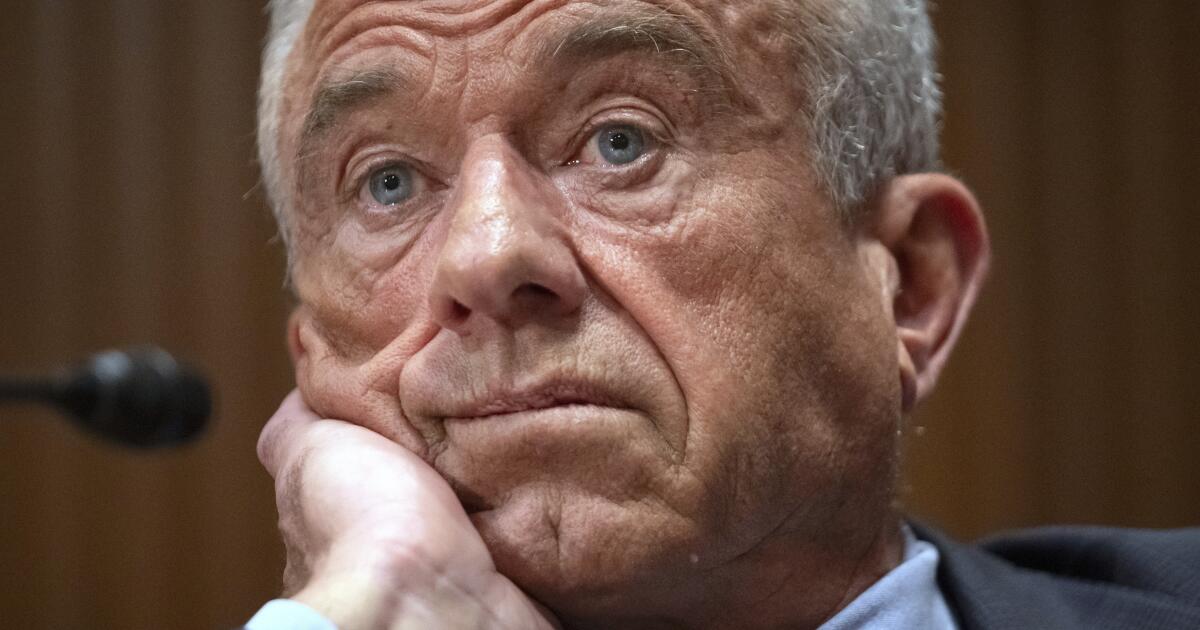
The conservative assault on child health starts with the anti-vaccine campaign and proceeds to cutbacks in nutrition assistance and narrowed access to healthcare.
In the old days, before accepted medical protocols came under partisan assault, infants typically received a vitamin K shot to enhance blood-clotting capability and a few drops of an antibiotic to stave off eye infections before leaving the hospital, followed by a thorough round of vaccines against life-threatening diseases.
Americans assumed that “whatever a family could afford, the country had already decided this child was worth protecting,” Robert B. Shpiner, a critical care expert at UCLA medical school, wrote recently. “I have seen children harmed by disease, poverty, by bad luck. I had not, until now, seen them harmed so methodically by their own government.”
Shpiner’s targets were the changes in healthcare policies instituted by the Trump administration generally and Health and Human Services Secretary Robert F. Kennedy Jr., as well as the mistrust in medical authority that Kennedy and his followers have helped to foment.
We’re going to be paying this bill for years to come, because the lack of proper nutrition has profound effects on learning and disability.
— Robert B. Shpiner, UCLA
As Shpiner wrote in the Guardian, the administration’s assault on child health begins with its anti-vaccination policies. In January, Kennedy’s agency reduced the list of recommended childhood immunizations to 11 from 17, removing shots for COVID-19, hepatitis and meningitis, among other diseases. The agency made the changes without the customary professional consultations, KFF has reported.
But that’s only the tip of the iceberg. “It’s just one thing after another,” Shpiner told me.
What triggered him into writing his Guardian essay, he says, was learning that congressional Republicans had advanced an agriculture appropriations bill that would cut the fruit and vegetable benefit for children in WIC, the supplemental nutritional program for women, infants and children to $10 a month from $26.
“That got me to looking at this as a sequence,” he says, starting with the reduction of child immunizations, followed by the proposed cuts in WIC and the cuts in food stamps enacted as part of the Republican budget bill that Trump signed one year ago Saturday (i.e., the Fourth of July, 2025).
“The image of us taking food away from kids and not giving them enough money to buy some apples and berries—the short-term response is outrage,” he says, “but the medium- and long-term effect is that we’re going to be paying this bill for years to come, because the lack of proper nutrition has profound effects on learning, and disability and anemia. A number of measures of health and success match with nutrition.”
At almost every stage of childhood development, he notes, programs aimed at preserving or enhancing children’s health have gone on the chopping block.
“A vaccine rule one week, a food program the next,” he wrote. “Each change arrives wrapped in a reasonable rationale: fiscal discipline, local control, parental choice. But arrange them in the order a child actually grows, and the rationales stop mattering.”
Judging from their rhetoric, one would think that Republicans would move heaven and earth to foster child immunizations, nutritional assistance and access to medical care.
In “Communion,” his recent book about his conversion to Catholicism, for example, Vice President JD Vance writes: “We want more children in our society because children are profoundly good — the greatest value add we can create.”
Yet the programmatic cutbacks advocated for and implemented by the Republican Congress and Trump give the lie to that sentiment. Let’s examine chapter and verse.
Measles is the canary in the coal mine for vaccination and public health, and at this moment, the canary is singing a doleful tune. The Centers for Disease Control and Prevention count 2,134 cases in the U.S. as of June 25. That’s poised to exceed the 2,288 cases in all of 2025, which was the worst outbreak since 1991.
There’s no question why this is happening. It’s because of a decline in measles vaccinations below the 95% generally considered to provide “herd immunity,” in which the disease is so rare that even unvaccinated individuals are protected from exposure.
Kennedy may not deserve all the blame for the immunization decline, but as pseudoscience debunker Steven Novella has pointed out, as secretary he has “done everything possible to undermine vaccine science and confidence in health institutions.”
Kennedy has paid lip service to the value of the MMR vaccine, which combines immunizations for measles, mumps and rubella. But he has claimed without evidence that the vaccine causes deaths “every year” and that the vaccine hasn’t been safety-tested, which isn’t so. He has asserted that it shouldn’t be subject to a government mandate. He also has promoted treatments for measles that aren’t known to be effective.
(The Department of Health and Human Services didn’t respond to my request for comment on the vaccine initiatives.)
As children grow, the crisis of malnutrition kicks in. The House GOP’s cuts to WIC are still only on the drawing board. But the Republican budget bill incorporated cuts to food stamps — the Supplemental Nutrition Assistance Program, or SNAP — that have driven some 4 million people off the program. In 13 states that have published data, according to the Center on Budget and Policy Priorities, child enrollment fell by more than 800,000, or 16%, between July 2025 and May of this year.
“This is where the nutrition cuts become a medical, not merely a moral, story,” Shpiner says. “Iron-deficiency anemia in infancy is associated with poorer cognitive, motor, and behavioral outcomes that persist more than 10 years after the deficiency itself has been corrected — the deficit does not fully reverse even with later treatment. Withdrawing produce and protein from WIC and SNAP at the peak window of brain growth is not a budget line that resets the following year; it is a developmental exposure with a long tail.”
The combination of reduced immunization and poor nutrition build on each other. “Unvaccinated kids are going to get sicker,” he told me. “If they’re malnourished, they’re going to get sicker. If their parents don’t get affordable care, they’re going to be strapped. It becomes a synergistic and multiplicative cascade.”
Indeed, the administration’s assault on Medicaid and the Affordable Care Act intensifies the damage. Enrollment in Medicaid and the Children’s Health Insurance Program, which is part of Medicaid, fell by 4.8 million people, or 6%, from March 2025 through March 2026, according to government data. The enrollment decline for children alone came to more than 1.9 million, or 5%.
White House spokesperson Kush Desai challenged the latter figure when I asked for comment. But it came from KFF, which sourced it to the government’s Centers for Medicare and Medicaid Services, or CMS.
“Nothing has been done to alter insurance or Medicaid coverage of any vaccination,” Desai told me by email, “and parents are encouraged to seek out the counsel of their pediatrician to make the best decisions for their children.”
The prospects are for further declines. That’s because new work requirements for enrollees in Medicaid expansion under the Affordable Care Act are almost certain to drive enrollment down, due to obstacles including paperwork burdens and administrative snafus, resulting in even some eligible enrollees losing their coverage.
(These problems became so pronounced in Arkansas, which implemented work requirements during the first Trump term, that a federal judge axed the program.)
The work rules enacted last year as part of the Republican budget bill aren’t scheduled to start until Jan. 1, but three states are starting early — Nebraska (May 1), Montana (Wednesday) and Iowa (Dec. 1). The impact on enrollment isn’t yet clear.
Whatever the effect of these changes, the public is going to know less about them than before. The reason is that the administration has shrunk the requirements for reports of immunization from states, changing the reports from mandated to voluntary. The affected data include childhood immunization rates against diphtheria, tetanus, pertussis, polio, measles, mumps and rubella, hepatitis, chicken pox and flu; and rates for 13 year olds and expectant mothers.
“While seemingly a small, technical change, the removal of vaccine reporting in Medicaid and CHIP may make it more difficult to monitor and understand vaccination trends for a large share of children in the U.S.,” KFF noted.
I asked the Department of Health and Human Services to explain the rationale for these changes, and specifically whether they were aimed at obscuring the effect of the narrowing of vaccine recommendations, but didn’t hear back.
-
 Lifestyle23 minutes ago
But first, coffee: The drink that energized the American Revolution
-

 Technology31 minutes ago
NASA launched an emergency mission to stop the Swift Observatory from crashing to Earth
-

 World38 minutes ago
Tens of thousands of far-left protesters clash with police in anti-conservative party riots
-

 Politics41 minutes ago
Trump set to deliver ‘historic’ speech celebrating America’s 250th anniversary
-

 Health46 minutes ago
The ‘1776 Diet’: What Americans really ate during the nation’s founding
-

 Sports53 minutes ago
Kylian Mbappé’s seventh goal of the World Cup lifts France past Paraguay in physical Round of 16 match
-
Business1 hour ago
California is bringing back EV rebates. This is how to get one
-
 Entertainment1 hour ago
Comedy saved her life. Now Teruko Nakajima’s ‘Made in America’ is saving others

