Business
Why do planes have door plugs? And other questions about the Alaska Airlines blowout, answered

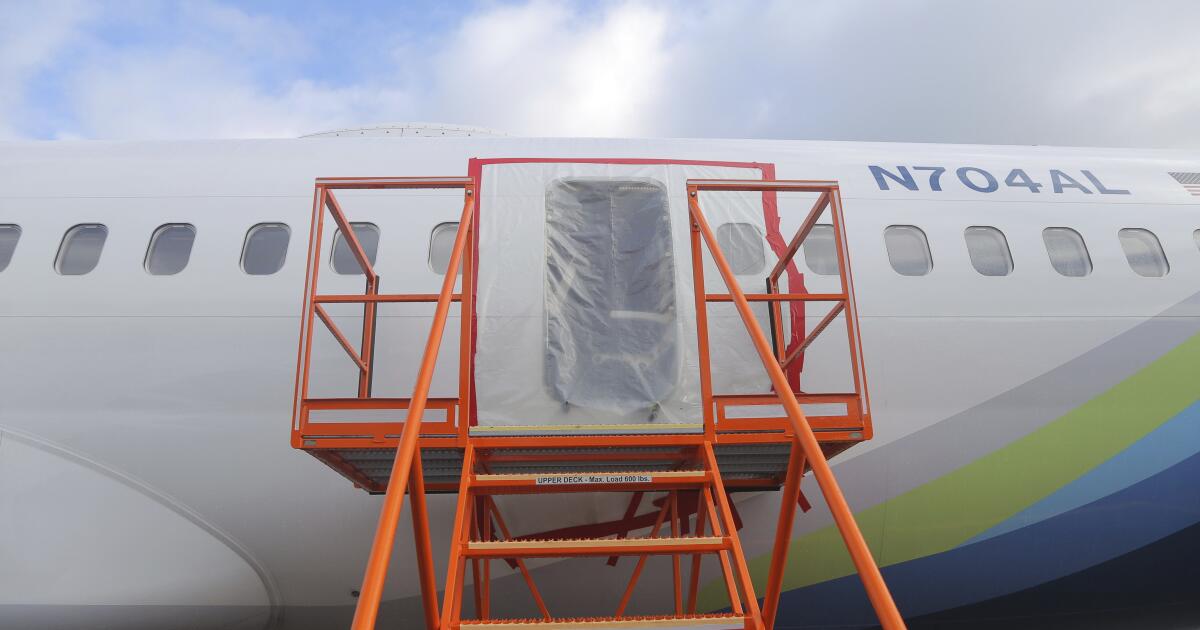
The landing gear was stowed, the plane was climbing to cruising altitude, and then a segment of the wall exploded out of the rear cabin of Alaska Airlines Flight 1282 on Friday night, just 20 minutes after the plane took off from Oregon’s Portland International Airport airport en route to Ontario, Calif.
No passengers were seriously injured in the incident, which occurred as the Boeing 737-9 Max was 16,000 feet off the ground, and the pilots managed to safely land it back at the Portland airport shortly after.
The event has raised a number of questions. The most crucial is just how this kind of failure, in which a door plug installed to replace an emergency exit was ejected out of the side of the pressurized cabin, could occur in a commercial plane. Federal regulators at the National Transportation Safety Board are actively investigating the incident but have not yet announced any findings.
But what exactly is a door plug in the first place? How did the cockpit voice recording end up being erased before anyone could listen to it? The Boeing 737-9 Max has been grounded worldwide pending the results of the investigation, but how can you figure out what plane your flight is going to be on in the future? And how exactly did an iPhone that got sucked out the gaping hole in the plane survive the fall to Earth?
These questions, at least, can be answered.
What is a door plug? Do a lot of planes have them?
The part of the plane fuselage that failed Friday was called a door plug and is not unique to the 737-9 Max or other Boeing planes.
The number of required emergency exits changes based on the number of passengers a plane can hold. The original design of the 737-9 Max had two additional emergency exits toward the rear of the plane, in addition to the exits over the wings, at the rear, and near the cockpit. Some international customers of the 737-9 Max have been flying the planes at maximum capacity, which requires all the original emergency exits in place.
Alaska Airlines opted to fly its 737-9 Maxes with fewer passengers, which meant it didn’t need those additional emergency doors.
Robert Ditchey, an aviation expert and former airline executive, explained the logic behind replacing the doors with a plug.
“One would think the more the merrier” when it comes to emergency exits, Ditchey said, but exit doors with embedded slides or life rafts add weight to a plane and cost extra to maintain over the life of the craft.
After the airline ordered the modified plane, the company that manufactures its fuselage, Spirit AeroSystems in Wichita, Kan., took out the original door and added the door plug in. That modified fuselage was shipped to Boeing “fitted but not completed,” according to Reuters, which allows Boeing to remove the plug and use the hole in the side to access the cabin of the plane, in order to install interior components. Boeing ultimately reattached the door plug in its facility, then delivered the craft to Alaska Airlines.
Why would a door plug just fly off like that?
The NTSB has yet to determine the specific cause of the failure, but one possible culprit is some flaw in the bolts that were holding the door plug onto the rest of the airframe. On Monday, United Airlines announced that it had found loose bolts and other installation issues on the door plugs of its own 737-9 Max planes.
“We don’t know what failed,” Ditchey said, mentioning the possibility that some bolts could have been missing, the wrong size, improperly tightened, or could have mechanical flaws in the metal. He added that there could have been a structural failure in the frame of the craft, but said that he thinks that less likely.
In his view, this points to a design flaw in the door plug itself. The doors in a commercial plane are designed specifically to be un-openable while the cabin is pressurized, and designed to withstand the pressure of the cabin. Even without bolts or a latch holding it in place, a passenger would not be able to open the emergency exit on a plane that was fully pressurized. To ensure that they can’t blow out, like the door plug on the Alaska flight, they are built like wedges: larger on the inside than the outside, so the cabin pressure fits them snugly into place.
“The plug is in my opinion a bad design, because it can blow out and did blow out in this case,” Ditchey said, since it appears to have been bolted on from the outside, rather than wedged against the frame from within. “That troubles me greatly.”
Boeing and Spirit AeroSystems said that they could not comment on the specifics of the door plug assembly given the ongoing NTSB investigation into the failure.
Accidents over the last half a century in which the airplane cabin depressurized have been mostly attributable to baggage hold door failure, particularly with the now-obsolete DC-10 airliner, and fuselage metal fatigue, rather than failures in the main cabin doors.
What’s the deal with the flight recorder?
When Jennifer Homendy, chair of the NTSB, spoke about Friday’s incident at a news conference over the weekend, she brought up a very specific frustration: The cockpit voice recorder in the plane had automatically erased the recording from the incident.
Nobody turned the recorder off for safekeeping, and they are programmed to retain only the most recent two hours of audio, which is then automatically overwritten. As The Times reported:
Homendy was visibly exasperated by the loss of the black box recording. She noted that it was a “very chaotic event” when the plane landed and officials set up an emergency operations center.
“The maintenance team went out to get [the cockpit voice recorder], but it was right at about the two-hour mark,” she said, later adding: “We have nothing.”
The two-hour setup of the recorders strictly follows FAA guidelines, but proposed rules would extend the recording time to 25 hours, in line with current European regulations.
How can I tell what kind of plane I’m about to get on for my next flight?
Most airlines show the type of plane that you’ll be flying in when you view the flight information on their booking site. Third-party websites such as FlightAware and FlightStats also show the model of plane being used for a given flight.
Airlines that have purchased the relatively new 737-9 Max have grounded the plane for the time being, though, so there’s no risk of getting on a similar model to the plane in Friday’s incident. The earlier version of the 737 Max, the 737-8, is in wide use in airline fleets around the world but has a notable blemish on its safety history — those planes were grounded in 2019 after two deadly crashes that killed 346 people, but they were deemed safe to fly in 2021 and have been in heavy use since.
How the heck did an iPhone survive the fall from 16,000 feet?
As Sean Bates took a walk around his home on Sunday, he stumbled upon a remarkable artifact of Friday’s accident: the iPhone of a passenger that had been sucked out the hole in the plane.
The phone appears to have been found in the grass, which made for a soft landing, but still: three miles is a pretty long way to fall.
Luckily, a little physics provides the answer. All objects have a certain terminal velocity that they reach when falling through the air, based on how their size and weight interact with wind resistance. Small, heavy objects reach a higher terminal velocity than big, lightweight ones — think a baseball versus a piece of paper.
As Wired calculated in an article in 2011 after another incident of an iPhone surviving a fall from the skies, the small weight of the handset means that its speed when falling maxes out at between 27 and 95 mph, depending on whether it’s tumbling, falling flat or falling edge-down. As anyone with an iPhone can attest, even a much shorter drop can be fatal for the phones when the target is a concrete sidewalk, but with spongy grass serving as a shock absorber, the iPhone (apparently) just didn’t pick up enough speed to be smashed to smithereens. It can’t hurt that the unlucky passenger had their phone in a protective case.
What happened to the door plug?
At Sunday’s news conference, NTSB Chair Homendy said that the agency had recovered the chunk of airplane from the backyard of a home in Portland, Ore., after the agency was notified by a schoolteacher named Bob.
“Thank you, Bob,” Homendy said. The agency later posted a photo of the debris on its Twitter account.



Welcome to the age of AI hacking, in which the right prompts make amateurs into master hackers.
A group of cybercriminals recently used off-the-shelf artificial intelligence chatbots to steal data on nearly 200 million taxpayers. The bots provided the code and ready-to-execute plans to bypass firewalls.
Although they were explicitly programmed to refuse to help hackers, the bots were duped into abetting the cybercrime.
According to a recent report from Israeli cybersecurity firm Gambit Security, hackers last month used Claude, the chatbot from Anthropic, to steal 150 gigabytes of data from Mexican government agencies.
Claude initially refused to cooperate with the hacking attempts and even denied requests to cover the hackers’ digital tracks, the experts who discovered the breach said. The group pummelled the bot with more than 1,000 prompts to bypass the safeguards and convince Claude they were allowed to test the system for vulnerabilities.
AI companies have been trying to create unbreakable chains on their AI models to restrain them from helping do things such as generating child sexual content or aiding in sourcing and creating weapons. They hire entire teams to try to break their own chatbots before someone else does.
But in this case, hackers continuously prompted Claude in creative ways and were able to “jailbreak” the chatbot to assist them. When they encountered problems with Claude, the hackers used OpenAI’s ChatGPT for data analysis and to learn which credentials were required to move through the system undetected.
The group used AI to find and exploit vulnerabilities, bypass defences, create backdoors and analyze data along the way to gain control of the systems before they stole 195 million identities from nine Mexican government systems, including tax records, vehicle registration as well as birth and property details.
AI “doesn’t sleep,” Curtis Simpson, chief executive of Gambit Security, said in a blog post. “It collapses the cost of sophistication to near zero.”
“No amount of prevention investment would have made this attack impossible,” he said.
Anthropic did not respond to a request for comment. It told Bloomberg that it had banned the accounts involved and disrupted their activity after an investigation.
OpenAI said it is aware of the attack campaign carried out using Anthropic’s models against the Mexican government agencies.
“We also identified other attempts by the adversary to use our models for activities that violate our usage policies; our models refused to comply with these attempts,” an OpenAI spokesperson said in a statement. “We have banned the accounts used by this adversary and value the outreach from Gambit Security.”
Instances of generative AI-assisted hacking are on the rise, and the threat of cyberattacks from bots acting on their own is no longer science fiction. With AI doing their bidding, novices can cause damage in moments, while experienced hackers can launch many more sophisticated attacks with much less effort.
Earlier this year, Amazon discovered that a low-skilled hacker used commercially available AI to breach 600 firewalls. Another took control of thousands of DJI robot vacuums with help from Claude, and was able to access live video feed, audio and floor plans of strangers.
“The kinds of things we’re seeing today are only the early signs of the kinds of things that AIs will be able to do in a few years,” said Nikola Jurkovic, an expert working on reducing risks from advanced AI. “So we need to urgently prepare.”
Late last year, Anthropic warned that society has reached an “inflection point” in AI use in cybersecurity after disrupting what the company said was a Chinese state-sponsored espionage campaign that used Claude to infiltrate 30 global targets, including financial institutions and government agencies.
Generative AI also has been used to extort companies, create realistic online profiles by North Korean operatives to secure jobs in U.S. Fortune 500 companies, run romance scams and operate a network of Russian propaganda accounts.
Over the last few years, AI models have gone from being able to manage tasks lasting only a few seconds to today’s AI agents working autonomously for many hours. AI’s capability to complete long tasks is doubling every seven months.
“We just don’t actually know what is the upper limit of AI’s capability, because no one’s made benchmarks that are difficult enough so the AI can’t do them,” said Jurkovic, who works at METR, a nonprofit that measures AI system capabilities to cause catastrophic harm to society.
So far, the most common use of AI for hacking has been social engineering. Large language models are used to write convincing emails to dupe people out of their money, causing an eight-fold increase in complaints from older Americans as they lost $4.9 billion in online fraud in 2025.
“The messages used to elicit a click from the target can now be generated on a per-user basis more efficiently and with fewer tell-tale signs of phishing,” such as grammatical and spelling errors, said Cliff Neuman, an associate professor of computer science at USC.
AI companies have been responding using AI to detect attacks, audit code and patch vulnerabilities.
“Ultimately, the big imbalance stems from the need of the good-actors to be secure all the time, and of the bad-actors to be right only once,” Neuman said.
The stakes around AI are rising as it infiltrates every aspect of the economy. Many are concerned that there is insufficient understanding of how to ensure it cannot be misused by bad actors or nudged to go rogue.
Even those at the top of the industry have warned users about the potential misuse of AI.
Dario Amodei, the CEO of Anthropic, has long advocated that the AI systems being built are unpredictable and difficult to control. These AIs have shown behaviors as varied as deception and blackmail, to scheming and cheating by hacking software.
Still, major AI companies — OpenAI, Anthropic, xAI, and Google — signed contracts with the U.S. government to use their AIs in military operations.
This last week, the Pentagon directed federal agencies to phase out Claude after the company refused to back down on its demand that it wouldn’t allow its AI to be used for mass domestic surveillance and fully autonomous weapons.
“The AI systems of today are nowhere near reliable enough to make fully autonomous weapons,” Amodei told CBS News.

The iPic dine-in movie theater chain has filed for Chapter 11 bankruptcy protection and intends to pursue a sale of its assets, citing the difficult post-pandemic theatrical market.
The Boca Raton, Fla.-based company has 13 locations across the U.S., including in Pasadena and Westwood, according to a Feb. 25 filing in U.S. Bankruptcy Court in the Southern District of Florida, West Palm Beach division.
As part of the bankruptcy process, the Pasadena and Westwood theaters will be permanently closed, according to WARN Act notices filed with the state of California’s Employment Development Department.
The company came to its conclusion after “exploring a range of possible alternatives,” iPic Chief Executive Patrick Quinn said in a statement.
“We are committed to continuing our business operations with minimal impact throughout the process and will endeavor to serve our customers with the high standard of care they have come to expect from us,” he said.
The company will keep its current management to maintain day-to-day operations while it goes through the bankruptcy process, iPic said in the statement. The last day of employment for workers in its Pasadena and Westwood locations is April 28, according to a state WARN Act notice. The chain has 1,300 full- and part-time employees, with 193 workers in California.
The theatrical business, including the exhibition industry, still has not recovered from the pandemic’s effect on consumer behavior. Last year, overall box office revenue in the U.S. and Canada totaled about $8.8 billion, up just 1.6% compared with 2024. Even more troubling is that industry revenue in 2025 was down 22.1% compared with pre-pandemic 2019’s totals.
IPic noted those trends in its bankruptcy filing, describing the changes in consumer behavior as “lasting” and blaming the rise of streaming for “fundamentally” altering the movie theater business.
“These industry shifts have directly reduced box office revenues and related ancillary revenues, including food and beverage sales,” the company stated in its bankruptcy filing.
IPic also attributed its decision to rising rents and labor costs.
The company estimated it owed about $141,000 in taxes and about $2.7 million in total unsecured claims. The company’s assets were valued at about $155.3 million, the majority of which coming from theater equipment and furniture. Its liabilities totaled $113.9 million.
The chain had previously filed for bankruptcy protection in 2019.

In an expansion of its business of processing pharmaceuticals in Earth’s orbit, Varda Space Industries is renting a large El Segundo plant where toy manufacturer Mattel used to design Hot Wheels and Barbie dolls.
The plant in El Segundo’s aerospace corridor will be an extension of Varda Space Industries’ headquarters in a much smaller building on nearby Aviation Boulevard.
Varda will occupy a 205,443-square-foot industrial and office campus at 2031 E. Mariposa Ave., which will give it additional capacity to manufacture spacecraft at scale, the company said.
Originally built in the 1940s as an aircraft facility, the complex has a history as part of aerospace and defense industries that have long shaped the South Bay and is near a host of major defense and space contractors. It is also close to Los Angeles Air Force Base, headquarters to the Space Systems Command.
Workers test AstroForge’s Odin asteroid probe, which was lost in space after launch this year.
(Varda Space Industries)
Varda is one of a new generation of aerospace startups that have flourished in Southern California and the South Bay over the last several years, particularly in El Segundo, often with ties to SpaceX.
Elon Musk’s company, founded in 2002 in El Segundo, has revolutionized the industry with reusable rockets that have radically lowered the cost of lifting payloads into space. Though it has moved its headquarters to Texas, SpaceX retains large-scale operations in Hawthorne.
Varda co-founder and Chief Executive Will Bruey is a former SpaceX avionics engineer, and the company’s spacecraft are launched on SpaceX’s workhorse Falcon 9 rockets from Vandenberg Space Force Base in Santa Barbara County.
Varda makes automated labs that look like cylindrical desktop speakers, which it sends into orbit in capsules and satellite platforms it also builds. There, in microgravity, the miniature labs grow molecular crystals that are purer than those produced in Earth’s gravity for use in pharmaceuticals.
It has contracts with drug companies and also the military, which tests technology at hypersonic speeds as the capsules return to Earth.
Its fifth capsule was launched in November and returned to Earth in late January; its next mission is set in the coming weeks. Varda has more than 10 missions scheduled on Falcon 9s through 2028.
For the last several decades, the Mariposa Avenue property served as the research and development center for Mattel Toys. El Segundo has also long been a center for the toy industry as companies like to set up shop in the shadow of Mattel.
The Mattel facility “has always been an exceptional property with a legacy tied to aerospace innovation, and leasing to Varda Space Industries feels like a natural continuation of that story,” said Michael Woods, a partner at GPI Cos., which owns the property.
“We are proud to support a company that is genuinely pushing the boundaries of what’s possible, and are excited to watch Varda grow and thrive here in El Segundo,” Woods said.
As one of the country’s most active hubs of aerospace and defense innovation, El Segundo has seen its industrial property vacancy fall to 3.4% on demand from space companies, government contractors and technology startups, real estate brokerage CBRE said.
Successful startups often have to leave the neighborhood when they want to expand, real estate broker Bob Haley of CBRE said. The 9-acre Mattel facility was big enough to keep Varda in the city.
Last year, Varda subleased about 55,000 square feet of lab space from alternative protein company Beyond Meat at 888 Douglas St. in El Segundo, which it started moving into in June.
Varda will get the keys to its new building in December and spend four to eight months building production and assembly facilities as it ramps up operations. By the end of next year, it expects to have constructed 10 more spacecraft.
In the future, Varda could consolidate offices there, given its size. Currently, though, the plan is to retain all properties, creating a campus of three buildings within a mile of one another that are served by the company’s transportation services, Chief Operating Officer Jonathan Barr said.
“We already have Varda-branded shuttles running up and down Aviation Boulevard,” he said.

How much have Tennessee gas prices risen amid war in Iran?

Andrew McCutchen, 39, and the Texas Rangers agree to a minor league contract, AP source says

22-year-old arrested in Utah in connection to Las Vegas double-homicide

Vermont high school playoff scores, results, stats for Thursday, March 5

Obama calls on voters to help Democrats’ Virginia redistricting ahead of midterm elections

Florida High School Football Rankings: Top 25 teams – Oct. 21

Cleary's 21 help Le Moyne down Central Connecticut State 69-64 in OT

How old is Bo Nix? What to know about Oregon quarterback ahead of 2024 NFL Draft

99th annual Pony Swim held in Virginia

Indiana Members Credit Union announced as new anchor tenant at Bottleworks District

Map: 4.9-Magnitude Earthquake Shakes Louisiana

Paxton vows he’s ‘staying in this race’ even if Trump backs Cornyn in Texas GOP clash

Which Kurdish groups is the US rallying to fight Iran?

Man accused of plot to assassinate Trump testifies Iran pressured him, says Biden and Haley were other possible targets

DHS defends McLaughlin against allegations husband’s company profited millions from ad contracts: ‘Baseless’
-

 World1 week ago
Exclusive: DeepSeek withholds latest AI model from US chipmakers including Nvidia, sources say
-

 Massachusetts1 week ago
Mother and daughter injured in Taunton house explosion
-

 Wisconsin4 days ago
Setting sail on iceboats across a frozen lake in Wisconsin
-

 Maryland4 days ago
AM showers Sunday in Maryland
-

 Florida4 days ago
Florida man rescued after being stuck in shoulder-deep mud for days
-

 Denver, CO1 week ago
10 acres charred, 5 injured in Thornton grass fire, evacuation orders lifted
-

 Massachusetts2 days ago
Massachusetts man awaits word from family in Iran after attacks
-

 Oregon6 days ago
2026 OSAA Oregon Wrestling State Championship Results And Brackets – FloWrestling