
Business
Video: Why This Nuclear Power Plant Is Restarting


The Ryan Gosling-led “Project Hail Mary” rocketed to the top of the box office this weekend, marking a big win for Amazon MGM Studios.
The film — which stars Gosling as a science teacher who embarks on a space mission to save humanity — hauled in $80.5 million in the U.S. and Canada, making it the biggest domestic debut of the year so far. Globally, “Project Hail Mary” brought in $140.9 million.
The movie is an adaptation of a novel by Andy Weir, author of “The Martian” — another successful book-to-screen adventure. The big opening weekend for “Project Hail Mary” is a boost for Amazon MGM Studios, which had heavily promoted the film as an example of the big blockbusters it could produce.
“We believe deeply in the Hail Mary, and it’s clear audiences do as well,” Kevin Wilson, head of domestic theatrical distribution for Amazon MGM Studios, said in a statement. “What we’re seeing in theaters —the energy, the exit scores, the word of mouth — is everything we believed this film would deliver.”
Walt Disney Co. and Pixar’s “Hoppers” came in second at the box office this weekend with a domestic total of $18 million. The original animated film has now garnered $120.4 million in the U.S. and Canada since it debuted in theaters earlier this month.
Indian action film “Dhurandhar The Revenge” came in third with $10 million, followed by Disney-owned Searchlight Pictures’ horror film “Ready or Not 2: Here I Come” and Universal Pictures’ romance “Reminders of Him” rounding out the top five.
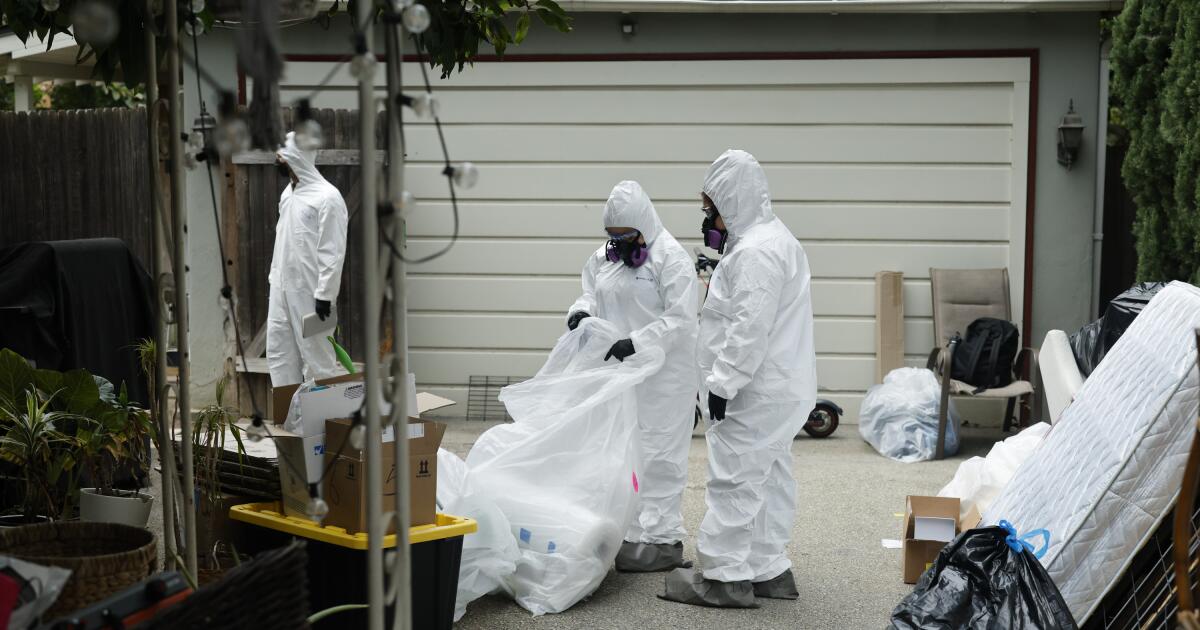
When the January 2025 firestorms swept through Altadena and Pacific Palisades they not only burned down homes but left thousands still standing riddled with smoke damage.
The disaster set the stage for lawsuits by fire victims who alleged their homes were filled with toxic contaminants, yet insurers refused to do hygienic testing and properly clean and make them habitable again.
This week, a much-anticipated bill was unveiled in the Legislature that would establish first-in-the-nation limits for smoke-damage contaminants, require testing and force insurers to restore homes to their prior condition.
The proposed law specifically applies to homes damaged in urban or “wildland-urban interface” fires — such as those in January 2025 — where burning structures, cars, utilities and other items generate more toxins than a rural wildfire.
Authored by Assemblymember Mike Gipson (D-Carson) and sponsored by Insurance Commissioner Ricardo Lara, Assembly Bill 1795 follows similar legislation introduced by Assemblymember John Harabedian (D-Pasadena).
That bill would apply to homes, schools and workplaces — and their properties — requiring insurers to meet existing health standards for lead and asbestos cleanup, while having the state develop additional ones for other contaminants.
Lara’s bill also follows a report issued last week by a smoke-damage task force he established last year, which established the framework for the bill. However, consumer advocates said it was stacked with members tied to the insurance industry.
Lara, who has been asked to step down by critics over his handling of insurers’ claims practices, has defended the task force and his handling of the wildfires, noting his department is investigating insurers.
Here’s what to know about the legislation, which still must go through legislative hearings before an Assembly vote.
Why is this bill a big deal?
Under the current system, insurers are not required to pay for expensive hygienic testing for toxins in smoke-damaged homes. That has been a big source of friction with fire victims, fueling the ongoing litigation over the matter.
Under the bill, however, insurers would be required to cover testing for lead, asbestos and other contaminants that have been found in soot, char and ash inside homes after a wildfire. Such testing would be required both before and after any cleanup work has begun to ensure the home is left in “preloss” condition. Additionally, it sets timelines for claims payments and prohibits insurers from halting payments for temporary housing until a home is cleared as safe, if a state of emergency has been declared.
Who will determine what levels of various contaminants are safe?
The bill requires the California Environmental Protection Agency to develop minimum sampling, testing and chemical screening levels by June 30, 2027. The requirements would be most rigorous in a “high-impact” zone within six miles of a fire perimeter, with potentially lesser requirements for residences as they get further away. The zones and testing requirements could be adjusted for specific fires.
The agency also is required to establish training standards and certification requirements for inspectors and others involved in the testing and restoration of properties.
How does this help the January 2025 fire victims?
More than 40,000 insurance claims have been filed as a result of the Eaton and Palisades fires, with more than 13,000 for smoke damage.
The bill allows the EPA, state and local agencies to establish expedited “interim” standards. Insurance department spokesman Michael Soller said this provision was written with the January 2025 fires in mind.
What do consumer advocates say?
They generally support the proposed changes. Amy Bach, executive director for United Policyholders in San Francisco, who sat on the smoke task force and was critical of its makeup, said she was pleased that the bill “acknowledges the perspectives of the homeowners and will advance their interests in an important way.” But she expects insurers will complain it’s too costly and threaten to leave the state if the bill is not toned down.
Attorney Dylan Schaffer, who has sued the California Fair Plan, the state’s insurer of last resort, over its smoke-damage practices, said the bill was a “very strong nod in the right direction” though it will be the final standards established by the state for testing and cleanup that will be most important. “It always gets down to the details,” he said.
What is the industry’s reaction?
The insurance industry is expected to lobby for changes to the bill, suggesting it could impose burdensome costs on companies.
Karen Collins, a vice president of the American Property Casualty Insurance Assn., said that “insurers support science‑based approaches to evaluating smoke damage and guiding appropriate remediation” but want to “help ensure the bill strikes a reasonable balance — protecting consumers while preserving insurance affordability, availability, and market stability.”
Rex Frazier, president of the Personal Insurance Federation of California, an industry group representing state property and casualty insurers, also said the bill lacks analysis of the “tradeoffs” between the higher claims payments that will result from it and and its effect on consumer premiums.
He also was concerned that the bill appears to bypass traditional rule-making procedures and allow the state EPA to establish the toxic contaminant and other standards without public hearings.
Soller said the intent of the bill is to allow the agency to forgo hearings only in developing interim standards.

San Diego County’s water agency is selling some of its water to another Southern California agency to help limit increasingly high water costs for 3.3 million people.
The water is going to Western Municipal Water District, which serves a growing area of nearly 1 million people in Riverside County, including Corona, Riverside and Temecula.
The San Diego County Water Authority will transfer at least 10,000 acre-feet of water per year over the next 21 years, enough for about 30,000 typical households.
The agencies said the deal will be worth about $100 million over the first five years.
The San Diego County agency has invested heavily to get more water in recent decades. In 2003, it struck an agriculture-to-urban transfer deal and it also buys water from the Carlsbad desalination plant under a 30-year agreement. These actions have brought San Diego County plentiful water — also some of the most expensive in the state. At the same time, conservation efforts in San Diego County have reduced water needs.
The San Diego County Water Authority delivers water to 22 cities and other agencies. Last year its board approved raising wholesale water rates 8.3%, which drew criticism from residents who said they were already struggling to afford their water bills.
Board Chair Nick Serrano said the deal “allows us to maximize the value of the investments San Diego County residents made over decades, strengthen water reliability, and do so in a way that is mindful of affordability.”
The two agencies said in a joint statement on Thursday that for Western Municipal, the additional water will help during drought and ensure reliable water without the cost and time involved in developing new water infrastructure projects.
The water will move from one area to the other through the pipelines of the Metropolitan Water District of Southern California, the regional wholesaler that imports water from the Colorado River and Northern California. Both San Diego County and Western Municipal are members of the MWD.
An agreement between the MWD and the San Diego County Water Authority last year ended a 15-year legal battle over water costs and cleared the way for San Diego County to start selling some of its excess water to areas that need it.

6 people injured after floor collapses at New Hampshire wedding venue

Pedestrian killed while crossing street in Ewing Township, New Jersey

New Mexico squares off against Saint Joseph’s (PA) in NIT matchup :: WRALSportsFan.com

Asheville Orchid Festival brings ‘best of the best’ to region

New York Giants met with WR RaJa Nelson at North Dakota State Pro Day

Florida High School Football Rankings: Top 25 teams – Oct. 21

How old is Bo Nix? What to know about Oregon quarterback ahead of 2024 NFL Draft

Cleary's 21 help Le Moyne down Central Connecticut State 69-64 in OT

99th annual Pony Swim held in Virginia

Indiana Members Credit Union announced as new anchor tenant at Bottleworks District

Video: Plane Collides With Vehicle at LaGuardia Airport

As cattle herds shrink and beef prices rise, investors back AI cow collars

French elections: Paris stays left as far right makes mixed gains

ICE officers set to deploy to airports as delays mount, border czar Homan confirms

Video: ICE Agents Will Be Deployed to U.S. Airports, White House Confirms
-

 Detroit, MI4 days ago
Drummer Brian Pastoria, longtime Detroit music advocate, dies at 68
-

 Oklahoma1 week ago
Family rallies around Oklahoma father after head-on crash
-

 Georgia7 days ago
How ICE plans for a detention warehouse pushed a Georgia town to fight back | CNN Politics
-

 Alaska1 week ago
Police looking for man considered ‘armed and dangerous’
-
 Science1 week ago
Federal EPA moves to roll back recent limits on ethylene oxide, a carcinogen
-

 Movie Reviews4 days ago
‘Youth’ Twitter review: Ken Karunaas impresses audiences; Suraj Venjaramoodu adds charm; music wins praise | – The Times of India
-

 World1 week ago
Thousands march worldwide in solidarity with Palestine, Iran on al-Quds Day
-

 World1 week ago
Jamal Rayyan, the first face of Al Jazeera, dies at 73