Business
U.S. hiring cools in January; California's outlook is dimmed by looming cuts in government and aid


WASHINGTON — U.S. job growth slowed at the start of the year, the government said Friday, as business services, manufacturing and other major industries held back on adding jobs amid increased uncertainty about the economy.
The Los Angeles-area wildfires, which began Jan. 7, didn’t have a material effect on the nation’s employment numbers, the Bureau of Labor Statistics noted. But analysts said it remains to be seen what the fires’ effect on jobs will be for California and beyond. Thousands of Californians affected by the fires already have filed for unemployment benefits. The state’s jobs and unemployment numbers for January won’t be reported until next month.
Although the national jobs report Friday was modestly below expectations, a separate national survey on consumer confidence was more concerning: It showed many people foresee increasingly higher prices in the months ahead. That, coupled with strong wage gains last month, sent stocks falling.
Investors and economists worry about tariffs and other Trump administration policies reigniting inflation — which not only would put the kibosh on near-term interest rate cuts but also could force the Federal Reserve to reverse course and raise rates.
“Uncertainty makes it more likely that something could tip us into recession,” said Erica Groshen, an economist and former commissioner of the Bureau of Labor Statistics, which produces the monthly jobs report. “A lot of it is going to depend on confidence,” she added. “Are we going to have a price shock?”
The jobs report Friday showed that the nation’s unemployment rate ticked back down to just 4%, from 4.1% in December. At the same time, hourly wages rose a strong 0.5% in January from the prior month, for an annual growth rate of 4.1%.
Thus far, experts believe that labor costs haven’t spurred inflation, but with the unemployment rate already near historical lows and U.S. birth rates down, plans for mass deportations of unauthorized foreign workers, combined with higher tariffs, probably would add to overall inflationary pressures.
The national jobs report included significant upward revisions to the adult and workforce populations, taking into account the large growth in foreign migration in recent years, although Southwest border crossings have slowed sharply since last summer.
The new population estimates “show clearly that the surge in net immigration was a key factor in boosting U.S. labor supply in the last couple of years, in turn alleviating the labor shortages that were so prevalent in 2022,” said Brian Coulton, chief economist at Fitch Ratings.
The University of Michigan’s consumer sentiment report said people’s expectations for inflation over the next 12 months jumped from 3.3% earlier this year to 4.3% in February, the highest since November 2023.
The Fed’s effort to curb inflation further to its target 2% level has stalled in recent months. Consumer price inflation in the fourth quarter was between 2.6% and 2.9%.
Higher inflation and weaker consumer confidence would weigh on spending and job creation. Last month, nearly all of the 143,000 net gain in payrolls came from healthcare, retail and government. That’s still healthy growth, but lower than the 170,000 that economists were expecting.
And both government and healthcare employers could soon feel the effects of the Trump administration’s moves to pare federal payrolls and public aid that is crucial for health services and social assistance.
That presents challenges especially for states like California, said Michael Bernick, an employment lawyer for Duane Morris in San Francisco. “California has lived off of heightened government spending in the post-pandemic period, but that is coming to an end,” said Bernick, former director of the state’s Employment Development Department.
“Also, California’s main sectors of job growth — healthcare and government — have been targeted for reform and employment reductions by the new administration.”
On the positive side, rebuilding after the wildfires should give a lift to the L.A.-area economy, although it may take some time for employment to bounce up after the disruption of normal economic activity caused by the disaster, which destroyed more than 16,000 structures, most of them houses.
California’s EDD reported that as of Tuesday, workers seeking relief had filed about 5,300 unemployment benefit claims linked to the fires. That’s about 10% of the total new claims filed statewide in the most recent week. Data on federal Disaster Unemployment Assistance for self-employed people weren’t yet available.
For months now, California has been lagging behind the nation in job growth, with hiring weakness in major sectors such as tech and entertainment. The state’s unemployment rate for December was 5.5%, the second-highest in the country, behind Nevada, which was 5.7%. Los Angeles County’s jobless rate was 6% at the end of last year.
The EDD said the statewide jobs report for January won’t be released until March 17, later than usual for most months, because of a yearly review of the statistics using a wider array of information.
Friday’s national jobs report also showed that the U.S. added about 600,000 fewer jobs last year than previously reported. The adjusted figures show that the U.S. economy created, on average, 166,000 additional jobs a month last year, down from 216,000 in 2023.
The rates of new job openings and people quitting their jobs, both of which jumped in 2021 and 2022, have since fallen below pre-pandemic levels. And the labor market outlook has become more cloudy as the new administration has promised to implement a range of policies, some positive and some negative for growth. These include increasing tariffs, cutting taxes and government regulations and implementing mass deportations of immigrants who are in the country illegally.
“The job market still looks solid — and the largest threats to its steadiness are Trump’s plans to deport immigrants and raise tariffs,” said Harry Holzer, a labor economist and public policy professor at Georgetown University.


The luxury shopping center in Pacific Palisades will reopen next month after more than $100 million in renovations forced by the January 2025 wildfire that devastated the Los Angeles neighborhood.
Palisades Village will reopen Aug. 15, owner Rick Caruso announced Wednesday. The outdoor center survived the blaze that destroyed homes and other businesses but needed refurbishment to eliminate contaminants that the fire could have spread.
Crews are putting finishing touches on mall buildings after tearing them down to the studs, treating the wood and rebuilding the walls, Caruso said.
“Everybody’s working, and stores are moving their products in,” he said. “It’s a really cool feeling that people have really locked arms and are working together.”
An electrician installs lighting for a restaurant at Rick Caruso’s Palisades Village on Thursday. The shopping center is scheduled to reopen mid-August.
(Myung J. Chun / Los Angeles Times)
Pacific Palisades resident Allison Polhill, who is rebuilding the home of 30 years that her family lost in the blaze, said she is “thrilled” at the prospect of returning to the mall she used to frequent. Its comeback is a boost for the community, she said.
“Every single step that we make to reopen our commercial corridors is going to bring more people back into the Palisades,” said Polhill, who expects to move back into her home at the end of August.
A total of 6,822 structures were destroyed in the Palisades fire, including more than 5,500 residences and 100 commercial businesses, according to the California Department of Forestry and Fire Protection.
Caruso previously attributed the mall’s survival to the hard work of private firefighters and the fire-resistant materials used in the mall’s construction.
The $200-million shopping and dining center opened in 2018 with a movie theater and a roster of upmarket tenants, including Erewhon, which may be the only grocer in the heart of the fire-ravaged neighborhood when it opens.
Caruso’s company was able to fill the mall with tenants despite the long shutdown.
Palisades Village is 99% leased, with the majority of tenants returning, said Jackie Levy, chief financial and revenue officer. Nearly one-third of the shops and restaurants are new to the property.
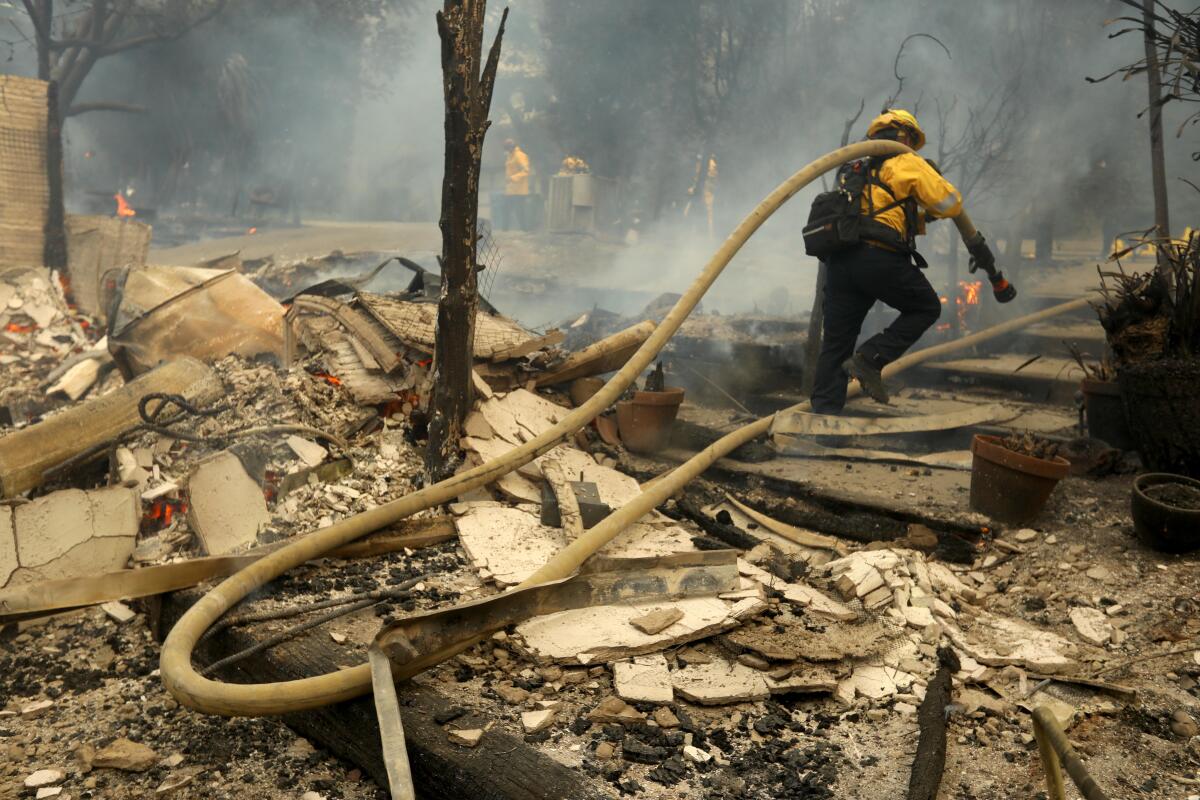
A firefighter carries a hose back to his rig while walking through a destroyed home from the Palisades fire in Pacific Palisades on Jan. 7, 2025.
(Genaro Molina / Los Angeles Times)
Last year, Pacific Palisades-based fashion designer Elyse Walker said she would reopen her eponymous store in Palisades Village after losing her 25-year flagship location on Antioch Street to the inferno.
Other neighborhood shops destroyed in the fire that are reopening at the mall include K Bakery and Loomey’s Toys, which caters to children up to age 12 and used to be across the street from Palisades Elementary Charter School.
“It’s been a journey and I’m excited because I wasn’t sure that there was going to be a place to come back to,” said toy store owner Amanda Rastegar. “Hopefully we can bring some of that magic back.”
Rastegar’s home in the Palisades survived but was damaged by the fire. The family returned about eight weeks ago. Her last memory of the fire was a burning supermarket.
“I just couldn’t wrap my brain around what was happening,” she said. “By the time I left, Gelson’s was on fire.”
Among the returning tenants is Angelini Ristorante & Bar. Well-known Los Angeles chef Gino Angelini said he will be in the kitchen next month for a return of the Italian restaurant.
“We won’t do a big celebrity open,” he said. “We want to have a very soft opening and see our customers come back.”

Construction takes place at Rick Caruso’s Palisades Village on Thursday. The shopping center is scheduled to reopen mid-August.
(Myung J. Chun / Los Angeles Times)
An elaborate celebration would not feel “correct for me,” Angelini said, because the devastation has been “very sad” for so many.
Other new tenants include local chef Nancy Silverton, who has agreed to move in with a new Italian steakhouse called Spacca Tutto. Women’s activewear retailer LESET will open its first West Coast location.
Caruso said he is optimistic that customers will return to the center, even though many Pacific Palisades residents are still dispersed. One tracking system estimated that about 30% of the Village’s customer base was impacted by the fire, he said.
“That means 70% did not get impacted, so there’s a lot of customers still left out there,” Caruso said. Historically, the center drew customers from as far away as Beverly Hills and Calabasas, as well as Malibu, Brentwood and Santa Monica.
He also hopes many will be inspired to visit the revived mall.
“I believe in the goodness of people and I believe that people are going to want to support the Palisades,” he said. “They’re going to want to be there and support the businesses that have had the courage and the heart to reopen.”

Walmart is rapidly expanding its network of electric vehicle chargers designed for customers to use while they shop.
The network could help fill gaps in EV infrastructure in states with greater need for chargers. Walmart, which has more than 5,000 locations in the U.S. and hundreds in California, says more than 90% of Americans live within 10 miles of one of its stores.
The chargers also offer an incentive for customers to choose Walmart — Walmart Plus members will receive a 10% discount off an average price of $0.46 per kilowatt-hour of energy at the company’s chargers.
Walmart chargers are already available at more than 75 locations in 17 states, with Texas boasting the most charging stations, followed by Florida and Arizona.
Matthew Nelson, Walmart’s director of energy policy, said last week on LinkedIn that the network will soon reach 29 states, including California.
“We are delivering on the promise of affordable, reliable and convenient charging,” Nelson said in his post.
According to Walmart’s website, six charging stations are coming to California soon, though the company did not offer a specific timeline.
The chargers will be installed at stores in Antelope, Brea, Fresno, Stockton, Suisun City and Vallejo.
Most charging sites in California will include eight to 16 fast-charging stalls, said Walmart spokesperson Kelsey Bohl.
The company first announced plans in April 2023 to install its own EV chargers at Walmart and Sam’s Club stores, with a goal of installing thousands of chargers by 2030. Partnering with ABB E-Mobility and Alpitronic, it added 25 new charging sites this past May and six more in June.
“Walmart is building a leading retail-integrated EV fast-charging network, focused on delivering an affordable, reliable and convenient charging experience where customers already shop,” Bohl said in an emailed statement. “Customers can charge while they shop, access stations through the Walmart app they already use, and benefit from affordable pricing.”
The charging stations already available include 612 individual charging stalls using 400-kilowatt chargers. Each stall has a dual charging cord with both Combined Charging System and North American Charging Standard connectors. The standard connectors, designed by Tesla, are smaller and lighter than the combined systems.
The primary way to pay for the chargers is through the Walmart app, but the company is also experimenting with built-in credit card readers to allow those without the app to use the stations.
Customers can check charger availability on the Walmart app. The company said the chargers will be available 24 hours a day.

Robotaxis could be turning into robocops.
A self-driving Waymo reported two teens to San Mateo, Calif., police on Monday after they were found drinking alcohol and shooting toy guns in the back of the vehicle.
According to a social media post from the San Mateo Police Department, officers detained two 15-year-olds after the Waymo they were riding in contacted the department and stopped in a parking lot until law enforcement arrived.
“Parents do you know where your teens are?” the San Mateo Police Department wrote on Facebook following the incident. “Waymo does!”
Officers removed both teens from the vehicle and determined they were using toy guns to shoot Orbeez out the windows. Orbeez are small, water-absorbing beads sold at toy stores.
“Toy guns, water guns, and BB guns all pose real dangers, especially to an untrained eye,” the Police Department said. “The simple handling of them can cause fear in [passersby].” “
A video posted on Facebook shows at least five officers and a police dog responding to the scene and approaching the Waymo with their weapons raised.
Waymo did not immediately respond to a request for comment.
Waymo vehicles have internal cameras and microphones that may be used in an emergency or to “promote safety and security,” according to Waymo’s online support page.
The cameras are also used to ensure the vehicles are clean and to help find lost items, according to the support page.
The company said it does not use facial recognition or other biometric identification technologies to identify individuals.
“In more urgent circumstances, support may access live video during a trip,” the Waymo page said.
The San Mateo Police Department’s Facebook post has garnered nearly 60 comments, with one user accusing Waymo of “snitching.”
“At least they got a designated driver?!” one user commented.
-

 Virginia5 minutes ago
MEOC Organization hosts annual summer picnic for Southwest Virginia seniors
-

 Washington12 minutes ago
Future uncertain for site of former Mount Washington church destroyed in massive fire
-

 Wisconsin14 minutes ago
South Milwaukee, Wisconsin, officials in standoff with homeowner over year-round skeleton display
-

 West Virginia20 minutes ago
West Virginia coach Rich Rodriguez wants to save college football. Here’s his pitch:
-

 Wyoming27 minutes ago
Cathy Holman named 2026 Mick & Susie McMurry Cowboy Code Try Award recipient
-

 Crypto30 minutes ago
LAB Token Crashes 80% to $1.25 as $5B Market Cap Vanishes in 48 Hours
-

 Finance35 minutes ago
Intact Financial provides update on Q2 catastrophe and large losses
-

 Fitness42 minutes ago
Wellness Wednesday: Exercise & heart disease

