Business
Trump Will Hit Mexico, Canada and China With Tariffs


President Trump plans to impose stiff tariffs on Mexico, Canada and China on Saturday, a move aimed at pressuring America’s largest trading partners into accepting more migrants and halting the flow of migrants and drugs into the United States.
Mr. Trump will put a 25 percent tariff on goods from Mexico and Canada, along with a 10 percent tariff on Chinese products, Karoline Leavitt, the White House press secretary, said in a news briefing Friday.
Speaking to reporters in the Oval Office on Friday, Mr. Trump said the tariffs were punishment for Canada, Mexico and China allowing drugs and migrants to flood into the United States.
Mr. Trump’s decision to hit America’s trading partners with tariffs could mark the beginning of a disruptive and damaging trade war, one that is far messier than the conflict that defined Mr. Trump’s first term.
Back then, Mr. Trump placed tariffs on nearly two-thirds of Chinese imports, resulting in China hitting the U.S. with levies of its own. Mr. Trump also imposed tariffs on steel and aluminum, inciting retaliation from the European Union, Mexico and Canada.
While the tariffs against allies were viewed as controversial, they were relatively limited in scope. It remains to be seen exactly what products Mr. Trump’s new tariffs apply to, but the president has implied that they would be expansive and cover imports from Canada and Mexico, close allies of the United States.
Mr. Trump said on Friday that he would also “absolutely” impose tariffs on the European Union, saying they had “treated us so terribly.” He added that the United States would eventually put tariffs on chips, oil and gas — “I think around the 18th of February,” he said — as well as later levies on steel, aluminum and copper.
Canada, Mexico and China are America’s three largest trading partners, supplying the United States with cars, medicine, shoes, timber, electronics, steel and many other products. Together, they account for more than a third of the goods and services imported to or bought from the United States, supporting tens of millions of American jobs.
The three governments have promised to answer Mr. Trump’s levies with tariffs of their own on U.S. exports, including Florida orange juice, Tennessee whiskey and Kentucky peanut butter. All three of those states have Republican senators representing them in Congress and voted for Mr. Trump in 2024.
Mr. Trump’s tariffs would immediately add a surcharge for the importers who bring products across the border, most of which are U.S. companies. In the nearer term, that could disrupt supply chains and lead to shortages, if importers choose not to pay the cost of the tariff.
If importers do pay the tariff, it will probably translate into higher prices for some American goods, as those companies generally pass the cost of tariffs on to their customers.
“Hopes that Trump’s tariffs threats were merely bluster and a bargaining tool are now crumbling under the harsh reality of his determination to deploy tariffs as a tool to shift other countries’ policies to his liking,” said Eswar Prasad, a trade policy professor at Cornell University.
Mr. Trump had said in November that he would put the tariffs on Canada, Mexico and China, in an effort to halt the flow of migrants and drugs, particularly fentanyl, into the United States.
The threat set off a scramble from Canadian and Mexican officials, who tried to persuade the administration to hold off on tariffs by engaging in last-minute talks with Secretary of State Marco Rubio and detailing the efforts they were making to police the border.
Auto, agricultural and energy companies have all been pushing the Trump administration hard not to apply tariffs, and have called for an exclusions process that could give some products an exemption.
Marcelo Ebrard, the Mexican economy minister, said Friday that tariffs would most likely lead to shortages in specific goods, and that U.S. prices on Mexican goods would increase. He called the move “a strategic mistake” by the Trump administration.
“The main impact is clear: Millions of families in the United States would have to pay 25 percent more,” he said.
Prime Minister Justin Trudeau of Canada, in a post on X on Friday afternoon, said that “no one — on either side of the border — wants to see American tariffs on Canadian goods.” He said that “if the United States moves ahead, Canada’s ready with a forceful and immediate response.”
A spokesman for the Chinese embassy said that China firmly opposed tariffs and that any differences or frictions should be resulted through dialogue. “There is no winner in a trade war or tariff war, which serves the interests of neither side nor the world,” the spokesman said.
Mr. Trump’s advisers had been weighing different options for the tariffs, like applying them to specific sectors, such as steel and aluminum, or delaying their effective date for several months, according to people familiar with the planning.
Ms. Leavitt said the president had chosen to impose tariffs because the countries “have allowed an unprecedented invasion of illegal fentanyl that is killing American citizens, and also illegal immigrants into our country.”
“The amount of fentanyl that has been seized at the southern border in the last few years alone has the potential to kill tens of millions of Americans,” she said. “And so the president is intent on doing this.”
At both borders, the number of illegal crossings has dropped sharply.
The number of unauthorized crossings at the southern border in December 2023 reached nearly 250,000, overwhelming the Border Patrol and causing the government to shut down a port of entry. At the northern border, the flow of migrants crossing illegally skyrocketed during the 2024 fiscal year. During that time, more than 23,000 arrests were made of migrants crossing illegally — two years before that figure was around 2,000.
The situation at the border has changed since then.
In December, agents made roughly 47,000 arrests at the southern border and 510 at the northern border.
The economic fallout from the tariffs would depend on how they were structured, but the ripple effects could be broad. Canada, Mexico and the United States have been governed by a trade agreement for more than 30 years, and many industries, from automobiles and apparel to agriculture, have grown highly integrated across North America.
Mary Lovely, a senior fellow at the Peterson Institute for International Economics, said the tariffs would be “very costly” for U.S. businesses.
U.S. factories rely on inputs from both countries, including minerals and timber from Canada and auto parts from Mexico. The tariffs would also go against efforts that U.S. companies have made in recent years to move out of China, at the urging of the Trump and Biden administrations, Ms. Lovely said.
According to economists at S&P Global, the auto and electric equipment sectors in Mexico would be most exposed to disruption if tariffs were enacted, as would mineral processing in Canada. In the United States, the largest risks would be to the farming, fishing, metals and auto sectors.
Jonathan Samford, the president of Global Business Alliance, which represents international companies, said the tariffs might result in rising costs for U.S. consumers, slowdowns for U.S. businesses and lost opportunities for future investment.
In his remarks from the Oval Office Friday, Mr. Trump said he would “probably” reduce the tariff on Canadian oil to 10 percent. Roughly 60 percent of the oil that the United States imports comes from Canada, and about 7 percent comes from Mexico, and experts have warned that cutting off those flows could cause American energy prices to spike.
While the United States is the world’s largest oil producer, refineries need to mix the lighter crude produced in domestic fields with heavier oil from places like Canada to make fuels like gasoline and diesel.
The potential economic implications from tariffs are also complicating matters for the Federal Reserve, which is still trying to wrestle inflation down to its 2 percent target. The Fed this week held interest rates steady, after a series of cuts, amid persistent inflation and questions about how the tariffs would play out.
On balance, most economists expect higher trade barriers to raise prices for U.S. businesses and households, which could lead to a temporary burst of higher inflation. Whether that escalates into a more pernicious problem will depend on whether Americans’ expectations about future inflation start to shift higher in a meaningful way.
Ernie Tedeschi, the director of economics at the Yale Budget Lab, estimates that a 25 percent tariff on all Canadian and Mexican imported goods — paired with a 10 percent tariff on all Chinese imports — would lead to a permanent 0.8 percent bump in the price level, as measured by the Personal Consumption Expenditures price index. That translates to roughly $1,300 per household on average. Those estimates assume that the targeted countries enact retaliatory measures and that the Federal Reserve does not take action by adjusting interest rates.
Mr. Tedeschi expects tariffs on that level to eventually shave 0.2 percent off gross domestic product once inflation is taken into account.
Mr. Trump’s top economic advisers have disputed the idea that the tariffs fuel inflation, and argued that exporters from countries such as China would lower their prices in the face of higher U.S. tariffs.
In the press briefing, Ms. Leavitt said inflation had remained subdued in Mr. Trump’s first term, despite tariffs being imposed. And she said the president was undertaking other policies that would lower inflation, like passing tax cuts and encouraging energy production.
Hamed Aleaziz, Vjosa Isai and Emiliano Rodríguez Mega contributed reporting.



A landmarked downtown Los Angeles apartment building designed by famed Los Angeles architect John Parkinson is on the market as its owners face foreclosure.
Residences in the Metropolitan, a 10-story tower built in 1913, are nearly filled with tenants but its ground floor retail spaces on Broadway and 5th Street are unoccupied, as are other street-level stores in downtown’s Historic Core.
The historic building was once considered one of the best in the city and is owned by the Fallas family, which operated a chain of value-priced clothing stores based in Gardena including one called Fallas Paredes in the Metropolitan.
Fallas-Paredes at 449 S. Broadway, Los Angeles, CA 90013.
(Google Maps)
Around 2011, Michael Fallas, who once worked in family’s downtown store as a stock boy, converted the upstairs floors from offices to apartments while continuing to operate Fallas Paredes. The store closed more than five years ago in the wake of a 2018 filing by its parent company for Chapter 11 bankruptcy protection.
Earlier this month in state Superior Court, a special servicer representing Fallas’ lender asked for a judicial foreclosure of the property, alleging that Fallas had stopped making payments on a $32 million loan dating to 2017. After leasing the property for years, Fallas bought the building in the 1990s.
Fallas didn’t respond to requests for comment.
The location of the Metropolitan where the buildings stands was hailed in a Times story in 1912, saying “it is regarded by many realty men as the most valuable piece of real estate in Los Angeles.”
The building today is recognized as a city historic-cultural monument because “Broadway became the commercial center of the Southland, a title it retained until well after World War II,” with its development, the city said. One of the architects who designed the Metropolitan in the Beaux-Arts style was John Parkinson, who is credited with designing such well-known local structures as City Hall, the Los Angeles Memorial Coliseum and Union Station.
Notable tenants in the Metropolitan have included the Los Angeles Public Library, Owl Drug Co., variety store J.J. Newberry and real estate company Janns Investment Co., which sold the land where UCLA is built and developed Westwood Village, among other Los Angeles neighborhoods.
In recent years, the buildings around the Metropolitan have struggled to keep retail tenants after a spurt of residential conversions of historic buildings starting in the early 2000s brought commerce to the neighborhood. Many downtown businesses have struggled since the pandemic reduced occupancy in offices downtown and reduced the flow of visitors.
“The lack of bodies on the street is generally hurting downtown, and that’s one of the reasons that has building has problems,” said downtown real estate broker Hal Bastian, who lives in the Historic Core.
There are close to 1,000 residential units in historic buildings at the intersection of Broadway and 5th Street, Bastian said, but all the ground floor stores are closed. Drug stores there suffered substantial losses from shoplifting he said, and now, “our challenge on Broadway is leasing.”
The 88 apartments in the Metropolitan are 91% rented, according to a listing for the property by the Zacuto Group, which also touts its roof deck with pool, fitness center and barbecue grills. No sale price is set.
Business
January 2025 wildfire victims seek tougher penalties against State Farm over claims handling
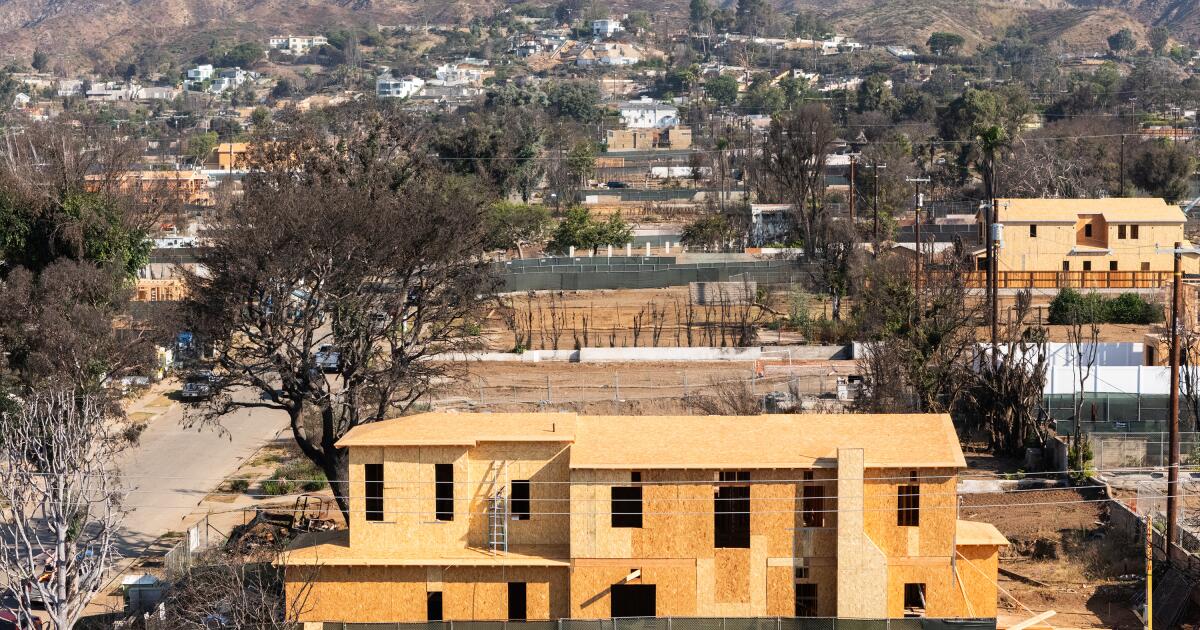
A fire survivors’ group announced Thursday it was seeking tougher penalties against State Farm over its handling of January 2025 wildfire claims.
The Every Fire Survivor’s Network said it was petitioning to join a state enforcement action announced this year against the company to make sure the case results in meaningful changes at California’s largest home insurer.
“We’re seeking a systematic review of all their claims and penalties calibrated to the actual scale of the harm — and we’re seeking the payouts that families are owed,” said Joy Chen, executive director of the group, at a Pacific Palisades news conference joined by victims of the fires.
The Department of Insurance in May filed an administrative action against State Farm General — the subsidiary of the giant Bloomington, Ill., insurer that handles California home insurance — after completing a “market conduct” exam.
The Jan. 7, 2025, fire damaged or destroyed more than 18,000 structures and killed 31 people.
State Farm has received more January 2025 claims than any other insurer — more than 13,700 auto and homeowners claims as of May 4, with payouts totaling $5.7 billion, according to the company.
The market conduct exam looked at 220 sample claims filed by the victims and found 398 violations of state law in about half of them.
Among other alleged violations, it found that the company failed in numerous cases to pursue a “thorough, fair and objective investigation” into claims, failed to come to “prompt, fair, and equitable settlements” and made settlement offers that were “unreasonably low.”
In announcing the action, Insurance Commissioner Ricardo Lara called the company’s claims handling “unacceptable” and said his department was taking “decisive action to hold them accountable.”
The state is seeking a “cease and desist” order to stop the insurer from engaging in unfair or deceptive practices.
It also has threatened to suspend State Farm’s license over the alleged violations, which each carry a penalty of up to $5,000 — or twice that figure if found to be willful. That could amount to a penalty of $2 million or more.
The threat to actually suspend State Farm’s license and its authority to write policies has been viewed skeptically by some, given its roughly 20% market share of the state’s home insurance market.
The company, which had an opportunity to include its responses in the exam report, denied fault in some cases and admitted fault in others. It often blamed problems on individual adjusters and denied systemic issues with its claims handling.
The petition filed by the wildfire survivor’s group criticizes the sample size of the market conduct exam as too small to capture all the alleged deficiencies in State Farm’s claims handling, which it claims are a “general business practice” of the company.
The group is seeking to conduct discovery, cross examine witnesses, present testimony from fire victims and bring more that 1,600 firsthand policyholder statements regarding State Farm’s practices into evidence, according to the petition.
It also wants State Farm to reopen cases in which claimants were paid too little, and it is seeking to participate in settlement discussions in order to increase any penalty State Farm would pay.
It calculated that a $2-million penalty would amount to a minute fraction of the assets of the State Farm Group.
“I submit to you that doesn’t defer bad conduct, it just allows you to continue to do it,” said Michelle Meyers, an attorney for Every Fire Survivor’s Network, at the news conference.
Consumer Watchdog, which has been a harsh critic of State Farm, also is providing legal support for victims’ effort.
Sevag Sarkissian, a spokesperson for State Farm, said the company was aware of the petition.
“We recognize that many wildfire survivors, including those that are State Farm General policyholders, continue to face difficult recovery challenges,” he said. “Our focus remains on helping customers recover.”
Michael Soller, a spokesperson for Lara, said the department is “acting with urgency to assist wildfire survivors in their ongoing recovery by investigating formal complaints filed by survivors and conducting the expedited market conduct exam that led to this enforcement action.”
He added that the department’s position is the state’s Administrative Procedure Act does not contemplate the commissioner or department staff authorizing intervention requests in the case.
He said that would be a hearing officer’s or administrative law judge’s decision when one is assigned to the case.
Meyers acknowledged the request was novel but said her reading of the law is that Lara can make the decision because no judge is yet assigned.
In response to the criticism, State Farm pledged earlier this year to improve its claims handling, including by providing single points of contact and improved communication so there are “fewer handoffs, fewer repeated explanations, and seamless support.”
It also named a new vice president of customer relations for State Farm General.

The state’s trial attorneys and Uber say they have reached a last-minute deal to scrap their dueling ballot measures and avert what was gearing up to be one of most expensive battles of the November election.
The deal, which comes a day after both measures qualified for the November ballot, has Uber agreeing to bulk up safety measures, while the trial attorneys will limit how much they can claim for lien-based medical treatment of victims who get in Uber or Lyft accidents, according to spokespeople for both sides of the campaign.
“Both sides agree: Californians deserve a system that’s safe, fair, and accountable,” read a joint statement from Uber and the Consumer Attorneys of California, a powerful attorney trade group. “This agreement protects patients from unnecessary treatment or getting overcharged, ensures access to medical care and legal representation, and strengthens safety measures.”
The agreement, finalized Thursday, means the ride-share giant will kill its ballot measure to cap how much attorneys can earn in vehicle collision cases and limit medical damages to rates based on insurance. Uber has argued that the costs for medical treatment done on a lien, which allows doctors to get paid from a cut of the plaintiff’s payout, far exceed what it would cost if the victim had used their own insurance.
In return, the Consumer Attorneys of California will cancel its competing ballot measure that sought to increase legal liability for ride-share companies if a passenger is sexually assaulted by a driver. The measure followed an investigation by the New York Times into sexual assault by drivers.
Both sides had poured tens of millions into the campaigns, plastering billboards across Los Angeles.
Lawyers claimed the fight had turned existential with the measure threatening to decimate the profit margin of many personal injury cases and leave drivers with small or thorny cases unable to find an attorney willing to take their case.
Spokespeople say the deal is predicated on their agreement being codified into a bill within the next week. Otherwise, they said, each side will move forward with its ballot measure.
-

 Illinois3 minutes ago
Illinois has already broken the record for number of tornadoes in a year — and it’s only June
-

 Indiana5 minutes ago
Hamilton County teen is youngest delegate at Indiana Republican convention
-

 Iowa11 minutes ago
Reynolds orders flags lowered for funeral of Iowa Sen. Julian Garrett
-
Kentucky21 minutes ago
Louisville celebrates Juneteenth with parade honoring history and culture
-

 Louisiana26 minutes ago
From ‘not pageant people’ to Miss Louisiana stage: Addison J…
-

 Maine33 minutes ago
Maine gubernatorial candidates trade barbs on first day of general campaign
-

 Maryland36 minutes ago
Maryland governor celebrates Juneteenth in historically-Black Montgomery County community – WTOP News
-

 Michigan41 minutes ago
West Michigan celebrates Juneteenth


