Business
The Stock Market Was One of Trump’s Favorite Talking Points. Not Lately.


Source: LSEG Data & Analytics
Note: Data is through Feb. 28.
Change in stock indexes since Inauguration Day
During his first term, President Trump regularly took credit for a booming stock market, citing soaring share prices as a measure of his success in office.
And after his election victory in November, he pointed to the market rise as a sign of optimism.
But since his inauguration in January, Mr. Trump has been relatively muted about stocks, even after the S&P 500 hit a record on Feb. 19.
The S&P 500 has since fallen almost every day, and the index is now lower than it was when Mr. Trump took office on Jan. 20.
Other indexes, including those more closely tied to the ebb and flow of the economy, have also fallen.
On Friday, the S&P 500 surged higher late in the day but remained lower for the week, its second consecutive week of losses for the first time since October. Other bullish reflections of Mr. Trump’s election have also faded, with Bitcoin tumbling roughly 20 percent over the past month.
While it is only less than two months into the new administration, the market is showing signs of weakness, as investors have become increasingly nervous about an impending sell-off. Consumer sentiment is souring and investors are growing weary over the cacophony of policy proposals emanating from Washington.
“The tariff rhetoric has become daily and extreme, sentiment is awful and trading is on edge,” said Andrew Brenner, head of international fixed income at National Alliance Securities.
Today’s market is fundamentally different than it was when Mr. Trump first entered the White House in early 2017.
For the two years preceding Mr. Trump’s first term, the S&P 500 had bumbled along. Stock and bond markets had grappled with the fallout of a domestic energy crisis as debt-laden oil companies had started going bankrupt.
Interest rates were roughly 4 percentage points lower than they are now, as the Federal Reserve tried to gently heat up the economy and revive tepid growth. As Mr. Trump unleashed tax cuts and promoted a pro-growth agenda, stocks were primed to rise.
“Highest stock market EVER,’’ Mr. Trump wrote in a social media post in July 2017.
But as Mr. Trump entered his second term, the stock market had already surged, with valuations at historic highs. The S&P 500 had risen more than 20 percent for two consecutive years — in 2023 and 2024 — for the first time since 1996. That means reaching new heights could prove harder, especially as the engine of the recent rally, big tech stocks, begins to sputter.
Source: LSEG Data & Analytics
Note: Data for 2025 is through Feb. 28.
The S&P 500 plotted daily
The market’s composition has also shifted since Mr. Trump’s first term.
The huge companies driving the A.I. boom have become so large that even small changes in their individual stock prices can move the entire S&P 500 index. That makes for a sometimes volatile market.
These stocks, known as the Magnificent Seven, together now account for roughly a third of the entire index by market value.
Market value of S&P 500 companies
Companies with a market capitalization of over $500 billion are labeled
Source: LSEG Data and Analytics
Note: Data is as of Feb. 28.
As these stocks’ share prices rose, they helped to lift the rest of the market. The risk is, as their prices fall, they become an anchor weighing the market down.
With competition among A.I pioneers intensifying, some of these marquee stocks have already lost their luster. Nvidia, which makes chips for A.I. companies, has fallen almost 10 percent since Mr. Trump’s inauguration. Of the S&P 500’s 11 sectors, tech is one of only two sectors that have declined so far this year
These moves have so far been largely unattributed to the new administration, illustrating the challenge facing Mr. Trump — and any president — seeking to engineer a buoyant stock market, especially if big tech continues to languish.
Source: LSEG Data & Analytics
Note: Data is through Feb. 28.
Change in stock prices since Inauguration Day
At a conference in Miami on Feb. 19, the day that the S&P 500 notched a record high, Mr. Trump said: “I think the stock market’s going to be great.”
In his speech, he exaggerated the gain made by the Dow Jones Industrial Average since the election, saying it had risen 10 percent, when it had risen less than 7 percent. The S&P 500 was up as much at 6.25 percent from the election to Feb. 19, but is now only 3 percent higher since Nov. 5.
Investors are notably nervous. While few foresee a full-blown recession, according to Bank of America’s latest survey of fund managers, many are wary of the market’s uncertain direction, especially given the potential for reciprocal tariffs to spark a trade war, upend the Federal Reserve’s fight with inflation and crimp economic growth.
Almost 90 percent of survey respondents said that stocks are overvalued. The CBOE Skew Index, which measures how much investors are girding for a sell-off by tracking trades in options markets that would buffer against a sudden plunge in the value of the S&P 500, reached its highest level ever on Feb. 18, the day before that index hit its record high.
It suggests that investors are nervous that the market could soon tumble. And that could be why the market is no longer the barometer of success that Mr. Trump once claimed it was.




Shortly after the Iran war started four weeks ago, farming executive Bikram Hundal was beside himself.
The vice president of operations at Sequoia Nut Co. had shipped 15 containers of almonds, walnuts and pistachios from the Port of Long Beach, and he wasn’t exactly sure where they were on the high seas.
Their destination was Dubai’s Port of Jebel Ali, a major trading hub, but the jets, missiles and rockets crisscrossing Middle Eastern skies had diverted one ship to the Netherlands and another to Algeria.
Finally, the remainder of the 300 tons of California nuts worth $1.7 million was offloaded at the Port of Fujairah, also in the United Arab Emirates but on the Gulf of Oman, a bit farther from the fighting.
Now, shipping costs to the region have tripled to $7,500 per container, and Hundal is uncertain when the Tulare County company will get its money.
“They will be slow in paying for those goods, and they told us whatever goods were sold already to them [that] have not shipped, please do not ship those,” he said. “That will impact our cash flow. We have to pay the growers for them.”
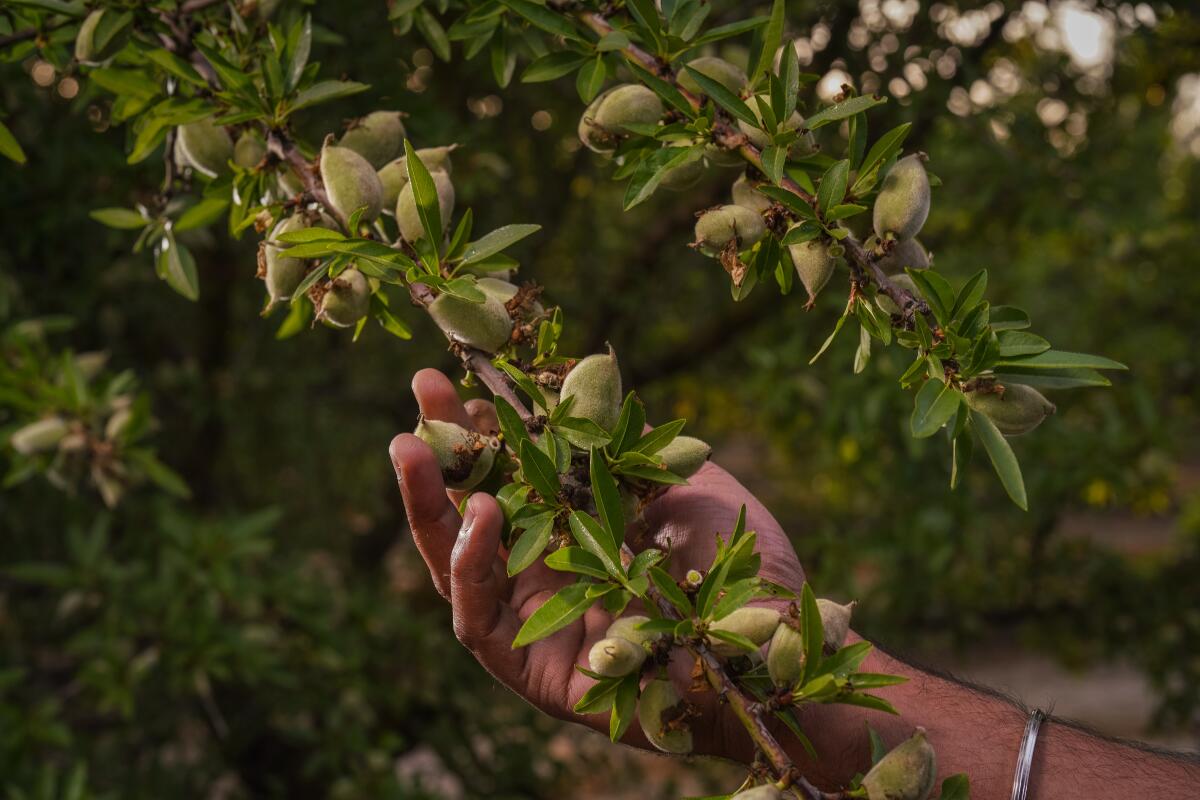
Since the start of the war, the average price of a gallon of diesel in California has hit $7.26. Fertilizer prices have risen too.
As the war unfolds in Iran, farmers like Hundal are being whiplashed by forces beyond their control, including the cutting off of key export markets and a sharp rise in the cost of doing business.
The war has driven up the price of diesel that fuels trucks and farm and ranch equipment, as well as fertilizers critical for increasing crop yields — leading to fears that if the conflict goes on much longer it could push up prices at the market.
The average price of a gallon of diesel in California has hit $7.26, up more than $2 compared with a month ago. Diesel that powers tractors and other non-road vehicles and engines is typically almost $1 cheaper as it is exempt from certain taxes.
Tara Gallegos, a spokesperson for Gov. Gavin Newsom, blamed the farm economy difficulties on President Trump’s “recklessness” in starting the war.
“California farmers are getting hit twice with higher fertilizer costs and higher fuel costs. Every American will wind up paying for that at the grocery store because these commodities are priced globally,” she said.
Trump has made conflicting statements about the rise in fuel prices, contending that it is a “small price to pay” to pursue his war aims of knocking out Iran, but also saying he wants to wrap up hostilities quickly.
Even before the war, California’s farmers were struggling due to the disruption caused last year by Trump’s tariffs, which hit farmers hard as trading partners responded with their own duties.
California is the largest agricultural state in the nation as measured by the value of its crops, which topped $60 billion for the first time in 2024 — and it was hit with corresponding big losses last year.
The value of the top 13 state agricultural products exported to China — including almonds, pistachios and dairy — fell in aggregate by 64%, or $1 billion, in 2025, according to a recent UC Davis estimate.
Faith Parum, an economist at the American Farm Bureau Federation, said the rise in fertilizer and diesel prices follows last year’s tariff-related trade disruption and several years of natural disasters, including droughts and freezes.
“How do we make sure that we keep farmers in business? Because it is a matter of national security and food security,” she said.
Parum noted that farmers who plant crops such as corn, soy, rice and cotton have experienced nationwide losses of $90 billion since 2023.

Key ingredients for some fertilizers come from the oil-and-gas-rich Middle East, where the war has unsettled markets and supply chains.
Already there are reports that some fertilizers are up by a third or more in price. The rise is taking place in California and across the U.S. even though the country produces the majority of its nitrogen-based fertilizers, which are critical to improving crop yields.
The fertilizers are typically applied by U.S. farmers either as liquid nitrogen, liquid ammonia or as pellets of urea, which is the most common nitrogen-based fertilizer in the world, said Veronica Nigh, chief economist at the Fertilizer Institute.
While the vast majority of liquid nitrogen and ammonia is domestically produced, the U.S. imports about half of its urea, making it susceptible to the Middle East supply shock.
All nitrogen fertilizers are derived from ammonia, which is made using natural gas — with half of all exportable urea supplies coming from the oil-and-gas rich Mideast, where it has to pass through the disputed Strait of Hormuz, she said.
Prices are up worldwide, with fertilizer plants closing in Bangladesh, raising the specter of an urea shortage. That could lead to food shortages first in less wealthy countries, while U.S. consumers might see higher food prices unless the war winds down quickly, Nigh said.
Food prices rose sharply after Russia invaded Ukraine in 2022, but that was largely due to the countries being major grain exporters.
“This is different than anything we’ve experienced before, in that it is not occurring in a single market, and that it is something that is a critical input to growers around the world,” she said.

Sunrise over some of the 14,000 acres of walnut and almond orchards of Sequoia Nut Company and Custom Almonds.
The war is hitting Midwest farmers just as they enter the planting season for crops such as wheat, corn and soybean, and need to apply vast quantities of fertilizer.
California grows those crops too, but the big money is in nuts, produce and other “specialty” crops, leading to a constant demand for fertilizer. “You have price and purchase exposure throughout the year,” Nigh said.
Sal Parra Jr., who helps run his family’s 1,500-acre farm in Fresno County and is operations director at the more than 10,000-acre Bowles Farming Co. in adjacent Merced County, is the kind of farmer Nigh is talking about.
The two farms plant a large variety of crops, including nuts, corn, wheat, cotton, alfalfa and fruits and vegetables — all needing a variety of fertilizers and other nutrients.
The rise in costs are bad enough, but now there are fears that a key liquid fertilizer, UAN-32 — which contains three forms of nitrogen, including liquid urea — could be in short supply.
“We actually have taken the initiative at Bowles to fill as much storage as we have available with fertilizer to try to lessen the blow,” he said, noting his family farm doesn’t have the capacity to store much fertilizer.
There are techniques to stretch supplies by more efficiently applying fertilizer, Parra noted, such as by administering soil treatments, though they are costly.


In addition to rising fuel costs, farmers in the Central Valley say they are stockpiling fertilizer and looking for otherways to fertilize their crops.
“I think that a year like this, where you see fertilizer prices moving the way they’re moving, it may justify using other methodologies,” he said. “I’m going to get very creative with with our fertilizer programs.”
At the same time, he said, the farms are having to absorb higher costs for diesel, which runs pumps, tractors and big rigs carrying crops to market.
Much of what the farms sell is on contract with prices already set, which means those costs will have to be absorbed for now, said Parra, who worries many state crops could see lower sales as prices eventually rise in markets.
“A lot of what we grow are beautiful watermelons, or carrots or tomatoes, and depending on what the price is, people may or may not buy it,” he said.
The economic shocks caused nationwide by extreme weather events, the disruption of export markets and now the war have prompted the industry, including California growers, to seek federal assistance.

A driver hauls almonds in a tractor trailer to the scales to be weighed at Sequoia Nut Company and Custom Almonds in Tulare, Calif, on Thursday.
Trump’s massive tax-cut-and-spending bill last year increased payments to farmers. In December, Trump approved $12 billion in emergency assistance, including $1 billion for the kind of produce, nuts and other specialty crops grown in California.
And just last week, the administration issued an emergency fuel waiver to allow continuing nationwide sales of E15 — a gasoline blended with 15% ethanol, nearly all of which is produced from corn grown by U.S. farmers.
“That is very helpful,” Parum said.
Typically, sales of the gas are restricted during the summer due to the volatility of ethanol and its contribution to smog, but the Farm Bureau maintains that new studies show the blend is non-polluting.
Other relief being sought includes dropping long-standing duties on countries that export fertilizer products to the U.S., such as Morocco, a supplier of phosphates.
The war also is disrupting key markets for growers like Sequoia.
While the Middle East isn’t as large an export market for California farmers and ranchers as Canada, the European Union or Mexico; the United Arab Emirates ranks in the top 10 as the nuts, strawberries and other products exported there are distributed across the region.

Eric Andrade and Bikram Hundal, Vice President of Operations at Sequoia Nut Company and Custom Almonds discuss quality control in the company offices in Tulare, Calif., on Thursday.
Along with almonds and pistachios, walnuts are a staple of the Mideastern diet — and those grown by California farmers are considered the “gold standard,” said Robert Verloop, chief executive of the California Walnut Board and Commission.
The war struck right it the middle of the holiest month on the Islamic calendar, Ramadan, which began Feb. 17 and ended March 19, when consumption is higher.
About 70,000 tons of walnuts were on their way or about to be shipped to the region in the period leading up to and including Ramadan. That accounts for roughly 10% of California’s production, expected to hit $1 billion this year.
Some ships were temporarily diverted to ports in China, India and Europe until new customers are located. Many shipments are now being canceled before being loaded on ships, creating a backlog, Verloop said.

Harpal Singh, left, an employee at Sequoia Nut Company and Custom Almonds, loads almonds into bulk bags.
The war also has closed Mideastern markets as residents fearful of rocket attacks stay home. That has been a factor in reducing consumption, forcing some nuts to be sold elsewhere at discounted prices, he said.
Also, an expected wave of orders that typically follows Ramadan has not materialized, hurting California farmers who might not be able to make up the losses, he said.
“Life is not the same, and it’s not business as usual,” Verloop said. “There an expression in the industry. If you don’t eat it in February, you don’t need twice as much in March.”
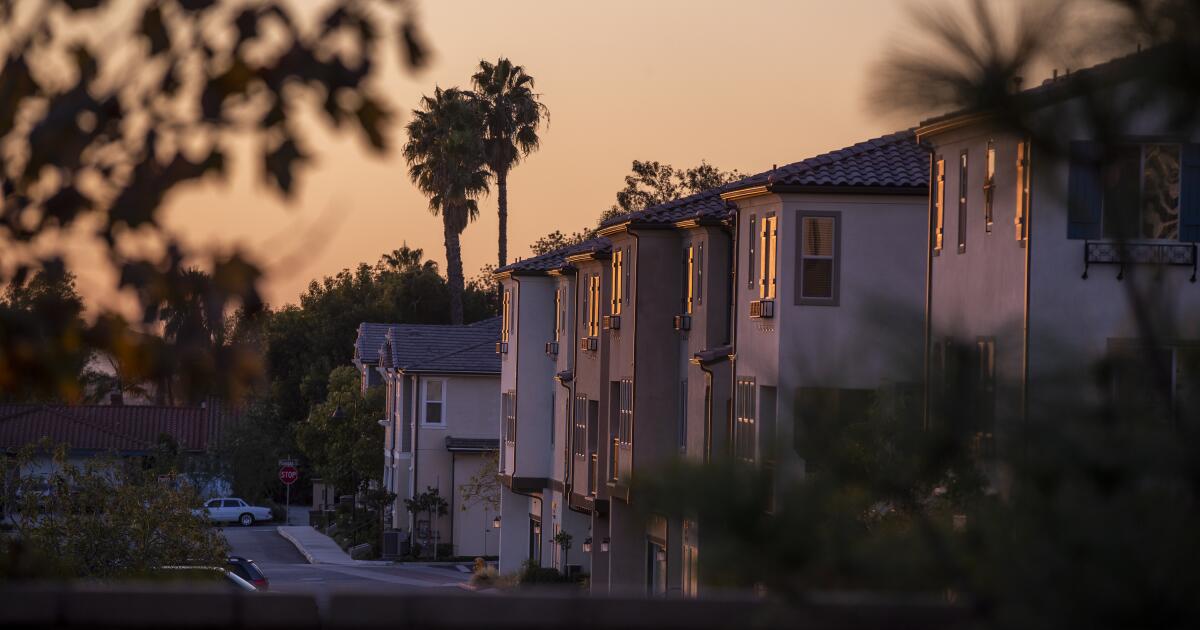
In California’s spendy cities, living comfortably costs more than almost anywhere else.
From the Bay Area to Orange County, living well requires incomes north of $150,000 in the pricier places, according to a recent study. A family with two kids needs more than $400,000 per year in some spots.
The study, conducted by financial technology company SmartAsset, analyzed 100 of the largest cities in the country.
San José ranked as the second-most expensive city, where a single adult must make nearly $160,000 and a family of four needs over $400,000 to live comfortably, the study found. Orange County cities — Irvine, Anaheim and Santa Ana — followed closely behind.
New York City topped the list, with a salary for comfortable living at about $900 higher than in San José.
Los Angeles ranked 16th on the list, where a single adult must make $120,307 to live comfortably. A family of four should bring in just over $280,000 annually.
San Diego and Chula Vista tied for seventh place, with a $136,781 salary for a single adult. San Francisco came in ninth, followed by Fremont and Oakland, which tied for 10th.
Santa Clarita, Long Beach, Riverside and Sacramento also made the top 20 list.
The study measured comfortable living using the 50/30/20 rule, in which half of a household’s post-tax income should go to needs, 30% to wants and 20% to savings.
The company used the MIT living wage calculator to determine cost of living by region for single adults and families of four.
A family of four faces the toughest living costs in the Bay Area, taking up four of the top five cities with the highest salaries needed to live comfortably.
San Francisco topped that list, with income for two parents projected at $407,597. Projected income in San José was slightly lower at $402,771, followed by Fremont and Oakland.
The study’s findings are in line with existing research that paints a grim picture of the statewide housing crisis, said Carolina Reid, an associate professor of city and regional planning at UC Berkeley.
“California is one of the more expensive places to live, and that definitely is true when we’re talking about families who are juggling multiple competing demands on their incomes,” Reid said.
Housing costs, groceries and gas prices — all considered necessities in the study — have skyrocketed nationwide, while wages have largely remained stagnant.
California housing costs are about double the national average. The state has struggled to keep up with demand, largely due to the lingering impacts of decades-long missteps in housing policies, said Paavo Monkkonen, a professor in urban planning at UCLA.
“It’s a problem that we created very slowly over a long period of time,” Monkkonen said.
The expected salary needed to live comfortably was significantly higher than the median household income for some California cities.
The difference is especially stark in Santa Ana, where the median salary is $95,118 — over $56,000 less than the projected salary needed to live comfortably in the city for a single adult.
Los Angeles had a $38,000 gap between the city’s median household income of $82,263 and the projected salary.
Cost of living is often hard to measure given the variability in how households choose to spend their money, Reid said. Housing is also the primary driver for living costs, which Monkkonen said is difficult to measure given the market’s unpredictability.
“People are living here somehow, right?” he said. “If you just look at the incomes and rents separately, you don’t really get a picture of how people are doing it…they’re spending a lot of their incomes on rents, but they’re also doubling up.”

A Los Angeles jury dealt a blow to social media giants Meta and YouTube this week when it found that the platforms were negligent for designing addictive features that harmed the mental health of a California woman.
Both companies plan to appeal, but the ruling has ignited uncertainty around the tech companies’ future and sparked questions about the potential fallout.
The seven-week trial kicked off in February, featuring testimony from Meta and YouTube executives.
Kaley G.M., a 20-year-old Chico, Calif., woman, sued the platforms in 2023, alleging that using social media at a young age led to her mental health problems such as body dysmorphia and depression. She also sued TikTok and Santa Monica-based Snap and those companies settled ahead of the trial.
Lawyers representing the woman argued that the platforms hook in young users with features such as infinite scrolling, autoplaying videos and beauty filters.
People use social media to keep up with their friends and family, but teens can also feel inadequate, sad or anxious when they compare themselves to a curated version of other people’s lives online. They’re also spending a lot of time watching a seemingly endless amount of short videos.
A jury determined that Meta was 70% responsible for Kaley’s harms and YouTube was 30% responsible. They awarded her a total of $6 million. The ruling came shortly after a New Mexico jury found Meta liable for $375 million in damages after the state Atty. Gen. Raúl Torrez alleged the platform’s features enabled predators and pedophiles to exploit children.
“These verdicts mark an unsurprising breaking point. Negative sentiment toward social media has been building for years, and now it’s finally boiled over,” said Mike Proulx, a director at Forrester, a market research company.
How have the companies reacted to the verdict?
Meta and Google, which owns YouTube, said they disagreed with the ruling and plan to appeal.
“This case misunderstands YouTube, which is a responsibly built streaming platform, not a social media site,” said Jose Castañeda, a Google spokesman, in a statement.
Meta spokesman Andy Stone posted the company’s statement on social media site X.
“Teen mental health is profoundly complex and cannot be linked to a single app. We will continue to defend ourselves vigorously as every case is different, and we remain confident in our record of protecting teens online,” the statement said.
Tech companies have been responding to mental health concerns, rolling out new parental controls so parents can keep track of their children’s screen time and moderating harmful content. Instagram and YouTube have versions of their apps meant for young people.
Some child advocacy groups and lawmakers, though, say these changes aren’t enough.
The ruling could affect how much money YouTube’s parent company, Alphabet, and Meta earn as they spend more on legal battles. While they make billions of dollars from advertising, investors are wary about higher expenses. The companies are already spending billions of dollars on artificial intelligence and developing new hardware such as smartglasses.
On Thursday, Meta’s stock fell more than 7% to $549 per share. Alphabet saw its share price drop more than 2% to roughly $280.
In 2025, Meta’s annual revenue grew 22% from the previous year to $200.97 billion.
Last year, YouTube’s annual revenue surpassed more than $60 billion. Both Google and Meta have been laying off workers as they spend more on AI.
The ongoing backlash hasn’t stopped tech companies from growing their users.
A majority of U.S. teens use YouTube, TikTok, Instagram and Snapchat, according to a 2025 Pew Research Center survey. More than 3.5 billion people use one of Meta’s products, which include Instagram and Facebook.
Social media has continued to change over the years as companies double down on short videos and AI chatbots.
Mental health concerns have only heightened as AI chatbots that respond to questions and generate content become more popular. Families have sued OpenAI, Character.AI and Google after their loved ones who used chatbots killed themselves.
Some analysts remain skeptical that Meta and YouTube would make drastic changes to their products because they’ve weathered crises before.
“Neither Meta nor YouTube is going to do anything different until a court orders them to, or there’s a significant drop in user or advertiser use,” said Max Willens, Principal Analyst at eMarketer.
Other analysts said legal risks could also affect how tech companies develop new AI-powered products and features.
“It’s likely that tech firms will now face increased scrutiny over the design of their platforms, which should drive more thoughtful inclusion of features that foster healthier interactions and safeguard mental health,” said Andrew Frank, an analyst with Gartner for Marketing Leaders.
At the very least, the verdicts serve as a “dire warning about how we handle the next wave of technology,” Proulx said.
“If we’re still struggling to put effective guardrails around social media after nearly two decades, we’re far from prepared for the growing harms of AI, which is moving faster, scaling wider, and embedding itself far deeper into people’s lives,” he said.
Times staff writer Sonja Sharp contributed to this report.

Boston Celtics Star Jayson Tatum Made History In Hornets Game

Game Thread: Denver Nuggets vs Golden State Warriors. March 29th, 2026. – Denver Stiffs

Trio helps Ottawa beat Seattle 2-0, spoiling return of Torrent captain Hilary Knight

Home damaged by fire in Carmel Valley
![[*LIVE*] Los Angeles Lakers vs Milwaukee Bucks Live Free Streams On Sport’sTvl 30 March 2026](https://i3.wp.com/encrypted-tbn0.gstatic.com/images?q=tbn:ANd9GcReQZPBURuIIuh0fPF6YTAqOY-y1_BeWJWzPA&s&w=80&resize=80,80&ssl=1 "[*LIVE*] Los Angeles Lakers vs Milwaukee Bucks Live Free Streams On Sport’sTvl 30 March 2026")
[*LIVE*] Los Angeles Lakers vs Milwaukee Bucks Live Free Streams On Sport’sTvl 30 March 2026

Florida High School Football Rankings: Top 25 teams – Oct. 21

How old is Bo Nix? What to know about Oregon quarterback ahead of 2024 NFL Draft

Cleary's 21 help Le Moyne down Central Connecticut State 69-64 in OT

99th annual Pony Swim held in Virginia

Indiana Members Credit Union announced as new anchor tenant at Bottleworks District

Scathing report claims nation’s oldest labor union ‘betrayed’ MAGA members through ‘shocking’ spending

Republican US lawmaker demands Congress vote on any Iran troop deployment

So you went to a No Kings protest. Now what?

JD Vance says he was ‘obsessed’ with UFOs, believes aliens are actually ‘demons’
The EU's recipe for trade deals : easy on beef, tough on wine
-

 Sports1 week ago
IOC addresses execution of 19-year-old Iranian wrestler Saleh Mohammadi
-

 New Mexico1 week ago
Clovis shooting leaves one dead, four injured
-

 Miami, FL4 days ago
Jannik Sinner’s Girlfriend Laila Hasanovic Stuns in Ab-Revealing Post Amid Miami Open
-

 Tennessee6 days ago
Tennessee Police Investigating Alleged Assault Involving ‘Reacher’ Star Alan Ritchson
-

 Minneapolis, MN4 days ago
Boy who shielded classmate during school shooting receives Medal of Honor
-

 Politics1 week ago
Schumer gambit fails as DHS shutdown hits 36 days and airport lines grow
-

 Science1 week ago
Record Heat Meets a Major Snow Drought Across the West
-

 Technology1 week ago
YouTube job scam text: How to spot it fast