Business
Striking video game actors hit picket lines over AI: 'The human element is irreplaceable'


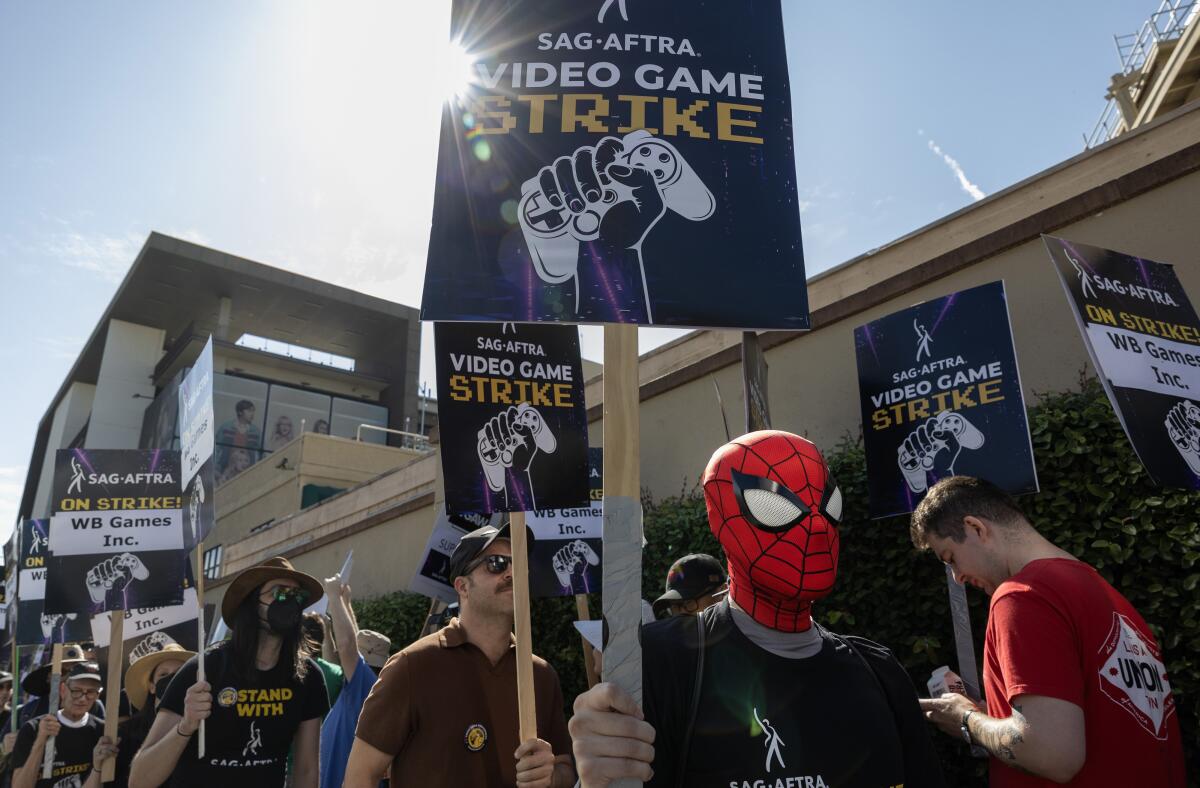
It was déjà vu in Burbank on Thursday as hundreds of striking video game actors carried picket signs and marched outside the Warner Bros. studio lot roughly a year after their film and TV colleagues did the same.
The Screen Actors Guild-American Federation of Television and Radio Artists held its first picket this week since calling a strike on behalf of some 2,600 performers doing voice acting and motion-capture work in the video game industry.
The walkout began Friday after negotiations between the union and the video game companies broke down over concerns about artificial intelligence.
The companies “come to us to ask how heroes sound and what they look like and what they do, and we’re gonna show them,” Sarah Elmaleh, chair of the union’s negotiating committee, said at the demonstration.
In a statement provided last week to The Times, video game company spokesperson Audrey Cooling said, “We are disappointed the union has chosen to walk away when we are so close to a deal, and we remain prepared to resume negotiations.”
SAG-AFTRA has been bargaining with the video game companies for a new agreement covering interactive media since the contract expired in 2022. Game actors have demanded AI regulations, wage increases to keep up with inflation, more rest time and medical attention for hazardous jobs.
Nearly two years later, the remaining issue at the heart of the strike is AI.
The performers are seeking a deal that will require video game producers to notify them when planning to replicate their voices, movements or likenesses with AI, inform them about how their work will be used, obtain their consent before moving forward and compensate them accordingly.
“As long as AI is used as a tool and not a replacement, that’s fine,” said Chris Jai Alex, a striking video game actor known for portraying Tusk in “Killer Instinct” and Strife in “Darksiders Genesis.”
“I’m all about being efficient, but … the human element is irreplaceable.”
SAG-AFTRA leaders Sarah Elmaleh and Duncan Crabtree-Ireland, center, march outside the Warner Bros. studio lot in Burbank.
(Myung J. Chun/Los Angeles Times)
LeQuan Bennett, a striking video game actor known for voicing Captain Trent in “Return to Monkey Island,” said he believes that a performer’s likeness, movements and voice should be regarded as their intellectual property in business negotiations with video game producers.
“Being technically minded, I understand that there’s no stopping AI,” Bennett added. “We are fighting to put guardrails that protect our rights.”
Video game actors argue that they are especially vulnerable to AI because of the invisible nature of voice acting and motion-capture work. They worry that if a company uses AI to replicate their voices or movements without permission or compensation, they will have a hard time proving it.
“Studios and [developers are] trying to make the argument that if it’s recognizable as you and your natural speaking voice, then we can talk about protections,” said Alejandra Reynoso, an actor known for voicing characters in “Dota 2” and “Stranger of Paradise: Final Fantasy Origin.”
“But I think we all know that you love what video game performers and actors do because they can become so many characters.”
A major concern for actor Seth Allyn Austin — who has worked on “The Last of Us Part II,” “Star Wars Jedi: Fallen Order” and Insomniac’s “Spider-Man” series — is being sufficiently informed about how his performances will be used. He and other performers want to make sure game developers’ plans align with their values before giving them permission to replicate performers’ work.
“This is one of the first strikes where I’ve seen movements, stunts, voice and actors all really come together as one,” Austin said. “We’re all taking up different burdens on the same fight.”
Actor Zachary Luna marches outside the Warner Bros. studio lot in Burbank.
(Myung J. Chun / Los Angeles Times)
AI was also a key sticking point during the film and TV actors’ strike, which ended with contract terms requiring studios to obtain performers’ consent and compensate them when replicating their work with AI. Some actors were critical of that agreement, arguing that the AI protections weren’t strong enough.
“We’ve been continuing to evolve our AI provisions since the … strike last year,” said Duncan Crabtree-Ireland, SAG-AFTRA national executive director and chief negotiator. “There will always be SAG-AFTRA members who want there to be no AI. I get it. I understand it. I even sympathize with it. That’s not a reality that we can create.”



Business
Disney to pay $2.75 million to settle alleged violations of the California Consumer Privacy Act

Walt Disney Co. will pay $2.75 million to settle allegations that it violated the California Consumer Privacy Act by not fully complying with consumers’ requests to opt out of data sharing on its streaming services, the state attorney general’s office said Wednesday.
The Burbank media and entertainment company allegedly restricted the extent of opt-out requests, including complying with users’ petitions only on the device or streaming services they processed it from, or stopping the sharing of consumers’ personal data through Disney’s advertising platform but not those of specific ad-tech companies whose code was embedded on Disney websites and apps, the attorney general’s office said.
In addition to the fine, the settlement, which is subject to court approval, will require Disney to enact a “consumer-friendly, easy to execute” process that allows users to opt-out of the sale or sharing of their data with as few steps as possible, according to court documents.
“Consumers shouldn’t have to go to infinity and beyond to assert their privacy rights,” Atty. Gen. Rob Bonta said in a statement. “In California, asking a business to stop selling your data should not be complicated or cumbersome.”
A Disney spokesperson said in a statement that the company “continues to invest significant resources to set the standard for responsible and transparent data practices across our streaming services.”
“As technology and media continue to evolve, protecting the privacy and preserving the experience of Californians and fans everywhere remains a longstanding priority for Disney,” the spokesperson said.
The settlement with Disney stemmed from a 2024 investigation by the attorney general’s office into streaming devices and apps for alleged violations of the California Consumer Privacy Act, which governs the collection of consumers’ personal data by businesses.
Under the law, businesses that sell or share personal data for targeted advertising must give users the right to opt-out.
Disney’s $2.75-million payment is the largest such settlement under the state privacy act, Bonta’s office said.
The attorney general has also reached settlements with companies such as beauty retailer Sephora, food delivery app DoorDash and SlingTV for alleged violations of the privacy act.

Victims of last year’s wildfires in Los Angeles County who were unable to get mortgage relief under a state law enacted last year would get another chance with a stronger bill introduced Wednesday.
The legislation, AB 1847, by Assemblymember John Harabedian (D-Pasadena), would triple to 36 months the 12 months of mortgage relief offered by last year’s AB 238, while allowing borrowers to repay the money through a deferral that extends the mortgage.
Also authored by Harabedian, AB 238 prohibited mortgage lenders and servicers from requiring borrowers to pay back any forbearance in a lump sum, but it otherwise did not specify repayment terms. It also banned late fees, foreclosures and negative reports to credit bureaus.
Borrowers told The Times that they had difficulty getting any relief and when they did, they were told if they didn’t want to pay it back in a lump sum, they would have to agree to a loan modification that could raise their interest rate.
Like AB 238, the relief can only be obtained if allowed by the underlying mortgage contract.
However, Harabedian said that most of the contracts and guidelines of Fannie Mae and Freddie Mac — the government-sponsored organizations that hold or guarantee the majority of U.S. mortgages — do not bar loan deferrals.
“I think some people were being offered forbearance that, frankly, didn’t comply with 238 when it should have,” he said. “They weren’t given any sort of election or flexibility on how they would repay so we’re trying to perfect it now.”
Harabedian said most of the problems borrowers are facing appear to be due to companies that service mortgages on behalf of lenders, while large institutions such as Bank of America have been more generous.
The Charlotte, N.C., financial institution in December started offering 36 months of mortgage relief to its borrowers without a change to the interest rate.
Another key AB 238 amendment is the extension of relief from 12 to 36 months, which borrowers seek in 90-day increments. The deadline for applying for relief would be extended to Jan. 7, 2029.
Harabedian said 36-months of relief are necessary as it will take many homeowners years to fix and rebuild their homes after the fires in Altadena, Pacific Palisades and nearby communities, which killed at least 31 people and damaged or destroyed more than 18,000 homes.
“This extension tries to align with the full rebuild process that survivors are going to endure, and make sure that from the start of it till the end of it, they’re not under financial distress that would cause them to abandon their communities,” he said.
Len Kendall, who lost his home in Pacific Palisades, said that while he welcomed the legislation, he is still uncertain how it might affect him, including his terms of repayment.
“There’s going to have to be follow up to make sure these these servicers and lenders actually abide by the laws, because there’s no one really holding them accountable at the moment,” he said.
Last month, Gov. Gavin Newsom said in a press release that the Department of Financial Protection and Innovation has received 233 mortgage forbearance complaints, with 92% resolved in the consumer’s favor.
However, Kendall said that the agency closed his complaint even though his mortgage servicer had requested a lump sum and his repayment plan remains up in the air.
The agency told him in a letter reviewed by The Times that it “cannot intervene on behalf of individual consumers in any particular case” and that it “brings consumer protection actions when we find patterns of deception, misrepresentation or unfair business practices of statewide interest.”
A spokesperson for the agency said it worked with Kendall to ensure he received “appropriate” forbearance relief and considers the matter resolved.
He added the department is monitoring compliance with AB 238 but so far has not announced any enforcement actions against lenders or servicers.
Harabedian introduced a second bill Wednesday that would provide for mortgage forbearance statewide for homeowners whose residences are uninhabitable after a state of emergency declared by the governor or federal government.
The California Emergency Mortgage Relief Act, AB 1842, requires mortgage servicers to file a monthly report with the DFPI about the number of forbearance requests they receive during a declared emergency and how many were approved and denied, including the reason for denial.
The bill also allows a borrower to bring a civil action against a mortgage servicer for violations of the law.
The AB 238 amendments, if signed into law, would take effect immediately.
Harabedian’s office worked with the California Bankers Assn. and the California Mortgage Bankers Assn. in developing AB 238. The lawmaker said he not sure if they will support the extension of mortgage relief.
“We look forward to reviewing it with our members and working constructively with stakeholders as we have consistently done. The banking industry proactively provided relief to wildfire victims, and this effort pre-dated legislative action,” said Yvette Ernst, spokesperson for the California Bankers Assn.
The California Mortgage Bankers Assn. said it also was reviewing the legislation.

A Los Angeles County Superior Court judge threatened to throw grieving mothers out of court Wednesday if they couldn’t stop crying during testimony from Instagram boss Adam Mosseri, who took the stand to defend his company’s app against allegations the product is harmful to children.
The social media addiction case is considered a bellwether that could shape the fate of thousands of other pending lawsuits, transforming the legal landscape for some of the world’s most powerful companies.
For many in the gallery, it was a chance to sit face to face with a man they hold responsible for their children’s deaths. Bereaved parents waited outside the Spring Street courthouse overnight in the rain for a place in the gallery, some breaking into sobs as he spoke.
“I can’t do this,” wept mom Lori Schott, whose daughter Annalee died by suicide after a years-long struggle with what she described as social media addiction. “I’m shaking, I couldn’t stop. It just destroyed her.”
Judge Carolyn B. Kuhl warned she would boot the moms if they could not contain their weeping.
“If there’s a violation of that order from me, I will remove you from the court,” the judge said.
Mosseri, by contrast, appeared cool and collected on the stand, wearing thick wire-framed glasses and a navy suit.
“It’s not good for the company over the long run to make decisions that profit us but are poor for people’s well-being,” he said during a combative exchange with attorney Mark Lanier, who represents the young woman at the center of the closely watched trial. “That’s eventually going to be very problematic for the company.”
Lanier’s client, a Chico, Calif., woman referred to as Kaley G.M., said she became addicted to social media as a grade-schooler, and charges that YouTube and Instagram were designed to hook young users and keep them trapped on the platforms. Two other defendants, TikTok and Snap, settled out of court.
Attorneys for the tech titans hit back, saying in opening statements Monday and Tuesday that Kaley’s troubled home life and her fractious relationship with her family were to blame for her suffering, not the platforms.
They also sought to discredit social media addiction as a concept, while trying to cast doubt on Kaley’s claim to the diagnosis.
“I think it’s important to differentiate between clinical addiction and problematic use,” Mosseri said Wednesday. “Sometimes we use addiction to refer to things more casually.”
On Wednesday, Meta attorney Phyllis Jones asked Mosseri directly whether Instagram targeted teenagers for profit.
“We make less money from teens than from any other demographic on the app,” Mosseri said. “We make much more the older you get.”
Meta Chief Executive Mark Zuckerberg is expected to take the witness stand next week.
Kaley’s suit is being tried as a test case for a much larger group of actions in California state court. A similar — and similarly massive — set of federal suits are proceeding in parallel through California’s Northern District.
Mosseri’s appearance in Los Angeles on Wednesday follows a stinging legal blow in San Francisco earlier this week, where U.S. District Judge Yvonne Gonzalez Rogers blocked a plea by the tech giants to avoid their first trial there.
That trial — another bellwether involving a suit by Breathitt County School District in Kentucky — is now set to begin in San Francisco in June, after the judge denied companies’ motion for summary judgment. Defendants in both sets of suits have said the actions should be thrown out under a powerful 1996 law called Section 230 that shields internet publishers from liability for user content.
On Wednesday morning, Lanier hammered Mosseri over the controversial beauty filters that debuted on Instagram’s Stories function in 2019, showing an email chain in which Mosseri appeared to resist a ban on filters that mimicked plastic surgery.
Such filters have been linked by some research to the deepening mental health crisis in girls and young women, whose suicide rates have surged in recent years.
They have also been shown to drive eating disorders — by far the deadliest psychiatric illnesses — in teens. Those disorders continue to overwhelm providers years after other pandemic-era mental health crises have ebbed.
Earlier research linking social media and harms to young women was referenced in the November 2019 email chain reviewed in court Wednesday, in which one Instagram executive noted the filters “live on Instagram” and were “primarily used by teen girls.”
“There’s always a trade-off between safety and speech,” Mosseri said of the filters. “We’re trying to be as safe as possible but also censor as little as possible.”
The company briefly banned effects that “cannot be mimicked by makeup” and then walked the decision back amid fears Instagram would lose market share to less scrupulous actors.
“Mark [Zuckerberg] decided that the right balance was to focus on not allowing filters that promoted plastic surgery, but not those that did not,” Mosseri said. “I was never worried about this affecting our stock price.”
For Schott, seeing those decisions unfold almost a year to the day before her daughter’s death was too much to bear.
“They made that decision and they made that decision and they made that decision again — and my daughter’s dead in 2020,” she said. “How much more could that match? Timeline, days, decisions? Bam, she was dead.”

'I Considered Him A Son': Louisiana Horsemen Mourn Death Of Trainer Jason Faul

Maine chief justice tells lawmakers courts are understaffed, judges lowest-paid in U.S.

Maryland Congressman Jamie Raskin visits ICE detainees at Baltimore field office

Michigan man accused making threat against Republicans amid phone call to state Capitol

Mass. weather: Warm-up coming over the next week

Florida High School Football Rankings: Top 25 teams – Oct. 21

Cleary's 21 help Le Moyne down Central Connecticut State 69-64 in OT

How old is Bo Nix? What to know about Oregon quarterback ahead of 2024 NFL Draft

99th annual Pony Swim held in Virginia

Indiana Members Credit Union announced as new anchor tenant at Bottleworks District

Tim Walz demands federal government ‘pay for what they broke’ after Homan announces Minnesota drawdown

Leaders embrace two-speed Europe as Macron sets June deadline

What the data tells us about kidnapped people — and how Nancy Guthrie is an outlier

House Republican Greg Steube introduces bill to nix controversial H-1B visa program

Photos: Bangladeshis turn out for historic election after Hasina’s downfall
-

 Politics1 week ago
White House says murder rate plummeted to lowest level since 1900 under Trump administration
-

 Alabama5 days ago
Geneva’s Kiera Howell, 16, auditions for ‘American Idol’ season 24
-

 Politics1 week ago
Trump unveils new rendering of sprawling White House ballroom project
-

 San Francisco, CA1 week ago
Exclusive | Super Bowl 2026: Guide to the hottest events, concerts and parties happening in San Francisco
-

 Ohio1 week ago
Ohio town launching treasure hunt for $10K worth of gold, jewelry
-

 Education1 week ago
Video: Is Ikea Cookware As Good As All-Clad?
-

 Culture1 week ago
Annotating the Judge’s Decision in the Case of Liam Conejo Ramos, a 5-Year-Old Detained by ICE
-

 Culture1 week ago
Is Emily Brontë’s ‘Wuthering Heights’ Actually the Greatest Love Story of All Time?