Lifestyle
At Riverside’s Mission Inn, former owner departs with historic art — and locals are outraged


In less than a month, Riverside’s Mission Inn has gained a new owner, lost two prized pieces of art and sparked a heated debate over the line between private property and community history.
The stage for this controversy was set in early May, when hotel owner Kelly Roberts decided to sell the Mission Inn to the Yuhaaviatam of San Manuel Nation, the tribe that owns the Yaamava’ Resort & Casino in Highland and the Palms Casino Resort in Las Vegas.
But it wasn’t the sale (for an undisclosed amount) that started arguments. It was Roberts’ removal of two beloved paintings from the hotel before the sale closed.
A painting at the Mission Inn in Riverside titled “Charge Up San Juan Hill” is taken down on March 20, shortly before the hotel’s change in ownership.
(James Ranger)
One is an alpine landscape called “California Alps” (1874) by William Keith, which measures roughly 6 feet by 8 feet and was displayed in the lobby near the front desk. The other painting, “Charge Up San Juan Hill” (about 1900) by Vasily Vereshchagin, was displayed on a wall of the steakhouse near the lobby. Both paintings had been a part of the hotel for more than a century.
“It was like a slow-motion version of the Louvre Museum heist, pulled off on a sunny day in Riverside in view of guests, staff and visitors,” wrote David Allen of the Riverside Press-Enterprise.
“There’s an outrage among members of this community,” said Mike Marlatt, a Riverside attorney and former board member of the Mission Inn Foundation.
The issue appears to be what agreements Roberts’ late husband made when he bought the building more than 30 years ago.
Former Riverside redevelopment official Ralph Megna, who facilitated the 1992 sale to Duane Roberts’ Historic Mission Inn Corp., wrote on Facebook that “What Kelly is apparently doing at this point is just pillaging the place in violation of those agreements.” But on a phone call, he was less absolute. He said the original pact included an agreement intended to protect about 180 movable pieces of art and artifacts from removal, but that “there’s shades of gray here.” Megna added, “We trusted people. Good faith turned out to be not so good.”

Duane and Kelly Roberts, photographed in 1998 at their home in Laguna Beach. Duane, who reopened the Mission Inn in the early 1990s, died in 2025.
(Glenn Koenig / Los Angeles Times)
Roberts’ family attorney Alan Jackson, however, said “Kelly is not pillaging anything.” He maintained that when Duane Roberts bought the hotel, “he bought every single item. Every single item was the Roberts family’s personal property.” When Kelly Roberts sold the hotel last month, Jackson said, she was free to keep or sell any of its contents.
In that deal, Jackson said, “the buyers would not close” until the paintings and a sculpture of Duane and Kelly Roberts were removed, because “they’re expensive.” Also, Jackson said that Duane Roberts, “before his passing, made it very clear to Kelly and the family that those are two of his favorite paintings ever.”
Jackson declined to say where the artworks are but said “they are in her possession” and “she has no intention of ever getting rid of those ever.”

The iconic spiral staircase in the rotunda of the historic Mission Inn.
(Gina Ferazzi / Los Angeles Times)
The hotel’s new owner, the San Manuel Investment Authority, declined to address questions about the sale agreement. But in a statement, it said it is “committed to collaborating with the Mission Inn Foundation and the City to respectfully steward and preserve this historic landmark, recognizing its deep history and significance to the Riverside community.”
Despite accolades from groups including Historic Hotels of America, tensions between the Roberts family and Riverside preservationists have risen in recent years. In late 2024, after more than 30 years renting space within the hotel, the nonprofit Mission Inn Foundation and Museum was unable to agree on a lease extension with hotel management and moved to a building on Main Street. Foundation leaders did not respond to messages seeking comment.
“The Mission Inn is so foundational to Riverside that any significant change brings real concern to me and makes me uneasy,” said City Council member Philip Falcone, 28, who has been leading tours of the inn since he was in high school.
The Keith painting is “quintessential California, a romanticized view of the Sierra Nevada range. William Keith, the painter, was friends with John Muir,” Falcone said. As for the San Juan Hill painting, it connects neatly with the history of Theodore Roosevelt, one of nine presidents who have visited the inn.

A guest takes in the view from the Spanish patio at the Mission Inn.
(Gina Ferazzi/Los Angeles Times)
The hotel is largely the creation of Frank Miller, who bought Glenwood Cottage, a modest boarding house, from his father in 1880. Then Miller enlisted investment help from his friend, railroad magnate Henry Huntington, transformed the boarding house into a hotel and renamed it. Over time, Miller built it into an architectural wonderland filled with art and antiques gathered in the U.S. and Europe. By 1931, the enterprise filled a city block.
“It’s a unique property,” said David Stolte, president of the Old Riverside Foundation. “It’s a National Historic Landmark. It kind of sits at the intersection of private commerce and public benefit. The original owner, Frank Miller, intended it as a public space, essentially a cultural museum, in addition to his business of running a hotel.”
After Miller’s death in 1935, the hotel’s reputation spread even further, attracting dignitaries of the day — and the future. It served as the site of Richard and Pat Nixon’s wedding in 1940 and Ronald and Nancy Reagan’s honeymoon in 1952. But by the 1960s, it was much diminished, and a later owner, Benjamin Swig, had sold close to 1,000 antiques and artworks to help pay bills.
By the mid-1980s, the hotel had passed through a period of city ownership and was closed. By 1992, more than $50 million had been spent in restoration and renovation, but the project was scuttled by a bankruptcy. That’s when Duane Roberts, who grew up in Riverside and made his fortune selling flash-frozen burritos, bought the property and reopened it.
Duane and Kelly Roberts, residents of Laguna Beach, also established the hotel’s annual Festival of Lights, an Inland Empire holiday tradition. The hotel today includes 238 guest rooms, four restaurants, two lounges, two chapels, a spa, pool and candy shop.
Besides their stewardship of the hotel, Duane and Kelly Roberts became known as major donors to the Republican Party. In 2017, Politico reported that Kelly Roberts was in line to be named the Trump administration’s ambassador to Slovenia, but turned down the post.
After Duane Roberts died at 88 in November, Riverside buzzed with questions over the fate of the hotel, prompting another Roberts family lawyer to offer public assurances.
“Nobody’s buying this hotel. Mrs. Roberts is keeping this hotel,” attorney Patrick O’Brien told a TV news crew in late November. But on May 4, Kelly Roberts and the San Manuel Investment Authority announced the pending sale.

Festival of Lights, Mission Inn’s popular holiday tradition, was created by Kelly and Duane Roberts after they reopened the hotel.
(Allen J. Schaben/Los Angeles Times)
Then on May 20, guests spotted workers removing the two paintings from the lobby area. Longtime hotel-watchers said other items had disappeared in recent years, including an 1876 Steinway piano; a statue of the goddess Pomona; William Wendt’s painting “Houses at Arch Beach”; Ilya Repin’s 1884 painting “Portrait of Madame K.”; and the hotel’s Taft Chair, a sturdy oak armchair commissioned by Frank Miller in 1909 to hold 335-pound President Taft. But the midday, presale removal of the Keith and Vereshchagin paintings prompted immediate outcry.
It was “traumatizing, seeing that stuff on display for so long and then seeing it come down,” said James Ranger, a veteran hotel tour guide and Mission Inn Foundation docent. After all the time and money the Roberts family invested in the property, “leaving on this note puts a sour taste out there,” he said.
The sale closed May 29. Though the Roberts family’s attorneys have insisted that the buyers and sellers are in accord, preservation advocates in Riverside have called for a review of documents associated with Roberts’ purchase of the property.
Meanwhile, the hotel’s new era as a tribal holding begins. Besides the two casino-hotels, the Yuhaaviatam of San Manuel Nation owns several other hotels, including the Waldorf Astoria Monarch Beach Resort & Club in Dana Point. As for the Mission Inn, the tribe has signed on Boston-based Pyramid Global Hospitality to take over management, and several changes are already evident.
Notably, the Roberts’ names have been dropped from the signage. Kelly’s Spa has become simply the spa, Duane’s Steakhouse is now just the steakhouse, and Casey’s Cupcakes, a hotel shop founded by Kelly’s daughter Casey Beau Brown, has closed. The Festival of Lights will continue, a spokesperson said.
Stolte said the Old Riverside Foundation believes the tribe will be “great stewards” for the Mission Inn.
“I wish that their welcome to Riverside was a little smoother,” he said.
Staff writer Alex Wigglesworth also contributed to this story.

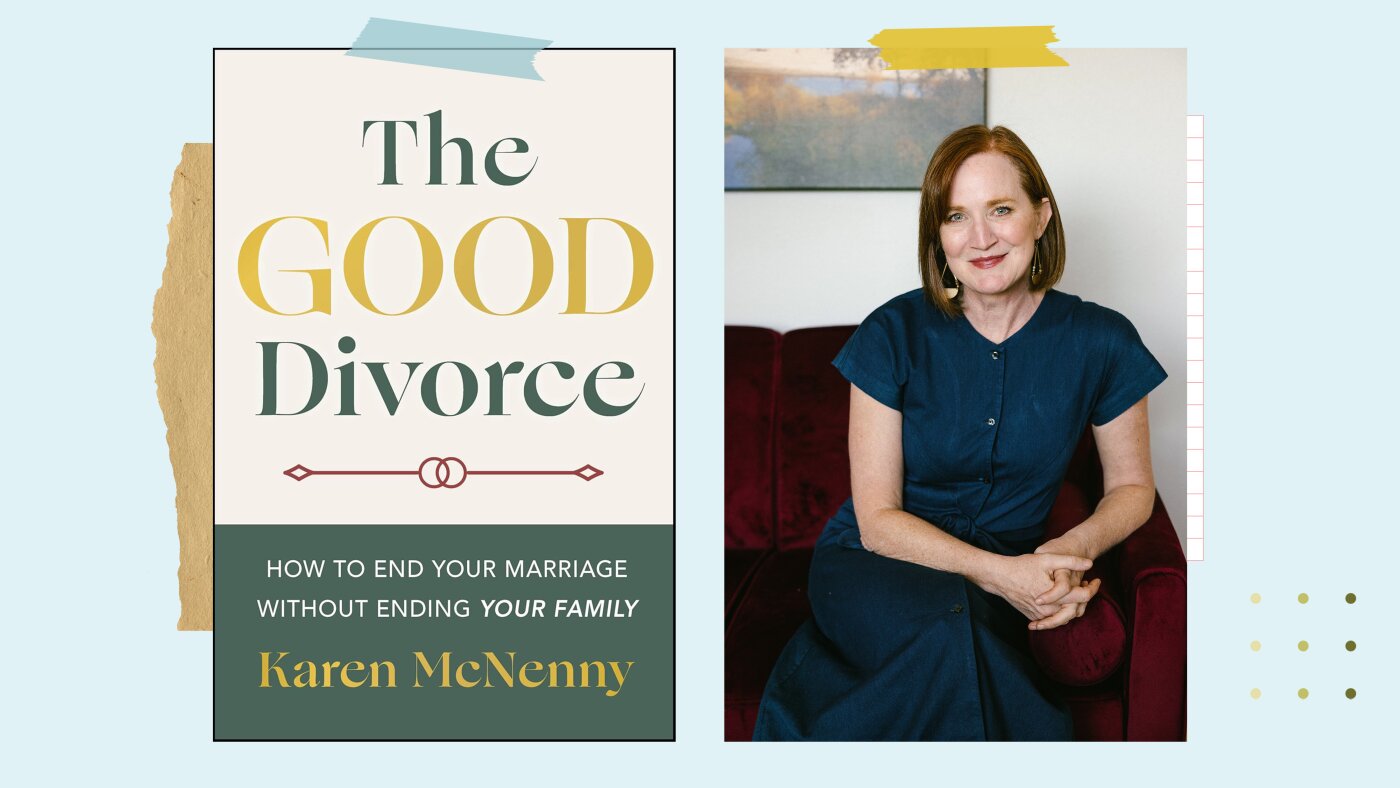
Karen McNenny is a certified divorce coach, certified co-parenting specialist and author of the book The Good Divorce: How to End Your Marriage Without Ending Your Family.
Wiley/Jossey-Bass/NPR, Nicole Wickens/NPR
hide caption
toggle caption
Wiley/Jossey-Bass/NPR, Nicole Wickens/NPR
When Karen McNenny was facing divorce about 15 years ago, she was afraid of what it would mean for her future: despair, debt and a lifetime of resentment, she says.
At the same time, she was thinking of her two children, she says. She didn’t want their father to become her enemy.
So she and her former husband chose to approach divorce differently as a couple. “We’re going to renovate and transform this family. We’re not going to destroy it,” she says. “The marriage is ending, not your relationship.”
For McNenny, a mediator, certified divorce coach and certified co-parenting specialist, divorce is a tool, not a weapon. She expands on this concept in The Good Divorce: How to End Your Marriage Without Ending Your Family, which came out this spring. The book offers guidance on how to maintain compassionate and respectful ties with a former spouse while also healing and moving forward.
According to Pew Research Center, a third of Americans who have ever been married had a first marriage that ended in divorce. For that reason, McNenny hopes her book becomes a must-read for couples before they get married. “The best time to talk about divorce is before you need to talk about it,” she says.
She shared insights from her book in a conversation with Life Kit. This interview has been edited for length and clarity.
The book is called The Good Divorce. What does that mean?
[For those with kids,] the good divorce is about protecting the future of the family while we dissolve the marriage.
After the paperwork is done and the assets have been divided, can you and your co-parent sit on the same side of the bleachers during the basketball game? Can you still see yourselves as a partnership, with the ability to have thoughtful conversations about your kids?
For those who don’t have kids, [the good divorce is] about protecting your health — your mental health and your physical health. If we are doubling down with resentment and bitterness, all of that gets stored in the body and shows up in different ways. You deserve a pathway that’s less destructive.
Let me also be clear: There are times when an amicable, collaborative process is not possible and maybe even inappropriate. For instance, where there’s active addiction, abuse, domestic violence, coercion or unmanaged mental health issues.
How do you get to a place where you don’t feel triggered by your partner, so you both can work together toward a good divorce?
That, my dear, does not happen overnight. That is more like a dimmer switch going up and down and up and down, and the gift of time helps to get there.
It’s a complex emotional journey because we do feel relief in walking away from our spouse and the challenges. But with it, there is extraordinary grief that comes with divorce that I think is often underestimated and undersupported.

If my spouse had died, people would’ve been checking in with me regularly. I never would’ve spent a holiday alone in that first year. There probably would’ve been a meal train.
But he didn’t die. My marriage died, my family structure died, my identity as a wife and a partner died. There’s so much grief through these transformations that come with divorce that we don’t see.
So supporting friends in all those ways that you would as if there had been an actual death is doing a lot for your friends who are going through divorce.
How do you let your friends, family and community know that you’re getting a divorce and that you might need support?
Put a communication strategy together. It’s not just for how we tell the kids. It’s also a communication strategy for the grandparents; to the circle of support around the kids, like teachers, coaches and mentors; and our shared community.
It’s extraordinary when a couple can write that message together, not unlike a marriage announcement. [You might say:] We’ve made a really difficult decision. We wanted to let you know. We’re not going to court. Don’t expect a battle. Please don’t ask us why. Just ask us how we’re doing. We’re on the same side as the kids. You don’t need to pick sides.
In doing so, we’ve given everyone the same information at once. It’s a unified message that comes from the parent team, and it allows your community to know how best to support you. And it takes out all the gossip and wonder about what is going on.
If you have kids and they’re splitting time between two homes, what are some ways to make that change easier for them?
Our kids were 5 and 7 when we divorced, so it was three or four nights at a time in each home. By the time they got to be about 8 or 10, it made sense to go a week in each residence. After COVID, the kids came to us and said, “Can we just have two weeks in a house? We wanna be able to settle in more.” [So we said] OK.
A lot of parents are so rigid about the schedule. There’s no flexibility. That doesn’t serve anyone. So I recommend liberating yourselves from the calendar and letting it grow and bend with your kids appropriately.
Knowing what you know now about divorce, what questions do you think couples should ask themselves before they get married?
So often when people arrive at the threshold of divorce, couples are like, “We don’t know what we’re doing.” Get educated about the business part of it.
There is no harm in having a prenuptial agreement. Even if you decided not to file it, have the conversation about the implications. What does it mean if we buy this house together? What does it mean if one of us works more and one of us works less?
We also underestimate what it means to be roommates. What are your value systems around cooking and cleaning? How much alone time do you need? It’s easy to fall in love and not know if you’re compatible.
Do you think you’d get married again?
I absolutely hope that I get to say yes to a lifelong commitment with a partner, as I believe we often are given the opportunity to become a better version of ourself through partnership.
The story was edited by Meghan Keane. The visual editor is CJ Riculan. We’d love to hear from you. Leave us a voicemail at 202-216-9823, or email us at LifeKit@npr.org.
Listen to Life Kit on Apple Podcasts and Spotify, and sign up for our newsletter. Follow us on Instagram: @nprlifekit.

In Alice and Steve, Jemaine Clement and Nicola Walker play long-time friends who turn on each other after he gets involved with her 26-year-old daughter.
Lara Cornell/Disney+
hide caption
toggle caption
Lara Cornell/Disney+
I grew up watching episodic shows on network TV, nearly all of them formulaic but some indelibly great. Then, like everyone else, I moved into the days of what my colleague David Bianculli dubbed Platinum TV, where series like The Sopranos and The Wire and Fleabag aspired to something higher. What both these eras had in common was that their shows were carefully crafted — they had an internal logic, and a tone, that held them together.
In recent years, though, there’s been a proliferation of shows that, possibly obeying some algorithm, care less for coherence than sensation. They lurch among tones, from cuteness to sentimentality to meanness, stirring in random plot twists along the way. Bouncing all over the emotional map, these shows depend on compelling actors and a few memorable scenes to make us overlook their loose construction.
A great example is Alice and Steve, an entertaining but sometimes exasperating six-part British comedy on Hulu about two 50-something best friends who turn on each other after he gets involved with her 26-year-old daughter.


While the premise is juicy, it’s also a tad yucky, and I mainly tuned in because its title characters are played by performers Jemaine Clement from Flight of the Conchords and Nicola Walker, whom I’ve raved up on this show more than once.
The series starts poorly with Steve and Alice going on a cutesy bender after a friend’s funeral. Now, I always hate drunk scenes, which are an invitation to overact. As Clement and Walker bray their lines, we learn that Steve’s a divorced celebrity hair stylist who can’t find a girlfriend while Alice is a clothes designer with a doting younger husband, nicely played by Joel Fry, a sweetie-pie of a teenage son — that’s Tyrese Eaton-Dyce — and, of course, that 26-year-old daughter, Izzy, who has inherited her mother’s willfulness. Played by Yali Topol Margalith, Izzy kickstarts the plot by flirting with Steve. Predictably, he succumbs.

Almost immediately, they think they’re in love. While the weak-willed Steve wants to hide their romance — he knows it’s inappropriate — Izzy just blurts out the facts to her mom. Alice flips. And from hereon out in this series where the women are as alpha as the men are hangdog, Alice drives the action. Betrayed and violently angry, she’ll do whatever it takes to break them up — no matter who gets hurt. Her antics unleash Steve’s own malice. We’re in Beef territory.
At its core, Alice and Steve hinges on the way that platonic friendships are often richer and more powerful than romantic ones. It’s a fascinating subject, which may be why I found the script by Sophie Goodhart so frustrating. I wanted her to dig deeper. While the show’s got some very funny bits — Alice’s sharp-tongued mother is a blast — it’s often annoyingly lax.

If Steve really does the hair of Charli XCX, how come he’s a clueless older guy whose pop culture references are Willie Nelson and Woody Allen? If Izzy truly adores her mother as she claims, why does she keep rubbing her relationship with Steve in her mom’s face? Halfway through, one character nukes the other’s career, but this life-shattering event has no real weight: It’s barely even mentioned for the rest of the series.
That said, Alice and Steve is worth seeing for scenes like the one in which Steve spinelessly sells Izzy out or the lacerating discussion between Alice and her husband when he fully grasps that he adores a woman who views him as a reliable but dull concierge, not a man she likes hanging with. Most touching of all may be the lovely sequence when Alice, wise for once, smooths a romantic crisis between her son and his would-be girlfriend, a pair who are the show’s emblem of hope. For once, we understand why people love her.

While most viewers will find Steve more likable than Alice — the show takes pains not to make him appear predatory or creepy — the role doesn’t give Clement a whole lot to do except play variations on shambolic dread and discomfort. The show gets its galvanizing zing from Walker, a beloved star in England with amazing, luminous eyes. Her Alice is the kind of complicated, volcanic heroine that you don’t see in movies and rarely see on TV, one who shows her apocalyptic rage freely and in many different forms.
At least once in every episode, something would lead me to say, “Man, is this show a mess.” But that wasn’t a deal breaker. I kept watching. After all, life is messy, too.


How to enter your Sporty Spice era.
Getty Images/quantic69/Olga Kurbatova/Anastasiia Zvonary/Photo Illustration by NPR
hide caption
toggle caption
Getty Images/quantic69/Olga Kurbatova/Anastasiia Zvonary/Photo Illustration by NPR
Reality dating and professional sports are not as different as you’d think.
Brittany is in her Sporty Spice era – she watched the NBA playoffs, she’s following World Cup games, and she’s watching the New York Liberty play their WNBA season. These games are daily – and so is the reality dating show Love Island. And she noticed that the two formats are not very different at all. Defector.com staff writer and co-owner Kelsey McKinney came to the same conclusion – so the two of them discuss why these games of athleticism and love can bring us together… and why they get valued differently in our culture.
For more episodes on sports and reality TV, check out:
Get rich or die trying: how sports betting is changing our love of the game
Is this the end of reality TV?
The ugly truth of America’s expensive homes
Support Public Media. Join NPR Plus.
Follow Brittany on Instagram: @bmluse
This episode was produced by Liam McBain. It was edited by Neena Pathak. Our Supervising Producer is Cher Vincent. Our Executive Producer is Barton Girdwood. Our VP of Programming is Yolanda Sangweni.
-

 Augusta, GA3 minutes ago
Augusta Volleyball Announces 2026 Schedule, Promotional Calendar – Augusta University
-

 Washington, D.C5 minutes ago
Storm Team4 Forecast: Foggy morning before chances of scattered showers, storms
-

 Cleveland, OH11 minutes ago
1 dead, 3 injured in early morning shooting on Cleveland’s East Side
-

 Austin, TX18 minutes ago
POLL: Should Texas pass stricter or looser laws on THC products?
-

 Alabama20 minutes ago
How the 2026 Rose Bowl made Alabama football quarterback Austin Mack
-

 Alaska26 minutes ago
Kei to stay, new Alaska law makes import vehicles roadworthy
-

 Arizona33 minutes ago
Padres host Arizona Diamondbacks, look to stop home slide
-

 California36 minutes ago
Man arrested after woman dies in California fireworks explosion

