Business
New Mexico weighs whether to toss Alec Baldwin criminal charges in 'Rust' shooting

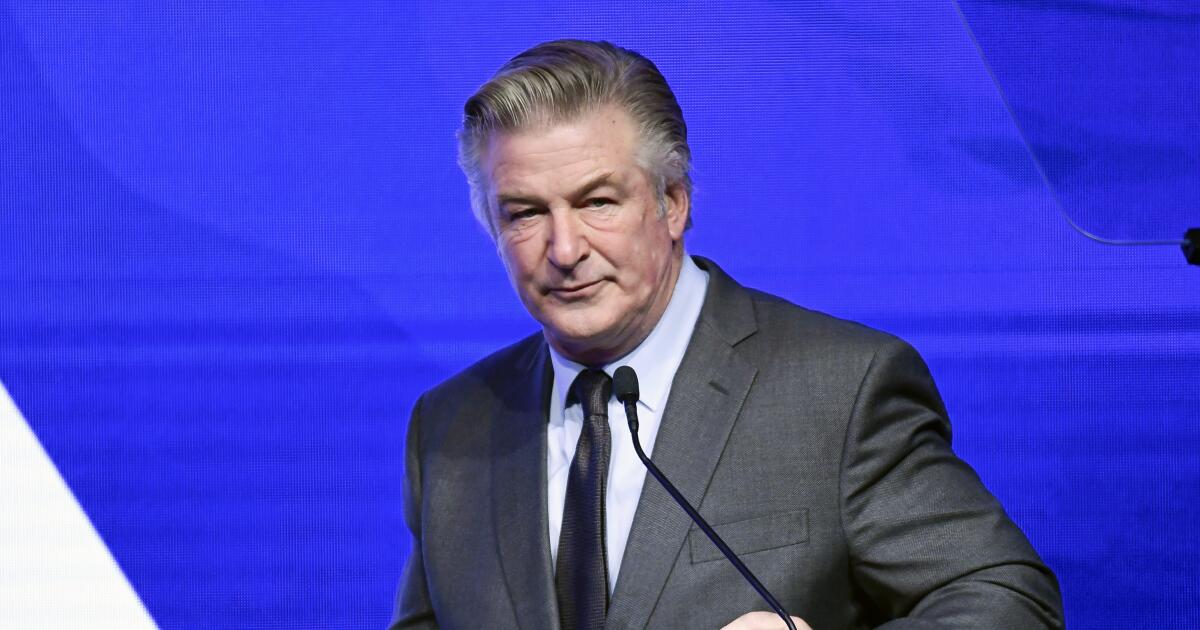
A New Mexico judge is weighing whether to dismiss involuntary manslaughter charges against Alec Baldwin for his alleged role in the 2021 shooting death of the “Rust” movie cinematographer.
Baldwin’s attorneys argued during a court hearing Friday that special prosecutor Kari T. Morrissey had abused her power by allegedly withholding “significant evidence,” including witnesses favorable to Baldwin, during a January grand jury proceeding.
The 66-year-old actor‘s lawyers said he was a victim of an “overzealous prosecutor” who steered grand jury proceedings in an effort to win an indictment in the high-profile case. At issue is whether the grand jury had been fully advised that they could hear from Baldwin’s witnesses during the proceedings. The grand jurors spent a day and a half questioning witnesses who were introduced by the prosecutors.
“The fix was in,” Baldwin attorney Alex Spiro told the judge Friday.
The grand jury indicted Baldwin on an involuntary manslaughter charge in the shooting death of Halyna Hutchins, the 42-year-old cinematographer, who was rehearsing a scene with Baldwin on Oct. 21, 2021. Baldwin has pleaded not guilty.
At the conclusion of Friday’s hearing, New Mexico First Judicial District Judge Mary Marlowe Sommer said she would issue her ruling next week. Should she dismiss the case, it would mark the second time that the felony charges against Baldwin were dropped.
Marlowe Sommer’s decision is expected less than two months before Baldwin is scheduled to go on trial in a Santa Fe courtroom.
During the hearing, which was conducted virtually, Morrissey denied that she had acted in bad faith. She said she didn’t prevent jurors from getting answers to their questions or from seeking additional information. She told the judge that grand jurors had been given written instructions that outlined their ability to quiz other witnesses, including those favorable to the defense.
But because the jurors didn’t ask to hear from the witnesses who were on a list supplied by Baldwin’s lawyers, several key figures in the tragedy, including film director Joel Souza, property master Sarah Zachry and assistant director David Halls, were not called to testify. Instead, jurors heard from police officers, a crew member who was in the church and expert witnesses hired by prosecutors.
On the day of the shooting, Hutchins, Baldwin, Souza and about a dozen other crew members were gathered in an old wooden church at Bonanza Creek Ranch, south of Santa Fe, preparing for a scene. Hutchins, according to the actor, told him to pull his Colt .45 revolver from his holster and point it at the camera for an extreme close-up view. That’s when the gun went off.
Hutchins died from her wounds. Souza was injured and recovered.
Last month, Marlowe Sommer sentenced the film’s armorer, Hannah Gutierrez, to 18 months in a New Mexico women’s prison for her role in the shooting. Morrissey argued that Gutierrez was criminally negligent by allegedly bringing the live ammunition to the movie production and unwittingly loading one of the lead bullets into Baldwin’s gun. Gutierrez denies bringing the ammunition on set.
Baldwin’s prosecution has long been fraught.
Morrissey and her law partner Jason J. Lewis joined the case last year after the first team of prosecutors was forced to step down due to missteps, including trying to charge Baldwin on a penalty enhancement that wasn’t in effect at the time of the tragedy.
“The government looked a little sophomoric and unprofessional when they charged him for a crime that wasn’t a crime at the time,” said Los Angeles litigator Tre Lovell, who is not involved in the “Rust” shooting matter. “That was embarrassing.”
The original prosecutors also displayed bluster in media interviews, making statements about the need to hold Baldwin responsible for his actions. Defense attorneys have argued that such commentary was out of line and prejudicial against the actor.
Shortly after Morrissey and Lewis joined the case, they dropped the charges against Baldwin. At the time, they said they needed more time to review evidence and address issues raised by Baldwin’s team. Morrissey and Lewis reserved the right to refile the charges.
Immediately after the charges were dropped, Baldwin traveled to Montana to finish the filming of “Rust.”
On Friday, Morrissey said last year’s decision to drop the charges was made at the request of Baldwin’s lead attorney, Luke Nikas, who had presented evidence that the gun Baldwin was using had been modified. Subsequent tests showed the gun was functional that day, but during FBI testing in 2022, the gun was broken by forensic analysts who wanted to see how much pressure needed to be applied for the hammer to drop.
The damaged gun is one of several complications that prosecutors are facing. Legal experts have said that winning a conviction in Baldwin’s case is expected to be more difficult than in the trial of Gutierrez, whose job was to make sure the weapons were safe.
Baldwin was handed the prop gun that day and was told that it was “cold,” meaning there was no ammunition inside. In reality, the chamber of the revolver contained six rounds — five so-called dummies and the lead bullet that killed Hutchins.
“The state has not even alleged that Baldwin had a subjective awareness of a substantial risk that the firearm held live ammunition,” Nikas argued in the motion to dismiss the charges. “Without a subjective awareness, he could not have committed the crime of involuntary manslaughter, which requires that the defendant consciously disregarded a substantial and unjustifiable risk that his actions could cause another person’s death.”
Baldwin has argued, with support from Hollywood’s performers’ union SAG-AFTRA, that it wasn’t his job to be the gun safety officer on set.
The actor has said he was relying on other professionals to do their jobs to ensure a safe production.
Prosecutors have an obligation to present evidence in a “fair and impartial manner,” Baldwin’s attorneys said.
The judge grilled Morrissey on her thinking at the time, including an instance when she had interrupted a sheriff’s deputy and prevented her from answering a question about gun safety measures on set. Morrissey said that deputy was not an expert in film set protocols and that she instead wanted jurors to get “the most accurate information,” which would come from a veteran film crew member who was an expert witness.
Baldwin’s attorneys were also sharply critical of Morrissey for divulging during a media interview the date the grand jury was expected to meet. Morrissey said she took responsibility for providing to a reporter the initial date, which had been scheduled for mid-November. However, the matter was postponed, and the case wasn’t brought before the grand jury until two months later, in mid-January.
Lovell, the L.A. entertainment attorney, said he believes the case will go to trial and that efforts to throw out the indictment will be unsuccessful.
“Courts are really reluctant to dismiss cases brought by a grand jury,” Lovell said. “Courts have limited ability to review what goes to a grand jury unless it was provided in bad faith.”



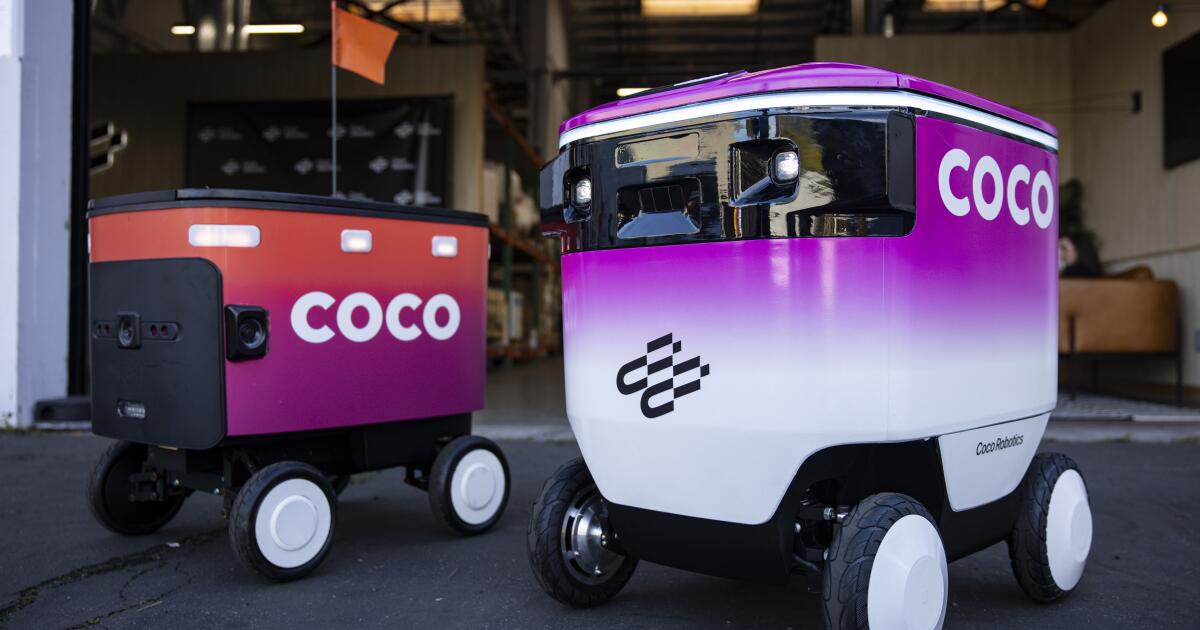
The rolling robots that deliver groceries and hot meals across Los Angeles are getting an upgrade.
Coco Robotics, a UCLA-born startup that’s deployed more than 1,000 bots across the country, unveiled its next-generation machines on Thursday.
The new robots are bigger, tougher and better equipped for autonomy than their predecessors. The company will use them to expand into new markets and increase its presence in Los Angeles, where it makes deliveries through a partnership with DoorDash.
Dubbed Coco 2, the next-gen bots have upgraded cameras and front-facing lidar, a laser-based sensor used in self-driving cars. They will use hardware built by Nvidia, the Santa Clara-based artificial intelligence chip giant.
Coco co-founder and chief executive Zach Rash said Coco 2 will be able to make deliveries even in conditions unsafe for human drivers. The robot is fully submersible in case of flooding and is compatible with special snow tires.
Zach Rash, co-founder and CEO of Coco, opens the top of the new Coco 2 (Next-Gen) at the Coco Robotics headquarters in Venice.
(Kayla Bartkowski/Los Angeles Times)
Early this month, a cute Coco was recorded struggling through flooded roads in L.A.
“She’s doing her best!” said the person recording the video. “She is doing her best, you guys.”
Instagram followers cheered the bot on, with one posting, “Go coco, go,” and others calling for someone to help the robot.
“We want it to have a lot more reliability in the most extreme conditions where it’s either unsafe or uncomfortable for human drivers to be on the road,” Rash said. “Those are the exact times where everyone wants to order.”
The company will ramp up mass production of Coco 2 this summer, Rash said, aiming to produce 1,000 bots each month.
The design is sleek and simple, with a pink-and-white ombré paint job, the company’s name printed in lowercase, and a keypad for loading and unloading the cargo area. The robots have four wheels and a bigger internal compartment for carrying food and goods .
Many of the bots will be used for expansion into new markets across Europe and Asia, but they will also hit the streets in Los Angeles and operate alongside the older Coco bots.
Coco has about 300 bots in Los Angeles already, serving customers from Santa Monica and Venice to Westwood, Mid-City, West Hollywood, Hollywood, Echo Park, Silver Lake, downtown, Koreatown and the USC area.

The new Coco 2 (Next-Gen) drives along the sidewalk at the Coco Robotics headquarters in Venice.
(Kayla Bartkowski/Los Angeles Times)
The company is in discussion with officials in Culver City, Long Beach and Pasadena about bringing autonomous delivery to those communities.
There’s also been demand for the bots in Studio City, Burbank and the San Fernando Valley, according to Rash.
“A lot of the markets that we go into have been telling us they can’t hire enough people to do the deliveries and to continue to grow at the pace that customers want,” Rash said. “There’s quite a lot of area in Los Angeles that we can still cover.”
The bots already operate in Chicago, Miami and Helsinki, Finland. Last month, they arrived in Jersey City, N.J.
Late last year, Coco announced a partnership with DashMart, DoorDash’s delivery-only online store. The partnership allows Coco bots to deliver fresh groceries, electronics and household essentials as well as hot prepared meals.
With the release of Coco 2, the company is eyeing faster deliveries using bike lanes and road shoulders as opposed to just sidewalks, in cities where it’s safe to do so. Coco 2 can adapt more quickly to new environments and physical obstacles, the company said.

Zach Rash, co-founder and CEO of Coco.
(Kayla Bartkowski/Los Angeles Times)
Coco 2 is designed to operate autonomously, but there will still be human oversight in case the robot runs into trouble, Rash said. Damaged sidewalks or unexpected construction can stop a bot in its tracks.
The need for human supervision has created a new field of jobs for Angelenos.
Though there have been reports of pedestrians bullying the robots by knocking them over or blocking their path, Rash said the community response has been overall positive. The bots are meant to inspire affection.
“One of the design principles on the color and the name and a lot of the branding was to feel warm and friendly to people,” Rash said.
Coco plans to add thousands of bots to its fleet this year. The delivery service got its start as a dorm room project in 2020, when Rash was a student at UCLA. He co-founded the company with fellow student Brad Squicciarini.
The Santa Monica-based company has completed more than 500,000 zero-emission deliveries and its bots have collectively traveled around 1 million miles.
Coco chooses neighborhoods to deploy its bots based on density, prioritizing areas with restaurants clustered together and short delivery distances as well as places where parking is difficult.
The robots can relieve congestion by taking cars and motorbikes off the roads. Rash said there is so much demand for delivery services that the company’s bots are not taking jobs from human drivers.
Instead, Coco can fill gaps in the delivery market while saving merchants money and improving the safety of city streets.
“This vehicle is inherently a lot safer for communities than a car,” Rash said. “We believe our vehicles can operate the highest quality of service and we can do it at the lowest price point.”

President Trump on Friday directed federal agencies to stop using technology from San Francisco artificial intelligence company Anthropic, escalating a high-profile clash between the AI startup and the Pentagon over safety.
In a Friday post on the social media site Truth Social, Trump described the company as “radical left” and “woke.”
“We don’t need it, we don’t want it, and will not do business with them again!” Trump said.
The president’s harsh words mark a major escalation in the ongoing battle between some in the Trump administration and several technology companies over the use of artificial intelligence in defense tech.
Anthropic has been sparring with the Pentagon, which had threatened to end its $200-million contract with the company on Friday if it didn’t loosen restrictions on its AI model so it could be used for more military purposes. Anthropic had been asking for more guarantees that its tech wouldn’t be used for surveillance of Americans or autonomous weapons.
The tussle could hobble Anthropic’s business with the government. The Trump administration said the company was added to a sweeping national security blacklist, ordering federal agencies to immediately discontinue use of its products and barring any government contractors from maintaining ties with it.
Defense Secretary Pete Hegseth, who met with Anthropic’s Chief Executive Dario Amodei this week, criticized the tech company after Trump’s Truth Social post.
“Anthropic delivered a master class in arrogance and betrayal as well as a textbook case of how not to do business with the United States Government or the Pentagon,” he wrote Friday on social media site X.
Anthropic didn’t immediately respond to a request for comment.
Anthropic announced a two-year agreement with the Department of Defense in July to “prototype frontier AI capabilities that advance U.S. national security.”
The company has an AI chatbot called Claude, but it also built a custom AI system for U.S. national security customers.
On Thursday, Amodei signaled the company wouldn’t cave to the Department of Defense’s demands to loosen safety restrictions on its AI models.
The government has emphasized in negotiations that it wants to use Anthropic’s technology only for legal purposes, and the safeguards Anthropic wants are already covered by the law.
Still, Amodei was worried about Washington’s commitment.
“We have never raised objections to particular military operations nor attempted to limit use of our technology in an ad hoc manner,” he said in a blog post. “However, in a narrow set of cases, we believe AI can undermine, rather than defend, democratic values.”
Tech workers have backed Anthropic’s stance.
Unions and worker groups representing 700,000 employees at Amazon, Google and Microsoft said this week in a joint statement that they’re urging their employers to reject these demands as well if they have additional contracts with the Pentagon.
“Our employers are already complicit in providing their technologies to power mass atrocities and war crimes; capitulating to the Pentagon’s intimidation will only further implicate our labor in violence and repression,” the statement said.
Anthropic’s standoff with the U.S. government could benefit its competitors, such as Elon Musk’s xAI or OpenAI.
Sam Altman, chief executive of OpenAI, the company behind ChatGPT and one of Anthropic’s biggest competitors, told CNBC in an interview that he trusts Anthropic.
“I think they really do care about safety, and I’ve been happy that they’ve been supporting our war fighters,” he said. “I’m not sure where this is going to go.”
Anthropic has distinguished itself from its rivals by touting its concern about AI safety.
The company, valued at roughly $380 billion, is legally required to balance making money with advancing the company’s public benefit of “responsible development and maintenance of advanced AI for the long-term benefit of humanity.”
Developers, businesses, government agencies and other organizations use Anthropic’s tools. Its chatbot can generate code, write text and perform other tasks. Anthropic also offers an AI assistant for consumers and makes money from paid subscriptions as well as contracts. Unlike OpenAI, which is testing ads in ChatGPT, Anthropic has pledged not to show ads in its chatbot Claude.
The company has roughly 2,000 employees and has revenue equivalent to about $14 billion a year.

new video loaded: The Web of Companies Owned by Elon Musk

By Kirsten Grind, Melanie Bencosme, James Surdam and Sean Havey
February 27, 2026

20k customers without power in Revere, Winthrop areas

How ICE’s presence is affecting child care in Minnesota

Mississippi State baseball, Brian O’Connor 10-0 after Arizona State win

Mississippi State basketball vs Missouri score, live updates, TV channel

Women who made agriculture work in Montana

Florida High School Football Rankings: Top 25 teams – Oct. 21

Cleary's 21 help Le Moyne down Central Connecticut State 69-64 in OT

How old is Bo Nix? What to know about Oregon quarterback ahead of 2024 NFL Draft

99th annual Pony Swim held in Virginia

Indiana Members Credit Union announced as new anchor tenant at Bottleworks District

2 Survivors Describe the Terror and Tragedy of the Tahoe Avalanche

Iran fires missiles at US bases across Middle East after American strikes on nuclear, IRGC sites

Israel strikes two schools in Iran, killing more than 50 people

Anthropic CEO says he’s sticking to AI “red lines” despite clash with Pentagon

ICE blasts Washington mayor over directive restricting immigration enforcement
-

 World3 days ago
Exclusive: DeepSeek withholds latest AI model from US chipmakers including Nvidia, sources say
-

 Massachusetts3 days ago
Mother and daughter injured in Taunton house explosion
-

 Montana1 week ago
2026 MHSA Montana Wrestling State Championship Brackets And Results – FloWrestling
-

 Louisiana6 days ago
Wildfire near Gum Swamp Road in Livingston Parish now under control; more than 200 acres burned
-

 Denver, CO3 days ago
10 acres charred, 5 injured in Thornton grass fire, evacuation orders lifted
-

 Technology1 week ago
YouTube TV billing scam emails are hitting inboxes
-

 Technology1 week ago
Stellantis is in a crisis of its own making
-

 Politics1 week ago
OpenAI didn’t contact police despite employees flagging mass shooter’s concerning chatbot interactions: REPORT