Business
L.A. consumer group calls FAIR Plan insurance reforms an industry 'bailout'


A new law that could force homeowners across California to cover billions of dollars of insurer losses caused by a catastrophic wildfire is generating pushback from a leading consumer group, which has called it an industry “bailout.”
State Insurance Commissioner Ricardo Lara announced Friday he had reached an agreement with the California FAIR Plan that would allow losses suffered by the state’s insurer of last resort to be recouped by surcharges on residential and commercial insurance policies statewide in an “extreme worst case scenario.”
The FAIR Plan, which insures property owners who cannot get or afford traditional policies, is backed by licensed insurers such as State Farm and Allstate. As the program is structured, they are on the hook to pay claims if the FAIR Plan runs through its reserves, reinsurance and catastrophe bonds.
Under Lara’s agreement, if that happens and those insurers suffer large losses, they could seek to be reimbursed by their own policyholders. The deal allow insurers that are assessed by the FAIR Plan to cover up to $1 billion in residential losses and up to $1 billion in commercial losses to ask the insurance commissioner to allow them to surcharge their policyholders for half of the assessed amounts. They also could seek surcharges on policyholders for 100% of losses that exceed those limits. Homeowners would not be surcharged for commercial losses.
“It’s outrageous and outside the law for the insurance commissioner to force consumers to bail out home insurance companies and then call that consumer protection,” said Carmen Balber, executive director of Los Angeles-based Consumer Watchdog.
Gabriel Sanchez, Lara’s press secretary, defended the agreement, saying, “It would be easy to listen to the elites and the entrenched interests defending a system that clearly isn’t working. Commissioner Lara is focused on hearing from the public, following the data and creating realistic, long-lasting solutions for everyone in this state.”
The FAIR Plan assessment is the latest element of Lara’s Sustainable Insurance Strategy, a package of executive actions intended to stabilize the California market, which has seen insurers stop writing new policies and decline to renew existing policies amid a sharp increase in claims for wildfires damage.
Just this week, firefighters are battling the massive Park fire in Butte, Tehama and Shasta counties, where 100 structures have been destroyed, 4,200 were threatened and 26,000 people were forced to evacuate as of Monday. It is the sixth-largest fire in state history.
As insurers have pulled back from high-fire risk neighborhoods, the number of residential FAIR Plan policies has more than doubled since 2019 to about 408,000 as of June. Commercial policies similarly increased to 11,026.
The FAIR Plan has a market share under 4%. Policyholders are concentrated in canyons, hillsides and other high-risk neighborhoods, vulnerable to fire and catastrophic insurance losses. The plan’s loss exposure was $393 billion as of June, even though the plan’s policies are more limited than those available through the regular commercial market.
Lara said Friday in a release announcing the agreement that “modernizing the FAIR Plan is a crucial step in our strategy to stabilize California’s insurance market.”
The FAIR Plan’s financial risk is overwhelmingly due to its residential policies, which account for about 95% of its $393 billion in total loss exposure, according to the insurer.
The Insurance Department downplayed a worst-case scenario, noting that even the 2018 Camp fire in Butte County that ravaged the town of Paradise, destroying or damaging more than 19,000 structures and causing some $16.5 billion in damage, did not deplete the FAIR Plan‘s reserves.
The Insurance Department contended that the agreement was actually favorable to consumers because under current law there is nothing prohibiting the insurers from seeking policyholder assessments on all FAIR Plan losses they must cover.
“The agreement … requires insurance companies to share the burden, something not clearly outlined before. That protects consumers by providing predictability which leads to stability,” Sanchez said.
Balber disputed that reading of the law and said Lara has not been able to get legislative authority for the insurer policyholder assessments, so he proceeded under questionable executive authority. “We have several questions about the legality of this proposal and are looking into it,” she said.
Consumer Watchdog has called for requiring insurers to offer policies in wildfire-prone neighborhoods to homeowners who have taken steps to reduce fire risks on their property as the best method to reduce enrollment in the FAIR Plan and stabilize the state’s insurance market.
Another key element of Lara’s FAIR Plan reforms call for the insurer to offer greater commercial coverage — up to $20 million per structure and $100 million for any one location.
Dan Dunmoyer, chief executive of the California Building Industry Assn., said the trade group has been seeking higher commercial coverage limits due to the rise of insurance premiums, which have slowed the construction of condominium complexes that builders insure.
He estimated that astronomical insurance rate increases have slowed condo construction by about 70% in the last 12 months, with fewer than 6,000 units built.
“Our view on this is: Get some competition in the marketplace, expand commercial coverage, let us build the most affordable for sale homes in California, which are condos,” he said.
The American Property Casualty Insurance Assn., an industry trade group, called Lara’s plan “an important step toward restoring the FAIR Plan’s financial stability and ensuring consumers have access to the coverage they need.”
The deal reached by Lara with the FAIR Plan is a binding legal stipulation and it requires the insurer to develop a “Plan of Operation” within 30 days detailing how it will carry out the agreement. It has 120 days to submit a rate plan for offering the higher commercial coverage.
The FAIR Plan was sued last week by four California residents who claim its policies offer subpar coverage for fire and smoke damage. The proposed class-action lawsuit seeks to represent more than 300,000 of the plan’s residential policyholders. The plan also is facing a lawsuit from more than 1,000 homeowners in Los Angeles who say the plan wrongly denied their claims.



President Trump on Friday directed federal agencies to stop using technology from San Francisco artificial intelligence company Anthropic, escalating a high-profile clash between the AI startup and the Pentagon over safety.
In a Friday post on the social media site Truth Social, Trump described the company as “radical left” and “woke.”
“We don’t need it, we don’t want it, and will not do business with them again!” Trump said.
The president’s harsh words mark a major escalation in the ongoing battle between some in the Trump administration and several technology companies over the use of artificial intelligence in defense tech.
Anthropic has been sparring with the Pentagon, which had threatened to end its $200-million contract with the company on Friday if it didn’t loosen restrictions on its AI model so it could be used for more military purposes. Anthropic had been asking for more guarantees that its tech wouldn’t be used for surveillance of Americans or autonomous weapons.
The tussle could hobble Anthropic’s business with the government. The Trump administration said the company was added to a sweeping national security blacklist, ordering federal agencies to immediately discontinue use of its products and barring any government contractors from maintaining ties with it.
Defense Secretary Pete Hegseth, who met with Anthropic’s Chief Executive Dario Amodei this week, criticized the tech company after Trump’s Truth Social post.
“Anthropic delivered a master class in arrogance and betrayal as well as a textbook case of how not to do business with the United States Government or the Pentagon,” he wrote Friday on social media site X.
Anthropic didn’t immediately respond to a request for comment.
Anthropic announced a two-year agreement with the Department of Defense in July to “prototype frontier AI capabilities that advance U.S. national security.”
The company has an AI chatbot called Claude, but it also built a custom AI system for U.S. national security customers.
On Thursday, Amodei signaled the company wouldn’t cave to the Department of Defense’s demands to loosen safety restrictions on its AI models.
The government has emphasized in negotiations that it wants to use Anthropic’s technology only for legal purposes, and the safeguards Anthropic wants are already covered by the law.
Still, Amodei was worried about Washington’s commitment.
“We have never raised objections to particular military operations nor attempted to limit use of our technology in an ad hoc manner,” he said in a blog post. “However, in a narrow set of cases, we believe AI can undermine, rather than defend, democratic values.”
Tech workers have backed Anthropic’s stance.
Unions and worker groups representing 700,000 employees at Amazon, Google and Microsoft said this week in a joint statement that they’re urging their employers to reject these demands as well if they have additional contracts with the Pentagon.
“Our employers are already complicit in providing their technologies to power mass atrocities and war crimes; capitulating to the Pentagon’s intimidation will only further implicate our labor in violence and repression,” the statement said.
Anthropic’s standoff with the U.S. government could benefit its competitors, such as Elon Musk’s xAI or OpenAI.
Sam Altman, chief executive of OpenAI, the company behind ChatGPT and one of Anthropic’s biggest competitors, told CNBC in an interview that he trusts Anthropic.
“I think they really do care about safety, and I’ve been happy that they’ve been supporting our war fighters,” he said. “I’m not sure where this is going to go.”
Anthropic has distinguished itself from its rivals by touting its concern about AI safety.
The company, valued at roughly $380 billion, is legally required to balance making money with advancing the company’s public benefit of “responsible development and maintenance of advanced AI for the long-term benefit of humanity.”
Developers, businesses, government agencies and other organizations use Anthropic’s tools. Its chatbot can generate code, write text and perform other tasks. Anthropic also offers an AI assistant for consumers and makes money from paid subscriptions as well as contracts. Unlike OpenAI, which is testing ads in ChatGPT, Anthropic has pledged not to show ads in its chatbot Claude.
The company has roughly 2,000 employees and has revenue equivalent to about $14 billion a year.

new video loaded: The Web of Companies Owned by Elon Musk

By Kirsten Grind, Melanie Bencosme, James Surdam and Sean Havey
February 27, 2026
Business
Commentary: How Trump helped foreign markets outperform U.S. stocks during his first year in office
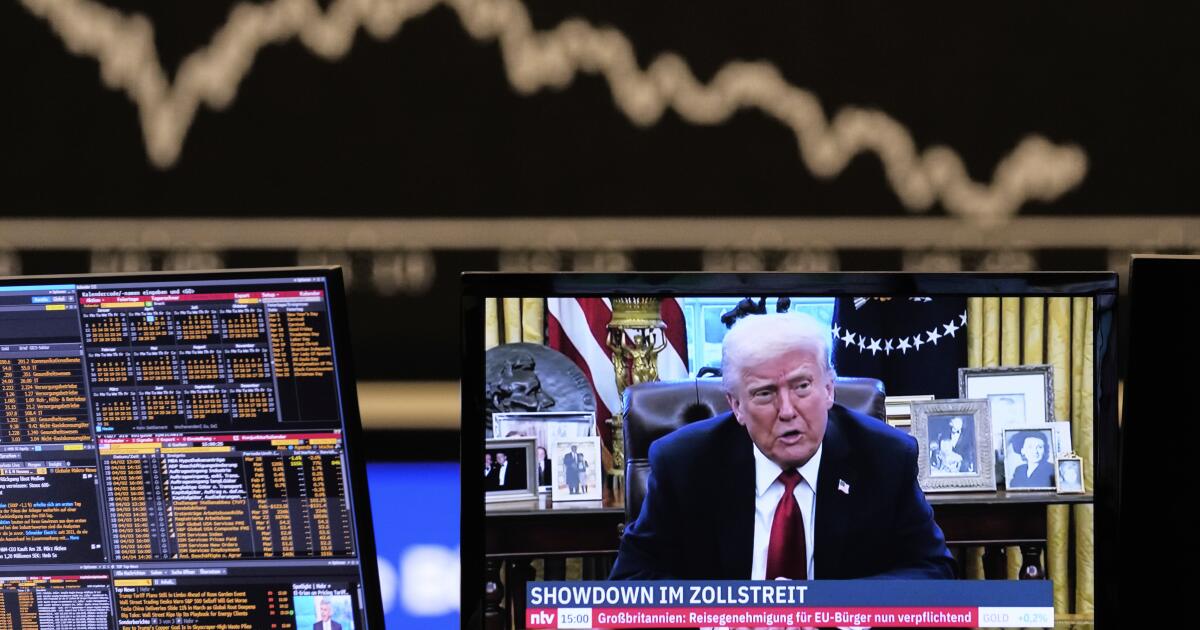
Trump has crowed about the gains in the U.S. stock market during his term, but in 2025 investors saw more opportunity in the rest of the world.
If you’re a stock market investor you might be feeling pretty good about how your portfolio of U.S. equities fared in the first year of President Trump’s term.
All the major market indices seemed to be firing on all cylinders, with the Standard & Poor’s 500 index gaining 17.9% through the full year.
But if you’re the type of investor who looks for things to regret, pay no attention to the rest of the world’s stock markets. That’s because overseas markets did better than the U.S. market in 2025 — a lot better. The MSCI World ex-USA index — that is, all the stock markets except the U.S. — gained more than 32% last year, nearly double the percentage gains of U.S. markets.
That’s a major departure from recent trends. Since 2013, the MSCI US index had bested the non-U.S. index every year except 2017 and 2022, sometimes by a wide margin — in 2024, for instance, the U.S. index gained 24.6%, while non-U.S. markets gained only 4.7%.
The Trump trade is dead. Long live the anti-Trump trade.
— Katie Martin, Financial Times
Broken down into individual country markets (also by MSCI indices), in 2025 the U.S. ranked 21st out of 23 developed markets, with only New Zealand and Denmark doing worse. Leading the pack were Austria and Spain, with 86% gains, but superior records were turned in by Finland, Ireland and Hong Kong, with gains of 50% or more; and the Netherlands, Norway, Britain and Japan, with gains of 40% or more.
Investment analysts cite several factors to explain this trend. Judging by traditional metrics such as price/earnings multiples, the U.S. markets have been much more expensive than those in the rest of the world. Indeed, they’re historically expensive. The Standard & Poor’s 500 index traded in 2025 at about 23 times expected corporate earnings; the historical average is 18 times earnings.
Investment managers also have become nervous about the concentration of market gains within the U.S. technology sector, especially in companies associated with artificial intelligence R&D. Fears that AI is an investment bubble that could take down the S&P’s highest fliers have investors looking elsewhere for returns.
But one factor recurs in almost all the market analyses tracking relative performance by U.S. and non-U.S. markets: Donald Trump.
Investors started 2025 with optimism about Trump’s influence on trading opportunities, given his apparent commitment to deregulation and his braggadocio about America’s dominant position in the world and his determination to preserve, even increase it.
That hasn’t been the case for months.
”The Trump trade is dead. Long live the anti-Trump trade,” Katie Martin of the Financial Times wrote this week. “Wherever you look in financial markets, you see signs that global investors are going out of their way to avoid Donald Trump’s America.”
Two Trump policy initiatives are commonly cited by wary investment experts. One, of course, is Trump’s on-and-off tariffs, which have left investors with little ability to assess international trade flows. The Supreme Court’s invalidation of most Trump tariffs and the bellicosity of his response, which included the immediate imposition of new 10% tariffs across the board and the threat to increase them to 15%, have done nothing to settle investors’ nerves.
Then there’s Trump’s driving down the value of the dollar through his agitation for lower interest rates, among other policies. For overseas investors, a weaker dollar makes U.S. assets more expensive relative to the outside world.
It would be one thing if trade flows and the dollar’s value reflected economic conditions that investors could themselves parse in creating a picture of investment opportunities. That’s not the case just now. “The current uncertainty is entirely man-made (largely by one orange-hued man in particular) but could well continue at least until the US mid-term elections in November,” Sam Burns of Mill Street Research wrote on Dec. 29.
Trump hasn’t been shy about trumpeting U.S. stock market gains as emblems of his policy wisdom. “The stock market has set 53 all-time record highs since the election,” he said in his State of the Union address Tuesday. “Think of that, one year, boosting pensions, 401(k)s and retirement accounts for the millions and the millions of Americans.”
Trump asserted: “Since I took office, the typical 401(k) balance is up by at least $30,000. That’s a lot of money. … Because the stock market has done so well, setting all those records, your 401(k)s are way up.”
Trump’s figure doesn’t conform to findings by retirement professionals such as the 401(k) overseers at Bank of America. They reported that the average account balance grew by only about $13,000 in 2025. I asked the White House for the source of Trump’s claim, but haven’t heard back.
Interpreting stock market returns as snapshots of the economy is a mug’s game. Despite that, at her recent appearance before a House committee, Atty. Gen. Pam Bondi tried to deflect questions about her handling of the Jeffrey Epstein records by crowing about it.
“The Dow is over 50,000 right now, she declared. “Americans’ 401(k)s and retirement savings are booming. That’s what we should be talking about.”
I predicted that the administration would use the Dow industrial average’s break above 50,000 to assert that “the overall economy is firing on all cylinders, thanks to his policies.” The Dow reached that mark on Feb. 6. But Feb. 11, the day of Bondi’s testimony, was the last day the index closed above 50,000. On Thursday, it closed at 49,499.50, or about 1.4% below its Feb. 10 peak close of 50,188.14.
To use a metric suggested by economist Justin Wolfers of the University of Michigan, if you invested $48,488 in the Dow on the day Trump took office last year, when the Dow closed at 48,448 points, you would have had $50,000 on Feb. 6. That’s a gain of about 3.2%. But if you had invested the same amount in the global stock market not including the U.S. (based on the MSCI World ex-USA index), on that same day you would have had nearly $60,000. That’s a gain of nearly 24%.
Broader market indices tell essentially the same story. From Jan. 17, 2025, the last day before Trump’s inauguration, through Thursday’s close, the MSCI US stock index gained a cumulative 16.3%. But the world index minus the U.S. gained nearly 42%.
The gulf between U.S. and non-U.S. performance has continued into the current year. The S&P 500 has gained about 0.74% this year through Wednesday, while the MSCI World ex-USA index has gained about 8.9%. That’s “the best start for a calendar year for global stocks relative to the S&P 500 going back to at least 1996,” Morningstar reports.
It wouldn’t be unusual for the discrepancy between the U.S. and global markets to shrink or even reverse itself over the course of this year.
That’s what happened in 2017, when overseas markets as tracked by MSCI beat the U.S. by more than three percentage points, and 2022, when global markets lost money but U.S. markets underperformed the rest of the world by more than five percentage points.
Economic conditions change, and often the stock markets march to their own drummers. The one thing less likely to change is that Trump is set to remain president until Jan. 20, 2029. Make your investment bets accordingly.

Town Hall to address future of Medicaid expansion in Idaho – Local News 8

Takeaways: Michigan basketball ends Illinois streak, wins Big Ten

Highlights: Beech Grove at Whiteland; February 27, 2026

Iowa Boys High School Basketball Substate Finals Locked In For 4A

Kansas Jayhawks vs. Arizona Wildcats: live game updates, stats, play-by-play

Florida High School Football Rankings: Top 25 teams – Oct. 21

Cleary's 21 help Le Moyne down Central Connecticut State 69-64 in OT

How old is Bo Nix? What to know about Oregon quarterback ahead of 2024 NFL Draft

99th annual Pony Swim held in Virginia

Indiana Members Credit Union announced as new anchor tenant at Bottleworks District

ICE blasts Washington mayor over directive restricting immigration enforcement

Did the EU bypass Hungary’s veto on Ukraine’s €90 billion loan?

How the federal government is painting immigrants as criminals on social media

Where Iran’s ballistic missiles can reach — and how close they are to the US

Has India’s influence in Afghanistan grown under the Taliban?
-

 World2 days ago
Exclusive: DeepSeek withholds latest AI model from US chipmakers including Nvidia, sources say
-

 Massachusetts3 days ago
Mother and daughter injured in Taunton house explosion
-

 Montana1 week ago
2026 MHSA Montana Wrestling State Championship Brackets And Results – FloWrestling
-

 Louisiana5 days ago
Wildfire near Gum Swamp Road in Livingston Parish now under control; more than 200 acres burned
-

 Denver, CO2 days ago
10 acres charred, 5 injured in Thornton grass fire, evacuation orders lifted
-

 Technology7 days ago
YouTube TV billing scam emails are hitting inboxes
-

 Technology7 days ago
Stellantis is in a crisis of its own making
-

 Politics7 days ago
OpenAI didn’t contact police despite employees flagging mass shooter’s concerning chatbot interactions: REPORT