Business
Johnson & Johnson Loses in Court Again in Bid to Settle Talc Cases


A federal bankruptcy judge in Houston on Monday rejected Johnson & Johnson’s request to approve a $9 billion settlement with tens of thousands of people who are suing the company over claims that its talcum powder products caused cancer.
The proposal would have resolved nearly all current and future claims that the company’s talc products contained asbestos and caused cancer. Like the previous two efforts — in 2021 and 2023 — the deal tried to use an element of the bankruptcy system to settle the claims.
Johnson & Johnson claims that its products did not contain asbestos and that there was no proven link between its products and the cancer, the judge, Christopher Lopez, wrote in his ruling. Johnson & Johnson has long denied those claims, but has in recent years stopped selling talc-based baby powder worldwide.
Over 90,000 claims against Johnson & Johnson and other parties are pending, far too many for the courts to process individually.
The settlement attempt by the company and lawyers for the plaintiffs who brought the claims was opposed by a Department of Justice bankruptcy trustee as well as other plaintiffs’ lawyers, the judge said.
In a statement on Monday, Johnson & Johnson said, “The court has unfortunately allowed a couple of law firms with financially conflicted motives, who have conceded they have not recovered a dime for their clients in a decade of litigation, to defeat the overwhelming desire of claimants.”
“Rather than pursue a protracted appeal,” the company said, it “will return to the tort system to litigate and defeat these meritless talc claims.” It added that it would reverse about $7 billion that it had set aside to resolve the bankruptcy.
Johnson & Johnson, which makes pharmaceuticals and consumer products including Band-Aids and Listerine, spent years arguing that its baby powder was safe. Internal memos showed that inside of the company, there were worries that the talc could be contaminated with asbestos, a known carcinogen.
Since 2021, critics have contended that Johnson & Johnson has been trying to take unfair advantage of protections afforded companies in bankruptcy court. That year, it created a subsidiary, LTL Management, and shunted the baby powder claims into it. A day later, LTL declared bankruptcy.
Johnson & Johnson announced at the time that the bankruptcy filing, in New Jersey, was intended to resolve the lawsuits “in a manner that is equitable to all parties.” It said the company would provide funds for any amounts that a bankruptcy court decided that LTL owed.
Plaintiffs’ lawyers derided the creation of LTL and its nearly instant bankruptcy as an example of “the Texas two-step” — an effort to shield a solvent company with an insolvent one. In January 2023, a federal judge rejected LTL’s bankruptcy filing.
Three months later, the company announced that it had reached a deal to pay $8.9 billion over 25 years to tens of thousands of claimants, an attempt to end litigation that by then had gone on for more than a decade. Plaintiffs’ lawyers in the case called the settlement a “significant victory for the tens of thousands of women suffering from gynecological cancers caused by J.&J.’s talc-based products.”
The U.S. Court of Appeals for the Third Circuit twice rejected the settlement. Johnson & Johnson tried again, this time in Texas, and Judge Lopez has now rejected it, too. He decided that the plaintiffs’ lawyers had not adequately secured the consent of enough claimants. He also found “solicitation irregularities, including the unreasonably short voting time for thousands of creditors,” he wrote.
“While the court’s decision is not an easy one,” he stated, “it is the right one.”



As big malls and department stores close, bargain chains like Ross Dress for Less are rolling out new stores.
Economic anxiety and inflation are leading shoppers to spend less and search for savings. In this bombed-out retail landscape, some chains are thriving and opening new outlets.
At a new Ross in Alhambra, Liz Lopez was shopping for a designer purse. She is a big fan of the Dublin-based chain and thrilled to now have one just 10 blocks from her home.
People check out after shopping at a newly opened Ross store.
(Jason Armond / Los Angeles Times)
“I come on Tuesdays for the senior discounts,” Lopez said, showing off her new black Dolce & Gabbana purse. “I always find good deals.”
The new store on East Valley Boulevard opened this month. One of its sister shops — dd’s Discounts, which is owned by the same parent company — opened in North Hollywood.
This year, the parent company, Ross Stores Inc., plans to open 110 new outlets across the country, after 90 last year.
Ross Chief Executive Jim Conroy said Ross is capturing market share by attracting customers away from other retail chains.
“The share shift is more from mainstream retail, department stores and other places like that,” he told analysts after announcing strong growth early this month.
Other discount outlets, including T.J. Maxx, Dollar General, Nordstrom Rack and Five Below, are also expanding to capitalize on tough times.
Retail data show shoppers are visiting a broader spectrum of destinations to find lower prices, said Placer.ai, which tracks people’s movements based on cellphone usage.
“Consumers have become increasingly selective and price-sensitive, actively pivoting away from traditional mid-market chains in favor of discount retailers and value-oriented brands,” Placer.ai said in a report this month. “Because affordability remains a core focus, average households are spreading their visits across a wider number of non-discretionary stores to hunt for deals.”
Discount retailers have been popular for decades, but a combination of factors is now driving accelerated growth for some, experts said.
Dollar stores and the first off-price retailers rose to popularity in the 1990s, but really took off around 2010 following the recession, according to Dylan Carden, a specialty retail analyst at William Blair.
Since then, the stigma surrounding bargain stores has lessened for both customers and brands.
“They’re phenomenal at what they do,” Carden said of the major off-price retailers, including Ross and TJX, which owns T.J. Maxx, Marshalls and Home Goods.
In the last year or so, well-established retailers that were already grappling with intense competition from online retailers have been hit as their customers cut back on discretionary spending amid inflation, tariffs and global conflict.

Savings signs on the walls at a newly opened Ross store in Alhambra.
(Jason Armond / Los Angeles Times)
For stores such as Ross, this dip in demand at department stores means a larger supply of discounted products, as they often buy unsold merchandise from struggling high-end outlets and manufacturers.
“These companies offer a tremendous value to shoppers, but they perhaps offer an even greater value to the brands,” said Simeon Siegel, a senior managing director at Guggenheim Partners. “They’ve solidified their role in the retail ecosystem.”
Five Below, the Pennsylvania-based discount outlet aimed at teens and tweens, opened 150 new stores in 2025 and has plans to open more this year. Its same-store sales rose 15% in the fourth quarter last year.
Ross sells everything from neckties to shower curtains. Its fourth-quarter profits last year rose 10% from the year prior. Ross reported record sales for 2025 of $22.8 billion, up 8% from the year prior. Its net income was $2.1 billion, similar to 2024, while comparable store sales grew 5%.
Investors have been happy with its outperformance.
Ross shares surged around 70% over the past year. TJX shares rose around 30%.

A man exits after shopping at a newly opened Ross store.
(Jason Armond / Los Angeles Times)
TJX has also seen year-over-year increases in sales and net income, according to its most recent earnings release. It plans to open 146 new stores this year.
“The revenues, the stores, the businesses are doing excellent,” Siegel said. “They are absolutely in their stride.”
In contrast, some department stores are struggling.
Macy’s closed two California locations earlier this year as part of its plan to reduce its footprint by 30% by 2027. Twelve more closures are planned in the coming months across the U.S.
Saks Global, which owns Saks Fifth Avenue and Neiman Marcus, filed for Chapter 11 bankruptcy protection in January, citing overwhelming debt.
“The department store pressure and the off-price success are not coincidental,” Siegel said. “They are clearly linked. Off-price has effectively become the new department store.”
In addition to opening new stores, Ross is working to streamline the shopping process by better organizing its stores and adding self-checkout at more branches.
The new Ross in Alhambra has several self-checkout lanes and well-stocked aisles organized into categories such as apparel, technology and cosmetics.
Lopez, a regular at Ross Dress for Less, put a pack of clothing hangers in her cart along with her new purse before checking out.
“I always seem to find what I need,” she said.

The Ryan Gosling-led “Project Hail Mary” rocketed to the top of the box office this weekend, marking a big win for Amazon MGM Studios.
The film — which stars Gosling as a science teacher who embarks on a space mission to save humanity — hauled in $80.5 million in the U.S. and Canada, making it the biggest domestic debut of the year so far. Globally, “Project Hail Mary” brought in $140.9 million.
The movie is an adaptation of a novel by Andy Weir, author of “The Martian” — another successful book-to-screen adventure. The big opening weekend for “Project Hail Mary” is a boost for Amazon MGM Studios, which had heavily promoted the film as an example of the big blockbusters it could produce.
“We believe deeply in the Hail Mary, and it’s clear audiences do as well,” Kevin Wilson, head of domestic theatrical distribution for Amazon MGM Studios, said in a statement. “What we’re seeing in theaters —the energy, the exit scores, the word of mouth — is everything we believed this film would deliver.”
Walt Disney Co. and Pixar’s “Hoppers” came in second at the box office this weekend with a domestic total of $18 million. The original animated film has now garnered $120.4 million in the U.S. and Canada since it debuted in theaters earlier this month.
Indian action film “Dhurandhar The Revenge” came in third with $10 million, followed by Disney-owned Searchlight Pictures’ horror film “Ready or Not 2: Here I Come” and Universal Pictures’ romance “Reminders of Him” rounding out the top five.
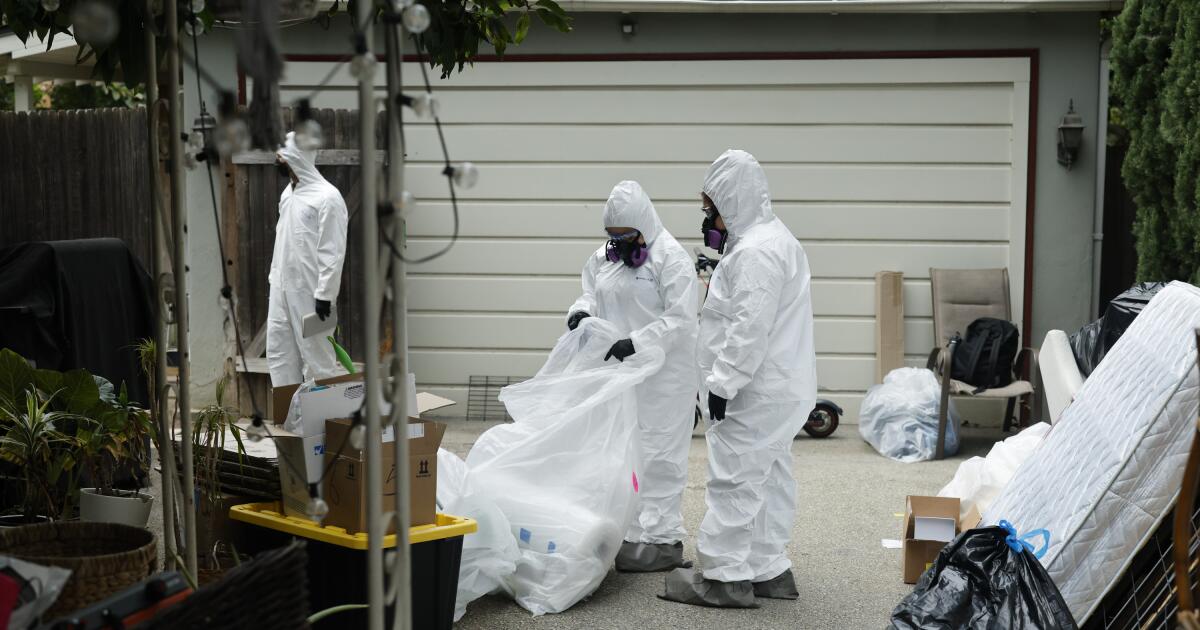
When the January 2025 firestorms swept through Altadena and Pacific Palisades they not only burned down homes but left thousands still standing riddled with smoke damage.
The disaster set the stage for lawsuits by fire victims who alleged their homes were filled with toxic contaminants, yet insurers refused to do hygienic testing and properly clean and make them habitable again.
This week, a much-anticipated bill was unveiled in the Legislature that would establish first-in-the-nation limits for smoke-damage contaminants, require testing and force insurers to restore homes to their prior condition.
The proposed law specifically applies to homes damaged in urban or “wildland-urban interface” fires — such as those in January 2025 — where burning structures, cars, utilities and other items generate more toxins than a rural wildfire.
Authored by Assemblymember Mike Gipson (D-Carson) and sponsored by Insurance Commissioner Ricardo Lara, Assembly Bill 1795 follows similar legislation introduced by Assemblymember John Harabedian (D-Pasadena).
That bill would apply to homes, schools and workplaces — and their properties — requiring insurers to meet existing health standards for lead and asbestos cleanup, while having the state develop additional ones for other contaminants.
Lara’s bill also follows a report issued last week by a smoke-damage task force he established last year, which established the framework for the bill. However, consumer advocates said it was stacked with members tied to the insurance industry.
Lara, who has been asked to step down by critics over his handling of insurers’ claims practices, has defended the task force and his handling of the wildfires, noting his department is investigating insurers.
Here’s what to know about the legislation, which still must go through legislative hearings before an Assembly vote.
Why is this bill a big deal?
Under the current system, insurers are not required to pay for expensive hygienic testing for toxins in smoke-damaged homes. That has been a big source of friction with fire victims, fueling the ongoing litigation over the matter.
Under the bill, however, insurers would be required to cover testing for lead, asbestos and other contaminants that have been found in soot, char and ash inside homes after a wildfire. Such testing would be required both before and after any cleanup work has begun to ensure the home is left in “preloss” condition. Additionally, it sets timelines for claims payments and prohibits insurers from halting payments for temporary housing until a home is cleared as safe, if a state of emergency has been declared.
Who will determine what levels of various contaminants are safe?
The bill requires the California Environmental Protection Agency to develop minimum sampling, testing and chemical screening levels by June 30, 2027. The requirements would be most rigorous in a “high-impact” zone within six miles of a fire perimeter, with potentially lesser requirements for residences as they get further away. The zones and testing requirements could be adjusted for specific fires.
The agency also is required to establish training standards and certification requirements for inspectors and others involved in the testing and restoration of properties.
How does this help the January 2025 fire victims?
More than 40,000 insurance claims have been filed as a result of the Eaton and Palisades fires, with more than 13,000 for smoke damage.
The bill allows the EPA, state and local agencies to establish expedited “interim” standards. Insurance department spokesman Michael Soller said this provision was written with the January 2025 fires in mind.
What do consumer advocates say?
They generally support the proposed changes. Amy Bach, executive director for United Policyholders in San Francisco, who sat on the smoke task force and was critical of its makeup, said she was pleased that the bill “acknowledges the perspectives of the homeowners and will advance their interests in an important way.” But she expects insurers will complain it’s too costly and threaten to leave the state if the bill is not toned down.
Attorney Dylan Schaffer, who has sued the California Fair Plan, the state’s insurer of last resort, over its smoke-damage practices, said the bill was a “very strong nod in the right direction” though it will be the final standards established by the state for testing and cleanup that will be most important. “It always gets down to the details,” he said.
What is the industry’s reaction?
The insurance industry is expected to lobby for changes to the bill, suggesting it could impose burdensome costs on companies.
Karen Collins, a vice president of the American Property Casualty Insurance Assn., said that “insurers support science‑based approaches to evaluating smoke damage and guiding appropriate remediation” but want to “help ensure the bill strikes a reasonable balance — protecting consumers while preserving insurance affordability, availability, and market stability.”
Rex Frazier, president of the Personal Insurance Federation of California, an industry group representing state property and casualty insurers, also said the bill lacks analysis of the “tradeoffs” between the higher claims payments that will result from it and and its effect on consumer premiums.
He also was concerned that the bill appears to bypass traditional rule-making procedures and allow the state EPA to establish the toxic contaminant and other standards without public hearings.
Soller said the intent of the bill is to allow the agency to forgo hearings only in developing interim standards.

Giants valued at $10.8B as Tisch family seeks equity transfer with Epstein investigation looming: report

Robot plays tennis with humans in real time
As malls and department stores fade, California’s Ross and other discounters are booming

Review: With Tina Fey as first host, ‘SNL UK’ kicked off with familiar skits and very British humor

L.A. Times Concierge: ‘It’s hard to make friends as an adult in L.A. What are some groups I can join?’

Florida High School Football Rankings: Top 25 teams – Oct. 21

How old is Bo Nix? What to know about Oregon quarterback ahead of 2024 NFL Draft

Cleary's 21 help Le Moyne down Central Connecticut State 69-64 in OT

99th annual Pony Swim held in Virginia

Indiana Members Credit Union announced as new anchor tenant at Bottleworks District

How the Iran war is about to hit your wallet

Suspect in slaying of Loyola University student was in the country illegally, officials say

Video: Plane Collides With Vehicle at LaGuardia Airport

As cattle herds shrink and beef prices rise, investors back AI cow collars

French elections: Paris stays left as far right makes mixed gains
-

 Detroit, MI5 days ago
Drummer Brian Pastoria, longtime Detroit music advocate, dies at 68
-

 Oklahoma1 week ago
Family rallies around Oklahoma father after head-on crash
-

 Georgia1 week ago
How ICE plans for a detention warehouse pushed a Georgia town to fight back | CNN Politics
-
 Science1 week ago
Federal EPA moves to roll back recent limits on ethylene oxide, a carcinogen
-

 Alaska1 week ago
Police looking for man considered ‘armed and dangerous’
-

 Movie Reviews4 days ago
‘Youth’ Twitter review: Ken Karunaas impresses audiences; Suraj Venjaramoodu adds charm; music wins praise | – The Times of India
-
 Science1 week ago
Long COVID leaves thousands of L.A. county residents sick, broke and ignored
-

 Education1 week ago
Video: Turning Point USA Clubs Expand to High Schools Across America