Business
Japan Reaches Peak Shohei Ohtani as Dodgers and Cubs Open MLB Season


It’s hard to be ubiquitous in Tokyo, one of the largest cities in the world, but Shohei Ohtani has found a way. The Los Angeles Dodgers star seems to be everywhere: on billboards, on products, in television ads and news and entertainment shows and, of course, on the field when his games are broadcast live in Japan.
Ohtani might play baseball 5,500 miles away, but one of the first things people see when they deplane at Haneda Airport, the city’s international gateway, is a photo of the superstar in an ad for green tea.
Leaving the airport, one sees Ohtani’s boyish image on vending machines, in convenience stores and wrapped around trains coursing through the city. Last week, when Ohtani and his team landed in Tokyo to prepare for two season-opening games against the Chicago Cubs, the Dodgers announced yet another sponsorship — with Hakkaisan Brewery, a sake distiller based in Japan.
Major League Baseball has had no shortage of stars over the years, but it has never seen a sensation like Ohtani, who is Japan’s answer to Babe Ruth, a rare player who can both pitch and hit at the highest level.
His return this month to Japan, where tickets to his games are going for as much as $10,000, has the feel of a coronation for a homegrown star who last season signed a record $700 million contract and helped the Dodgers win the World Series.
In sports, money often follows success, and Ohtani’s success has created a windfall for himself, the Dodgers and the league. Ohtani has about 20 active sponsorship deals at any time, like with the Japanese drugmaker Kowa and with New Balance, and the value of his deals spiked after he joined the Dodgers last season following six years with the Los Angeles Angels.
Rob Manfred, the commissioner of M.L.B., who has overseen its international expansion, has encountered his share of stars in his nearly 30 years at the league. But Ohtani is a cut above.
“I’ve never seen anything at the level of excitement for Ohtani,” he said in an interview.
Ohtani, 30, is a marketer’s dream — a sports icon, pop star and national hero rolled into one. As the Dodgers made their way to Japan ahead of a pair of games with the Cubs on Tuesday and Wednesday, news programs tracked the team’s charter flight across the Pacific Ocean, and fans speculated about whether Ohtani had brought his spaniel, Decoy. Talk shows dissected Ohtani’s diet, fashion choices and home décor, as well as his wife’s hobbies.
“Right now, Ohtani is the thing that fills me with the most spirit in life,” said Kiyotada Sato, 79, an Ohtani obsessive who visited an M.L.B. fan festival last week in Tokyo.
Sato has a closet full of Dodgers gear, one reason M.L.B. apparel and jersey sales in Japan jumped 183 percent last year and sponsorships grew 114 percent, including new deals with Mastercard Japan and the video game company Konami. The Dodgers have seen the number and value of their deals skyrocket, and they are poised to surpass the Dallas Cowboys as the top-earning team, according to SponsorUnited, which tracks sports sponsorships.
The Dodgers, already the top-drawing team in the league, saw attendance grow 2.7 percent last year. According to the Los Angeles Tourism & Convention Board, 80 to 90 percent of Japanese visitors to the city last year were there to attend a Dodgers game.
“I lived through this with Magic Johnson,” said Lon Rosen, the team’s chief marketing officer who previously worked for the Lakers. “You don’t ever take an athlete like this for granted.”
Of course, injuries and overexposure could take the shine off Ohtani. But for now, he is making money even for rival teams.
When Ohtani comes to town, home teams have seen a surge in sponsorships from Japanese companies who buy in-stadium ads that can be seen by fans watching Ohtani’s games in Japan. Ads for more than three dozen Japanese brands were visible on television during Dodgers away games, SponsorUnited said.
Going back to the 1990s, Japanese M.L.B. stars like Hideo Nomo, Ichiro Suzuki and Hideki Matsui have created buzz. But Ohtani is a different caliber player. After five seasons in Japan, Ohtani has won three M.V.P. awards in his first seven seasons in the United States.
In October, the number of fans in Japan and South Korea watching the Dodgers play the Yankees in the World Series equaled the number watching in the United States and Canada.
NHK, the Japanese national broadcaster that shows Ohtani’s games, as well as those of other Japanese players in the United States, saw viewership surge 50 percent last season. It uses extra cameras in Dodger Stadium to track Ohtani in the dugout and on the field.
Ohtani’s agent, Nez Balelo, said the income Ohtani generates from his sponsorships has allowed him to defer the bulk of his $700 million contract until after the 10-year deal ends in 2033. This gave the Dodgers room to sign other players, which was important to Ohtani.
Balelo has tried not to overexpose Ohtani, lest it diminish his brand and eat into his training schedule, which includes recovering from off-season surgery and practicing both batting and pitching. That has meant turning away offers and limiting the time he spends working with sponsors.
“I wanted to make it a much, much lighter lift for Shohei because he’s got a lot on his plate,” he said.
Still, there is an undercurrent of fatigue in Japan with the wall-to-wall coverage.
Publicly, many Japanese gush over Ohtani. But on forums like Reddit, resentment bubbles from those who have had their favorite television shows pre-empted, believe Ohtani may be tainted by a gambling scandal that landed his interpreter in jail, or just can’t bear the nonstop fawning.
Toyo Keizai, a business news publication, ran a story during the World Series with the headline, “The perspective missing in those making a fuss about ‘Ohtani Harassment.’” One commenter said, “It’s all Ohtani from morning to night,” and another added, “Not everyone likes Ohtani.”
“People are scared to criticize him, like, ‘Oh, something’s off with his batting stance,’” said Mike Peters, who worked as a Japanese translator for the New York Mets and teaches at Shizuoka University. “No one will say that, even if it’s true because it’s like blasphemy to say anything negative about him.”
Ohtani has many years ahead of him. But topping his extraordinary success, including hitting 50 home runs and stealing 50 bases last year, will be difficult. So, too, will be finding new fans.
“Ohtani has become such a prominent figure in Japan that there is hardly anyone who doesn’t know him,” said Seiji Terasawa, the deputy director of the broadcasting rights group at NHK. “To further elevate his presence, he might need to achieve even more incredible feats, such as winning the Cy Young Award.”
For now, Peak Ohtani continues. Last week in Los Angeles, hundreds of fans waited online a day in advance to buy limited-edition Dodgers merchandise, including Ohtani jerseys, designed by the Japanese artist Takashi Murakami. The collection, made available on the Fanatics app, sold out in an hour.
Last week, Japanese flooded the fanfest at the Tokyo Skytree Town, which included a life-size cutout of Ohtani and American stadium food. Mari Muki and Donn Ozaki, who live in Southern California, bought tickets to see one of Ohtani’s games, which Muki compared to Taylor Swift concert tickets.
“Ohtani is popular in the U.S., and we knew he would be popular in Japan, too,” Ozaki said, “but you really have to see it to believe it here.”
River Akira Davis contributed reporting from Tokyo.



Ranch dressing is having a moment thanks to the World Cup and Kraft is ready to meet it.
The company said Thursday that it is working on a “TSA Compliant Ranch” for those looking to travel with the quintessentially American condiment. The announcement follows the influx of social media videos showing international soccer fans sampling the dressing for the first time.
“Some visitors leave with souvenirs. Others leave with America’s favorite dressing,” Kraft wrote in a caption accompanying an AI image of a TSA-approved clear bag packed with ranch dressing packets posted to social media. The image showed the bag — complete with a luggage tag resembling a ranch dressing bottle — placed in an airport security screening bin along with other travel essentials.
Additional details will be announced later, the company said.
TSA has also leaned into ranch’s apparent newfound popularity among international travelers, providing some helpful tips (and warnings) on social media.
“If you’re visiting for a very large sporting event & you happen to discover RANCH while you’re here… pls pack it in your CHECKED BAG on your way home,” the agency posted on Instagram Tuesday. It also asked travelers to “avoid chugging your ranch outside security” lines.
“Who knew dip-lomacy could be achieved through addressing the obvious: ranch is the king of condiments,” TSA wrote in the caption accompanying its carousel of humorous ranch-related quips. “If you’re traveling within the U.S., make sure to keep your carry-on sauces to 3.4 oz or less and place any larger containers in your checked bags.”
“Some heroes wear capes. Others bring ranch,” it added.
According to 1987 Times reports, ranch dressing was invented by Steve Henson, who opened the Hidden Valley Guest Ranch in Santa Barbara in the mid-1950s with his wife, Gayle. The unnamed condiment originally mixed herbs and spices with buttermilk and mayonnaise and its popularity with guests led to it being jarred so they could take some home. The more travel-friendly powdered form followed.

A landmarked downtown Los Angeles apartment building designed by famed Los Angeles architect John Parkinson is on the market as its owners face foreclosure.
Residences in the Metropolitan, a 10-story tower built in 1913, are nearly filled with tenants but its ground floor retail spaces on Broadway and 5th Street are unoccupied, as are other street-level stores in downtown’s Historic Core.
The historic building was once considered one of the best in the city and is owned by the Fallas family, which operated a chain of value-priced clothing stores based in Gardena including one called Fallas Paredes in the Metropolitan.
Fallas-Paredes at 449 S. Broadway, Los Angeles, CA 90013.
(Google Maps)
Around 2011, Michael Fallas, who once worked in family’s downtown store as a stock boy, converted the upstairs floors from offices to apartments while continuing to operate Fallas Paredes. The store closed more than five years ago in the wake of a 2018 filing by its parent company for Chapter 11 bankruptcy protection.
Earlier this month in state Superior Court, a special servicer representing Fallas’ lender asked for a judicial foreclosure of the property, alleging that Fallas had stopped making payments on a $32 million loan dating to 2017. After leasing the property for years, Fallas bought the building in the 1990s.
Fallas didn’t respond to requests for comment.
The location of the Metropolitan where the buildings stands was hailed in a Times story in 1912, saying “it is regarded by many realty men as the most valuable piece of real estate in Los Angeles.”
The building today is recognized as a city historic-cultural monument because “Broadway became the commercial center of the Southland, a title it retained until well after World War II,” with its development, the city said. One of the architects who designed the Metropolitan in the Beaux-Arts style was John Parkinson, who is credited with designing such well-known local structures as City Hall, the Los Angeles Memorial Coliseum and Union Station.
Notable tenants in the Metropolitan have included the Los Angeles Public Library, Owl Drug Co., variety store J.J. Newberry and real estate company Janns Investment Co., which sold the land where UCLA is built and developed Westwood Village, among other Los Angeles neighborhoods.
In recent years, the buildings around the Metropolitan have struggled to keep retail tenants after a spurt of residential conversions of historic buildings starting in the early 2000s brought commerce to the neighborhood. Many downtown businesses have struggled since the pandemic reduced occupancy in offices downtown and reduced the flow of visitors.
“The lack of bodies on the street is generally hurting downtown, and that’s one of the reasons that has building has problems,” said downtown real estate broker Hal Bastian, who lives in the Historic Core.
There are close to 1,000 residential units in historic buildings at the intersection of Broadway and 5th Street, Bastian said, but all the ground floor stores are closed. Drug stores there suffered substantial losses from shoplifting he said, and now, “our challenge on Broadway is leasing.”
The 88 apartments in the Metropolitan are 91% rented, according to a listing for the property by the Zacuto Group, which also touts its roof deck with pool, fitness center and barbecue grills. No sale price is set.
Business
January 2025 wildfire victims seek tougher penalties against State Farm over claims handling
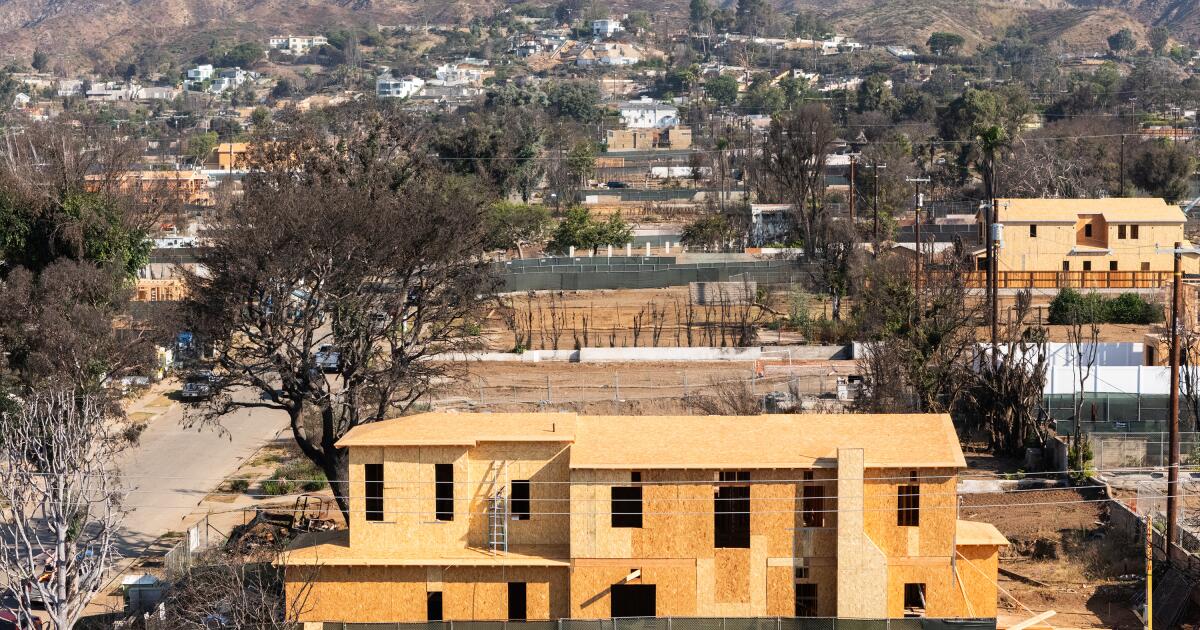
A fire survivors’ group announced Thursday it was seeking tougher penalties against State Farm over its handling of January 2025 wildfire claims.
The Every Fire Survivor’s Network said it was petitioning to join a state enforcement action announced this year against the company to make sure the case results in meaningful changes at California’s largest home insurer.
“We’re seeking a systematic review of all their claims and penalties calibrated to the actual scale of the harm — and we’re seeking the payouts that families are owed,” said Joy Chen, executive director of the group, at a Pacific Palisades news conference joined by victims of the fires.
The Department of Insurance in May filed an administrative action against State Farm General — the subsidiary of the giant Bloomington, Ill., insurer that handles California home insurance — after completing a “market conduct” exam.
The Jan. 7, 2025, fire damaged or destroyed more than 18,000 structures and killed 31 people.
State Farm has received more January 2025 claims than any other insurer — more than 13,700 auto and homeowners claims as of May 4, with payouts totaling $5.7 billion, according to the company.
The market conduct exam looked at 220 sample claims filed by the victims and found 398 violations of state law in about half of them.
Among other alleged violations, it found that the company failed in numerous cases to pursue a “thorough, fair and objective investigation” into claims, failed to come to “prompt, fair, and equitable settlements” and made settlement offers that were “unreasonably low.”
In announcing the action, Insurance Commissioner Ricardo Lara called the company’s claims handling “unacceptable” and said his department was taking “decisive action to hold them accountable.”
The state is seeking a “cease and desist” order to stop the insurer from engaging in unfair or deceptive practices.
It also has threatened to suspend State Farm’s license over the alleged violations, which each carry a penalty of up to $5,000 — or twice that figure if found to be willful. That could amount to a penalty of $2 million or more.
The threat to actually suspend State Farm’s license and its authority to write policies has been viewed skeptically by some, given its roughly 20% market share of the state’s home insurance market.
The company, which had an opportunity to include its responses in the exam report, denied fault in some cases and admitted fault in others. It often blamed problems on individual adjusters and denied systemic issues with its claims handling.
The petition filed by the wildfire survivor’s group criticizes the sample size of the market conduct exam as too small to capture all the alleged deficiencies in State Farm’s claims handling, which it claims are a “general business practice” of the company.
The group is seeking to conduct discovery, cross examine witnesses, present testimony from fire victims and bring more that 1,600 firsthand policyholder statements regarding State Farm’s practices into evidence, according to the petition.
It also wants State Farm to reopen cases in which claimants were paid too little, and it is seeking to participate in settlement discussions in order to increase any penalty State Farm would pay.
It calculated that a $2-million penalty would amount to a minute fraction of the assets of the State Farm Group.
“I submit to you that doesn’t defer bad conduct, it just allows you to continue to do it,” said Michelle Meyers, an attorney for Every Fire Survivor’s Network, at the news conference.
Consumer Watchdog, which has been a harsh critic of State Farm, also is providing legal support for victims’ effort.
Sevag Sarkissian, a spokesperson for State Farm, said the company was aware of the petition.
“We recognize that many wildfire survivors, including those that are State Farm General policyholders, continue to face difficult recovery challenges,” he said. “Our focus remains on helping customers recover.”
Michael Soller, a spokesperson for Lara, said the department is “acting with urgency to assist wildfire survivors in their ongoing recovery by investigating formal complaints filed by survivors and conducting the expedited market conduct exam that led to this enforcement action.”
He added that the department’s position is the state’s Administrative Procedure Act does not contemplate the commissioner or department staff authorizing intervention requests in the case.
He said that would be a hearing officer’s or administrative law judge’s decision when one is assigned to the case.
Meyers acknowledged the request was novel but said her reading of the law is that Lara can make the decision because no judge is yet assigned.
In response to the criticism, State Farm pledged earlier this year to improve its claims handling, including by providing single points of contact and improved communication so there are “fewer handoffs, fewer repeated explanations, and seamless support.”
It also named a new vice president of customer relations for State Farm General.
-
 Lifestyle22 minutes ago
James Burrows, director of classic shows ‘Cheers’ and ‘Friends,’ dies at 85
-

 Technology30 minutes ago
Nothing cancels this year’s CMF phone due to RAM prices
-

 World37 minutes ago
Two-train crash leaves at least 1 dead, 89 injured as emergency crews rush to chaotic scene
-

 Politics40 minutes ago
Double endorsement drama: Trump backs second candidate in red state’s GOP gubernatorial runoff
-

 Health45 minutes ago
Measles-infected traveler may have exposed passengers at LAX and nearby hotel, health officials warn
-

 Sports52 minutes ago
World Cup Red Cards: 2026 Has More Red Cards Than Each Of Last 2 World Cups
-

 Technology55 minutes ago
China’s brain chip breakthrough raises big questions
-
Business60 minutes ago
Ranch lovers can soon travel with a TSA-friendly kit of the popular American dressing

