Business
Ivan Boesky Was Seen as Greed Incarnate, and Never Said Otherwise


Before the answers to life’s questions fit in our pocket, you used to have to turn a dial. If you were lucky, Phil Donahue would be on, ready to guide you toward enlightenment. In a stroke of deluxe good fortune, Dr. Ruth Westheimer might have stopped by to be the enlightenment. He was the search engine. She was a trusted result.
Donahue hailed from Cleveland. The windshield glasses, increasingly snowy thatch of hair, marble eyes, occasional pair of suspenders and obvious geniality said “card catalog,” “manager of the ’79 Reds,” “Stage Manager in a Chevy Motors production of ‘Our Town.’” Dr. Ruth was Donahue’s antonym, a step stool to his straight ladder. She kept her hair in a butterscotch helmet, fancied a uniform of jacket-blouse-skirt and came to our aid, via Germany, with a voice of crinkled tissue paper. Not even eight years separated them, yet so boyish was he and so seasoned was she that he read as her grandson. (She maybe reached his armpit.) Together and apart, they were public servants, American utilities.
Donahue was a journalist. His forum was the talk show, but some new strain in which the main attraction bypassed celebrities. People — every kind of them — lined up to witness other people being human, to experience Donahue’s radical conduit of edification, identification, curiosity, shock, wonder, outrage, surprise and dispute, all visible in the show’s televisual jackpot: cutaways to us, reacting, taking it all in, nodding, gasping. When a celebrity made it to the “Donahue” stage — Bill Clinton, say, La Toya Jackson, the Judds — they were expected to be human, too, to be accountable for their own humanity. From 1967 to 1996, for more than 6,000 episodes, he permitted us to be accountable to ourselves.
What Donahue knew was that we — women especially — were eager, desperate, to be understood, to learn and learn and learn. We call his job “host” when, really, the way he did it, running that microphone throughout the audience, racing up, down, around, sticking it here then here then over here, was closer to “switchboard operator.” It was “hot dog vendor at Madison Square Garden.” The man got his steps in. He let us do more of the questioning than he did — he would just edit, interpret, clarify. Egalitarianism ruled. Articulation, too. And anybody who needed the mic usually got it.
The show was about both what was on our mind and what had never once crossed it. Atheism. Naziism. Colorism. Childbirth. Prison. Rapists. AIDS. Chippendales, Chernobyl, Cher. Name a fetish, Phil Donahue tried to get to its bottom, sometimes by trying it himself. (Let us never forget the episode when he made his entrance in a long skirt, blouse and pussy bow for one of the show’s many cross-dressing studies.) Now’s the time to add that “Donahue” was a morning talk show. In Philadelphia, he arrived every weekday at 9 a.m., which meant that, in the summers, I could learn about compulsive shopping or shifting gender roles from the same kitchen TV set as my grandmother.
Sex and sexuality were the show’s prime subjects. There was so much that needed confessing, correction, corroboration, an ear lent. For that, Donahue needed an expert. Many times, the expert was Dr. Ruth, a godsend who didn’t land in this country until she was in her late 20s and didn’t land on television until she was in her 50s. Ruth Westheimer arrived to us from Germany, where she started as Karola Ruth Siegel and strapped in as her life corkscrewed, as it mocked fiction. Her family most likely perished in the Auschwitz death camps after she was whisked to the safety of a Swiss children’s home, where she was expected to clean. The twists include sniper training for one of the military outfits that would become the Israel Defense Forces, maiming by cannonball on her 20th birthday, doing research at a Planned Parenthood in Harlem, single motherhood and three husbands. She earned her doctorate from Columbia University, in education, and spent her postdoc researching human sexuality. And because her timing was perfect, she emerged at the dawn of the 1980s, an affable vector of an era’s craze for gnomic sages (Zelda Rubinstein, Linda Hunt, Yoda), masterpiece branding and the nasty.
Hers was the age of Mapplethorpe and Madonna, of Prince, Skinemax and 2 Live Crew. On her radio and television shows, in a raft of books and a Playgirl column and through her promiscuous approach to talk-show appearances, she aimed to purge sex of shame, to promote sexual literacy. Her feline accent and jolly innuendo pitched, among other stuff, the Honda Prelude, Pepsi, Sling TV and Herbal Essences. (“Hey!” she offers to a young elevator passenger. “This is where we get off.”) The instructions for Dr. Ruth’s Game of Good Sex says it can be played by up to four couples; the board is vulval and includes stops at “Yeast Infection,” “Chauvinism” and “Goose Him.”
On “Donahue,” she is direct, explicit, dispelling, humorous, clear, common-sensical, serious, vivid. A professional therapist. It was Donahue who handled the comedy. On one visit in 1987, a caller needs advice about a husband who cheats because he wants to have sex more often than she does. Dr. Ruth tells Donahue that if the caller wants to keep the marriage, and her husband wants to do it all the time, “then what she should do is to masturbate him. And it’s all right for him to masturbate himself also a few times.” The audience is hear-a-pin-drop rapt or maybe just squirmy. So Donahue reaches into his parochial-school-student war chest and pulls out the joke about the teacher who tells third-grade boys, “Don’t play with yourself, or you’ll go blind.” And Donahue raises his hand like a kid at the back of the classroom and asks, “Can I do it till I need glasses?” Westheimer giggles, maybe noticing the large pair on Donahue’s face. This was that day’s cold open.
They were children of salesmen, these two; his father was in the furniture business, hers sold what people in the garment industry call notions. They inherited a salesman’s facility for people and packaging. When a “Donahue” audience member asks Westheimer whether her own husband believes she practices what she preaches, she says this is why she never brings him anywhere. “He would tell you and Phil: ‘Do not listen to her. It’s all talk,’” which cracks the audience up.
But consider what she talked about — and consider how she said it. My favorite Dr. Ruth word was “pleasure.” From a German mouth, the word conveys what it lacks with an American tongue: sensual unfurling. She vowed to speak about sex to mass audiences using the proper terminology. Damn the euphemisms. People waited as long as a year and a half for tickets to “Donahue” so they could damn them, too. But of everything Westheimer pitched, of all the terms she precisely used, pleasure was her most cogent product, a gift she believed we could give to others, a gift she swore we owed ourselves.
I miss the talk show that Donahue reinvented. I miss the way Dr. Ruth talked about sex. It’s fitting somehow that this antidogmatic-yet-priestly Irish Catholic man would, on occasion, join forces with a carnal, lucky-to-be-alive Jew to urge the exploration of our bodies while demonstrating respect, civility, reciprocation. They believed in us, that we were all interesting, that we could be trustworthy panelists in the discourse of being alive. Trauma, triviality, tubal ligation: Let’s talk about it! Fear doesn’t seem to have occurred to them. Or if it did, it was never a deterrent. Boldly they went. — And with her encouragement, boldly we came.
Wesley Morris is a critic at large for The New York Times and a staff writer for the magazine.



Tech behemoths, including Oracle and Meta Platforms, are laying off hundreds of California workers as they invest heavily in artificial intelligence.
Some of the top companies in tech that already had announced big plans to lay off thousands have revealed more details about where they are cutting in recent government filings.
Software giant Oracle has shed more than 700 workers in Santa Monica, Redwood City, Pleasanton and Santa Clara, filings to the California Employment Development Department show. The company, which was founded in California before moving its headquarters to Texas, started notifying employees of mass layoffs in late March.
Oracle declined to comment. The company hasn’t said publicly how many workers it has laid off. Several news outlets, citing people familiar with the matter, reported that the company laid off thousands of employees across multiple divisions.
As of May 2025, Oracle had 162,000 workers.
Software developers, analysts, sales representatives and product managers were among California Oracle workers who lost their jobs. Laid-off employees will officially separate from the company June 1.
California is home to some of the world’s most powerful and largest tech companies. But as they race ahead to advance AI-powered tools that can generate text, images and code, workers are anxious that businesses will automate tasks and shrink their workforce workforces. Tech companies also are more wary about their expenses, even as they spend billions of dollars on data centers and developing new products.
In March, Meta began laying off employees who worked on its virtual reality efforts.
The company laid off roughly 200 employees at its offices in Burlingame and Sunnyvale. They’re expected to leave the company May 29. Meta laid off engineers, recruiters, product managers and other workers.
“Teams across Meta regularly restructure or implement changes to ensure they’re in the best position to achieve their goals. Where possible, we are finding other opportunities for employees whose positions may be impacted,” a Meta spokesperson said in a statement.
Meta has been doubling down on its efforts to sell AI-powered smart glasses and is working on more powerful AI that surpasses human intelligence. The company, which debuted a new AI model Wednesday, is building a personal “superintelligence” to help people achieve their goals, create and be more productive.
Meta had 78,865 workers as of December 2025.
Chipmaker Qualcomm recently laid off more than 60 workers. The cuts hit employees across various offices in San Diego. Laid-off employees are anticipated to leave the company May 26. Various information technology and cybersecurity jobs were among the roles slashed as part of the layoffs.
Qualcomm didn’t immediately respond to a request for comment.
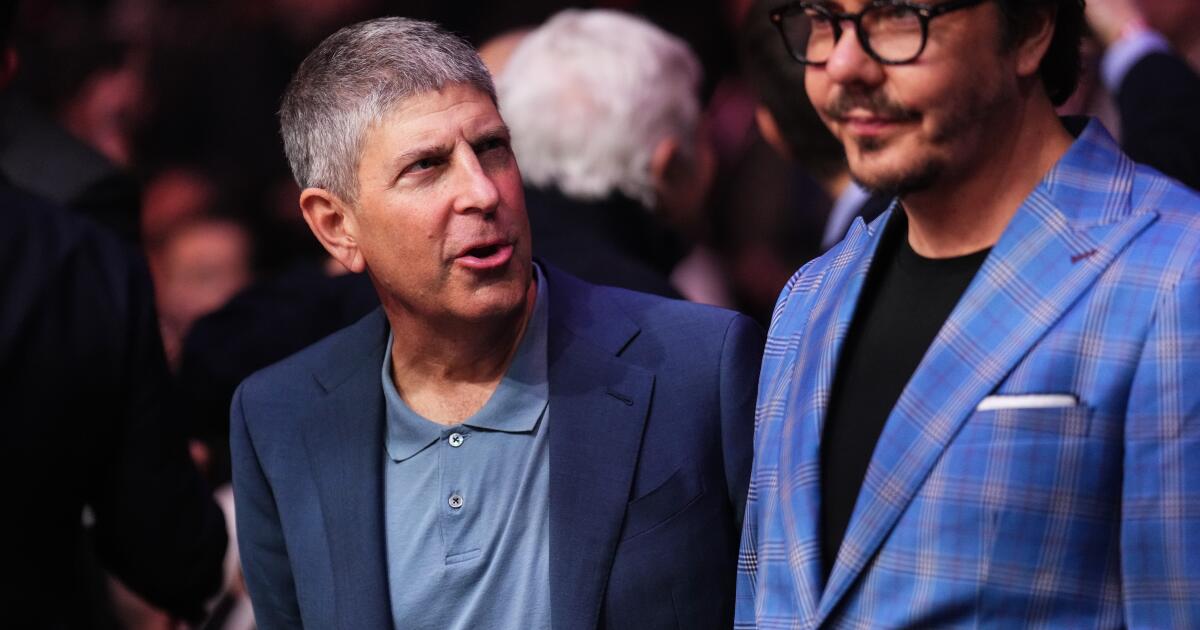
Jeff Shell agreed to step down as president of Paramount Skydance after becoming entangled in a legal battle with a controversial Las Vegas gambler and self-styled “fixer.”
Paramount announced Shell’s departure Wednesday after the two sides negotiated an amicable resolution to the drama. Paramount said its external review into Shell’s conduct, initiated by Paramount’s board of directors, found no violation of securities laws.
Shell also resigned as a Paramount board member to focus on his legal skirmish, the company said.
His departure comes after just eight months on the job.
Paramount Skydance “is grateful for Mr. Shell’s many contributions and to have relied on him as a valued advisor,” the company said in its statement.
The veteran entertainment executive officially joined the media company with David Ellison’s takeover in August, though he had been a key member of Ellison’s team for nearly two years as the group worked to assemble the pieces of the tech scion’s growing empire. Ellison’s Skydance Media acquired Paramount and then pulled off a stunning $111-billion deal to buy Warner Bros. Discovery in late February.
Shell brought substantial experience running a media company to Ellison’s inner circle, a group that included former investment bankers and others who haven’t run a large-scale enterprise. But his role within the company long felt awkward because key division managers, including the heads of CBS, the Paramount movie studio and the company’s streaming businesses, reported to Ellison, which left Shell with a nebulous portfolio.
He wasn’t planning to stay on after the company acquires Warner Bros. Discovery, according to two people close to the situation who were not authorized to speak publicly. Paramount hopes to complete that deal this summer.
Shell’s exit this week was prompted by his unlikely association with the high-roller, Robert James “R.J.” Cipriani, who created a public stir after his dealings with Shell went south.
Cipriani sued Shell in Los Angeles County Superior Court on March 9, alleging fraud and breach of an oral contract. Cipriani claimed that he provided Shell with “sophisticated, high-value crisis communications services,” according to his suit.
He alleged Shell spilled corporate secrets, which Shell has denied. Cipriani said he reported Shell to the U.S. Securities & Exchange Commission because Shell allegedly had discussed highly sensitive Paramount information with him: Paramount’s $7.7-billion deal last summer to bring UFC mixed-martial arts fights to CBS and other Paramount outlets.
Cipriani accused Shell of failing to deliver on a verbal pledge to help him produce an English-language version of a Roku TV Spanish music show.
Shell maintained Cipriani fictionalized the two men’s dealings, then spread “false and salacious lies to extract a massive payday,” according to a counterclaim filed by Shell. Cipriani has been seeking $150 million in damages.
In his court documents, Shell said the two men met only twice and that Shell owed him nothing.
But the Cipriani controversy made Shell’s future at Paramount untenable, the sources told The Times.
There was just “too much noise,” one of the sources said.
The Ellisons wanted to stay focused on building Paramount and completing their Warner Bros. takeover. The company needs to line up regulatory approvals in the U.S. and abroad.
Jeff Shell, Paramount Skydance president.
(Paramount / Skydance)
Paramount’s board last month hired the Gibson Dunn law firm to look into Cipriani’s allegations.
The firm conducted a “complete and thorough” review, Paramount said.
“The facts demonstrated that [Cipriani’s] allegations do not establish a securities law violation,” Paramount said. “Mr. Shell promptly notified PSKY of these accusations and is taking forceful legal action.”
Paramount Skydance, and its board members also named in Cipriani’s lawsuit, plan to respond “to the frivolous and baseless claims against PSKY and its named board members and stockholders,” the company said.
The firm attributed Shell’s decision to step down as “consistent with Mr. Shell’s commitment to prioritizing PSKY’s success.”
His departure comes three years after he was ousted as NBCUniversal chief executive.
NBCUniversal-owner Comcast hired a law firm to investigate him after a CNBC anchor filed an internal sexual harassment claim against him. Shell stepped down, acknowledging that he’d had an “inappropriate relationship” with the journalist, who has since left the company.
The job at Paramount was envisioned to be his second act.
Shell’s dealings with Cipriani began with an August 2024 meeting at litigator Patty Glaser’s Century City office.
At the time, Glaser represented both men and urged Cipriani to “cease” his efforts to drum up damaging stories about Shell, who was trying to recover from the scandal that cost him his job at NBC.

Robert James “R.J.” Cipriani in Amazon Prime Video’s 2025 series, “Cocaine Quarterback.”
(Courtesy of Prime)
Near the end of that meeting, Cipriani pledged to help Shell keep negative publicity at bay, according to sources and court documents.
The two men communicated via text messages, on-and-off, for about 18 months.
“Nobody believed me,” Cipriani said Wednesday. “The best thing I did was cooperate with Gibson Dunn and showed them that the texts were real.”
It’s unclear whether Ellison will look to bring in other experienced media executives or look to senior Warner Bros. Discovery executives following Paramount’s proposed takeover of that company.
Times staff writer Stacy Perman contributed to this report.

new video loaded: Unraveling the Mystery Behind Bitcoin’s Creator

By John Carreyrou, Sutton Raphael, James Surdam, Coleman Lowndes and Joey Sendaydiego
April 8, 2026

Inside a One-Man Workshop for Ultrapotent Drugs

Hilariously caustic ‘Big Mistakes’ drags Dan Levy into organized crime

Google makes it easy to deepfake yourself

Iran threatens to end ceasefire over Hezbollah’s exclusion from truce deal

Spanberger ripped after taking credit for billions in investments secured under GOP predecessor: ‘Pathetic’

Florida High School Football Rankings: Top 25 teams – Oct. 21

How old is Bo Nix? What to know about Oregon quarterback ahead of 2024 NFL Draft

Cleary's 21 help Le Moyne down Central Connecticut State 69-64 in OT

99th annual Pony Swim held in Virginia

Indiana Members Credit Union announced as new anchor tenant at Bottleworks District
Spanberger ripped after taking credit for billions in investments secured under GOP predecessor: ‘Pathetic’

Newsletter: NATO holds amid fragile Iran ceasefire
Jim Whittaker, the first American to summit Mount Everest, dies at 97

Video: Military Families Bear the Burden of War, Again

Fox News Poll: Record number say taxes are too high; government spending seen as wasteful
-

 Atlanta, GA4 days ago
1 teenage girl killed, another injured in shooting at Piedmont Park, police say
-

 Culture1 week ago
Do You Know Where These Famous Authors Are Buried?
-

 Movie Reviews1 week ago
Vaazha 2 first half review: Hashir anchors a lively, chaos-filled teen tale
-

 Georgia2 days ago
Georgia House Special Runoff Election 2026 Live Results
-

 Education1 week ago
Video: We Put Dyson’s $600 Vacuum to the Test
-

 Pennsylvania2 days ago
Parents charged after toddler injured by wolf at Pennsylvania zoo
-
 Milwaukee, WI3 days ago
Potawatomi Casino Hotel evacuated after fire breaks out in rooftop HVAC system
-
 Entertainment1 week ago
Inside Ye’s first comeback show at SoFi Stadium