Business
‘It’s killing everything.’ California’s truckers are buckling under country’s priciest diesel

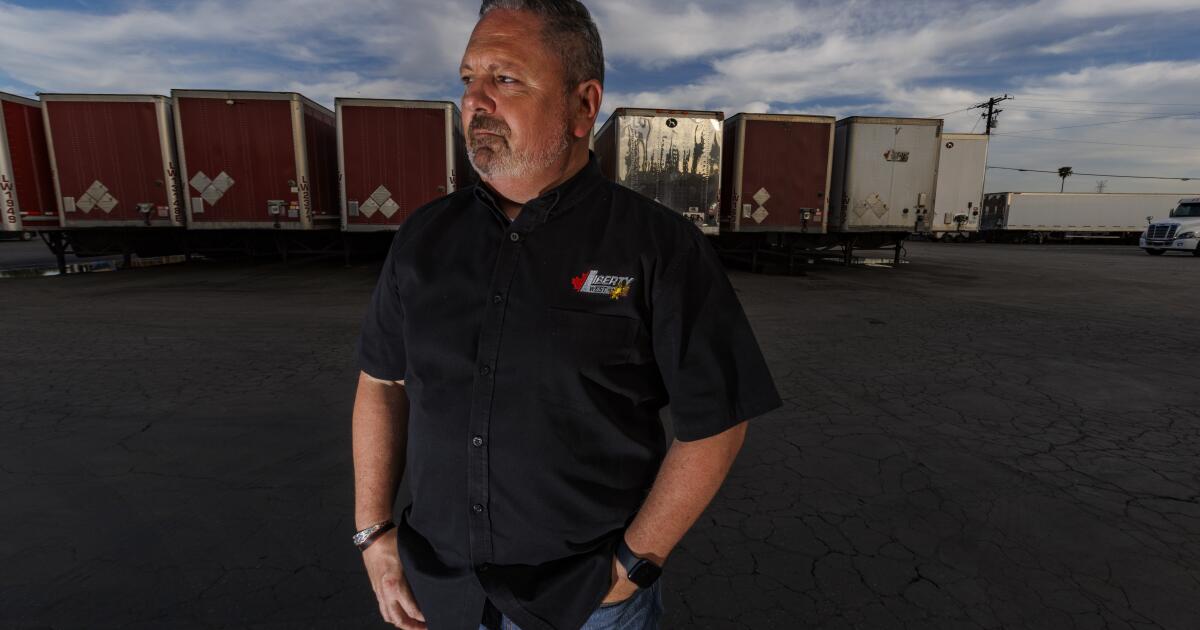
Record diesel prices are crushing California’s truckers, forcing them to adjust to avoid losses as they grapple with the most expensive pump prices in the country.
Greg Dubuque’s 40 drivers are in a constant diesel-devouring loop. Their big rigs pick up loads of electronics, office furniture and other goods around Los Angeles. They drive close to 1,000 miles through the Mojave Desert and over the Rocky Mountains to Denver. They bring back containers full of everything from pinto beans to home remodeling products.
One tank of gas for his vehicles cost $600 a couple of months ago. Today it costs $1,000. That’s a record high and more than 35% above the country’s average.
“California sets itself apart from the rest of the country when it comes to pricing,” said Dubuque, a third-generation trucker and general manager of Liberty Linehaul West. “Now it’s really out of control.”
The average price of a gallon of diesel in California got close to $7.75 this week, up 50% from a month ago, according to the American Automobile Assn. The national average of diesel is closer to $5.65 at recent peaks.
Dubuque, general manager of Liberty Linehaul West, says small truckers are hurting with out-of-control gas prices.
(Gina Ferazzi / Los Angeles Times)
The trucking industry was already reeling from a prolonged freight recession, a crackdown on immigrant drivers, and the adverse impacts of tariffs, all of which contributed to a significant increase in bankruptcy filings in the industry.
Now, the price shock from the war with Iran has become yet another headache for the beleaguered industry that hauls 70% of all freight in America.
“It’s got a tremendous impact on the industry,” said Eric Sauer, the chief executive of California Trucking Assn.
And it is not just truckers being affected. The rising prices of ground and air transportation will eventually be paid for by consumers.
The biggest companies are already passing the extra transportation costs on to consumers. FedEx, United Parcel Service, the U.S. Postal Service and Amazon said they will all start charging an extra fee. Amazon said it would apply a 3.5% charge to merchants for its fulfillment service. USPS will charge an 8% delivery fee for certain packages.
“The longer energy prices remain elevated, the more households will need to confront tradeoffs,” said Philip N. Jefferson, vice chairman of the Federal Reserve, at a recent lecture.

Liberty Linehaul West trucking company keeps a daily list of fuel prices to help its truckers on April 3 in Montebello, Calif.
(Gina Ferazzi / Los Angeles Times)
This could eventually dampen demand for other products and further hurt the economy, Jefferson noted.
“Families who depend on petroleum products to commute to jobs and school and to heat their homes may need to pull back on more discretionary forms of spending,” he said. “That could potentially result in lower spending at restaurants or retailers. It could also result in households carrying elevated levels of debt.”
Truckers often rely on fuel surcharges to cover rising fuel costs. It’s an industry practice for customers to pay a fuel surcharge, on top of the base freight rate, to offset unexpected fuel price increases. The fee is calculated based on a weekly diesel price index.
Sukhdeep Singh, who owns Merced County-based Cali Brothers Truck Lines, said standard surcharge policies are insufficient when there are wild swings in fuel prices.
“It’s killing everything,” he said.
Singh’s business faced challenges earlier this year when a crackdown on immigrant drivers led to sudden departures, shrinking the available labor pool and leaving 15 of his trucks unused. Despite the diminished fleet, his weekly fuel expenses have surged from $80,000 to $130,000.
Smaller trucking companies are getting hit first.
Major carriers with thousands of trucks have different ways to hedge against price fluctuations that insulate them from temporary volatility. They have long-term shipping contracts and have greater flexibility in surcharges.
Smaller carriers are often paid at a flat rate and have no certainty about whether they will recover the higher fuel costs.
On a recent trip to Denver, one of Dubuque’s trucks had to consider returning empty, as the going rate barely covered gas to get back to Los Angeles.
“I wouldn’t be able to cover my cost,” he said.
He has been instructing drivers to save on fuel by planning their routes, finding truck stops with the best rates, and avoiding California when possible.
“Where we’re trying to avoid buying fuel is here in the state of California,” he said.
He is also asking his regular customers to pitch in.

A Roadies Inc. truck, right, leaves for a delivery in Bakersfield on Nov. 29.
(Myung J. Chun / Los Angeles Times)
Liberty Linhaul West’s fleet also works with L.A.’s entertainment and event industries, transporting staging, lighting and other equipment for events such as the Oscars, Grammys and Country Music Awards. He’s started calling customers with whom he had flat rates to renegotiate prices.
“We started calling customers, saying, ‘Okay, we need some emergency help here,’” Dubuque said.
While he appreciates that the extra fees and restrictions on fuel help build roads and protect the environment in California, he would love to see more support from the state.
“I think the government needs to interact with the oil and fuel world and talk about how they can take this pain away from us, or at least try to lessen this blow,” he said.
Without an end to high oil prices or some help from the government, customers can expect the same sticker shock the trucking industry is struggling with.
“Whether you’re a grocer, a meatpacking plant, a vegetable grower, that cost has to be factored in, because it doesn’t matter who you are, you’re faced with it,” Dubuque said. “The impact was so hard and so fast, I would think we’re going to start seeing just another increase to the cost of goods for people.”


new video loaded: Why Your Paycheck Feels Smaller
By Ben Casselman, Nour Idriss, Sutton Raphael and Stephanie Swart
April 18, 2026

Nearly two years after actor Alec Baldwin was cleared of criminal charges in the “Rust” movie shooting death, a long simmering civil negligence case is inching toward a trial this fall.
On Friday, a Los Angeles Superior Court judge denied a summary judgment motion requested by the film producers Rust Movie Productions LLC, as well as actor-producer Baldwin and his firm El Dorado Pictures to dismiss the case.
During a hearing, Superior Court Judge Maurice Leiter set an Oct. 12 trial date.
The negligence suit was brought more than four years ago by Serge Svetnoy, who served as the chief lighting technician on the problem-plagued western film. Svetnoy was close friends with cinematographer Halyna Hutchins and held her in his arms as she lay dying on the floor of the New Mexico movie set. Baldwin’s firearm had discharged, launching a .45 caliber bullet, which struck and killed her.
The Bonanza Creek Ranch in Santa Fe, N.M. in 2021.
(Jae C. Hong / Associated Press)
Svetnoy was the first crew member of the ill-fated western to bring a lawsuit against the producers, alleging they were negligent in Hutchins’ October 2021 death. He maintains he has suffered trauma in the years since. In addition to negligence, his lawsuit also accuses the producers of intentional infliction of emotional distress.
Prosecutors dropped criminal charges against Baldwin, who has long maintained he was not responsible for Hutchins’ death.
“We are pleased with the Court’s decision denying the motions for summary judgment filed by Rust Movie Productions and Mr. Baldwin,” lawyers Gary Dordick and John Upton, who represent Svetnoy, said in a statement following the hearing. “He looks forward to finally having his day in court on this long-pending matter.”
The judge denied the defendants’ request to dismiss the negligence, emotional distress and punitive damages claims. One count directed at Baldwin, alleging assault, was dropped.
Svetnoy has said the bullet whizzed past his head and “narrowly missed him,” according to the gaffer’s suit.
Attorneys representing Baldwin and the producers were not immediately available for comment.
Svetnoy and Hutchins had been friends for more than five years and worked together on nine film productions. Both were immigrants from Ukraine, and they spent holidays together with their families.
On Oct. 21, 2021, he was helping prepare for an afternoon of filming in a wooden church on Bonanza Creek Ranch. Hutchins was conversing with Baldwin to set up a camera angle that Hutchins wanted to depict: a close-up image of the barrel of Baldwin’s revolver.
The day had been chaotic because Hutchins’ union camera crew had walked off the set to protest the lack of nearby housing and previous alleged safety violations with the firearms on the set.
Instead of postponing filming to resolve the labor dispute, producers pushed forward, crew members alleged.
New Mexico prosecutors prevailed in a criminal case against the armorer, Hannah Gutierrez, in March 2024. She served more than a year in a state women’s prison for her involuntary manslaughter conviction before being released last year.
Baldwin faced a similar charge, but the case against him unraveled spectacularly.
On the second day of his July 2024 trial, his criminal defense attorneys — Luke Nikas and Alex Spiro — presented evidence that prosecutors and sheriff’s deputies withheld evidence that may have helped his defense . The judge was furious, setting Baldwin free.
Variety first reported on Friday’s court action.

The highest gas prices in the country are making it tougher for some gig drivers to make a living.
Gas prices have shot up amid the war in the Middle East. On average, California gas prices are the most expensive in the United States, according to data from the American Automobile Assn. The average price of regular gas in California is almost $6. The national average is a little above $4.
While Uber and Lyft drivers have concocted clever ways to cut gas consumption, they say that without some relief they will be forced to leave the ride-hailing business.
John Mejia was already struggling to make money as a part-time Lyft driver when soaring gas prices made his side hustle even harder.
“Unfortunately, it’s the economics of paying less to drivers and gas prices,” he said. “It actually is pulling people out of the business.”
Guests at The Westin St. Francis hotel get into an Uber.
(Jess Lynn Goss / For The Times)
Gig work offers drivers the freedom to work for themselves and more flexibility, but being independent contractors also means they must shoulder unexpected costs.
Ride-sharing companies say they’re trying to help, but drivers say the gas relief comes with caveats. For now, drivers say they’re being pickier about what rides they accept, cutting hours and are looking at other ways to make money.
Mejia, who started driving for Lyft more than a decade ago, said in his early days, he would sometimes make $400 in three hours. Now it takes 12 hours to rake in $200.
The San Francisco Bay Area consultant is an active member of the California Gig Workers Union, so he knows he isn’t alone. California has more than 800,000 gig rideshare drivers, according to the group, which is affiliated with the Service Employees International Union.
On social media sites such as Reddit and Facebook, gig workers have posted about how the higher gas prices are eating into their earnings. Among the tricks they are suggesting: reducing the number of times the ignition is turned on or off, avoiding traffic, working in specific neighborhoods and at times with high demand and switching to electric vehicles.
Gig drivers usually have only seconds to decide whether to accept a ride on the app, but they have become more strategic about which rides and deliveries they accept.
That means they are more likely to sit back in their cars and wait for higher fares for quick pick-up and drop-off.
“I highly recommend the ‘decline and recline’ strategy, rejecting unprofitable rides until a better one appears,” wrote Sergio Avedian, a driver, in the popular blog the Rideshare Guy.

Pedestrians cross the street in front of a Lyft and Uber driver on Wednesday. High gas prices have made it hard for gig drivers to make a living, cutting into their profits.
(Jess Lynn Goss / For The Times)
Uber, Lyft and other companies have unveiled several ways to help drivers save on gas.
Uber said drivers can get up to 15% cash back through May 26 with the Uber Pro card, a business debit Mastercard for drivers and couriers. Based on a worker’s tier, they can get up to $1 off per gallon of gas through Upside — an app that offers cash rewards — and up to 21 cents off per gallon of gas with Shell Fuel Rewards. The company also offers incentives for drivers who want to switch to electric vehicles.
“We know the price of gas is top of mind for many rideshare and delivery drivers across the country right now,” Uber said in a blog post about its gas savings efforts.
Lyft also said it’s expanding gas relief through May 26 because the company knows that the extra cost “hits hardest for drivers who depend on driving for their income.”
The company is offering more cash back, depending on the driver’s tier, for drivers who use a Lyft Direct business debit card to pay for gas at eligible gas stations. They can get an additional 14 cents per gallon off through Upside.
Drivers say the fine print on the offers dictates which card they use and where they fill up gas, making it difficult for them to save money.
“If I do the math, it’s ridiculous,” Mejia said. “They’re offering us nothing.”
Uber declined to comment, but pointed to its blog post about the gas relief efforts. Lyft also referenced the blog post and said “the gas savings were structured through rewards to maximize stackable opportunities.”

Guests at The Westin St. Francis hotel get into an Uber.
(Jess Lynn Goss / For The Times)
Gig workers have struggled with rising gas prices in the past.
In 2022, Lyft and Uber temporarily added a surcharge to their fares amid record-high gas prices following Russia’s invasion of Ukraine. This year, Uber is adding a fuel charge to its fares in Australia for roughly two months to offset the high cost of gas for drivers. Lyft said it hasn’t added a fuel charge in the U.S. or elsewhere.
Margarita Penalosa, who drives full time for Uber and Lyft in Los Angeles, started as a rideshare driver in 2017. Back then, gas was cheaper. She would easily hit her goal of making $300 in eight hours. Now she’s making just $250 after working as much as 14 hours.
Gas prices, she said, used to be less than $3 per gallon. Now some gas stations are charging more than $8 per gallon.
“Take out the gas. Take out the mileage from my car and maintenance. How much [do] I really make? Probably I get $11 for an hour,” she said.
Jonathan Tipton Meyers wants to spend fewer hours as a rideshare driver.
He already juggles multiple gigs even while driving for Uber and Lyft in Los Angeles. He’s a mobile notary and loan signing agent, a writer and performer.
Driving is “a very challenging, full-time job,” he said. “It’s very taxing and, of course, wages were just continually decreasing.”

John Mejia, a longtime Lyft and Uber driver, poses for a portrait before attending a meeting about unionizing gig drivers.
(Jess Lynn Goss / For The Times)
Even if oil continues to flow through the Strait of Hormuz, which Iran reopened Friday, it could take a while for gas prices to come down to earth, said Mark Zandi, the chief economist at Moody’s Analytics.
“There’s an old adage that prices rise like a rocket and fall like a feather,” he said. “I think that’ll apply.”
In the meantime, it will be survival of the fittest drivers. If enough of them decide to leave the apps, the ride-hailing companies could be forced to raise fares further to attract some back.
“Those who approach rideshare driving strategically, tracking expenses, choosing trips carefully, and optimizing efficiency are far more likely to weather periods of high gas prices,” wrote Avedian in the Rideshare Guy blog. “For everyone else, a spike at the pump can quickly turn rideshare driving from a side hustle into a money-losing venture.”
-
 Sports10 minutes ago
Ryan Ward has a solid debut, but bullpen blows it again as Dodgers lose to Rockies
-

 World22 minutes ago
Schools, shops shut in northern Israel to protest the Lebanon ceasefire
-
 News52 minutes ago
Communities launch cleanup after severe weather and tornadoes churn across Midwest
-

 Detroit, MI3 hours ago
Game 21: Tigers at Red Sox, Garrett Crochet battles both Detroit and the weather
-

 San Francisco, CA3 hours ago
Why do gray whales keep dying in San Francisco’s waters?
-

 Dallas, TX3 hours ago
Dallas Mavericks Owners Might Be Making Big Mistake in Search for New GM
-

 Miami, FL3 hours ago
Defense dominates, Mensah flashes in Miami’s spring game – The Miami Hurricane
-
Boston, MA3 hours ago
A crowd scientist is helping the Boston Marathon manage a growing field of 30,000-plus runners

