Business
Hypersonic aircraft company moves headquarters from Atlanta to El Segundo


Aerospace startup Hermeus is moving its headquarters to El Segundo from Atlanta as it aims to build autonomous hypersonic aircraft for the military, the latest sign of revival in the region’s aerospace and defense sectors.
The company, valued at $1 billion, is opening executive offices and a facility where it will design and build its next prototype, a supersonic plane intended to hit Mach 3 — faster than any modern warplane.
The company’s goal is to eventually develop a hypersonic plane reaching Mach 5, or five times the speed of sound, and Southern California has the engineering talent base to help achieve that, executives said.
“Building a lot of aircraft developmentally very quickly, doing iterative developments, it really doesn’t exist anywhere out in the world other than SpaceX — and we’ve recruited a lot of talent from there over the years,” said co-founder and Chief Executive AJ Piplica, a Georgia Tech alumnus.
“We’re now at a point in the company’s trajectory where we are scaling what the team can do,” he added.
-
Share via
Elon Musk founded SpaceX in El Segundo 24 years ago and later moved its operations to Hawthorne, where the company still maintains a large campus despite relocating its headquarters to Texas in 2024.
El Segundo and other South Bay cities have witnessed explosive growth in recent years, with scores of startups in aerospace and defense tech — many founded by former SpaceX employees.
Hermeus announced its move Tuesday at the same time it disclosed its latest $350-million funding round, which it said values the company at $1 billion.
The round was led Khosla Ventures, founded by prominent Silicon Valley venture capitalist Vinod Khosla. Other participants included billionaire Peter Thiel‘s Founders Fund.
Sam Altman, the CEO and co-founder of OpenAI, led a prior $100-million funding round in 2022. The company said it has now raised $500 million in equity and debt.
Hypersonic planes and weapons are at the cutting edge of military research and development. China and Russia have developed the weapons, which are viewed as strategic threats, with Russia deploying them in Ukraine.
Missile development also is taking place in the United States, including at legacy defense contractors Northrop Grumman and Lockheed Martin, as well as Torrance startup Castelion.
Hermeus is developing supersonic and hypersonic aircraft that are not only autonomous but also reusable, like any modern jet. The aircraft would have multiple uses, including as a strike fighter, conducting reconnaissance and transporting cargo.
“What we are building here is not just an airplane, it is a platform,” Piplica said.
The company, founded in 2019, flew its first prototype, Quarterhorse Mk 1, in May 2025 during a short low-speed flight at Edwards Air Force Base in the Mojave Desert.

Hermeus’ headquarters in El Segundo. The aerospace firm has begun moving into its 67,000-square-foot offices and will take full occupancy early next year.
(Hermeus)
It flew its first second aircraft in February at Spaceport America over White Sands Missile Range airspace in New Mexico. The Quarterhorse Mk 2.1 plane is three times larger than the initial prototype and about the size of an F-16. The goal is to reach supersonic speeds.
Hermeus plans to continue testing aircraft at the isolated missile range, where it can fly faster while not endangering structures or anyone on the ground.
Since 2021, the firm has operated out of a 110,000-square-foot facility in Atlanta, where it has its offices as well as design and production operations.
It will retain the site and use the entire space for production.
Georgia is the home of multiple aerospace manufacturing facilities, including Northrop Grumman.
“That talent base [in Georgia] is extremely aligned to large-scale aerospace manufacturing. Prototyping is a whole different world — different skill sets, different capabilities,” said Piplica, who had been an executive at Atlanta hypersonic research company Generation Orbit before co-founding Hermeus.
The aerospace firm has begun moving into its 67,000-square-foot offices at 888 North Douglas St. in El Segundo and will take full occupancy early next year. The Southern California operation will employ more than 200 people by next year, adding hundreds more in the coming years, executives said. Hermeus currently employs about 300.
The company is currently building its third Quarterhorse aircraft, which it expects will fly faster than Mach 2, in the Atlanta facility. It is expected to fly later this year. The fourth Quarterhorse will be built in El Segundo — with the goal of hitting Mach 3. It should fly next year with the military showing interest in a plane flying at that speed, Piplica said. .
Its hypersonic plane, designed for defense and national security missions, is farther off and dubbed the Darkhorse. Reaching Mach 5 involves the use of a so-called ramjet, which is similar to a traditional jet engine but doesn’t have any moving parts.
Hermeus does engine testing in Jacksonville, Fla., and has engineering offices in Hawthorne that it plans to retain.
In El Segundo, it’s leasing space in two buildings in a 30-acre complex Hackman Capital Partners acquired from Northrop Grumman in 2017 and spent $100 million making over into modern offices.
The complex includes the West Coast offices of L’Oreal USA, the headquarters of alternative protein company Beyond and labs that El Segundo aerospace company Varda Space Industries recently subleased from Beyond.
El Segundo Mayor Chris Pimentel said the city helped market the Hermeus space.
“We spoke loudly about the opportunity over there for a couple different players. I thought frankly that Hermeus had passed us by and that they were going to stay in Atlanta, so we’re delighted,” he said.
The city counts more than 40 aerospace and tech companies as having headquarters or major operations in El Segundo. In addition to contractors Boeing and Northrop Grumman, they include startups Picogrid and Sift. There are other companies, including suppliers.



Software giant Oracle on Tuesday started laying off workers as it looks to rein in costs and double down on artificial intelligence.
On LinkedIn, Oracle employees, including software engineers, account executives and program managers, shared publicly that they were affected by a mass layoff at the company and were looking for new jobs.
Oracle was founded in California, but moved its headquarters to Austin, Texas, in 2020.
The company, which sells software and other services to help businesses manage and store data, hasn’t said publicly how many jobs were cut. CNBC, citing people familiar with the matter, reported that Oracle was slashing thousands of workers. As of May 2025, Oracle had 162,000 workers.
Oracle has offices throughout the world, including in California in Irvine, Santa Monica, Redwood City and Santa Clara. It’s unclear if the mass layoff also affected workers in California. Oracle declined to comment.
The company is the latest tech firm to shed workers as it focuses more heavily on AI. Meta, Block, Amazon, Salesforce and other tech giants have continued to lay off their workers even as they hire for other roles and spend billions of dollars on AI data centers and products.
U.S.-based tech employers announced more than 33,000 job cuts from January to February, up 51% compared with the same period last year, outplacement firm Challenger, Gray & Christmas said in March.
Business Insider reported earlier on the Oracle cuts, citing an email the company sent to employees early Tuesday.
“After careful consideration of Oracle’s current business needs, we have made the decision to eliminate your role as part of a broader organizational change. As a result, today is your last working day,” the email stated.
As part of their pivot to artificial intelligence, Oracle, OpenAI and Softbank announced last year that they would invest $500 billion in AI infrastructure over the next four years in a project called Stargate. Companies rely on a massive trove of data to train and maintain AI systems, increasing the demand for data centers that house computing equipment. Oracle has also teamed up with with AI chipmaker Nvidia, the world’s most valuable tech company.
Oracle co-founder Larry Ellison has been playing a bigger role in Hollywood too.
He backed his son David’s Paramount bid for Warner Bros. Discovery, personally guaranteeing $40.4 billion to support the offer. Competing against streaming giant Netflix, Paramount Skydance prevailed in the bidding war for Warner Bros. Discovery, striking a deal valued at more than $111 billion.
Oracle is the cloud provider for TikTok, a short-form video app that faced threats of a ban in the United States because it’s owned by Chinese tech company ByteDance. TikTok then struck a deal to create a new U.S. entity to avoid a ban. Oracle’s stake in TikTok’s U.S. operation, which includes other managing investors such as Silver Lake and MGX, is roughly $2 billion, according to a March filing from Oracle.
Oracle’s stock price jumped more than 5% on Tuesday to $146.92 per share following reports of the company’s job cuts.
Since January, Oracle’s shares have dropped more than 24%. Oracle has benefited from the AI boom but investors have been wary about how much the company is spending. Oracle also competes against Amazon, Salesforce, Microsoft and others for business customers.
In February, Oracle said it would raise up to $50 billion through debt and equity to expand its cloud infrastructure business, which includes customers such as AMD, Meta, Nvidia, OpenAI and xAI.
Business
Commentary: A proposed new ‘fix’ for Social Security that harms workers and protects the rich
How worried are America’s wealthy about the possibility they’ll be hit with a higher tax for Social Security?
Plenty, judging from the endless creativity of their proposals to improve the program’s fiscal condition by cutting benefits rather than raising revenue (typically from our most affluent taxpayers).
The latest run at this fence comes from the Committee for a Responsible Federal Budget, which as I’ve explained before is an offspring of the late billionaire hedge fund operator Peter G. Peterson, who was an obdurate foe of Social Security. The committee dubs its proposal the “Six Figure Limit,” which is accurate enough: It would cap annual Social Security benefits at $50,000 per person, or $100,000 per couple.
The $100,000 amount will continue to erode to the point that it is a subsistence level benefit unrelated to prior earnings, just as conservatives have been advocating since 1936.
— Nancy Altman, Social Security Works
Make no mistake: This is a benefit cut. It’s part and parcel of the enduring Republican and conservative project to protect their rich patrons from paying taxes to cover their fair share of the costs of social programs.
As recently as a White House event Wednesday, President Trump revived the old “guns or butter” debate—it was Lyndon Johnson who said during the Vietnam War that the country could afford both, but Trump stated that as long as “we’re fighting wars…it’s not possible for us to take care of daycare, Medicaid, Medicare, all these individual things.”
Trump said those programs should be taken up by the states, which would have to raise their own taxes, allowing the federal government to “lower our taxes.”
The committee claims its proposal would affect only the richest, but that’s true only as a snapshot of current conditions. About 1.2 million of the 53.6 million retirees receiving benefits today, or about 2.3%, receive enough from Social Security to breach the $50,000 annual cap.
Typically they’re retirees who earned the maximum taxable wage income — $184,500 this year — almost every year of their work careers, and also opted to defer receiving their benefits until age 70 to receive a higher monthly stipend. Thanks mostly to inflation, however, the cap will creep into the middle class as sure as water seeks its own level; that may take years, but by the time today’s youngest workers retire, it would be entrenched in the system.
The proposal reflects one of Pete Peterson’s hobby horses, which was the idea that scads of money could be saved by means-testing Social Security so billionaires like himself don’t get handouts they don’t need.
The Six Figure Limit reads like a stepchild of that notion, but as I’ve reported before, the problem with it is that means-testing Social Security wouldn’t save the program much money unless you started cutting means-tested benefits at incomes as small as $50,000.
The CRFB’s proposal, as embodied in an explanatory manifesto posted on its website, doesn’t explain why $100,000 should be the cutoff, other than that maybe it’s a nice round number.
“This is a program that, when you go back to its founding, was a measure of protection against falling into poverty,” Marc Goldwein, the committee’s senior policy director, told CBS News. “The fact that an income support program would pay six figures is a little silly.”
I asked the committee what’s “silly” about a couple receiving $100,000 from Social Security after they’ve paid for it all their working lives, and given that U.S. median household income was $1,071 when Social Security was founded in 1935 and today it’s $83,730. I didn’t hear back.
The committee acknowledges that only “a small fraction of retirees” currently receive benefits of $50,000 or more today. But it frets that “$100,000 benefits will become increasingly common as Social Security’s benefit formula leads benefits to grow over time.” This isn’t quite true: It’s economic growth, more than the benefit formula, that does that, by advancing average wages.
Social Security advocates and experts have responded to the proposal with disdain. Nancy Altman, president of Social Security Works, labels it a “Trojan horse.”
That’s because of its proposed structure. The committee presents three possible models: Two would fix the cutoff at $50,000 per person for 20 or 30 years. The third would allow it to increase in accordance with the chained consumer price index, a little-used inflation metric that rises more slowly than the commonly used urban CPI.
Either way, Altman observes, “the $100,000 amount will continue to erode to the point that it is a subsistence level benefit unrelated to prior earnings, just as conservatives have been advocating since 1936.”
The CRFB manifesto is a scary document. It asserts that the cap would be a boon for economic growth by reducing federal borrowing and prompting retirees to rely more on resources such as personal savings and investment returns.
This happens, it says, according to “a large body of research” finding that “workers — especially high-income workers — increase their private retirement savings in response to reductions in expected public pension benefits.” In other words, if you’re afraid your Social Security is going to be cut, you put more in your IRA.
That makes sense, but only superficially. First, what about everyone other than “high-income workers”? Many middle- and working class households already struggle to meet common everyday expenses, let alone saving for college and retirement. Where will they find the money they’ll need once Social Security is gutted?
Second, who says workers invariably save more when they’re afraid of Social Security cuts? The committee footnotes this assertion to a Congressional Budget Office meta-analysis of 30 studies, conducted in 1998. What did the CBO learn? It was that no one knows.
Some studies, the CBO said, found that each dollar of expected Social Security reduces personal savings, but the range of reduction was “between zero and 50 cents.” In other words, the phenomenon may or may not be real. And if not, this pillar of the Six Figure Limit crumbles to dust. People will be thrown back on personal resources that don’t exist.
The CRFB manifesto contains other specious arguments. For example, it argues that America’s Social Security benefits are unduly generous in global terms. It validates this conclusion by comparing the maximum benefit in the U.S. in 2024 ($93,452 for a couple) to those of such other advanced economies as France ($69,403 in purchasing parity with the U.S.), Canada ($43,608) and the Netherlands ($41,765).
Yet the comparisons are suspect. National pension systems are highly diverse. France’s social security program, for example, is a mandatory supplement to private pensions, unlike in the U.S. In some countries, old-age benefits are part of broad social programs that include universal government-paid healthcare as well as government child care and other social services that don’t exist in the U.S. I asked the CRFB to respond to these issues, but received no reply.
It’s important to keep in mind that proposals like this have one fundamental goal: sparing the wealthy from an increase in their Social Security payroll tax, which is the only way to ensure the program’s fiscal feet stand on dry ground other than cutting benefits.
This year, the tax of 12.4% is levied on wage income up to $184,500, with half paid out of worker paychecks and half directly by employers. That means workers will pay a maximum $11,439, with employers paying the same.
On wages higher than the income tax cap, the rate drops to zero. For someone with income of, say, $500,000, the effective rate for each side falls from 6.2% to about 4.3%; for those with $1-million incomes, it falls to 2.28% on each side. Since the tax is on wage income alone, wealthier taxpayers get an additional break — half of the income or more for the richest Americans is in the form of investment income, which isn’t taxed at all for Social Security.
Making such so-called unearned income part of their tax base and eliminating the tax cap would improve Social Security’s fiscal balance far more than the Six Figure Limit, but that would significantly increase the Social Security tax liability of millionaires and near-millionaires. That may explain why their cat’s paws in Congress and at conservative think tanks expend so much energy finding alternatives to a tax hike.
It’s tempting to relegate this latest idea to the pile of transparent maneuvers to avert a higher Social Security tax, but the danger is that policymakers and pundits will parrot the argument that $100,000 is just too much for a retirement pension. The Washington Post editorial board started the process on March 24 with an unsigned editorial headlined, “Nobody needs over $100,000 per year in Social Security benefits.”
The piece balanced the putative generosity of Social Security against the federal government’s $39-trillion debt and a federal deficit “larger than during the Great Depression,” as though those are the consequences of providing for 53 million retirees, disabled persons and their dependents, rather than enormous tax cuts provided for the wealthy. The Post’s owner, Amazon.com founder Jeff Bezos, is one of the richest men on Earth.
Anyway, the Post’s screed elicited a well-deserved beat-down from Max Richtman, president of the National Committee to Preserve Social Security and Medicare, who crisply informed the board that its editorial was “based on the fallacy that Social Security is a welfare program. It is, in fact, social insurance.”
As he explained, “workers pay into the program and receive payments to replace income upon retirement, disability or the death of a family breadwinner. These are the ‘hazards and vicissitudes of life’ that President Franklin D. Roosevelt referred to when signing Social Security into law.”
Richtman is right about Social Security, and the CRFB is wrong. For the beneficiaries who have been saved from poverty in their old age or after disability, the difference is more than rhetorical. It’s a fact of life.
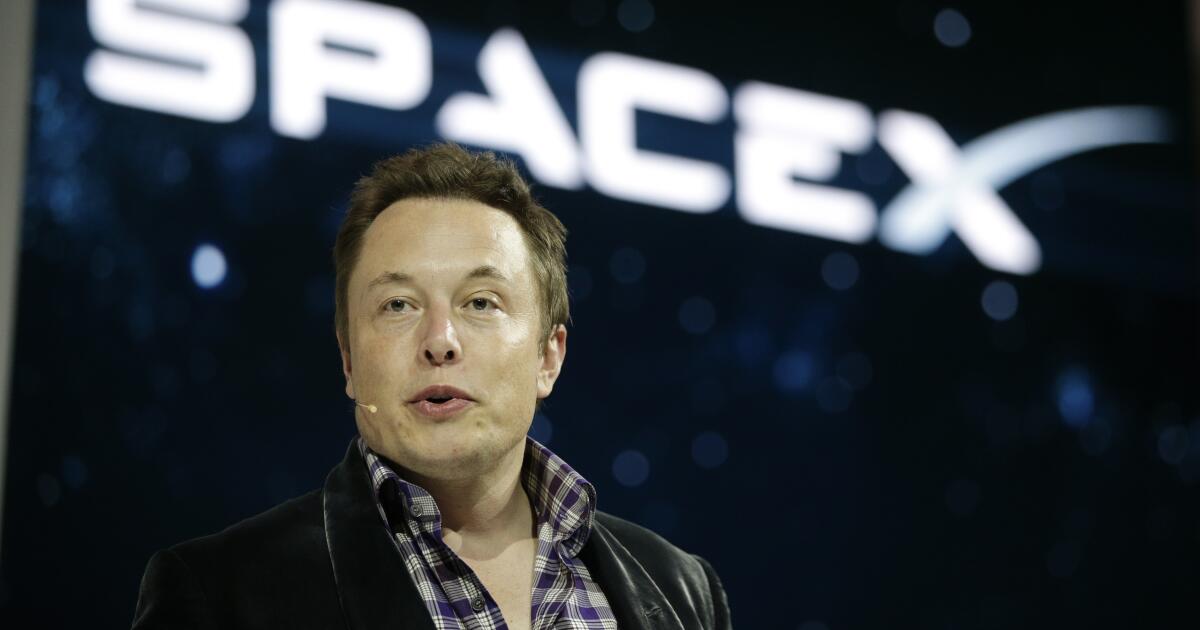
A recent policy change by NASA has given Elon Musk’s SpaceX a greater role in the Artemis moon program just as the company contemplates a record initial public offering.
When the first American crew since 1972 orbits around the moon this month, SpaceX’s stylized logo will be nowhere to be found — but it might as well be plastered everywhere.
Elon Musk’s rocket company is preparing what is expected to be the largest initial public offering in history, and it has as much, if not more, riding on NASA’s Artemis program as Boeing and the other contractors that built the SLS rocket that will blast the astronauts into space and the Orion capsule carrying them on their mission — a fly-by of our closest celestial neighbor.
Radical changes announced in February by new NASA Administrator Jared Isaacman to speed up the country’s return to the moon could make the program more reliant on SpaceX on future launches.
That includes using its massive Starship rocket to ferry crews and construction materials to the moon, where Isaacman said NASA now plans to build a research and exploration station as it faces competition from a joint China-Russian team.
SpaceX, which maintains a large presence in Southern California’s burgeoning aerospace sector, is readying an initial public offering possibly for this summer that is expected to be the largest in history, perhaps raising as much as $75 billion. It follows Musk’s merging of his xAI artificial intelligence company into his rocket company in February.
The funds would help pay for Musk’s equally giant if quixotic plans: building his own Moonbase Alpha colony, manufacturing millions of driverless cars and robots, and putting artificial intelligence data centers into space, using satellites that use solar energy to do AI computations.
Here’s what to know about what this means for SpaceX, which has large operations in Hawthorne and launches its workhorse Falcon 9 rockets from Vandenberg Space Force Base in Santa Barbara County.
How important is it for SpaceX that NASA is returning American astronauts to the moon?
Wedbush analyst Dan Ives calls the Artemis launch a “watershed” event for the company, which he expects will be a leader in the new space economy where trillions will be spent on artificial intelligence, space infrastructure and related businesses.
“The moon ultimately represents the golden goose for Musk and SpaceX,” he said. “It’s a fourth industrial revolution and we just happen to live in it.”
What plans does SpaceX have for the moon?
Musk has long said that his life’s ambition is to colonize Mars, but in February the world’s richest man posted on X that his company first planned to build “a self-growing city on the Moon, as we can potentially achieve that in less than 10 years.”
What would be the purpose of such a city?
A moon outpost would solve some of the same technological challenges a Mars colony would face without the same level of cost and risk, given how much faster and less expensive it is to reach the moon. Musk also has sketched out a futuristic vision of building AI data centers on the moon with the help of the company’s Optimus robots and catapulting them into space.
Catapulting data centers into space from the moon sounds like science fiction. How is that even possible?
At a February presentation, Musk said that the lower gravity of the moon would allow the satellites to be shot into space using a magnetic accelerator — what he called a “mass driver” — radically reducing the cost compared with Earth launches, in which rockets expend tons of fuel to escape gravity. “I want to just live long enough to see the mass driver on the moon, because that’s going to be incredibly epic,” he said. That timeline doesn’t even consider that SpaceX has yet to launch a data center satellite from Earth.
How does this fit into NASA’s plans?
In March, Isaacman announced the government’s own highly ambitious plans to spend $20 billion to start building a sustained human presence on the moon within seven years. While the SLS rocket would still lift the Orion capsule into Earth’s orbit, Artemis could now rely on the Starship rocket, still in its testing and development phase, to dock with the capsule in Earth’s orbit and ferry astronauts to the moon, where it would land the crew and building materials. A spacecraft being developed by Jeff Bezos’ Blue Origin could serve as another moon lander given the vast payload needed for a moon colony. The first crewed mission to the moon’s surface is planned for 2028.
How does this tie in to SpaceX’s IPO?
SpaceX has confidentiality filed for an IPO expected later this year sources told Bloomberg on Wednesday. It could value the company at $1.75 trillion, which would allow it to sell just a fraction of its shares yet still raise more than twice as much as the current largest IPO on record: Saudi Aramco’s $29.4-billion oil-and-gas offering in 2019. Given its massive size, SpaceX is in talks with at least 21 banks to sell the securities to investors, Reuters reported.
The company has a massive need for capital if it is going to pull off Musk’s dreams, which he said rely on vast numbers of AI chips. In February, he announced the construction of a giant chip fabrication plant in Austin, Texas, because of a lack of supply from existing chipmakers.
How are financial markets reacting to Musk’s plans?
The IPO has drawn huge attention given its size and SpaceX’s prospects for growth.
“As an investor, I’m excited. As a human being, I’m excited. It’s just opening a whole different world, a universe, essentially, that we were not exposed to before. We went to the moon over 50 years ago, and that was it. Nothing has happened really since then,” said Mike Alves, founder of Pasadena’s Vida Vision Fund, which has a stake in SpaceX and xAi that accounts for 45% of his AI and robotics fund.
An analysis of the IPO by PitchBook assigns no revenue to Musk’s AI data centers or his Moonbase Alpha plan but estimates that the company earned $7.5 billion in profit last year on nearly $16 billion of revenue from its Starlink satellite network, commercial launch services for third parties and other businesses.
It estimates that growth from the company’s Starlink internet, launch and nascent satellite phone service could boost profit to $60 billion and revenue to $150 billion by 2040 — making an IPO that values the company at $1.5 trillion “expensive but not irrational.”
Are there skeptical voices about SpaceX and its IPO?
Yes, plenty. There are technological hurdles for SpaceX to carry out its plans. Most immediately, the Starship rocket that NASA is relying on — even bigger than Apollo’s Saturn V — has suffered some bad test flights. SpaceX also must master a key technological hurdle: refueling the rocket while it’s in Earth’s orbit so it has enough fuel to carry out its flight to the moon, land there and return to Earth. Beyond that, Musk’s plans to manufacture millions of chips and robots aren’t close to becoming a reality.
“There is an AI-hungry market at the moment and there’s a lot of investors waiting for those opportunities to happen,” said Igor Pejic, author of “Tech Money.” “But you face the likelihood that it might never happen, or it might happen in three years, five years, 10 years from now.”

NASA Releases Photos of Far Side of the Moon From Artemis II Astronauts

How to Plan Your Wedding: Budgeting, Venues, Dress Codes and More

Nothing’s noise-canceling CMF Buds 2A are down to just $19.99 just for today

China aiding Iran missile program amid US-Israeli strikes, reports say

Democrat swing candidate called Biden’s border handling ‘a huge misstep’ after backing his approach as mayor

Florida High School Football Rankings: Top 25 teams – Oct. 21

How old is Bo Nix? What to know about Oregon quarterback ahead of 2024 NFL Draft

Cleary's 21 help Le Moyne down Central Connecticut State 69-64 in OT

99th annual Pony Swim held in Virginia

Indiana Members Credit Union announced as new anchor tenant at Bottleworks District
Democrat swing candidate called Biden’s border handling ‘a huge misstep’ after backing his approach as mayor

‘Policy of abuse’: Women march in Cuba against US energy blockade

Acting AG says ‘Nobody has any idea why’ Pam Bondi was fired except for Trump | CNN Politics

Ilhan Omar calls Trump an ‘unhinged lunatic,’ urges booting him out of office
Between Budapest and Brussels: Péter Magyar’s political tightrope
-

 Atlanta, GA3 days ago
1 teenage girl killed, another injured in shooting at Piedmont Park, police say
-

 South-Carolina1 week ago
South Carolina vs TCU predictions for Elite Eight game in March Madness
-

 Movie Reviews6 days ago
Vaazha 2 first half review: Hashir anchors a lively, chaos-filled teen tale
-

 Vermont1 week ago
Skier dies after fall at Sugarbush Resort
-

 Politics1 week ago
Trump’s Ballroom Design Has Barely Been Scrutinized
-

 Politics1 week ago
JD Vance says he was ‘obsessed’ with UFOs, believes aliens are actually ‘demons’
-

 Atlanta, GA1 week ago
Fetishist ‘No Kings’ protester in mask drags ‘Trump’ and ‘JD Vance’ behind her wheelchair
-
 Entertainment6 days ago
Inside Ye’s first comeback show at SoFi Stadium