Business
How Ted Sarandos became the ultimate Hollywood gate-crasher


Hollywood moguls once dismissed the outsize ambitions of Netflix’s executives.
“Is the Albanian army going to take over the world?” former Time Warner Chairman Jeff Bewkes asked a reporter 15 years ago. “I don’t think so.”
Think again. On Friday, Netflix co-Chief Executive Ted Sarandos pulled off an audacious $82-billion deal to buy much of Bewkes’ old haunts: the Warner Bros. film and TV studios in Burbank, and HBO and the HBO Max streaming service in Culver City.
“This is a rare opportunity,” Sarandos said in an investor call. “It’s going to help us achieve our mission to entertain the world and to bring people together through great stories. We’ve built a great business, and to do that, we’ve had to be bold and continue to evolve.”
If the takeover is approved — it could face a raft of legal and regulatory challenges — Netflix would gain ownership of such classics as “Casablanca” and “Goonies” and popular characters including Batman, Scooby-Doo, Dirty Harry and Harry Potter.
The acquisition represents a moment of triumph for the brash Sarandos, who has gone from Hollywood gate-crasher to the ultimate power broker.
“There seems to be no ceiling of opportunity for Ted Sarandos,” said Tom Nunan, a former studio and network executive. “He’s the king of Hollywood.”
Netflix’s victory in the auction for Warner Bros. stunned many in Hollywood who figured Paramount — whose bid was backed by the one of the world’s wealthiest men, Larry Ellison — had a lock on the prized Warner assets.
Even Netflix’s brass downplayed their merger ambitions as recently as two months ago. Co-Chief Executive Greg Peters shrugged off any interest at a Bloomberg conference, saying: “We come from a deep heritage of builders rather than buyers.”
But the streaming giant’s dominant market position and strong balance sheet allowed it to assemble a largely cash bid that wowed Warner Bros. Discovery’s board, which voted unanimously in favor. What’s more, Netflix agreed to absorb more than $10 billion of Warner Bros.’ debt, bringing the deal’s total value to $82.7 billion.
Warner shareholders and U.S. and foreign regulators still must approve Netflix’s takeover. Netflix — which is based in Los Gatos but has a large presence in Hollywood — said it expects the deal will close within a year to 18 months.
Netflix, however, already is facing stiff opposition from cinema chains, lawmakers, prominent creatives and labor unions. The Writers Guild of America said the deal should be blocked.
“The world’s largest streaming company swallowing one of its biggest competitors is what antitrust laws were designed to prevent,” the WGA said.
A career of defying convention
If it succeeds, the takeover would be a coup for Sarandos, the company’s often controversial co-CEO who has been responsible for Netflix’s content operations since 2000. Until recently, he was seen as a disruptor who upended the industry’s long-standing business models, especially its reliance on the big screen.
It’s a remarkable trajectory for the 61-year-old Phoenix native and movie buff, who once clerked in a strip mall video store, joining Netflix when it was a scrappy Silicon Valley startup distributing DVDs through the mail in red envelopes.
Company co-founder Reed Hastings was impressed by Sarandos after he struck a first-of-its-kind revenue-sharing deal with Warner Bros. as an executive at West Coast Video/Video City retail chain.
Sarandos has been in charge of Netflix’s content operations ever since.
One of five children, he’s the son of an electrician and a stay-at-home mom who left the TV on all day.
While working at the video store, Sarandos earned a reputation for giving great movie recommendations to customers based on what they liked to watch. In many ways, he was a human version of Netflix’s now famous recommendation algorithm.
Sarandos spent his first three years at Netflix working out of his bedroom in Los Angeles. Hastings and Sarandos’ enterprise was largely responsible for bankrupting the then-dominant video rental chain, Blockbuster.
His knack for knowing what audiences want was instrumental in Sarandos’ ascent at Netflix and Hollywood: Netflix now has more than 301 million subscribers, and it could grow even more.
Analysts estimate the acquisition could add an additional 100 million customers to the streaming service — a bounty that is expected to draw the attention of antitrust regulators.
Over time, the company shifted to streaming licensed TV and films, but as studios started to pull away from those deals, Netflix began its foray into original content.
Again, Netflix wasn’t taken too seriously at first. Sarandos would get TV show scripts with signs of rejection — coffee stains and smudged fingerprints — but his gamble on buying the rights to David Fincher’s political thriller, “House of Cards,” starring Kevin Spacey and Robin Wright, in 2011 changed that.
Sarandos walked into Fincher’s office and offered him a provocative deal: Netflix would commit to the first two seasons of “House of Cards” without seeing a pilot for $100 million.
“There were 100 reasons not to do this with Netflix,” Sarandos told The Times in 2013. “We had to give them one great reason to do it with Netflix.”
Sarandos has made a career out of defying convention.
Under his leadership, Netflix released episodes to shows all at once, allowing people to binge watch an entire season. The platform greenlighted full seasons of shows even before they began, and older series like “Friends” and “The Office” found new audiences years after they ended on network television.
He made bets on series that other traditional studios passed on, including the popular sci-fi show “Stranger Things,” which would become a global hit with its own universe of characters, like “Star Wars.”
Some studios were hesitant to give the show’s creators, Matt and Ross Duffer, first-time showrunners, the reins. Typically, Netflix and Sarandos thought differently.
“They read it, they got the project, and they wanted me and Ross to be involved as showrunners and to direct, and that completely changed our lives,” said Matt Duffer on stage at the L.A. premiere of the final season of “Stranger Things” in Hollywood this month.
“Ted made that decision all the way back then, 2015, and that’s why we’re here today,” he said.
Over time, Netflix became a place where talent wanted to pitch their shows.
“The goal is to become HBO faster than HBO can become us,” Sarandos told GQ in 2013.
Soon, Sarandos might be in charge of HBO.
Netflix expanded its reach globally, creating a production pipeline abroad. Its biggest international hits include 2021 Korean language series “Squid Game,” Netflix’s most popular show of all time, with its first season generating 265.2 million views in its first three months.
But as Netflix’s strategy changed the Hollywood landscape, it also angered theater owners and competitors who were upset that the streamer was playing by different rules that challenged long-standing practices in the entertainment industry.
Sarandos in particular has taken direct aim at the traditional practice of releasing movies in theaters first — and keeping them there for months before making them available for home viewing.
Netflix generally releases movies in theaters only for short periods in order to appeal to fans or qualify for awards. They appear on its platform shortly after they debut in theaters.
Sarandos was promoted from chief content officer to co-CEO in 2020, running the company with Hastings, who had previously served as Netflix’s CEO.
The duo faced their biggest challenge in 2022, when Netflix’s subscriber numbers plunged by 200,000 subscribers in its first quarter, the first decline in more than a decade.
Analysts feared that the streaming revolution was over and Netflix had reached a ceiling to its growth.
But Netflix was able to find new revenue streams by cracking down on password sharing and entering new areas of business it previously overlooked, including advertising and live events like sports, including NFL football.
In 2023, Hastings stepped down from his role to be executive chairman, and Peters, chief operating officer, was named to the co-CEO role.
Today, Netflix is widely heralded as the winner of the streaming wars years after many rivals tried to enter into the space, putting the company in an ideal position to make a significant cash and stock bid for the Warner Bros. Discovery assets it was seeking.
Unlike many of its competitors, Netflix is profitable — the company generated $2.5 billion in net income in the third quarter, up 8% from a year earlier.
Netflix has offered Warner Bros. Discovery shareholders $23.25 in cash and $4.50 of Netflix stock for each share. In September, before Paramount started the bidding, Warner Bros. was trading around $12.
“These assets are more valuable in our business model, and our business model is more valuable with these assets,” Sarandos said in a call with investors on Friday.
If the deal is approved, Netflix would be the third owner of Warner Bros. and HBO in a decade. On the call, Peters addressed his earlier critique that most big media mergers fail.
“We understand these assets that we’re buying,” Peters told investors on Friday. “Things that are critical in Warner Bros. are key businesses that we operate in, and we understand a lot of times, the acquiring company, it was a legacy, non-growth business that was looking for a lifeline. That doesn’t apply to us. We’ve got a healthy, growing business.”
Sarandos expressed confidence the deal would go through.
“This deal is pro-consumer, pro-innovation, pro-worker, pro-creator, pro-growth,” Sarandos told investors. “Our plans here are to work really closely with all the appropriate governments and regulators, but really confident that we’re going to get all the necessary approvals that we need.”
Sarandos is one of Hollywood’s most well-compensated CEOs, with a package that was valued at $61.9 million in 2024.
Long seen as friendly to talent, he has weathered some controversies over the years.
During dual strikes in 2023, writers and actors complained bitterly about how Netflix was compensating them for their work on streaming shows.
Sarandos was seen as one of the key Hollywood players in helping bridge the gap. One of the outcomes of the strikes was that studios, including Netflix, would release viewership data to the unions and give bonuses to talent based on certain viewership metrics.
In 2021, Sarandos faced internal backlash within Netflix when some employees organized a walkout over transphobic comments said on comedian Dave Chappelle’s special “The Closer.” Sarandos had stood by the comedian, saying in a staff memo that “content on screen doesn’t directly translate to real-world harm.” But days later he told Variety that “I screwed up that internal communication.”
“I should have led with a lot more humanity,” Sarandos said.
Despite its dominance in streaming, Netflix continues to face challenges from other forms of entertainment, including YouTube and social media sites like TikTok or gaming communities like Fortnite that all compete for eyeballs.
“In a world where people have more choices than ever how to spend their time, we can’t stand still,” Sarandos said Friday. “We need to keep innovating and investing in stories that matter most to audiences, and that’s what this deal is all about.”


Robotaxis could be turning into robocops.
A self-driving Waymo reported two teens to San Mateo, Calif., police on Monday after they were found drinking alcohol and shooting toy guns in the back of the vehicle.
According to a social media post from the San Mateo Police Department, officers detained two 15-year-olds after the Waymo they were riding in contacted the department and stopped in a parking lot until law enforcement arrived.
“Parents do you know where your teens are?” the San Mateo Police Department wrote on Facebook following the incident. “Waymo does!”
Officers removed both teens from the vehicle and determined they were using toy guns to shoot Orbeez out the windows. Orbeez are small, water-absorbing beads sold at toy stores.
“Toy guns, water guns, and BB guns all pose real dangers, especially to an untrained eye,” the Police Department said. “The simple handling of them can cause fear in [passersby].” “
A video posted on Facebook shows at least five officers and a police dog responding to the scene and approaching the Waymo with their weapons raised.
Waymo did not immediately respond to a request for comment.
Waymo vehicles have internal cameras and microphones that may be used in an emergency or to “promote safety and security,” according to Waymo’s online support page.
The cameras are also used to ensure the vehicles are clean and to help find lost items, according to the support page.
The company said it does not use facial recognition or other biometric identification technologies to identify individuals.
“In more urgent circumstances, support may access live video during a trip,” the Waymo page said.
The San Mateo Police Department’s Facebook post has garnered nearly 60 comments, with one user accusing Waymo of “snitching.”
“At least they got a designated driver?!” one user commented.
Business
Commentary: How right-wing anti-transgender attacks led to a Supreme Court ruling upholding sex discrimination
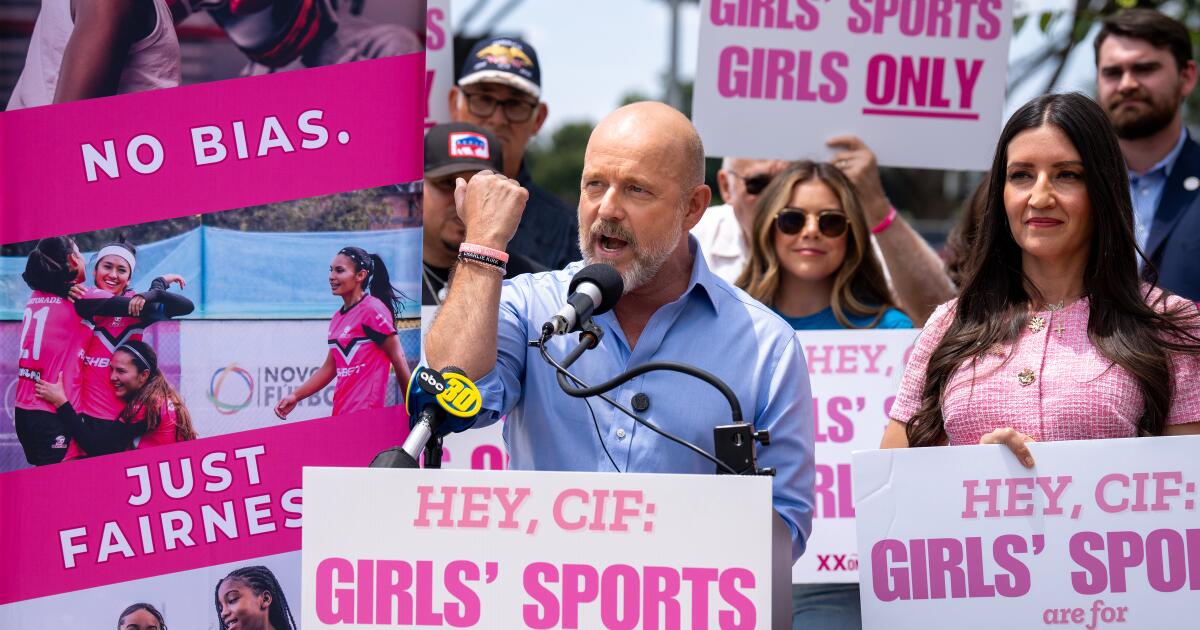
At the Supreme Court, the unfounded fear of boys masquerading as girls in youth sports rolled the clock back on gender equality.
On the surface, the Supreme Court’s June 30 opinion upholding state laws barring transgender girls from women’s and girl’s sports teams looks like a victory for women’s rights.
The 6-3 opinion by Justice Brett M. Kavanaugh certainly presents itself that way. “Females and males have inherent physical differences relevant to athletic performance,” Kavanaugh wrote. “Therefore, in contact sports, forcing female athletes to compete against males can create significant safety risks.” He also asserted that “forcing female athletes to compete against males can undermine competitive fairness.”
The ruling applied to prohibitions enacted in Idaho and West Virginia against “biological” males’ participation on women’s teams in public schools. Federal judges in both states overturned the bans. The Supreme Court majority restored them. The ruling essentially upholds similar bans enacted in 25 other states.
There was no record of any transgender person participating in school sports in the State, let alone any ‘problem’ with transgender students … creating unfair competition or unsafe conditions.
— Justice Sonia Sotomayor, demolishing the Supreme Court’s argument in favor of banning transgender girls from girl’s sports
Kavanaugh, like Donald Trump and others in the anti-transgender camp, maintained that one’s gender is an immutable fact of life, established even before birth.
Anything else, Trump stated in an executive order he issued on inauguration day 2025, could only be the product of “gender ideology extremism.” The U.S., his order stated, recognizes “two sexes, male and female. These sexes are not changeable and are grounded in fundamental and incontrovertible reality.” That’s a “biological truth,” he declared.
In his own version of this overconfident and factually insupportable conclusion, Kavanaugh wrote: “As all agree, females and males have inherent physical differences relevant to athletic performance.”
Science recognizes that some people are “born with sex traits that don’t fit into typical male or female patterns,” to cite a discussion on the Cleveland Clinic web page on the topic “intersex.” The condition “may involve chromosomes, hormones, reproductive organs or genitals.”
From a psychological standpoint, medical science recognizes “gender dysphoria” as a real condition often requiring counseling and medical intervention such as the use of puberty blockers and hormones to stave off the development of secondary sex characteristics until the condition can be resolved.
No one disputes that there are physical differences between the sexes. Few would dispute that on average or even at the median, males may be bigger and more powerful than females, or that in certain contact sports the difference may be telling and on occasion dangerous.
But that’s not the same as asserting that the physical differences between males and females invariably mean that men will invariably prevail over women in all competitions or that their participation will endanger women.
The International Olympic Committee — in a policy statement Kavanaugh cited incompletely — says that in “most running and swimming events,” males have a 10% to 12% advantage over women. That’s a range that would accommodate the full spectrum of outcomes — transgender females win, cisfemales win, they tie. (The “cis” prefix denotes those living consistent with their birth gender.)
West Virginia and Idaho addressed this ambiguity by banning transgender women from all girls’ teams. So under their rules transgender girls can’t play football or soccer with cisgirls. But what’s the argument in favor of banning them from the 100-yard dash, or cross-country track, or diving, or archery?
But something else is going on here. The Supreme Court’s ruling was almost preordained, given the years-long campaign by conservatives to demonize transgender individuals as if they’re members of an alien species.
It will be recalled that during his presidential campaign, Trump spun a despicable fantasy in which children were kidnapped in school and secretly subjected to sex-change operations.
Trump’s executive order wiped out policies aimed at protecting transgender adults from discrimination. He moved to outlaw gender-affirming medical therapies for anyone under 19 by cutting off federal funding for healthcare institutions that provide such care.
He banned transgender individuals from serving in the military and ordered federal prison officials to move transgender inmates into the general populations consistent with their birth genders, which exposes them to physical assault. (Federal Judge Royce Lamberth of Washington, D.C., has blocked the government from transferring three transgender women into the male prison population or terminating their hormone treatments.)
I wrote during Trump’s first term, when his anti-transgender policies were still gestating, that the goal was to show that “one can target any community, as long as it doesn’t have a strong political voice or political power. These are the actions of bullies and cowards, pretending to be strong.”
Last year, the Supreme Court struck its first blow against transgender rights by upholding a Tennessee law banning transgender care, including puberty blockers and hormone therapy, for minors. Similar laws have been enacted in 25 other states. The majority in that ruling by Chief Justice John G. Roberts Jr. was identical to the one in the June 30 ruling — Roberts, Kavanaugh, and Justices Clarence Thomas, Samuel A. Alito Jr., Neil M. Gorsuch and Amy Coney Barrett.
Who are the targets of this ideological campaign? They number only about 1.6 million U.S. adults, or one-half of 1% of the U.S. population. About 300,000 adolescents ages 13 to 17, or 1.4%, identify as transgender, according to a study by UCLA School of Law.
In West Virginia, as Justice Sonia Sotomayor observed in her dissenting opinion, “there was no record of any transgender person participating in school sports in the State, let along any ‘problem’ with transgender students … creating unfair competition or unsafe conditions.”
In endorsing the flat bans directed at transgender women in Idaho and West Virginia, Kavanaugh argued that any attempt to implement case-by-case judgments of students’ requests to join sports teams inconsistent with their biological gender would create “an enormous practical and administrability problem.”
Is that so? That wasn’t the case in Maine, where the annual K-12 population is more than 170,000. There, a committee was charged with determining whether a student’s participation in a sport consistent with their gender identity but inconsistent with their biological sex would “result in an unfair athletic advantage” or present a risk of injury to others. The committee held 56 hearings from 2013 through 2021, or an average of seven per year. During the entire time span, only four involved transgender girls. (The outcome of those hearings couldn’t be learned.)
It was Maine’s policy, one might recall, that provoked a confrontation between Trump and Maine Gov. Janet Mills at the White House last year, when Trump threatened to withhold federal funding from the state unless it barred transgender students from competing on women’s sports teams. “We’ll see you in court,” Mills snapped.
Whether the Idaho and West Virginia laws genuinely protect girls from unfair competition is questionable. (The Idaho law is styled the “Fairness in Women’s Sports Act.”) In practice, the laws may subject women in public schools to “invasive sex verification procedures,” as educational expert George Theoharis of Syracuse University wrote after the court ruling.
They’re also based on a retrograde view of women as fragile creatures needing men’s protection, Theoharis wrote — “the same logic that has historically been used to justify excluding women from making their own healthcare decisions and girls from rigorous math and science; that physically demanding work is simply beyond them.” (There don’t appear to be any state laws barring transgender women from competing in men’s sports.)
Becky Pepper-Jackson, the plaintiff in the West Virginia case, in which she is identified only as B.P.J., is the only transgender girl who sought to join girl’s teams — track and cross-country — in the state. That was in 2021, just after West Virginia passed its law and she was about to enter sixth grade. She didn’t appear to pose any competitive risk to others on the track and cross-country teams she applied to join — her lawyers told the Supreme Court that on those no-cut teams, she “came in near the back.”
Anyway, she had not gone through male puberty, which theoretically might have endowed her with a competitive advantage, because she had been taking puberty blockers and female hormones.
Thanks to the court’s ruling, Sotomayor observed in a dissent joined by Justices Elena Kagan and Ketanji Brown Jackson, West Virginia can deny Becky access to school sports “because it thinks they have an inherent athletic advantage, even if the facts show that they do not.”
B.P.J., Sotomayor wrote, “cannot practice on girls’ teams, even if she would not take anyone’s spot in an eventual competition, even if everyone who tries out for the team makes it, and even if having the chance to participate could aid immensely in treating B. P. J.’s gender dysphoria.”
So whose interest was really protected by the Supreme Court?

An Orange County real estate investor accused of criminally defrauding an Arizona bank of nearly $100 million pleaded not guilty Monday and remains in custody.
Mahender Makhijani, 44, of Corona del Mar — who also was ordered by an arbitrator to pay $1.34 billion in a separate civil fraud case — was arraigned in Santa Ana federal court on two charges.
He is accused of bank fraud and making a false statement to a bank in a June 8 case involving a $100 million real estate loan made by Phoenix-based Western Alliance Bank. He was taken into custody on June 10.
Makhijani is accused of providing bogus collateral for the October 2024 loan now in default. In a civil lawsuit, Western Alliance said the outstanding balance as nearly $99 million.
Prosecutors say he falsified title insurance policies that showed the bank would have a first lien on the underlying collateral if the loan went bad, when in fact it did not.
A trial was set for August 11 before U.S. District Judge David O. Carter in Santa Ana.
Michael Schachter, his criminal defense attorney, did not respond to messages seeking comment.
In the civil case, an arbitrator in May ordered Makhijani to pay Laguna Beach real estate mogul Mohammad Honarkar $1.34 billion after ruling he had fraudulently induced him into a 2021 joint venture — and then wrested control and lost to creditors more than two dozen properties Honarkar had owned.
Makhijani has not been criminally charged in that case, but prosecutors alleged in an affidavit in support of the bank fraud charges that he used “force and threats” in his dealings with Honarkar and others — including taking over the landmark Hotel Laguna in 2023 that Honarkar was renovating.
Prosecutors sought to hold Makhijani without bail after his arrest.
The affidavit noted he is a legal Indian immigrant with a home and bank accounts in that country, has access to private jets and threatened to “run away” if caught in a difficult situation.
The request was denied and he was granted $500,000 bail.
However, Makhijani remains in custody after a hearing sought by prosecutors last month before Magistrate Judge Autumn Spaeth.
The judge declined to accept a $450,000 cashier’s check submitted by a Makhijani associate for the bail, finding insufficient proof the source of the funds was legitimate, according to court records.
Makhijani is not prominent outside Orange County real estate circles, but he established a thriving distressed-assets business over the last decade that attracted prominent Southern California real estate investors.
Prosecutors said it paid for a lifestyle that included two multimillion-dollar homes in Corona del Mar, a luxury apartment in Newport Beach and various luxury vehicles.
As of last month, prosecutors had not fully traced his assets, which they believe are not held in his name and some of which may be in India.
The businessman employed an array of shell companies and strawmen to sign documents on his behalf, and to stand in for him as operators of his companies, according to the affidavit.
Makhijani told an associate he took extra precautions because wanted to insulate himself from litigation and that “they were sharks in the distressed world who took advantage of people,” the affidavit stated.
-

 Los Angeles, Ca16 minutes ago
Bicyclist killed by hit-and-run driver in Long Beach
-

 Detroit, MI34 minutes ago
Child shot while riding bike outside home on Detroit’s west side, police say
-

 San Francisco, CA46 minutes ago
Bay Area restaurant has strict policy on acceptable children behavior
-

 Dallas, TX49 minutes ago
Detroit Pistons trade Marcus Sasser to Dusty May’s Dallas Mavericks
-

 Miami, FL54 minutes ago
The offseason has been a massive success for the Miami Heat
-

 Boston, MA1 hour ago
Can’t afford Boston’s priciest restaurants? Try these instead. – The Boston Globe
-

 Denver, CO1 hour ago
City of Denver says images of piling waste a case of illegal dumping
-

 Seattle, WA1 hour ago
14-year-old dies in electric motorcycle crash at Seattle bike park

