Business
Fear of Trump’s Tariffs Ripples Through France’s Champagne Region


French Champagne producers do nearly a billion dollars’ worth of business with the United States every year. But on Friday in Épernay, the world capital of sparkling wine, the only number on anybody’s lips was 200.
That was the percent tariff that President Trump has threatened to impose on Champagne and other European wines and spirits exported to the United States, in a trade war that exploded this past week after the European Union countered Mr. Trump’s penalties on steel and aluminum with its own duties on American products.
The triple-digit menace landed like a thunderbolt in Épernay, rattling workers in nearby fields, producers in small villages and the venerable houses that line the Avenue de Champagne, Épernay’s central boulevard and a UNESCO Heritage site that oozes tasteful wealth.
“A 200 percent tariff is designed to make sure that no Champagne will be shipped to the United States,” said Calvin Boucher, a manager at Michel Gonet, a 225-year-old Champagne house on the avenue. With 20 to 30 percent of the 200,000 bottles it makes yearly exported to American wine merchants and restaurants, “that business would be crushed,” he said, adding that the price of a $125 Champagne would more than triple overnight.
Épernay sits in the heart of a region that produces the world’s finest bubbly. The United States is its biggest foreign market, with 27 million bottles shipped there in 2023, valued at around 810 million euros ($885 million).
Chardonnay, Pinot Noir and Meunier grapes blanket the rolling hills and deep valleys of Champagne, which covers more than 130 square miles, from the city of Reims to the Aube river. The area is under France’s strict Appellation d’Origine system, which ensures that only the sparkling wine made here, using specific methods, can legally be called Champagne.
With more than 4,000 independent winemakers and 360 Champagne houses, the region produces around 300 million bottles annually, with one billion more resting in cellars. The biggest houses — including Dom Pérignon, Veuve Clicquot and Moët & Chandon, owned by the luxury conglomerate LVMH Moët Hennessy Louis Vuitton — dominate production and exports and account for a third of total sales.
But such figures were of little comfort in the wake of Mr. Trump’s threat. Just off the Avenue de Champagne, Nathalie Doucet, the president of Besserat de Bellefon, a specialty Champagne house that exports 10 percent of its premium production to the United States, said that the trade war made her anxious.
“We are waiting to see what happens, but it’s not good news,” said Ms. Doucet, whose Champagne is made with a laborious low-pressure process that gives it a crisp acidity and fine effervescence.
Champagne already had a tough year with bad weather that had reduced the harvest. Consumption has declined as young people shifted habits and switched to cocktails and artisanal beer. Champagne sales have thinned since the pandemic, falling 9 percent last year.
At the same time, she said, Europe was grappling with wars in Ukraine and Gaza. And now the trade war with the United States, one of France’s traditional allies, over issues that have nothing to do with Champagne, has made her feel like collateral damage.
“It seems like a deliberate punishment,” said Cyril Depart, the owner of the Salvatori wine shop, just off the avenue, which offers a wide variety of artisanal Champagnes. His wife was an export manager for one of the big Champagne houses and had already been crunching numbers on the potential impact.
Leah Razzouki, an Épernay resident whose family has worked in the Champagne business for generations, said she was infuriated. “Many of our friends are small producers and they would be hit very hard,” she said.
The damage of a trade war would spread far beyond Champagne’s regal houses, hitting American importers and distributors and putting numerous small businesses at risk.
Michael Reiss, the president of Vineyard Road, a small distributor in Framingham, Mass., that imports Champagne and wines from Europe and distributes them in New England, said that small businesses like his, including restaurants and retail shops, would be “very hurt.” The unpredictable trade environment could force businesses to cancel planned investments, he added.
Adding to the pain, tariffs applied at the beginning of the supply chain can multiply, as each business handling the product marks it up accordingly, Mr. Reiss said. “So even a 25 percent tariff can easily lead to a 40 to 60 percent increase in prices,” he said.
A 200 percent tariff “would eliminate the possibility of people buying things that bring them joy in their lives,” he added.
Even inside the Champagne Museum bordering the avenue in Épernay, the chatter strayed to Mr. Trump’s tariffs. Sacha Raynaud, whose family owns a small Champagne house, had brought a friend to learn the history of Champagne, which first appeared in the 17th century on the tables of royalty, giving the drink its nickname, “the king of wines.”
“French people are waking up to what’s happening in the United States, and starting to speak about boycotting American products,” she said.
Similar worries circulated in the fields. Working in a buttery morning light, a dozen field hands secured knotted brown vines to wires ahead of the spring growing season on freshly plowed earth in the shadow of the Champagne-producing town of Reuil, just west of Épernay.
Even these jobs were at risk, said Patrick Andrade, who runs a small company that helps maintain Champagne vineyards. The 12 hectare (30 acre) plot belonged to a small house that exports to the United States, he said.
Should sales fall, wine producers would need fewer field hands, and there would be less work for tractor operators, cork makers and bottle makers. In the worst case, he added, it could force Champagne producers to consider ripping out vines.
On Friday, France’s finance minister, Eric Lombard, called the trade war “idiotic” and said he would travel to Washington soon. “We need to talk to the Americans to bring the tension back down,” he told French television.
France’s biggest Champagne houses have stayed conspicuously silent, declining to say anything while waiting to see how Mr. Trump’s threat would play out — and whether European officials could get him to back off.
Among them was LVMH Moët Hennessy Louis Vuitton, which sells nearly 35 percent of its wines and spirits in the United States. The company did not respond to a request for comment.
Outside of LVMH’s Moët & Chandon mansion on the Avenue de Champagne, a group of Americans snapped selfies in front of a statue of Dom Pérignon, the monk who invented Champagne. Inside the stately building, no staff members wanted to talk tariffs.
Even so, locals whispered rumors that the big houses were upset by the tariff threat, but expected that it could quite possibly blow over.
After all, some said, Bernard Arnault, France’s richest man and the head of the LVMH empire, which dominates much of Champagne’s production, has a longstanding relationship with the U.S. president and was invited by Mr. Trump to his inauguration. Perhaps Mr. Arnault’s friendship would prevail at the end of the day, they said.
But for now, that is all just speculation. The reality is that nothing is certain — and uncertainty is bad for business.
Back at the Michel Gonet Champagne house, Mr. Boucher pointed to a display of cuvées that were popular among customers in the United States.
“It’s just a stressful situation because we don’t know if the tariffs will even happen,” he said. “It’s not good for anybody.”
Aurelien Breeden and Ségolène Le Stradic contributed reporting.



A landmarked downtown Los Angeles apartment building designed by famed Los Angeles architect John Parkinson is on the market as its owners face foreclosure.
Residences in the Metropolitan, a 10-story tower built in 1913, are nearly filled with tenants but its ground floor retail spaces on Broadway and 5th Street are unoccupied, as are other street-level stores in downtown’s Historic Core.
The historic building was once considered one of the best in the city and is owned by the Fallas family, which operated a chain of value-priced clothing stores based in Gardena including one called Fallas Paredes in the Metropolitan.
Fallas-Paredes at 449 S. Broadway, Los Angeles, CA 90013.
(Google Maps)
Around 2011, Michael Fallas, who once worked in family’s downtown store as a stock boy, converted the upstairs floors from offices to apartments while continuing to operate Fallas Paredes. The store closed more than five years ago in the wake of a 2018 filing by its parent company for Chapter 11 bankruptcy protection.
Earlier this month in state Superior Court, a special servicer representing Fallas’ lender asked for a judicial foreclosure of the property, alleging that Fallas had stopped making payments on a $32 million loan dating to 2017. After leasing the property for years, Fallas bought the building in the 1990s.
Fallas didn’t respond to requests for comment.
The location of the Metropolitan where the buildings stands was hailed in a Times story in 1912, saying “it is regarded by many realty men as the most valuable piece of real estate in Los Angeles.”
The building today is recognized as a city historic-cultural monument because “Broadway became the commercial center of the Southland, a title it retained until well after World War II,” with its development, the city said. One of the architects who designed the Metropolitan in the Beaux-Arts style was John Parkinson, who is credited with designing such well-known local structures as City Hall, the Los Angeles Memorial Coliseum and Union Station.
Notable tenants in the Metropolitan have included the Los Angeles Public Library, Owl Drug Co., variety store J.J. Newberry and real estate company Janns Investment Co., which sold the land where UCLA is built and developed Westwood Village, among other Los Angeles neighborhoods.
In recent years, the buildings around the Metropolitan have struggled to keep retail tenants after a spurt of residential conversions of historic buildings starting in the early 2000s brought commerce to the neighborhood. Many downtown businesses have struggled since the pandemic reduced occupancy in offices downtown and reduced the flow of visitors.
“The lack of bodies on the street is generally hurting downtown, and that’s one of the reasons that has building has problems,” said downtown real estate broker Hal Bastian, who lives in the Historic Core.
There are close to 1,000 residential units in historic buildings at the intersection of Broadway and 5th Street, Bastian said, but all the ground floor stores are closed. Drug stores there suffered substantial losses from shoplifting he said, and now, “our challenge on Broadway is leasing.”
The 88 apartments in the Metropolitan are 91% rented, according to a listing for the property by the Zacuto Group, which also touts its roof deck with pool, fitness center and barbecue grills. No sale price is set.
Business
January 2025 wildfire victims seek tougher penalties against State Farm over claims handling
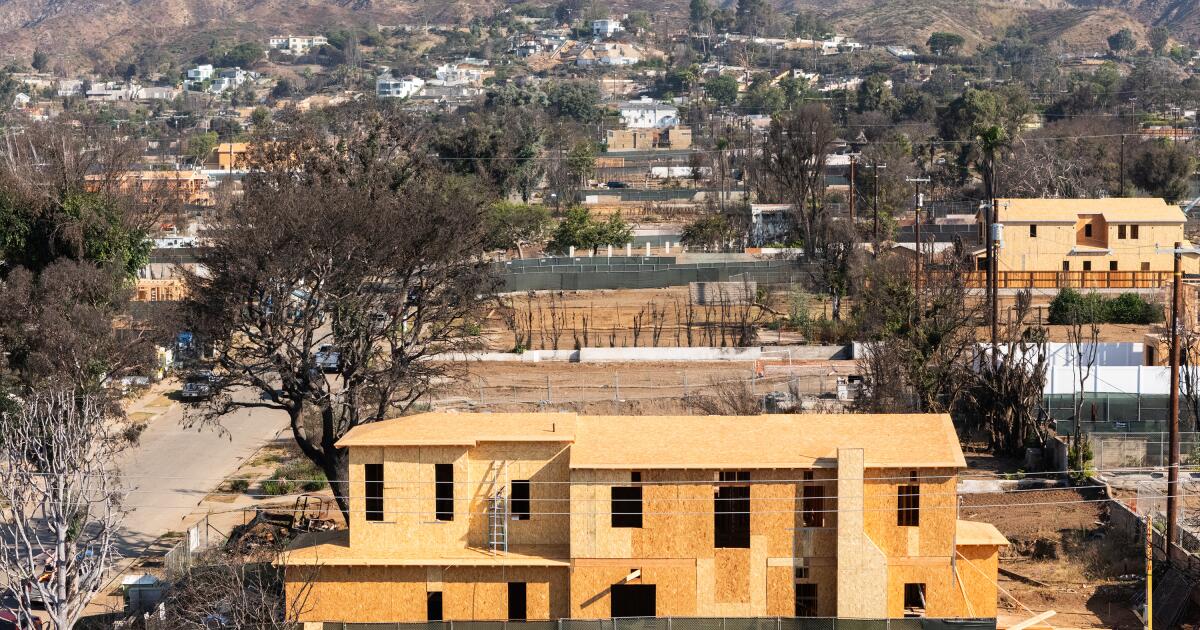
A fire survivors’ group announced Thursday it was seeking tougher penalties against State Farm over its handling of January 2025 wildfire claims.
The Every Fire Survivor’s Network said it was petitioning to join a state enforcement action announced this year against the company to make sure the case results in meaningful changes at California’s largest home insurer.
“We’re seeking a systematic review of all their claims and penalties calibrated to the actual scale of the harm — and we’re seeking the payouts that families are owed,” said Joy Chen, executive director of the group, at a Pacific Palisades news conference joined by victims of the fires.
The Department of Insurance in May filed an administrative action against State Farm General — the subsidiary of the giant Bloomington, Ill., insurer that handles California home insurance — after completing a “market conduct” exam.
The Jan. 7, 2025, fire damaged or destroyed more than 18,000 structures and killed 31 people.
State Farm has received more January 2025 claims than any other insurer — more than 13,700 auto and homeowners claims as of May 4, with payouts totaling $5.7 billion, according to the company.
The market conduct exam looked at 220 sample claims filed by the victims and found 398 violations of state law in about half of them.
Among other alleged violations, it found that the company failed in numerous cases to pursue a “thorough, fair and objective investigation” into claims, failed to come to “prompt, fair, and equitable settlements” and made settlement offers that were “unreasonably low.”
In announcing the action, Insurance Commissioner Ricardo Lara called the company’s claims handling “unacceptable” and said his department was taking “decisive action to hold them accountable.”
The state is seeking a “cease and desist” order to stop the insurer from engaging in unfair or deceptive practices.
It also has threatened to suspend State Farm’s license over the alleged violations, which each carry a penalty of up to $5,000 — or twice that figure if found to be willful. That could amount to a penalty of $2 million or more.
The threat to actually suspend State Farm’s license and its authority to write policies has been viewed skeptically by some, given its roughly 20% market share of the state’s home insurance market.
The company, which had an opportunity to include its responses in the exam report, denied fault in some cases and admitted fault in others. It often blamed problems on individual adjusters and denied systemic issues with its claims handling.
The petition filed by the wildfire survivor’s group criticizes the sample size of the market conduct exam as too small to capture all the alleged deficiencies in State Farm’s claims handling, which it claims are a “general business practice” of the company.
The group is seeking to conduct discovery, cross examine witnesses, present testimony from fire victims and bring more that 1,600 firsthand policyholder statements regarding State Farm’s practices into evidence, according to the petition.
It also wants State Farm to reopen cases in which claimants were paid too little, and it is seeking to participate in settlement discussions in order to increase any penalty State Farm would pay.
It calculated that a $2-million penalty would amount to a minute fraction of the assets of the State Farm Group.
“I submit to you that doesn’t defer bad conduct, it just allows you to continue to do it,” said Michelle Meyers, an attorney for Every Fire Survivor’s Network, at the news conference.
Consumer Watchdog, which has been a harsh critic of State Farm, also is providing legal support for victims’ effort.
Sevag Sarkissian, a spokesperson for State Farm, said the company was aware of the petition.
“We recognize that many wildfire survivors, including those that are State Farm General policyholders, continue to face difficult recovery challenges,” he said. “Our focus remains on helping customers recover.”
Michael Soller, a spokesperson for Lara, said the department is “acting with urgency to assist wildfire survivors in their ongoing recovery by investigating formal complaints filed by survivors and conducting the expedited market conduct exam that led to this enforcement action.”
He added that the department’s position is the state’s Administrative Procedure Act does not contemplate the commissioner or department staff authorizing intervention requests in the case.
He said that would be a hearing officer’s or administrative law judge’s decision when one is assigned to the case.
Meyers acknowledged the request was novel but said her reading of the law is that Lara can make the decision because no judge is yet assigned.
In response to the criticism, State Farm pledged earlier this year to improve its claims handling, including by providing single points of contact and improved communication so there are “fewer handoffs, fewer repeated explanations, and seamless support.”
It also named a new vice president of customer relations for State Farm General.

The state’s trial attorneys and Uber say they have reached a last-minute deal to scrap their dueling ballot measures and avert what was gearing up to be one of most expensive battles of the November election.
The deal, which comes a day after both measures qualified for the November ballot, has Uber agreeing to bulk up safety measures, while the trial attorneys will limit how much they can claim for lien-based medical treatment of victims who get in Uber or Lyft accidents, according to spokespeople for both sides of the campaign.
“Both sides agree: Californians deserve a system that’s safe, fair, and accountable,” read a joint statement from Uber and the Consumer Attorneys of California, a powerful attorney trade group. “This agreement protects patients from unnecessary treatment or getting overcharged, ensures access to medical care and legal representation, and strengthens safety measures.”
The agreement, finalized Thursday, means the ride-share giant will kill its ballot measure to cap how much attorneys can earn in vehicle collision cases and limit medical damages to rates based on insurance. Uber has argued that the costs for medical treatment done on a lien, which allows doctors to get paid from a cut of the plaintiff’s payout, far exceed what it would cost if the victim had used their own insurance.
In return, the Consumer Attorneys of California will cancel its competing ballot measure that sought to increase legal liability for ride-share companies if a passenger is sexually assaulted by a driver. The measure followed an investigation by the New York Times into sexual assault by drivers.
Both sides had poured tens of millions into the campaigns, plastering billboards across Los Angeles.
Lawyers claimed the fight had turned existential with the measure threatening to decimate the profit margin of many personal injury cases and leave drivers with small or thorny cases unable to find an attorney willing to take their case.
Spokespeople say the deal is predicated on their agreement being codified into a bill within the next week. Otherwise, they said, each side will move forward with its ballot measure.
-

 World51 seconds ago
Lebanese influencer organises World Cup event amid Israel’s attack on Leban
-
 News24 minutes ago
Air Force One, gifted to Trump from Qatar, arrives at Joint Base Andrews
-

 New York2 hours ago
Video: Fans Show Up to the Parade in Their Best Knicks-Themed Attire
-

 Los Angeles, Ca2 hours ago
Victims sought after man allegedly points gun at passing cars in Santa Clarita Valley
-

 Detroit, MI2 hours ago
Best barbershop in Metro Detroit: Finalists for this year’s Vote 4 The Best
-

 San Francisco, CA2 hours ago
How to watch San Francisco Giants vs. Miami Marlins
-

 Dallas, TX2 hours ago
Drivers in North Texas struggle with Friday floods
-

 Miami, FL3 hours ago
Three wildfires burn more than 20,000 acres in Miami-Dade, force road closures

