Business
Elon Musk's multibillion-dollar pay package is rejected for a second time. What to know

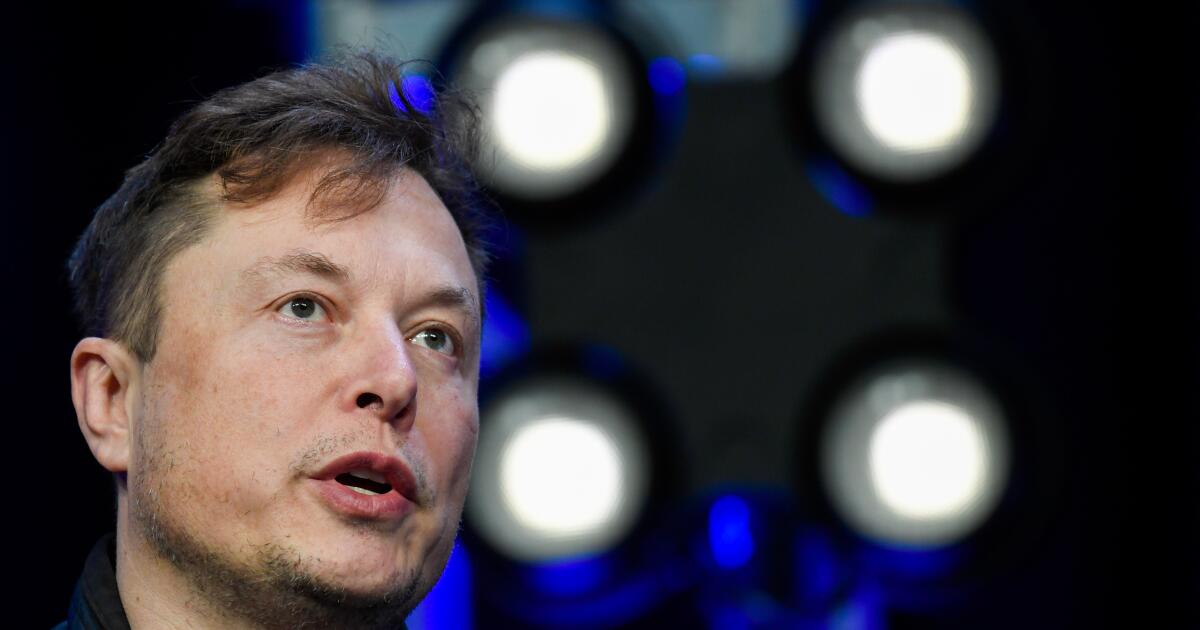
A Delaware judge rejected Tesla Chief Executive Elon Musk’s multibillion-dollar pay package for a second time, writing in her opinion this week that the company’s approval process for the package was “deeply flawed.”
Tesla shareholders approved the compensation plan in 2018, which was once valued at $56 billion but fluctuates dramatically with Tesla’s stock price. Chancellor Kathaleen McCormick first rejected the plan earlier this year on the grounds that Musk had unfair influence over shareholders and that negotiations over his pay plan were not legitimate.
McCormick rejected the plan again this week, citing similar reasons, although attorneys for Musk have argued that the outsized compensation plan is justified because it’s directly tied to Tesla’s valuation, which currently sits at more than $1 trillion.
A dominant player in the electric vehicle market, Tesla has faced setbacks this year amid increased competition and safety concerns surrounding its Full Self-Driving mode. The company slashed more than 10% of its global workforce in April, citing a need to cut costs.
Musk was tapped last month to lead President-elect Donald Trump’s new Department of Government Efficiency, a role that could bolster his influence and Tesla’s standing.
How did we get here?
Tesla shareholder Richard Tornetta filed a lawsuit against Musk and the company in 2018 after the majority of shareholders approved a 10-year performance-based pay package for Musk.
Tornetta alleged that Musk misled investors who approved the plan and exercised inappropriate influence over negotiations. Musk denied the allegations at trial, saying he did not control the terms of the pay package or attend meetings where it was discussed.
McCormick sided with Tornetta in January and blocked the plan. After the ruling, Tesla shareholders voted again to approve the pay package, with more than 70% in favor, but it was not enough to change McCormick’s mind.
Why did the judge rule twice?
After McCormick’s first ruling, Musk’s attorneys argued that the shareholders’ overwhelming support of his compensation plan should override the court’s decision. Tesla shareholders voted twice to approve the plan, but McCormick maintained that they were not acting independently.
“There were undoubtedly a range of healthy amounts that the board could have decided to pay Musk,” McCormick wrote in her second opinion. Instead, the board “capitulated to Musk’s terms and then failed to prove that those terms were entirely fair,” she said.
McCormick said that it was not standard for a judge to change a ruling based on the vote of shareholders. There was “no procedural ground” to reverse the decision, she wrote.
How does Musk’s pay compare?
If approved, Musk’s compensation plan would be the largest in U.S. history for a public company executive, according to CNBC. The pay plan includes a series of 12 milestones and would award Musk additional Tesla shares as the company grows.
In order for Musk to reach each milestone, Tesla’s market capitalization must increase in $50-billion increments. For Musk to fully vest in the award, the company’s market cap must reach $650 billion, the company said.
Musk’s attorneys argue that the pay plan is a reflection of what the executive is worth, but McCormick disagrees. In her second ruling, the judge also awarded the plaintiffs $345 million in legal fees, although plaintiff attorneys had asked for a whopping $5.6 billion.
Who’s right?
Corporate governance expert Charles Elson said the Delaware court’s ruling was sound and in line with the law because Musk had violated conflict of interest regulations. Tesla also created improper new evidence after McCormick’s first decision by calling for a second shareholder vote, he said.
“The judge found that the board was not independent of Musk and there was no negotiation between him and the board that produced this package, which makes it suspect,” Elson said. “The standard rules have to apply.”
What will Musk do now?
Musk criticized McCormick’s ruling on X, the social media platform he owns, writing that “shareholders should control company votes, not judges.”
Tesla also posted on X that the court’s decision was wrong and the company plans to appeal. The appeal would be filed with the Delaware Supreme Court.
“This ruling, if not overturned, means that judges and plaintiffs’ lawyers run Delaware companies rather than their rightful owners,” the company wrote.
Attorneys for Tornetta and the other shareholders who oppose Musk’s pay plan said they would defend the court’s ruling if the decision is appealed.
The Associated Press contributed to this report.




Asad Ayaz, the Disney marketing chief behind creative campaigns for Disneyland Resort’s 70th anniversary and films like “Zootopia 2” and the live-action adaptation of “Lilo & Stitch,” has been named chief marketing and brand officer for Walt Disney Co., the entertainment giant said Wednesday.
The 21-year veteran most recently served dual roles as the company’s first chief brand officer as well as president of marketing for Walt Disney Studios.
Ayaz will now lead a new marketing and brand organization within the Burbank media and entertainment company. He reports to Disney Chief Executive Bob Iger, as well as the heads of Disney’s film and TV studios, theme parks segment and ESPN for those sectors’ respective marketing efforts.
“As our businesses have evolved, it’s clear that we need a company-wide role that ensures brand consistency and allows consumers today to seamlessly interact with our wonderful products and experiences,” Iger said in a statement Wednesday. “The Chief Marketing and Brand Officer role is critical for this moment, and Asad is the perfect fit.”
In his new role, Ayaz will lead the company’s global marketing efforts, including social and digital strategy, overseeing corporate partnerships and franchise priorities, Disney said.
Ayaz previously worked on brand campaigns commemorating Disney’s 100th anniversary, global expansion of Disney’s D23 fan club and led marketing for Disney+, including shows such as “The Mandalorian,” Marvel Studios’ “WandaVision” and the launch of Taylor Swift’s “The End of an Era” on the streaming platform.
Business
Commentary: Trump is demanding a 10% cap on credit card interest. Here’s why that’s a lousy idea

A few days ago, President Trump staked a claim to the “affordability” issue by demanding that banks cap their credit card interest rates at 10% for one year.
Actually, Trump announced that in effect he had imposed the cap, a claim that some news organizations accepted as gospel.
So let’s dispose of that misconception right off: Trump has zero power to cap interest rates on credit cards. Only Congress can do so.
The idea of a 10% rate cap has all the seriousness of bread-and-circuses governance.
— Adam Levitin, Georgetown Law
More to the point, his proposal, announced via a post on his TruthSocial platform, is a terrible idea. It’s half-baked at best, and harbors unintended consequences by the carload — so much, in fact, that the putative savings that ordinary households could see from the rate reduction might be diluted, or even reversed, by the drawbacks.
Still, the idea has so much consumerist appeal that it placed Trump in accord with some of his most obdurate critics, such as Sen. Elizabeth Warren (D-Mass.), who has been pressing to place limits on bank fees for years. Warren said she and Trump had a phone conversation in which they seemed to have talked companionably about the issue.
Trump’s announcement did have the salutary effect of placing the issue of financial services costs on the front burner, after its having languished for years. But it obscured the immense complexities of making any such change.
“Certainly this demonstrates a populist streak on both sides of the aisle,” says Adam Rust, director of financial services at the Consumer Federation of America. “But you can’t just write a tweet and upend a huge market.”
The market for credit cards is indeed huge. As of 2024, credit card debt in the U.S. exceeded $1.21 trillion. This is the most profitable line of business for many banks, producing $120 billion in interest income and $162 billion in fees, chiefly those the card issuers impose on merchants.
“Almost 30% of that is pure profit,” reported Brian Shearer of Vanderbilt University, a former official at the Consumer Financial Protection Bureau, in a 2025 study.
So it should come as no surprise that the entire banking industry has circled the wagons against a cap on credit card interest rates, especially one as stringent as 10%. On Jan. 9, the very day of Trump’s announcement, five leading bank lobbying organizations issued a joint statement asserting that a 10% cap would be “devastating for millions of American families and small business owners who rely on and value their credit cards, the very consumers this proposal intends to help.”
Among its drawbacks, the statement said, “this cap would only drive consumers toward less regulated, more costly alternatives.”
It’s tempting to dismiss the statement as the normal grousing of a big industry about a government regulation. Banks have acquired a certain reputation for profiteering from customers, especially less well-heeled customers, and playing fast and loose with the facts about their costs and profits. But the truth is that on this topic, they have a point.
Let’s take a look, starting with some basic facts — and misconceptions — about credit cards.
The credit card market is heterogeneous, segmented by income and more importantly by credit score. Those with the highest FICO scores typically get the lowest interest rates, but are also more inclined to pay off their balances every month without incurring any fees, even as their average balances are the highest.
About 40% of all users, including many with middling credit scores, pay off their balances monthly but use their cards for convenience, to access fraud protections provided by credit cards but not by other forms of credit, and to garner card rewards.
Interest fees aren’t the issuers’ sole source of revenue. Most revenue comes at the other end of the transaction, in interchange or “swipe” fees paid by merchants.
That’s why card issuers still cherish high-income transactors and shower them with rewards — the monthly balances of users in the 760-to-840 FICO score range vastly exceed those of other users, indicating that they’re generating correspondingly more in interchange fees from the merchants they patronize.
The average interest rate on credit cards reached 25.2% last year, according to a December report by the Consumer Financial Protection Bureau. It has steadily increased since 2022, mostly because of an increase in the prime rate, the benchmark for card issuers.
How did it get so high? Blame the Supreme Court, which in 1978 undermined state usury laws by ruling that banks could charge customers the usury rate of their home state rather than the rate in the customer’s state. That’s why your credit card may be “issued” by a bank subsidiary in Utah, South Dakota or Delaware, which have lax usury limits. The solution would be enactment of a nationwide usury limit, but that falls entirely within congressional authority.
So what would happen if Congress did place a limit on the maximum credit card interest rate — if not 10%, then 15% or 18%, as has been proposed in the past? Shearer contends that banks make such fat profits from credit card users at every FICO level that they could still earn healthy returns even at a 15% cap. Shearer estimated that a cap of 15% would produce more than $48 billion in annual customer savings “coming almost entirely out of bank profits.”
Other analysts are not so sanguine. “There is no free lunch here,” argues Adam Levitin, a credit market expert at Georgetown law school. Levitin argues that while issuer profits are large, their margins are not so large. He calculates that a 10% cap would make the general credit card business unprofitable, because there wouldn’t be enough headroom over the benchmark prime rate (currently 6.75%) to cover administrative costs and other overhead.
Issuers don’t have many options to preserve their profitability. So they’re likely to respond by shutting the door on low-income and low-FICO customers and ratcheting back credit limits.
“The effects will be devastating,” Levitin says. “Families that need the short-term float or the ability to pay back purchases over several months won’t have it. How will they pay for a new water heater when the old one goes out and they don’t have $3,000 sitting around?”
Many will be forced to resort to other short-term unsecured lenders — payday lenders, buy-now-pay-later firms and others that don’t offer the consumer protections of credit cards and would be exempt from the interest cap on credit cards.
“The idea of a 10% rate cap,” Levitin says, “has all the seriousness of bread-and-circuses governance.”
The availability of credit from alternative consumer lenders that don’t offer the statutory protections mandated for credit cards concerns consumer advocates.
A hard cap on interest rates “could create a sharp contraction in the kind of credit available in the marketplace,” says Delicia Hand of Consumer Reports. “It sounds good, but there could be unintended consequences, especially if you don’t think about what fills the gap,”
Alternative products aren’t regulated as stringently as credit cards. “Direct-to-consumer products can layer subscription fees, expedited access fees, and ‘voluntary’ tips in combinations that produce effective annual percentage rates ranging from under 100% to well over 300% — and in some documented cases, exceeding 1,000% when annualized for frequent users,” Hand said in remarks prepared for delivery Tuesday to the House Committee on Financial Services.
If an interest rate cap is too tight, all but the highest-rated customers might face higher annual fees and stingier rewards. Issuers are likely to squeeze merchants too. Big businesses — think Costco and Amazon — might be able to negotiate swipe fees down and eat the remainder instead of passing them through to consumers. But small neighborhood merchants might refuse to accept credit cards for purchases below a certain amount, or add a swipe fee surcharge to customers’ bills.
Other complexities bedevil proposals like Trump’s, or for that matter bills introduced last year in the Senate by Bernie Sanders (I-Vt.) and Josh Hawley (R-Mo.) and in the House by Reps. Alexandria Ocasio-Cortez (D-N.Y.) and Anna Paulina Luna (R-Fla.), capping rates at 10% for five years. Those measures have the virtue of simplicity — they’re only three pages long — but the drawback, also, of simplicity.
Among the open questions, Levitin observes, are whether the 10% cap would apply to all balances or just to purchases. If the former, it remakes credit cards into tools for “low-cost leverage for cryptocurrency speculation and sports betting,” because in today’s interest rate environment it’s cheap money.
Trump’s announcement, in particular, displays all the drawbacks of insufficient cogitation characteristic of so many of his ventures. Published on Jan. 9, it called for the cap to be implemented on Jan. 20, the anniversary of his inauguration: a mere 11 days to implement a change in a $1.21-trillion market with potential ramifications on a dizzying scale.
Since he doesn’t have the authority to mandate the cap by executive order, he’s in effect calling for the banks to make the change voluntarily. Given the impact on their profits, on the gonna-happen scale, that’s a “not.”
Adding to the sour ironies of this effort, Trump’s far-right budget director, Russell Vought, has been pursuing a vicious campaign to destroy the agency with statutory authority over the consumer lending industry, the CFPB — of which Trump appointed Vought acting director.
Vought also rescinded a Biden-era CFPB rule reducing credit card late fees to no more than $8 from as much as $41—further undermining Trump’s attempt to pose as a friend of the credit card customer.
Consumer advocates are pleased that the debate over card fees has placed financial services costs squarely in the “affordability” debate, where they belong.
There’s no question that capping card interest rates at some level could bring savings to consumers to maintain monthly balances — “revolvers,” in industry parlance. “It could be worth several bags of groceries a month, or a tank of gas,” Rust conjectures — “significant savings for millions of people.”
The challenge is finding “where the right level is, balancing risk and availability,” he told me. “That’s not clear at the moment.”

Disneyland, the iconic tourist destination that transformed the entertainment landscape in Southern California, has reached a new milestone: 900 million people have visited the park since its opening in 1955.
The latest attendance figure was described in a new documentary called “Disneyland Handcrafted,” chronicling the creation of the theme park. The film, which includes footage from the Walt Disney Archives, will stream on Disney+.
In 2024 — the most recent year data was available — Disneyland’s attendance ticked up 0.5% to 17.3 million, according to a report from the Themed Entertainment Assn. Like many other theme parks, Disney does not release internal attendance figures.
Walt Disney Co.’s theme parks, cruise ships and vacation resorts have been a key economic driver for the Burbank media and entertainment company.
Last year, almost 57% of the company’s operating income was generated by the tourism and leisure segment, known as Disney’s “experiences” business. That sector reported revenue of $36.2 billion for fiscal year 2025, a 6% bump compared to the previous year. Operating income increased 8% to nearly $10 billion.
Disney has said it will invest $60 billion into its experiences segment, underscoring the importance of that business to the company. At Disneyland Resort in Anaheim, that could mean at least $1.9 billion of development on projects including an expansion of the Avengers Campus and a “Coco”-themed boat ride at Disney California Adventure, as well as an “Avatar”-inspired area.
Over its 70 years, Disneyland has undergone many changes and expansions. Though some of its original attractions still exist, including Peter Pan’s Flight, Dumbo the Flying Elephant and the Mark Twain Riverboat, the park has evolved to align more with its Hollywood cinematic properties and expanded in 2019 to include a “Star Wars”-themed land.

X claims it has stopped Grok from undressing people, but of course it hasn’t

Armed Kurdish fighters try to breach Iran border as regional threat grows amid protests: reports

Hochul endorses legislation to allow New Yorkers to sue ICE agents: ‘Power does not justify abuse’

Forcing an early wake-up time could harm your health, sleep doctors warn

Mike Tomlin’s exit was unexpected as Steelers begin rare coaching search, team president says

Florida High School Football Rankings: Top 25 teams – Oct. 21

Cleary's 21 help Le Moyne down Central Connecticut State 69-64 in OT

How old is Bo Nix? What to know about Oregon quarterback ahead of 2024 NFL Draft

99th annual Pony Swim held in Virginia

Video: ‘It Didn’t Have to Happen This Way:’ U.Va. Faculty Call for Review of Police Response to Protests
Hochul endorses legislation to allow New Yorkers to sue ICE agents: ‘Power does not justify abuse’

Iran reopens airspace after closure to most flights amid US attack threats

Trump says he’s been assured Tehran has stopped killing protesters as Iran reopens its airspace – live

Republicans light cigars, cigarettes on burning photos of Khamenei to show support for Iranian protesters

EU Parliament questions defence loan’s ‘€17 billion gift’ to Hungary
-

 Montana4 days ago
Service door of Crans-Montana bar where 40 died in fire was locked from inside, owner says
-

 Technology1 week ago
Power bank feature creep is out of control
-

 Delaware6 days ago
MERR responds to dead humpback whale washed up near Bethany Beach
-

 Dallas, TX6 days ago
Anti-ICE protest outside Dallas City Hall follows deadly shooting in Minneapolis
-

 Dallas, TX1 week ago
Defensive coordinator candidates who could improve Cowboys’ brutal secondary in 2026
-

 Education1 week ago
Video: This Organizer Reclaims Counter Space
-

 Virginia4 days ago
Virginia Tech gains commitment from ACC transfer QB
-

 Iowa1 week ago
Pat McAfee praises Audi Crooks, plays hype song for Iowa State star