Business
Efforts brewing at UC Riverside and UCLA to evict Starbucks from campuses for 'union busting' activities

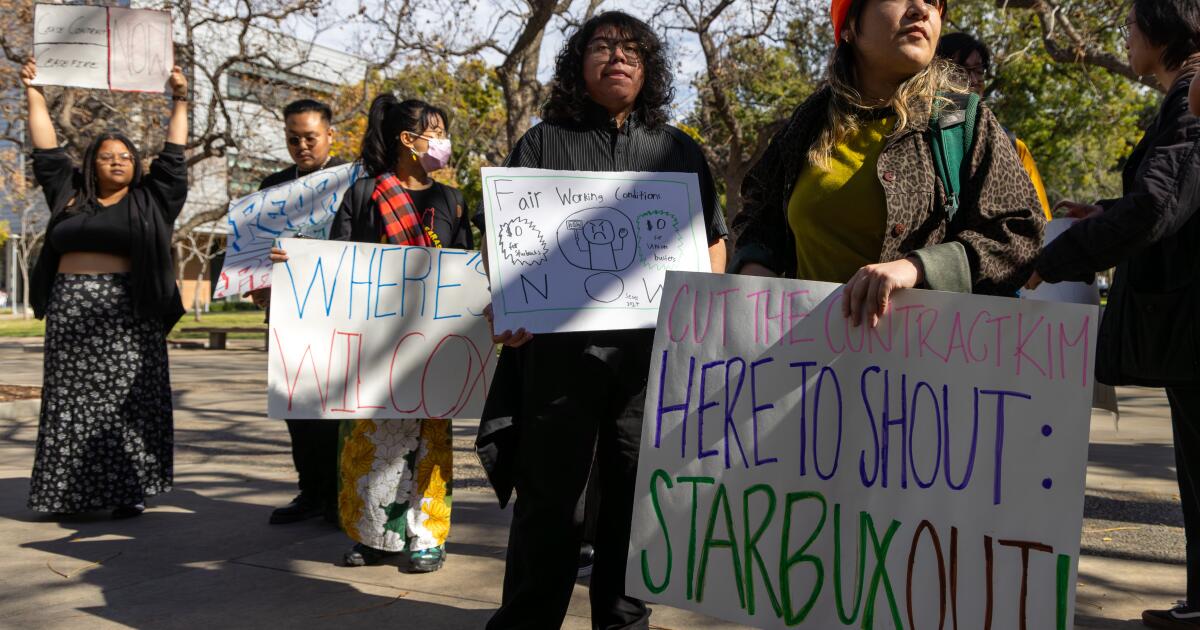
Two dozen UC Riverside students chanted “People over property” and carried signs that read “Crush the contract” and “Seize the beans of production” as they climbed four flights of stairs within the university’s administrative office Wednesday afternoon.
The goal was to present Chancellor Kim Wilcox a petition with nearly 800 signatories calling on the school’s administration to dump licensing agreements with coffee juggernaut Starbucks because of what critics call “union-busting campaigns.”
The protest Wednesday in Riverside mirrored a similar action Tuesday at UCLA, where students affiliated with the union-organizing group Starbucks Workers United have been leading efforts to push Starbucks off college campuses.
Starbucks Workers United says there are more than 385 stores and more than 9,500 workers unionized throughout company-owned Starbucks outlets. The coffee giant operates 38,587 stores in 80 countries with 235,000 employees.
A number of UC Riverside students rally against Starbucks at UC Riverside.
(Irfan Khan/Los Angeles Times)
One student-run campaign claimed victory last year when Cornell University pledged not to renew a partnership with Starbucks when their contract ends in June 2025.
“We want Starbucks off this campus,” said UC Riverside junior Eren Whitfield, an organizer with the group UC Riverside Students Against Starbucks. “There is a countless list of federal labor violations against Starbucks, including the firing of employees involved with union organizing, the denying of increased benefits and so many other things.”
Whitfield, a psychology major who aspires to get involved in social work, led a protest at noon in front of Hinderaker Hall, the office of the chancellor and school administrators.
He carried a printed copy of the digital petition and headed toward the chancellor’s office with a small cadre of supporters.
The only traffic they ran into was from a line of students and employees that snaked out of one of the several school-run stores that offer Starbucks drinks and snacks.
After reaching the chancellor’s office, Whitfield knocked on Wilcox’s door and received no answer.
Eren Whitfield, right, presents signed petition against Starbucks to Gerry Bomotti, Vice Chancellor and Chief Financial Officer, at Hinderaker Hall, UC Riverside on Jan. 31.
(Irfan Khan/Los Angeles Times)
That’s when Gerry Bomotti, UC Riverside’s vice chancellor and chief financial officer, opened his door near the chancellor’s office and accepted the petition on behalf of the administration.
Whitfield asked that the group be given “some sort of response” by administrators within a week.
Bomotti agreed to read the letter and offer some feedback.
“We’ll want to educate ourselves on what their concerns are and be able to get back to them and chat about it,” he said.
UC Riverside owns a licensing agreement with Starbucks that is also up for renewal in 2025, Bomotti said.
“In essence, we participate in a franchise agreement with them, but we sell and operate everything,” he said.
The campus has one Starbucks store, but several school-affiliated stores that sell Starbucks-branded drinks and products.
All full-time, nonmanagement workers at Starbucks locations throughout the campus are unionized university employees who have collective bargaining rights, campus officials confirmed.
“This protest isn’t just about the workers on campus but about the actions that Starbucks has taken with its employees across the country,” said Max Ohshima-Li, a UC Riverside senior who’s majoring in political science.
The National Labor Relations Board filed a complaint in December accusing Starbucks of closing six Los Angeles-area stores and 17 other locations nationwide in 2022 allegedly to suppress union organizing.
A Starbucks official rejected claims that the corporation was hostile to organizing.
“We respect our partners’ right to organize, freely associate, engage in lawful union activities and bargain collectively without fear of reprisal or retaliation — and remain committed to our stated aim of reaching ratified contracts for union-represented stores in 2024,” spokesperson Andrew Trull said in a statement.
Trull said Starbucks has engaged in negotiations with several labor organizations representing employees throughout North America, including the Teamsters and United Steelworkers. He acknowledged some difficulty in agreeing to a “format of bargaining” with Starbucks Workers United.
“We disagree with claims made that Starbucks engages in ‘union busting,’” he said.
He also said Starbucks offered robust benefits for student workers.
Trull said the average salary is $17.50 an hour for baristas, plus tips, along with full medical, dental and vision benefits for those working at least 20 hours a week. He said the business also offers free undergraduate degrees for employees who lodge 20 or more hours a week through a partnership with Arizona State University’s online program for first-time degree seekers.
At UCLA on Tuesday, about 15 students offered statements during an Associated Students of UCLA board meeting.
They then delivered a petition to ASUCLA Chief Executive Pouria Abbassi.
David Ramirez, a UCLA senior majoring in geography and environmental and labor studies, said Starbucks “doesn’t share UCLA’s values.”
“We demanded that UCLA cut any purchasing agreements with Starbucks and to remove any facilities off campus,” Ramirez said. “We can do better.”

Business
Snap CEO Evan Spiegel and Miranda Kerr help erase $550 million in medical debt for Californians

Snap Chief Executive Evan Spiegel and his wife, supermodel Miranda Kerr, have helped pay off $550 million in medical debt for more than 261,000 Californians.
The couple made a multimillion-dollar donation to Undue Medical Debt, a nonprofit that provides debt relief to people in financial need. The organization acquires medical debt in bulk from hospitals, physician groups, collection agencies and other groups for a fraction of the cost.
“When someone you love is sick. All you want to do is focus on helping them get better,” Kerr said in a video with Spiegel. “That’s why we wanted to support this effort and help relieve medical debt, so families can focus on caring for their loved ones and really supporting their healing.”
The couple and the nonprofit didn’t disclose the exact amount of the donation, but a small gift can go a long way. Every $10 donated to Undue Medical Debt relieves an average of $1,000 in medical debt.
The gift comes as Americans struggle with the medical debt and rising cost of living. California is one of the most expensive states to live in because of soaring housing costs and energy prices. Concerns about wealth inequality have sparked heated political debates about how much billionaires should contribute.
In the United States, 1 in 4 adults are in medical debt, said Undue Medical Debt President and Chief Executive Allison Sesso in a statement.
“It’s a growing crisis undermining healthcare access, economic wellbeing and mental health and we’re so grateful that Evan Spiegel and Miranda Kerr share our belief that no one should go bankrupt because of a cancer diagnosis and no family should have to choose between insulin and groceries,” she said.
Californians whose medical debt have been paid off will start receiving a letter in mid-July from Undue Medical Debt informing them of the debt relief. Individuals can’t request debt relief because the nonprofit acquires bundled debt for thousands of people at once. Those who qualify for debt relief either earn at or below 400% of the federal poverty level or have medical debt that is more than 5% of their income, the nonprofit says on its website.
San Diego County residents benefited the most from the donation with total medical debt relief through the couple’s gift totaling roughly $99 million and affecting 40,369 people. In Los Angeles County, the gift provided $26.7 million in medical debt relief to 17,466 people, according to the nonprofit.
Spiegel, whose net worth is roughly $2 billion, and Kerr have helped relieve debt for others in the past. In 2022, the couple paid off the student loans for the Otis College of Art and Design’s graduating class.
In 2025, Spiegel was among business leaders and philanthropists who helped form the Department of Angels, a group that aims to help L.A.’s fire recovery efforts. The California Community Foundation, Snap, Spiegel and Snapchat co-founder Bobby Murphy committed $10 million to help start that group.
Roughly 200,000 people lost their homes in the January 2025 Los Angeles County wildfires. Spiegel, who grew up in Pacific Palisades and lost his childhood home in the fires, donated $5 million in immediate aid with Snap and Murphy that month.
He said in a statement that California has given so much to him and his family and that he cares “deeply about the wellbeing of our communities.”
“At a time when many families are already facing rising costs across nearly every aspect of daily life, an unexpected medical bill can create financial stress that lasts for years,” Spiegel said.
Undue Medical Debt said it’s abolished more than $40 billion of medical debt in all 50 states.

The electric vehicle company Slate Auto set out in 2022 to make the most affordable electric truck in the country. This week, it unveiled the price tag: $24,950.
At a time when demand for new electric vehicles is cooling and cars are getting harder to afford, Slate’s customizable truck could bring a fresh wave of excitement to the industry.
Deliveries will begin later this year and accelerate in 2027, the company said. Slate’s vehicle is built around a simple concept — pay only for what you actually want.
Buyers will start with a basic truck without power windows or even paint and can then customize it however they like. They can tailor-make their “blank slate” by paying extra for smart phone-compatible screens, speakers, colored wrap or paint. A $5,000 kit even converts the truck into an SUV.
Slate’s design team is based in Los Angeles County and recently moved into a new space in Carson, which employs about 50 workers. The company’s headquarters are in Troy, Mich., and its vehicles will be produced in Warsaw, Ind.
Squeezing out as much cost as possible while making it as easy as Legos to snap on different options has required complex engineering, which is why the company decided to set up its design studio in Southern California. The region is full of experts.
“Slate has done something smart,” said auto industry analyst Brian Moody. “Their EV isn’t only about price, there’s also a strong personalization element. In Southern California, the boxy, retro look will earn it a lot of attention.”


Slate is an EV startup that makes electric trucks and SUVs. Customers buy only the features they want. Photographed on Friday, Dec. 19, 2025. (Myung J. Chun/Los Angeles Times)
The company is building a marketplace of accessories for customers to choose from, including 54 basic wraps that cost less than $500 each. In contrast, a paint job on a car can cost thousands of dollars. The marketplace also offers roof stacks, zip-on seat covers and stereos.
For just under $30,000 total, customers can get a basic SUV in a fastback or squareback style. Whether it’s configured as a truck or SUV, the EV will have an estimated range of 205 miles and will be compatible with Tesla chargers.
“This is the first time in automotive history that consumers are going to get to choose,” said Slate Chief Executive Peter Faricy, who joined the company in March after 13 years with Amazon.
“It started with design, then engineering, and eventually manufacturing, and we figured out innovations in all three of those phases that make the vehicle less expensive,” he said.
For example, Slate vehicles were designed from the beginning to be wrapped instead of painted. The company will offer more than 100 colors of wrap at its launch, or customers can choose a custom color.
Slate did not disclose financial information or how much the vehicles cost to produce. However, Faricy said the company will generate a positive gross margin on its vehicles, meaning they are selling for more than what they cost to make.
“Whether Slate succeeds or fails, it has already influenced the conversation … forcing the industry to ask why affordable vehicles have become so rare,” said Jesse Toprak, an industry analyst and founder of OptiCar.ai. “They are betting on making higher profit margins on the accessories and do-it-yourself angle.”
Slate says it has already received more than 180,000 reservations. The earlier a customer placed their reservation, the sooner they’ll get their vehicle. Pre-orders opened Wednesday for $300, or $250 if the customer has already paid a $50 reservation fee.
Despite the hype, Slate is still a startup that has yet to prove itself in the market. The company has about 750 employees and has raised more than $700 million from Amazon’s Jeff Bezos and others.
“For the vehicle itself, the concept is brilliant,” Toprak said. “I think the execution risk is enormous.”
The EV industry has been under fire from the Trump administration, which has removed incentives for ownership and clean-car goals. Major automakers including Ford and Stellantis have pared back their EV offerings, and other startups have struggled to turn a profit.
The Irvine-based EV company Rivian, which hasn’t reached profitability since its founding in 2009, recently laid off hundreds of workers. It launched its highly anticipated R2 SUV earlier this month, which will eventually be available for less than $45,000.
Lucid, the luxury electric vehicle maker based in Newark, Calif., announced this week that it’s reducing its workforce by 18%. The cuts come just months after it laid off 319 Bay Area employees in February.
Faricy, Slate’s chief executive, said the company’s vehicle will appeal to a wide range of customers.
“There will be a lot of people that are attracted to the affordability but have never had an EV before,” he said.
According to Cox Automotive, the average transaction price for a new EV in the U.S. is $55,000, compared with $49,000 for a gas-powered vehicle.
“The EV market at this point doesn’t have a technology problem anymore,” Toprak said. “It has an affordability problem. Slate is one of the first companies built entirely around solving that.”

Sony Pictures will invest $100 million and take a minority stake in virtual reality venue operator Cosm, as the studio continues to build a business in communal experiences.
As part of the investment, Sony Pictures Chief Executive Ravi Ahuja will also join Cosm’s board of directors, the studio said Wednesday. The size of Sony’s minority stake was not disclosed.
The El Segundo-based Cosm currently operates three venues — one at Hollywood Park in Inglewood, and the others in Dallas and Atlanta. The company plans to open additional venues in Detroit and Cleveland.
Cosm bills itself as a “shared reality venue,” and its facilities center around a massive, wraparound screen that is intended to envelop viewers with additional digital effects. The company has largely focused on sports, though it has also shown Cirque du Soleil shows and done several collaborations with Warner Bros., including recent screenings of 2001’s “Harry Potter and the Sorcerer’s Stone” in honor of the film’s 25th anniversary.
“Cosm sits at the intersection of several trends shaping the future of entertainment,” Ahuja said in a statement. “We’ve followed Cosm since before launch and have been impressed with the quality of the experience and the enthusiasm it’s generating with audiences.”
The investment is Sony’s latest venture into experiential entertainment. In 2024, the Culver City-based studio acquired dine-in theater chain Alamo Drafthouse Cinema.
-
Business4 minutes ago
Snap CEO Evan Spiegel and Miranda Kerr help erase $550 million in medical debt for Californians
-
 Entertainment7 minutes ago
How Culver City-based Scopely built ‘Monopoly Go!’ into a mobile games juggernaut
-
 Politics19 minutes ago
Supreme Court rules Trump may end legal protection for Haitians and Syrians
-
 Science22 minutes ago
Drug overdoses in L.A County drop for third straight year. Here’s why
-
 Sports27 minutes ago
Drug charges against U.S. skiing great Bode Miller to be dropped, his attorney says
-

 World37 minutes ago
Prioritise workers’ health during heatwaves, says ETUI
-
News1 hour ago
Federal judge halts Trump’s election executive order seeking to create a federal voter list
-

 Los Angeles, Ca2 hours ago
Boyle Heights warehouse cleanup begins as crews face 85 million pounds of spoiled food


