Business
Disney says it will build a new theme park in the Middle East


Mickey Mouse is headed to the Middle East, as Walt Disney Co. plans to open a theme park in Abu Dhabi, the company said Wednesday.
The park will be located on Yas Island, which is already home to several theme parks including Ferrari World, Warner Bros. World and SeaWorld. It will be Disney’s seventh theme park.
To build the park, Disney is entering a strategic partnership with Miral, an Abu Dhabi firm specializing in leisure and entertainment locations.
Disney will oversee the park’s design, license its intellectual property and provide “operational expertise” while Miral provides the capital, construction resources and operational oversight, company Chief Executive Bob Iger said on a Wednesday earnings call with analysts.
“Disneyland Abu Dhabi will be authentically Disney and distinctly Emirati,” he said from Abu Dhabi. “It will serve as an oasis of extraordinary Disney entertainment for millions and millions of people in this crossroads of the world.”
Also Wednesday, the company reported that streaming and domestic theme park spending helped propel its earnings during the fiscal second quarter, as analysts wait to see whether broader economic uncertainty will dampen the entertainment giant’s prospects.
The Burbank firm reported $23.6 billion in revenue for the three-month period that ended Mar. 29, a 7% increase compared with the same quarter a year earlier. Earnings before taxes totaled $3.1 billion, up $2.4 billion from last year. Earnings per share were $1.81, up from a loss of $0.01.
“Overall, we remain optimistic about the direction of the company, and our outlook for the remainder of the year,” Iger said in a statement.
The company’s entertainment unit, which includes its studios and Disney+ and Hulu streaming services, reported revenue of $10.7 billion, up 9% compared to the previous year. Operating income for the division rose 61% to $1.3 billion.
The segment saw a boost from its streaming services, which reported revenue of $6.1 billion, up 8% from the previous year, and operating income of $336 million for the quarter, up from $47 million last year.
In total, the two services now have 180.7 million subscribers, with an increase of 2.5 million subscribers from the fiscal first quarter.
Those gains were attributed to the strength of new titles that made their way to streaming platforms that quarter, including blockbuster films “Moana 2” and “Mufasa: The Lion King.”
Revenue for Disney’s content sales and licensing, which includes theatrical box office, was up 54% to $2.1 billion, reflecting the dearth of significant titles in the prior-year’s quarter rather than a knockout box office performance during the second quarter. Carryover box office revenue from “Moana 2” and “Mufasa: The Lion King” was largely offset by the lackluster performances of the live-action film “Snow White” and “Captain America: Brave New World.”
The company’s linear networks continued to struggle, reporting revenue of $2.4 billion, a 13% decrease from the previous year. Operating income totaled $769 million, up 2% compared to last year.
Disney’s experiences division, which includes parks and cruise lines, reported revenue of $8.9 billion, up 6% compared to the previous year. Operating income was up 9% to $2.5 billion.
The company said the results were driven by growth in domestic theme park attendance and increased guest spending, as well as bookings on its newest cruise ship, the Disney Treasure.
But Disney’s parks in China did not fare as well. The company reported lower attendance and increased costs at its Shanghai Disney Resort and Hong Kong Disneyland Resort, which dragged the international parks results.
Disney’s sports segment, which includes ESPN, reported revenue of $4.5 billion, up 5% from last year. Operating income, however, was $687 million, down 12%, which reflected the higher programming and production costs of airing three additional College Football Playoffs games and an extra NFL game.



As a child, Clara Spars, who grew up in Charles M. Schulz’s adoptive hometown of Santa Rosa, assumed that every city had life-size “Peanuts” statues dotting its streets.
After all, Spars saw the sculptures everywhere she went — in the Santa Rosa Plaza, at Montgomery Village, outside downtown’s Empire Cleaners. When she and her family inevitably left town and didn’t stumble upon Charlie Brown and his motley crew, she was perplexed.
Whatever void she felt then is long gone, since the beagle has become a pop culture darling, adorning all manner of merchandise — from pimple patches to luxury handbags. Spars herself is the proud owner of a Baggu x Peanuts earbuds case and is regularly gifted Snoopy apparel and accessories.
“It’s so funny to see him everywhere because I’m like, ‘Oh, finally!’” Spars said.
The spike in Snoopy products has been especially pronounced this year with the 75th anniversary of “Peanuts,” a.k.a. Snoopy’s 75th birthday. But the grip Snoopy currently has on pop culture and the retail industry runs deeper than anniversary buzz. According to Sony, which last week acquired majority ownership of the “Peanuts” franchise, the IP is worth half a billion dollars.
To be clear, Snoopy has always been popular. Despite his owner being the “Peanuts” strip’s main character and the namesake for most of the franchise’s adaptations, Snoopy was inarguably its breakout star. He was the winner of a 2001 New York Times poll about readers’ favorite “Peanuts” characters, with 35% of the vote.
This year, the Charles M. Schulz Museum celebrated the 75th anniversary of the “Peanuts” comic strip’s debut.
(Brennan Spark / Charles M. Schulz Museum)
But the veritable Snoopymania possessing today’s consumers really exploded with the social media boom of the early 2010s, said Melissa Menta, senior vice president of global brand and communications for Peanuts Worldwide.
That’s also when the company saw the first signs of uncharacteristically high brand engagement, Menta said. She largely attributed the success of “Peanuts” on social media to the comic strip’s suitability to visual platforms like Instagram.
“No one reads the comic strips in newspapers anymore,” Menta said, “but if you think about it, a four-panel comic strip, it’s actually an Instagram carousel.”
Then, in 2023, Peanuts Worldwide launched the campaign that made Snoopy truly viral.
That year, the brand partnered with the American Red Cross to create a graphic tee as a gift for blood donors. The shirt, which featured Snoopy’s alter ego Joe Cool and the message “Be Cool. Give Blood,” unexpectedly became internet-famous. In the first week of the collaboration, the Red Cross saw a 40% increase in donation appointments, with 75% of donors under the age of 34.
“People went crazy over it,” Menta said, and journalists started asking her, “Why?”
Her answer? “Snoopy is cute and cool. He’s everything you want to be.”

“Charles Schulz said the only goal he had in all that he created was to make people laugh, and I think he’s still doing that 75 years later,” Schulz Museum director Gina Huntsinger said.
(Brennan Spark / Charles M. Schulz Museum)
The Red Cross collaboration was so popular that Peanuts Worldwide brought it back this year, releasing four new shirt designs. Again, the Snoopy fandom — plus some Woodstock enthusiasts — responded, with 250,000 blood donation appointments made nationwide in the month after the collection’s launch.
In addition to the Red Cross partnership, Peanuts Worldwide this year has rolled out collaborations with all kinds of retailers, from luxury brands like Coach and Kith to mass-market powerhouses like Krispy Kreme and Starbucks. Menta said licensed product volume is greater than ever, estimating that the brand currently has more than 1,200 licensees in “almost every territory around the world,” which is approximately four times the number it had 40 years ago.
Then again, at that time, Schulz enjoyed and regularly executed veto power when it came to product proposals, and licensing rules were laid out in what former Times staff writer Carla Lazzareschi called the “Bible.”
“The five-pound, 12-inch-by-18-inch binder given every new licensee establishes accepted poses for each character and painstakingly details their personalities,” Lazzareschi wrote in a 1987 Times story. “Snoopy, for example, is said to be an ‘extrovert beagle with a Walter Mitty complex.’ The guidelines cover even such matters as Snoopy’s grip on a tennis racquet.”
Although licensing has expanded greatly since then, Menta said she and her retail development associates “try hard not to just slap a character onto a T-shirt.” Their goal is to honor Schulz’s storytelling, she added, and with 18,000 “Peanuts” strips in the archive, licensees have plenty of material to pull from.
Rick Vargas, the senior vice president of merchandising and marketing at specialty retailer BoxLunch, said his team regularly returns to the Schulz archives to mine material that could resonate with customers.
“As long as you have a fresh look at what that IP has to offer, there’s always something to find. There’s always a new product to build,” Vargas said.
Indeed, this has been one of BoxLunch’s strongest years in terms of sales of “Peanuts” products, and Snoopy merchandise specifically, the executive said.

BaubleBar co-founder Daniella Yacobovsky said the brand’s “Peanuts” collaboration was one of its most beloved yet.
(BaubleBar)
Daniella Yacobovsky, co-founder of the celebrity-favorite accessory retailer BaubleBar, reported similar high sales for the brand’s recent “Peanuts” collection.
“Especially for people who are consistent BaubleBar fans, every time we introduce new character IP, there is this huge excitement from that fandom that we are bringing their favorite characters to life,” Yacobovsky said.
The bestselling item in the collection, the Peanuts Friends Forever Charm Bracelet, sold out in one day. Plus, customers have reached out with new ideas for products linked to specific “Peanuts” storylines.
More recently, Peanuts Worldwide has focused on marketing to younger costumers in response to unprecedented brand engagement from Gen Z. In November, it launched a collaboration with Starface, whose cult-favorite pimple patches are a staple for teens and young adults. The Snoopy stickers have already sold out on Ulta.com, Starface founder Julie Schott said in an emailed statement, adding that the brand is fielding requests for restocks.
“We know it’s a certified hit when resale on Depop and EBay starts to spike,” Schott said.
The same thing happened in 2023, when a CVS plush of Snoopy in a puffer jacket (possibly the dog’s most internet-famous iteration to date) sold out in-store and started cropping up on EBay — for more than triple the original price.
The culprits were Gen-Zers fawning over how cute cozy Snoopy was, often on social media.

“People who love Snoopy adore Snoopy, whether you grew up with ‘Peanuts’ or connect with Snoopy as a meme and cultural icon today,” said Starface founder Julie Schott.
(Starface World Inc.)
Hannah Guy Casey, senior director of brand and marketing at Peanuts Worldwide, said in 2024, the official Snoopy TikTok account gained 1.1 million followers, and attracted 85.4 million video views and 17.6 million engagements. This year, the account has gained another 1.2 million followers, and racked up 106.5 million video views and 23.2 million engagements.
Guy Casey noted that TikTok is where the brand experiences much of its engagement among Gen Z fans.
Indeed, the platform is a hot spot for fan-created Snoopy content, from memes featuring the puffer jacket to compilations of his most relatable moments. Several Snoopy fan accounts, including one dedicated to a music-loving Snoopy plushie, boast well over half a million followers.
Caryn Iwakiri, a speech and language pathologist at Sunnyvale’s Lakewood Tech EQ Elementary School whose classroom is Snoopy-themed, recently took an impromptu trip to the Charles M. Schulz Museum in Santa Rosa after seeing its welcome center decked out with Snoopy decor on TikTok. Once she arrived, she realized the museum was celebrating the “Peanuts” 75th anniversary.

Last year, the Schulz Museum saw its highest-ever attendance, driven in large part by its increased visibility on social media.
(Brennan Spark / Charles M. Schulz Museum)
It’s a familiar story for Schulz Museum director Gina Huntsinger.
“Last December, we were packed, and I was at the front talking to people, and I just randomly asked this group, ‘Why are you here?’”
It turned out that the friends had traveled from Washington, D.C., and Las Vegas to meet in Santa Rosa and visit the museum after seeing it on TikTok.
According to Stephanie King, marketing director at the Schulz Museum, the establishment is experiencing its highest-ever admissions since opening in 2002. In the 2024–2025 season, the museum increased its attendance by nearly 45% from the previous year.
Huntsinger said she’s enjoyed watching young visitors experience the museum in new ways.
In the museum’s education room, where visitors typically trace characters from the original Schulz comics or fill out “Peanuts” coloring pages, Gen Z museumgoers are sketching pop culture renditions of Snoopy — Snoopy as rock band Pierce the Veil, Snoopy as pop star Charli XCX.
“When our social media team puts them up [online], there’s these comments among this generation that gets this, and they’re having conversations about it,” Huntsinger said. “It’s dynamic, it’s fun, it’s creative. It makes me feel like there’s hope in the world.”
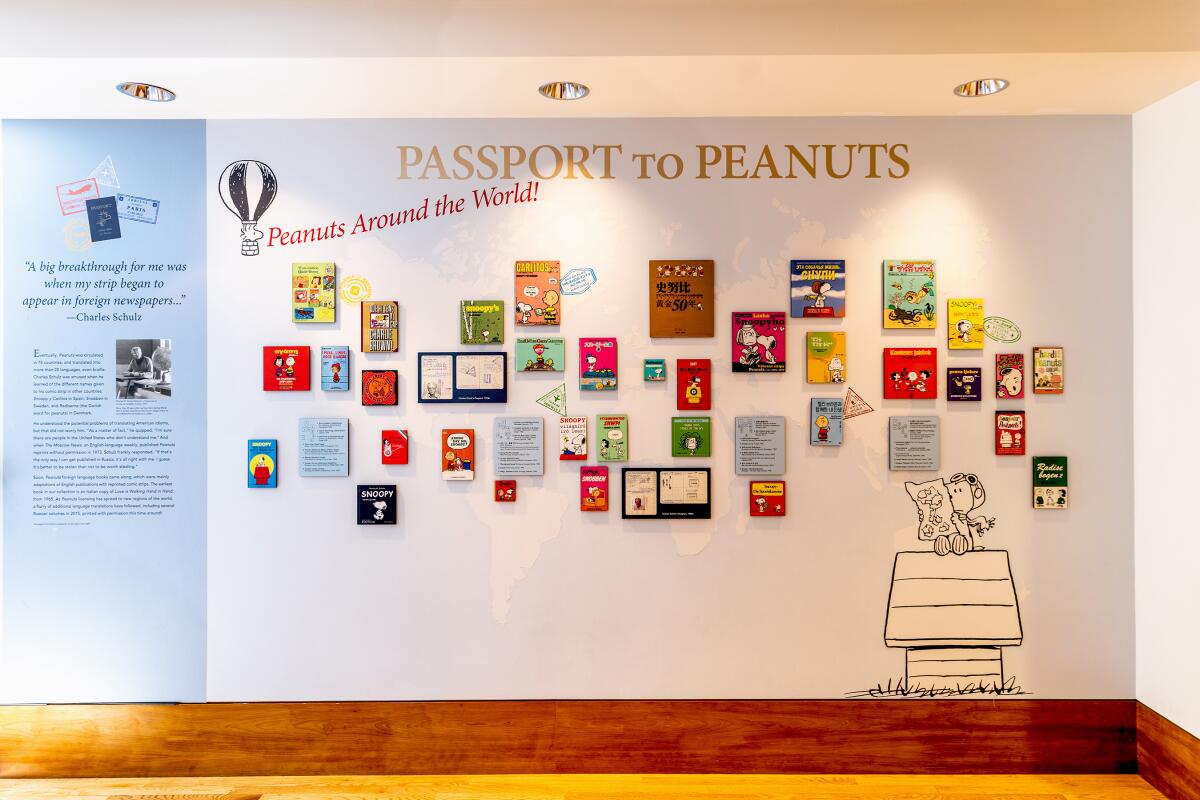
The Schulz Museum’s “Passport to Peanuts” exhibition emphasizes the comic’s global reach.
(Brennan Spark / Charles M. Schulz Museum)
Laurel Roxas felt similarly when they first discovered “Peanuts” as a kid while playing the “Snoopy vs. the Red Baron” video game on their PlayStation Portable. For Roxas, who is Filipino, it was Snoopy and not the “Peanuts” children who resonated most.
“Nobody was Asian. I was like, ‘Oh, I’m not even in the story,’” they said.
Because Snoopy was so simply drawn, Roxas added, he was easy to project onto. They felt similarly about Hello Kitty; with little identifying features or dialogue of their own, the characters were blank canvases for their own personification.
Roxas visited Snoopy Museum Tokyo with their brother last year. They purchased so much Snoopy merchandise — “everything I could get my hands on” — that they had to buy additional luggage to bring it home.
For some Snoopy enthusiasts, the high volume of Snoopy products borders on oversaturation, threatening to cheapen the spirit of the character.
Growing up, Bella Shingledecker loved the holiday season because it meant that the “Peanuts” animated specials would be back on the air. It was that sense of impermanence, she believes, that made the films special.
Now, when she sees stacks of Snoopy cookie jars or other trend-driven products at big-box stores like T.J. Maxx, it strikes her as a bit sad.
“It just feels very unwanted,” she said. For those who buy such objects, she said she can’t help but wonder, “Will this pass your aesthetic test next year?”
Lina Jeong, for one, isn’t worried that Snoopy’s star will fade.

“[Snoopy is] always able to show what he feels, but it’s never through words, and I think there’s something really poetic in that,” said Lina Jeong.
(Brennan Spark / Charles M. Schulz Museum)
Jeong’s affinity for the whimsical beagle was passed down to her from her parents, who furnished their home with commemorative “Peanuts” coffee table books. But she fell in love with Snoopy the first time she saw “Be My Valentine, Charlie Brown,” which she rewatches every Valentine’s Day.
This past year, she was fresh out of a relationship when the holiday rolled around and she found herself tearing up during scenes of Snoopy making Valentine’s crafts for his friends.
“Maybe I was hyper-emotional from everything that had happened, but I remember being so struck,” that the special celebrated platonic love over romantic love, Jeong said.
It was a great comfort to her at the time, she said, and she knows many others have felt that same solace from “Peanuts” media — especially from its dear dog.
“Snoopy is such a cultural pillar that I feel like fads can’t just wash it off,” she said.
Soon, she added, she plans to move those “Peanuts” coffee table books into her own apartment in L.A.
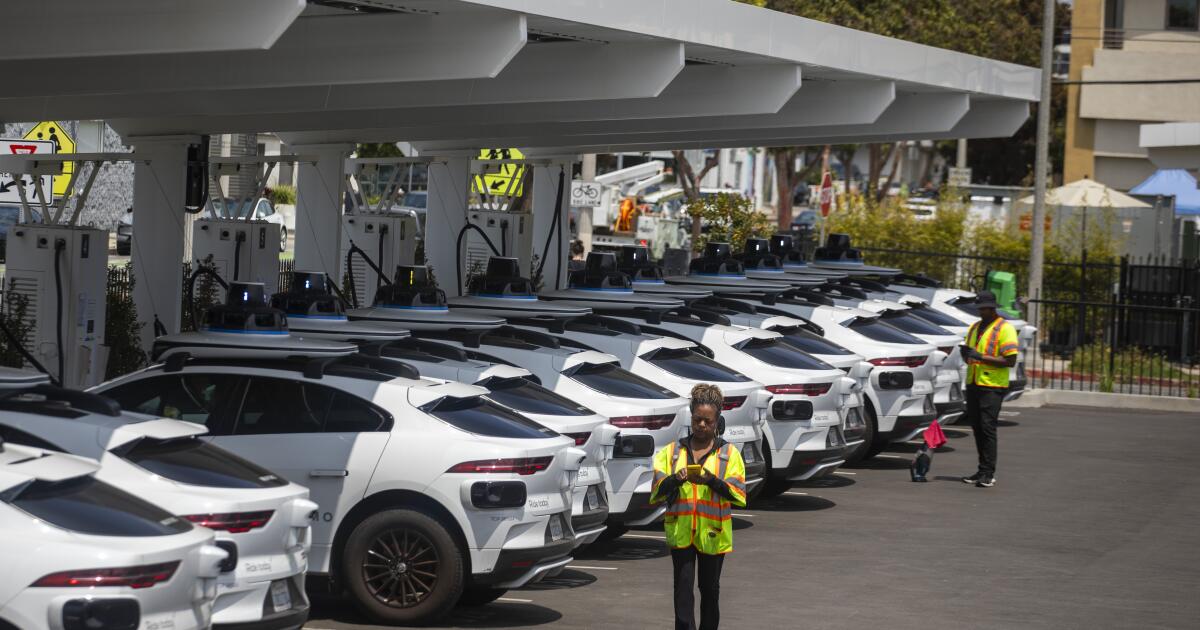
Waymo is taking the city of Santa Monica to court after the city ordered the company to cease charging its autonomous vehicles at two facilities overnight, claiming the lights and beeping at the lots were a nuisance to residents.
The two charging stations at the intersection of Euclid Street and Broadway have been a sour point for neighbors since they began operating roughly a year ago. Some residents have told The Times they’ve been unable to sleep because of the incessant beeping from Waymos maneuvering in and out of charging spots on the lot 24 hours a day.
Last month, the city ordered Waymo and the company that operates the charging stations, Voltera, to stop overnight operations at the sites, arguing that the light, noise and activity there constitute a public nuisance. Instead of complying, Waymo has turned around and filed a suit against the city, asking the court to intervene.
“Waymo’s activities at the Broadway Facilities do not constitute a public nuisance,” the company argued in its complaint, filed Wednesday in Los Angeles County Superior Court. “Waymo faces imminent and irreparable harm to its operations, employees, and customers.”
A spokesperson for the city did not immediately respond to a request for comment.
According to the suit, the city was aware that the Voltera charging facilities were to operate and maintain a commercial electric vehicle fleet 24 hours a day, and the city approved its use when it approved the permits for the stations.
The rift between the company and some Santa Monica residents began as soon as the vehicles began utilizing the 24-hour charging stations, which have overnight staffing, lights and cars beeping as they reverse in and out of parking spots. Tensions got so bad that some residents took to blocking the path of the driverless vehicles, blocking the driveways into the charging stations, and placing orange cones in the area to hinder their routes and create backups, a practice several have called “stacking the Waymos.”
Meanwhile, employees at the charging stations have called police several times as a result, although no arrests have been made. Waymo also unsuccessfully attempted to obtain a temporary restraining order against one resident who had allegedly repeatedly blocked the vehicles.
On Nov. 19, the city ordered Waymo to stop charging its autonomous cars at the two lots overnight or face the possibility of legal action. Waymo declined and instead sued the city last week after negotiations with the city on mitigation measures to the lots fell apart.
According to the lawsuit, Waymo and Voltera representatives reached out to the city after the Nov. 19 order, looking for ways to mitigate the noise and lights from the lots, including initiating a software update that would change the vehicles’ path to the charging stations. But after a meeting on Dec. 15 with the city, no agreement was reached, the company said in its complaint.
“We are disappointed that the City has chosen an adversarial path over a collaborative one,” a spokesperson for Waymo said in a statement.
“The City’s position has been to insist that no actions taken or proposed by Waymo would satisfy the complaining neighbors and therefore must be deemed insufficient.”
The company also blasted the city’s handling of the dispute, arguing that despite facing a budget crisis, city officials have adopted a contentious strategy against business.
“The City of Santa Monica’s recent actions are inconsistent with its stated goal of attracting investment,” the company said in a statement. “At a time when the City faces a serious fiscal crisis, officials are choosing to obstruct properly permitted investment rather than fostering a ‘ready for business’ environment.”
The lawsuit is just the latest legal battle for the Alphabet-owned company, which has been rapidly expanding across California, making the white, driverless vehicles more commonplace.
Two years ago, the company was sued by the city of San Francisco, which argued that the California Public Utilities Commission shouldn’t have handed Waymo permits to expand and operate in the city, and that the regulatory agency had abdicated its responsibilities.
The California 1st District Court of Appeal disagreed, and ruled against the city.
This past June, Waymo announced it would expand its service area to 120 square miles in Los Angeles County, with Waymos operating in Playa del Rey, Ladera Heights, Echo Park, Silver Lake and Hollywood.
In November the company launched its ride-hailing service to now operate across Los Angeles County freeways, as well as in the San Francisco Bay and Phoenix.
Since it launched in Santa Monica, the company argues it has done more than a million trips in the city and in November alone, recorded more than 50,000 rides starting or ending there.
“The [charging] site has enabled Waymo to provide a safe, sustainable and accessible transportation option to city residents,” Waymo said in the statement.

new video loaded: Uber Clears Violent Felons to Drive
By Emily Steel, Christina Shaman, Zach Caldwell, David Jouppi and Thomas Trudeau
December 22, 2025

Wisconsin judge sends Slender Man attacker back to mental health institution after group home escape

West Virginia DoHS reports decrease in children waiting for Wraparound services

GOP Rep. Harriet Hageman launches Senate run in Wyoming

Bitwise Turns ‘Really Bullish’ on Ethereum and Solana as Stablecoins Drive Structural Demand Shift

Spanberger taps Del. Sickles to be Secretary of Finance

Florida High School Football Rankings: Top 25 teams – Oct. 21

Cleary's 21 help Le Moyne down Central Connecticut State 69-64 in OT

How old is Bo Nix? What to know about Oregon quarterback ahead of 2024 NFL Draft

99th annual Pony Swim held in Virginia

Video: ‘It Didn’t Have to Happen This Way:’ U.Va. Faculty Call for Review of Police Response to Protests
404 | Fox News

Trump says Greenland ‘essential’ for security: Could he take it by force?

BBC Verify: Satellite image shows tanker seized by US near Venezuela is now off Texas

20% of NYC mayor-elect Mamdani transition appointees have anti-Zionist ties: ADL

Exclusive: Former MEP Kaili doubles down on ‘Belgiangate’
-

 Iowa1 week ago
Addy Brown motivated to step up in Audi Crooks’ absence vs. UNI
-

 Iowa1 week ago
How much snow did Iowa get? See Iowa’s latest snowfall totals
-

 Maine7 days ago
Elementary-aged student killed in school bus crash in southern Maine
-

 Maryland1 week ago
Frigid temperatures to start the week in Maryland
-

 New Mexico6 days ago
Family clarifies why they believe missing New Mexico man is dead
-

 South Dakota1 week ago
Nature: Snow in South Dakota
-

 Detroit, MI1 week ago
‘Love being a pedo’: Metro Detroit doctor, attorney, therapist accused in web of child porn chats
-

 Health1 week ago
‘Aggressive’ new flu variant sweeps globe as doctors warn of severe symptoms