Business
Column: The Hoover Institution says all recent California job growth has been in government jobs. That's completely wrong

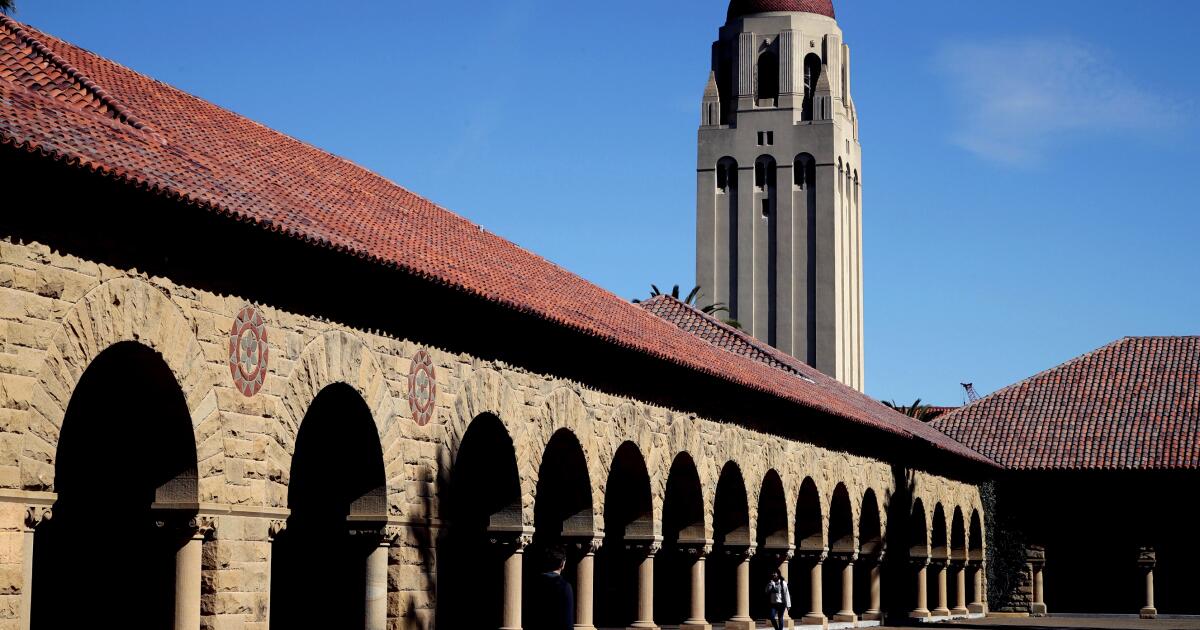
Back when most sensible Californians were concerning themselves with Thanksgiving preparations, the California-bashing right wing went hog wild over a stunning report that almost all private job growth in the state collapsed from January 2022 to June 2024 and almost all growth — 96.5% — was in government jobs.
“California’s Businesses Stop Hiring,” was the headline on the report published by the conservative Hoover Institution. Its main claim was that from January 2022 to June 2024, private employers in the state added only 5,400 jobs.
You can imagine how California bashers, including some within the state, greeted the news that government was propping up the state’s economy.
“This is what a failing state looks like,” Rep. Kevin Kiley (R-Rocklin), who badly lost a bid to replace Gov. Gavin Newsom in the 2021 recall election, tweeted. Others who gleefully tweeted about the Hoover claim included Rep. Vince Fong (R-Bakersfield), and venture investor Steve Jurvetson. Right-wingers outside California also joined the choir.
The Hoover article was what we in the news biz often pigeonhole as “interesting, if true.”
But it’s not true.
The original article, by UCLA economics professor Lee Ohanian, a Hoover Institution senior fellow, asserted that California added only 156,000 nonfarm jobs in the January 2022-June 2024 period. Since government statistics also showed that government employment in the state rose by 150,500, that left (after rounding) only about 5,400 new jobs created outside the government sector.
The picture painted was one in which private employers are shutting down and only government hiring is keeping the California economy afloat. The opposite is true, however.
(The Hoover Institution has retracted the original article and removed it from its website. An archived version of the original can be found here.)
Here’s the main problem with the Hoover analysis: During the sample period, California actually added 672,300 nonfarm jobs, not 156,000. Consequently, the 150,500 new government jobs accounted for only about 22.4% of the total, not 96.5%. The accurate figures show that not only did California’s businesses not stop hiring, but continued to hire fairly robustly from January 2022 to June 2024.
How did this calculation go so awry? The answer is simple. Ohanian conflated the two separate monthly employment surveys issued by the Bureau of Labor Statistics: One is its so-called household survey, which asks a national sample of about 60,000 households how many people in the household are employed. The other is its establishment or “payroll” survey, which asks about 629,000 workplaces how many people they employ.
Generally, the household survey yields a higher number of employed persons than the establishment survey. That’s because it counts the self-employed (including gig workers) and farmworkers, among others who are excluded from the payroll statistics. But that relationship breaks down when you’re counting only payroll workers, slicing and dicing the statistics into industry sectors.
Mixing together the BLS household data and the BLS establishment data is “a cardinal sin of BLS data analysis,” observes the pseudonymous economics commentator Invictus on The Big Picture blog of Ritholtz Wealth Management, in an indispensable deconstruction of Ohanian’s original post.
In that post, Ohanian subtracted the government jobs figure reported in the establishment survey from the nonfarm employment figure in the household survey. That effectively overstated the government jobs percentage of California employment growth. The proper approach, Invictus notes, would have been to use the establishment survey for both measures.
Ohanian acknowledged in an email that he had erroneously considered the household and establishment figures similar enough to treat them as effectively equivalent. “If I had seen the differences in the two series,” he says, “I would have written the piece differently. Mea culpa.”
In a corrective article posted Tuesday on the Hoover website, Ohanian makes public his mea culpa but also reiterates a point he made in the original article, which is that California’s job growth is weakening. That’s echoed by other studies, including a recent warning from the state’s Legislative Analyst’s Office.
Yet there’s much more to be said about Ohanian’s original article, as well as the glee with which conservatives seized on its headline claim as the basis for largely groundless attacks on California’s economic policies. First, it’s proper to note that the original piece was published Aug. 7, which is why its analysis covers only the period that ended in June.
The government issues two distinct sets of employment statistics — the payroll or establishment survey (in orange) and the household survey (in red). It also adjusts the household survey to confirm more with the payroll survey. The adjusted figure is in blue. The two major surveys measure different things and shouldn’t be mixed.
(Bureau of Labor Statistics)
Why it got resurrected and shot around the right-wing echo chamber last week is a mystery. Ohanian himself seemed uncertain when I asked him about it. Kiley, Fong and Jurvetson haven’t responded to my requests for comment.
That brings us to the statistics themselves. Employment data bristle with pitfalls for the unwary, even among experienced economists such as Ohanian. Indeed, in April, Ohanian posted an analysis on the Hoover website that purported to show a loss of 10,000 fast-food jobs in California from September 2023, when Newsom signed a minimum wage increase for that sector, through January this year — even before the increase went into effect.
As I reported, Ohanian based his post on a Wall Street Journal article that used employment figures that weren’t seasonally adjusted. That’s a crucial error when tracking jobs in seasonal industries such as restaurants.
The Journal’s article, and consequently Ohanian’s, mistook a seasonal decline in restaurant employment that occurs from September to January every single year for the one-time consequences of the minimum wage increase. Fast-food jobs, seasonally adjusted, actually rose by 6,300 in the period being reported. Ohanian told me at the time that he had been unaware that the Journal used nonseasonally adjusted figures.
BLS employment figures may be especially confusing because the bureau’s two surveys superficially seem to measure the same thing, but are very different — so much so that the bureau itself has issued a detailed explainer about the distinction. It notes that the establishment survey is “a highly reliable gauge of monthly change in nonfarm payroll employment.” The household survey is oriented more toward demographics and is best known as the source of the national unemployment rate.
Ohanian used his misconstruction of employment figures as the basis for a wide-ranging critique of California economic policy, mostly citing how the high cost of living drives people out of the state.
“Part of California’s job weakness,” he wrote, “reflects the number of people and businesses leaving the state.” California’s population fell by about 75,000 from 2022 and 2023 (the latest data available), he wrote, adding that companies such as Tesla, Oracle, and Chevron have moved or are moving their headquarters elsewhere.
“Population loss naturally leads to job loss,” Ohanian told me by email. “It is challenging to see how California could be gaining jobs as portrayed in the Establishment Survey, given a smaller population.”
That may well be true over the longer term and with larger numbers. But the 75,000 departed residents in 2022-23 represent less than two hundredths of a percent of the state’s population. Even the larger population decline of about 538,000 since 2020 represents about 1.4% of the state’s population.
The key question would be: Who’s leaving? Many emigrants may be retirees, who don’t have occupational reasons to stay in the high-cost state and may have sizable equity in their homes to pocket for a move to a cheaper location; about 7.5 million of California’s residents today are older than 65. The pandemic also drove the population down — COVID-related deaths numbered at least 60,000 in 2020 and 2021.
As for the emigration of corporate headquarters, California still leads the nation in headquarters of Fortune 500 companies, with 57. New York and Texas were runners up with 52 each. California remains a national leader in business creation, with nearly 560,000 new business applications filed with the state in 2023. When new technologies emerge with the potential to aid economic expansion, they tend to start in California.
One other subtext of the debate over California job growth needs to be mentioned. That’s the picture that conservatives paint about government jobs. The tweeted hand-wringings about the purported explosion in government jobs, which implies that the government workers are an army of faceless bureaucrats engaged in writing anti-business regulations.
The idea that the Musk/Ramaswamy Department of Government Efficiency can cashier them without affecting your daily life is a fantasy. In fact, the federal government employs only about 3 million workers, about half of whom are in the military, the Department of Veterans Affairs, and the Department of Homeland Security; the overall figure has remained fairly stable since the 1960s.
An additional 20 million are state and local employees, the majority of whom are teachers, along with police and fire fighters. Which of these workers should we fire?
Any discussion of California’s economy limited to periods of a year or two needs to be viewed in relation to the big picture, which is that California’s economy is by far the biggest in the country — indeed, it would rank in the top five or six countries if it were a sovereign state. At an estimated $4.08 trillion in gross domestic product, its economy is more than half again as large as the runner-up among U.S. states, Texas ($2.7 trillion).
Ohanian is right to argue that there’s reason for concern about where the state goes from here. But to suggest that there’s something fundamentally faulty about policies that still undergird the most powerful state economy in the nation or that California is a “failing state” — that’s “interesting, if true” … but, again, not true.


The luxury shopping center in Pacific Palisades will reopen next month after more than $100 million in renovations forced by the January 2025 wildfire that devastated the Los Angeles neighborhood.
Palisades Village will reopen Aug. 15, owner Rick Caruso announced Wednesday. The outdoor center survived the blaze that destroyed homes and other businesses but needed refurbishment to eliminate contaminants that the fire could have spread.
Crews are putting finishing touches on mall buildings after tearing them down to the studs, treating the wood and rebuilding the walls, Caruso said.
“Everybody’s working, and stores are moving their products in,” he said. “It’s a really cool feeling that people have really locked arms and are working together.”
An electrician installs lighting for a restaurant at Rick Caruso’s Palisades Village on Thursday. The shopping center is scheduled to reopen mid-August.
(Myung J. Chun / Los Angeles Times)
Pacific Palisades resident Allison Polhill, who is rebuilding the home of 30 years that her family lost in the blaze, said she is “thrilled” at the prospect of returning to the mall she used to frequent. Its comeback is a boost for the community, she said.
“Every single step that we make to reopen our commercial corridors is going to bring more people back into the Palisades,” said Polhill, who expects to move back into her home at the end of August.
A total of 6,822 structures were destroyed in the Palisades fire, including more than 5,500 residences and 100 commercial businesses, according to the California Department of Forestry and Fire Protection.
Caruso previously attributed the mall’s survival to the hard work of private firefighters and the fire-resistant materials used in the mall’s construction.
The $200-million shopping and dining center opened in 2018 with a movie theater and a roster of upmarket tenants, including Erewhon, which may be the only grocer in the heart of the fire-ravaged neighborhood when it opens.
Caruso’s company was able to fill the mall with tenants despite the long shutdown.
Palisades Village is 99% leased, with the majority of tenants returning, said Jackie Levy, chief financial and revenue officer. Nearly one-third of the shops and restaurants are new to the property.

A firefighter carries a hose back to his rig while walking through a destroyed home from the Palisades fire in Pacific Palisades on Jan. 7, 2025.
(Genaro Molina / Los Angeles Times)
Last year, Pacific Palisades-based fashion designer Elyse Walker said she would reopen her eponymous store in Palisades Village after losing her 25-year flagship location on Antioch Street to the inferno.
Other neighborhood shops destroyed in the fire that are reopening at the mall include K Bakery and Loomey’s Toys, which caters to children up to age 12 and used to be across the street from Palisades Elementary Charter School.
“It’s been a journey and I’m excited because I wasn’t sure that there was going to be a place to come back to,” said toy store owner Amanda Rastegar. “Hopefully we can bring some of that magic back.”
Rastegar’s home in the Palisades survived but was damaged by the fire. The family returned about eight weeks ago. Her last memory of the fire was a burning supermarket.
“I just couldn’t wrap my brain around what was happening,” she said. “By the time I left, Gelson’s was on fire.”
Among the returning tenants is Angelini Ristorante & Bar. Well-known Los Angeles chef Gino Angelini said he will be in the kitchen next month for a return of the Italian restaurant.
“We won’t do a big celebrity open,” he said. “We want to have a very soft opening and see our customers come back.”

Construction takes place at Rick Caruso’s Palisades Village on Thursday. The shopping center is scheduled to reopen mid-August.
(Myung J. Chun / Los Angeles Times)
An elaborate celebration would not feel “correct for me,” Angelini said, because the devastation has been “very sad” for so many.
Other new tenants include local chef Nancy Silverton, who has agreed to move in with a new Italian steakhouse called Spacca Tutto. Women’s activewear retailer LESET will open its first West Coast location.
Caruso said he is optimistic that customers will return to the center, even though many Pacific Palisades residents are still dispersed. One tracking system estimated that about 30% of the Village’s customer base was impacted by the fire, he said.
“That means 70% did not get impacted, so there’s a lot of customers still left out there,” Caruso said. Historically, the center drew customers from as far away as Beverly Hills and Calabasas, as well as Malibu, Brentwood and Santa Monica.
He also hopes many will be inspired to visit the revived mall.
“I believe in the goodness of people and I believe that people are going to want to support the Palisades,” he said. “They’re going to want to be there and support the businesses that have had the courage and the heart to reopen.”

Walmart is rapidly expanding its network of electric vehicle chargers designed for customers to use while they shop.
The network could help fill gaps in EV infrastructure in states with greater need for chargers. Walmart, which has more than 5,000 locations in the U.S. and hundreds in California, says more than 90% of Americans live within 10 miles of one of its stores.
The chargers also offer an incentive for customers to choose Walmart — Walmart Plus members will receive a 10% discount off an average price of $0.46 per kilowatt-hour of energy at the company’s chargers.
Walmart chargers are already available at more than 75 locations in 17 states, with Texas boasting the most charging stations, followed by Florida and Arizona.
Matthew Nelson, Walmart’s director of energy policy, said last week on LinkedIn that the network will soon reach 29 states, including California.
“We are delivering on the promise of affordable, reliable and convenient charging,” Nelson said in his post.
According to Walmart’s website, six charging stations are coming to California soon, though the company did not offer a specific timeline.
The chargers will be installed at stores in Antelope, Brea, Fresno, Stockton, Suisun City and Vallejo.
Most charging sites in California will include eight to 16 fast-charging stalls, said Walmart spokesperson Kelsey Bohl.
The company first announced plans in April 2023 to install its own EV chargers at Walmart and Sam’s Club stores, with a goal of installing thousands of chargers by 2030. Partnering with ABB E-Mobility and Alpitronic, it added 25 new charging sites this past May and six more in June.
“Walmart is building a leading retail-integrated EV fast-charging network, focused on delivering an affordable, reliable and convenient charging experience where customers already shop,” Bohl said in an emailed statement. “Customers can charge while they shop, access stations through the Walmart app they already use, and benefit from affordable pricing.”
The charging stations already available include 612 individual charging stalls using 400-kilowatt chargers. Each stall has a dual charging cord with both Combined Charging System and North American Charging Standard connectors. The standard connectors, designed by Tesla, are smaller and lighter than the combined systems.
The primary way to pay for the chargers is through the Walmart app, but the company is also experimenting with built-in credit card readers to allow those without the app to use the stations.
Customers can check charger availability on the Walmart app. The company said the chargers will be available 24 hours a day.

Robotaxis could be turning into robocops.
A self-driving Waymo reported two teens to San Mateo, Calif., police on Monday after they were found drinking alcohol and shooting toy guns in the back of the vehicle.
According to a social media post from the San Mateo Police Department, officers detained two 15-year-olds after the Waymo they were riding in contacted the department and stopped in a parking lot until law enforcement arrived.
“Parents do you know where your teens are?” the San Mateo Police Department wrote on Facebook following the incident. “Waymo does!”
Officers removed both teens from the vehicle and determined they were using toy guns to shoot Orbeez out the windows. Orbeez are small, water-absorbing beads sold at toy stores.
“Toy guns, water guns, and BB guns all pose real dangers, especially to an untrained eye,” the Police Department said. “The simple handling of them can cause fear in [passersby].” “
A video posted on Facebook shows at least five officers and a police dog responding to the scene and approaching the Waymo with their weapons raised.
Waymo did not immediately respond to a request for comment.
Waymo vehicles have internal cameras and microphones that may be used in an emergency or to “promote safety and security,” according to Waymo’s online support page.
The cameras are also used to ensure the vehicles are clean and to help find lost items, according to the support page.
The company said it does not use facial recognition or other biometric identification technologies to identify individuals.
“In more urgent circumstances, support may access live video during a trip,” the Waymo page said.
The San Mateo Police Department’s Facebook post has garnered nearly 60 comments, with one user accusing Waymo of “snitching.”
“At least they got a designated driver?!” one user commented.
-

 Pennsylvania5 minutes ago
60th annual Central Pennsylvania Festival of the Arts now underway in State College
-

 Rhode Island8 minutes ago
Handshake Initiative instills confidence, motivation in students
-

 South-Carolina13 minutes ago
ESPN recruiting writers break down five-star Josh Dobson’s fit with South Carolina
-

 South Dakota20 minutes ago
South Dakota man faces abuse charges after authorities called to NW Iowa casino
-

 Tennessee22 minutes ago
Data centers driving up Tennessee power bills, report finds
-

 Texas28 minutes ago
Family demands investigation after US man killed by ICE agent in Texas
-

 Utah35 minutes ago
Turn your miles into meals
-

 Vermont37 minutes ago
Poll: Most young Vermonters say they’re likely to leave state amid affordability concerns – VTDigger

